

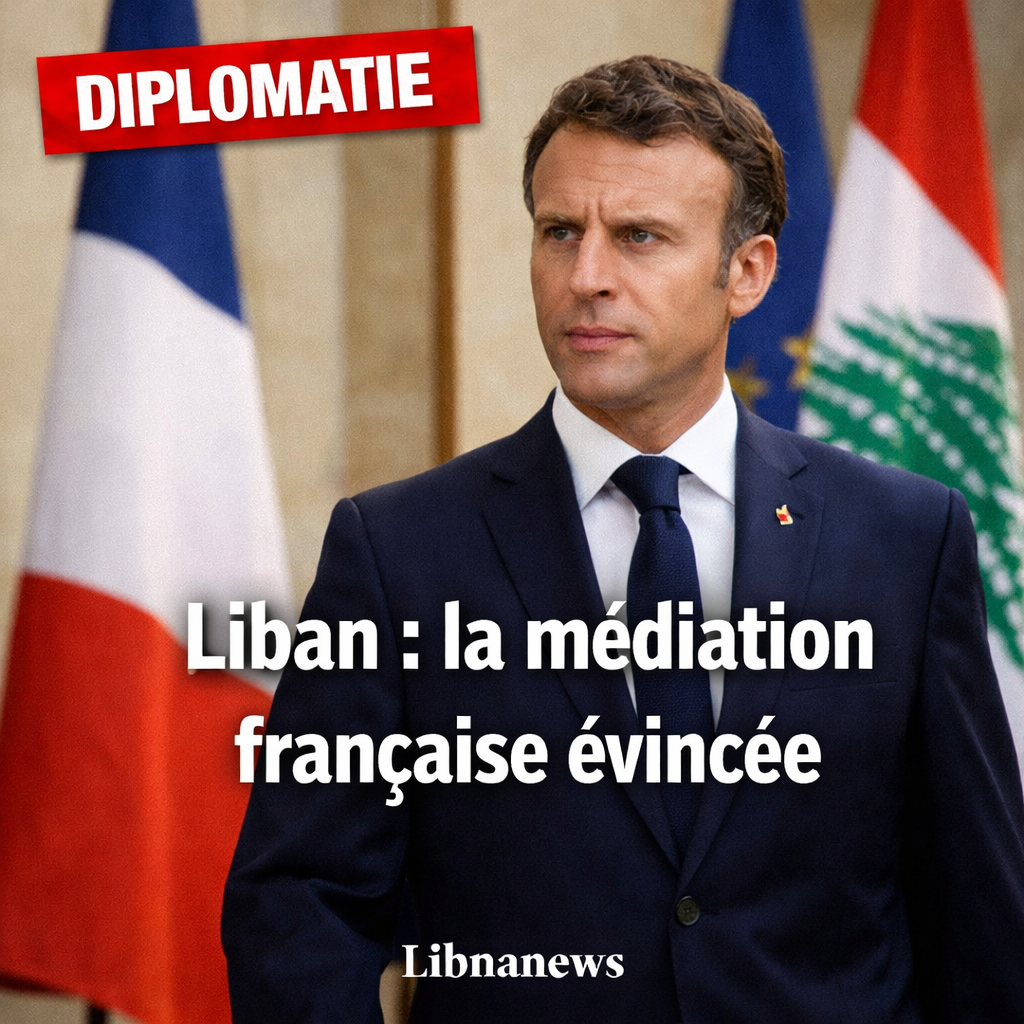
In Washington, the representatives of the United States, Israel and Lebanon opened an unprecedented diplomatic sequence. But an actor is missing at the table: France. This is not a mere protocol detail. It marks a shift from the centre of gravity of the Lebanese file at the same time as Paris co-sponsored the ceasefire of November 2024, participated in its monitoring mechanism and maintained, despite the setbacks, a line of support for the Lebanese State, support for the army and pressure for the progressive disarmament of Hezbollah. By turning to a strictly American-Lebano-Israeli format, negotiations change in nature as well as in decor.
The new framework says a lot about the current balance of power. Beirut hopes first to obtain a ceasefire, or at least a break from the strikes, in order to make the dialogue politically sustainable. Israel, on the other hand, wants to discuss the military pressure and already places in the forefront the security of its northern border, the long-term distance from Hezbollah and, in the long run, its disarmament. The United States is a single mediator and an indispensable guarantor of any acceptable formula. In this set, France appears to be relegated outside the first circle, even though it was still seeking, a few weeks ago, another sequence: cessation of hostilities, gradual negotiation, strengthening of the Lebanese army and political treatment of border disputes.
Washington redrafts Lebanese file
The Washington meeting is not just opening a direct channel between two countries that are still officially at war. It also devotes a new diplomatic format. The talks must bring together Lebanon’s Ambassador to Washington, the Israeli Ambassador to the United States and American officials under the auspices of the State Department. American and Israeli media present it as a rare, almost historic moment, precisely because it bypasses the broader cadres that had previously structured the Lebanese file, whether it be the Franco-American mediation or the arrangements related to UNIFIL and resolution 1701. The absence of Paris is therefore a political fact in itself.
This move is all the more striking since France was not leaving anything. The ceasefire between Israel and Hezbollah on 26 November 2024 was announced as the result of joint work between Washington and Paris. Subsequently, a monitoring mechanism chaired by the United States had been set up in Beirut, with a French representation entrusted to General Guillaume Ponchin. Officially, this mechanism was to monitor the implementation of the ceasefire in connection with the Lebanese army, the Israeli army and UNIFIL. In other words, France was not a peripheral observer: it was part of the architecture responsible for transforming a fragile truce into a framework of stability.
Paris then tried to extend this role. On 18 March, according to a news agency, Special Envoy Jean-Yves Le Drian explained that it was unrealistic to demand that Lebanon disarm Hezbollah while the country was bombed. He pleaded for a negotiated end to the conflict and was part of a broader approach: France had transmitted counter-proposals to the Americans, including a three-month period to end hostilities, move towards a non-aggression pact, deal with land demarcation and organize security guarantees supported by a coalition mandated by the Security Council. The United States welcomed these ideas without enthusiasm, while Israel rejected them. This is where the current shift is read: even before Washington, French mediation had begun to lose its hand.
Yet Paris had not abandoned diplomatic ground. In early April, Emmanuel Macron and Jean-Noël Barrot insisted that Lebanon be included in any regional ceasefire agreement. French diplomacy condemned the massive Israeli strikes on Beirut and called for a return to the cessation of hostilities on 26 November 2024. At the same time, France continued to demand the surrender of Hezbollah’s weapons, the restoration of the state monopoly on force and the strengthening of Lebanese institutions. This double line is essential to understand the current episode: Paris did not depart from the case because it would have renounced Lebanese sovereignty or closed its eyes to Hezbollah, but because its approach no longer coincided with the framework imposed on Washington.
Why Israel no longer wants French mediation
The reasons given by Israel were expressed with rare sharpness in the Israeli press. According toJerusalem PostIsraeli officials now consider France to be an « unfair » or « biased » mediator, because of its initiatives, according to them, to limit Israeli freedom of action against Iran, its condemnation of the strikes in Lebanon and its unwillingness to force the disarmament of Hezbollah.The Times of IsraelIn the same vein, he quoted two officials for whom France had « no role » to play in the talks and had become, in the eyes of Jerusalem, « unnecessary » in that context. The word is less important than the signal: Israel does not only challenge the French method, it challenges its legitimacy as a political third party.
This exclusion is also part of a wider sequence of bilateral tensions. At the end of March, France refused to fly over its airspace to aircraft to transport American arms to Israel for the war against Iran, according to several sources cited by Reuters. The Israeli government denounced this decision and announced the suspension of its defence purchases in France. In addition, Emmanuel Macron’s repeated criticism of the expansion of Israeli operations in Lebanon, as well as his stated commitment to include Lebanon in a regional ceasefire framework, are added. For Israel, France is no longer a balanced partner, but a Western ally deemed insufficiently aligned when Jerusalem wants to convert its military advantage into a diplomatic advantage.
Yet there is a paradox in the Israeli accusation. The official French positions of March and April 2026 show that Paris was not on the Hezbollah side. France clearly condemns the attacks of the Shiite movement, calls for the surrender of its weapons, supports the Lebanese State’s monopoly of force and encourages direct negotiations between Beirut and Israel to stabilize the border. But it refuses to reduce the Lebanese case to one logic of coercion. At the same time, it calls on Israel to cease its massive strikes, abandon its land offensive and respect Lebanon’s sovereignty. It is precisely this partial symmetry, unbearable in Jerusalem in the present phase, which makes French mediation suspicious to Israeli eyes.
In reality, the expulsion of Paris is less like a moral sanction than a choice of method. Washington and Israel today share, at least partially, the idea that effective negotiations on Lebanon should be tightened, bilateral in its form and driven by the United States alone. A broader framework, including France, would introduce another language: more references to resolution 1701, the protection of civilians, reconstruction, UNIFIL and the role of the Lebanese army. Israel wants to open discussions on a tougher basis, focusing on the immediate security and disarmament of Hezbollah. By excluding Paris, it reduces the number of political filters between its agenda and the table of discussions.
Lebanon accepts a narrower framework
The Lebanese decision also deserves to be looked at without detour. For weeks Beirut sought to open channels of discussion with Israel with the support of Washington, but also with the support of Paris. The Israeli press even reports that these steps have gone through both high-ranking American officials and French channels. A few days earlier, a news agency reported that Lebanon considered it essential to have the United States as a mediator and guarantor of any agreement. The move to Washington does not therefore mean that Beirut would have ceased to appreciate the French role. Rather, it means that at the decisive moment, Lebanon felt that it could not condition the opening of the discussions with the presence of Paris.
This choice reveals the weakness of the Lebanese position more than it reflects a diplomatic preference. Under the strikes, with more than one million displaced people according to several estimates and a state apparatus under pressure, Beirut is looking first and foremost for an actor capable of pulling a minimum of restraint from Israel. However, this actor can only be Washington in the present state of the balance of power. France can condemn, propose, mobilize Europeans, prepare for aid conferences or support the Lebanese army. But it has neither the US military lever nor the direct channel to impose a suspension on Israel. By accepting Washington without Paris, Lebanon therefore does not choose a more legitimate mediator; He chooses the only mediator deemed able to speak to Israel in the language he still listens.
The problem is that acceptance has a high political cost. With France outside the first circle, Beirut lost a Western counterweight which, while supporting the disarmament of Hezbollah, also insisted on the protection of civilians, the sovereignty of Lebanon, Israeli withdrawal and respect for the cessation of hostilities. The Washington format thus creates a more marked dissymmetry between participants: the United States is both a mediator, a strategic ally of Israel and a guarantor requested by Lebanon; Israel arrives with a clear military advantage; Lebanon, on the other hand, does not bring a European sponsor capable of rebalancing the discussion. This reading is a matter of analysis, but it stems directly from the composition of the table and the public positions of the actors.
This fragility is also reflected in the Lebanese internal debate. Hezbollah rejects the discussions as long as no ceasefire is obtained, while the Presidency affirms that only the State can negotiate on behalf of the country. Between these two lines, the government is trying to argue that Washington’s appointment is first of all aimed at pulling a halt to the strikes, not at endorsing a peace treaty or an externally imposed disarmament. But the French absence makes this exercise more difficult: it deprives Beirut of a traditional partner capable of translating Lebanese demand into a familiar Western language, while cushioning politically, inside, the image of a negotiation conducted under American tutelage.
UNIFIL, another French lever that is effaced
The other dimension of this sequence concerns UNIFIL. France has historically held an important political place there, even when the number of its soldiers is not the highest. However, the UN mission is itself in a phase of strategic retreat. The Security Council renewed its mandate in August 2025 « for the last time » until 31 December 2026, before an orderly withdrawal in 2027. Reuters points out that this decision, taken in the context of the disruption of the balance of power in Lebanon, already opens a logic of end for the mission. Israel, which has long considered UNIFIL incapable of preventing the rooting of Hezbollah south of the Litani River, welcomed this development much more than it regretted. Paris, for its part, finds itself defending an international architecture whose very foundations are cracking.
This development does not mean that Israel alone would have achieved the end of UNIFIL. The facts are more nuanced. The resolution of August 2025 was drafted by France and adopted unanimously by the Security Council. But it nevertheless devotes a relative failure: the mission is no longer conceived as a lasting instrument of stabilization, only as a force to accompany a transition before its release. At the same time, the war made it more vulnerable. Three peacekeepers were killed in late March, others were injured by shooting or incidents involving Israel and non-State armed groups, and the mission itself said it could no longer patrol as before. For Paris, which linked part of its Lebanese credibility to resolution 1701 and UNIFIL, this erosion is considerable.
French marginalization in Washington is therefore part of a broader process. Paris is losing ground on three levels at the same time: in political mediation, in the ceasefire monitoring mechanism and in the multilateral environment that UNIFIL represented. The result is that France remains very present in the discourse on Lebanon, in humanitarian aid, in support of the army and in support conferences, but much less in the place where the link between war and negotiation is now decided. That’s a major difference. We can support a state, finance its reconstruction and defend its sovereignty while being absent from the room where security priorities are set. This is precisely what happens today in Paris.
What Paris loses, what Beirut loses
For France, the stakes go beyond diplomatic prestige. Lebanon is one of the few Middle Eastern issues where Paris still retained an identifiable role, based on both history, old political networks, the presence within UNIFIL and the ability to mobilize a European response. To be excluded from the Washington framework means that this centrality is no longer recognized by Israel and is no longer considered indispensable by the United States. This mechanically weakens the French capacity to influence the regional architecture that could emerge from the present war. The paradox is that this exclusion comes at the very moment when Paris remains one of the western capitals most invested in Lebanon’s institutional survival.
For Beirut, the loss is of another nature. Without French mediation, Lebanon deals with discussions with less diplomatic depth and less plurality in external guarantees. The table becomes simpler, but also harder. The United States can offer guarantees that no European power can provide. But they also have their own agenda, more directly linked to Israeli priorities. France, for its part, proposed a less decisive mediation in terms of coercion, but more protective for the Lebanese sovereign narrative: ceasefire first, institutions then, disarmament in a state framework, and reconstruction in parallel. By moving away from the first circle, we do not just eliminate a country; It also eliminates a different way of ordering the steps.
This is why the French absence is nothing of a diplomatic casting detail. She said that the sequence opened in Washington was not conceived as the continuation of the 2024 ceasefire by other means. It is more like the opening of a new cycle, dominated by the United States, calibrated for Israeli demands and accepted by Lebanon for lack of better. In this context, Paris remains a supporter, a useful partner, a defender of Lebanese sovereignty and the army. But he is no longer, for the moment, one of the authors of the score. And for a Lebanon that has long sought in the French presence a form of foreign political protection, the vacuum left around the table says almost as much as the words exchanged in Washington.




