

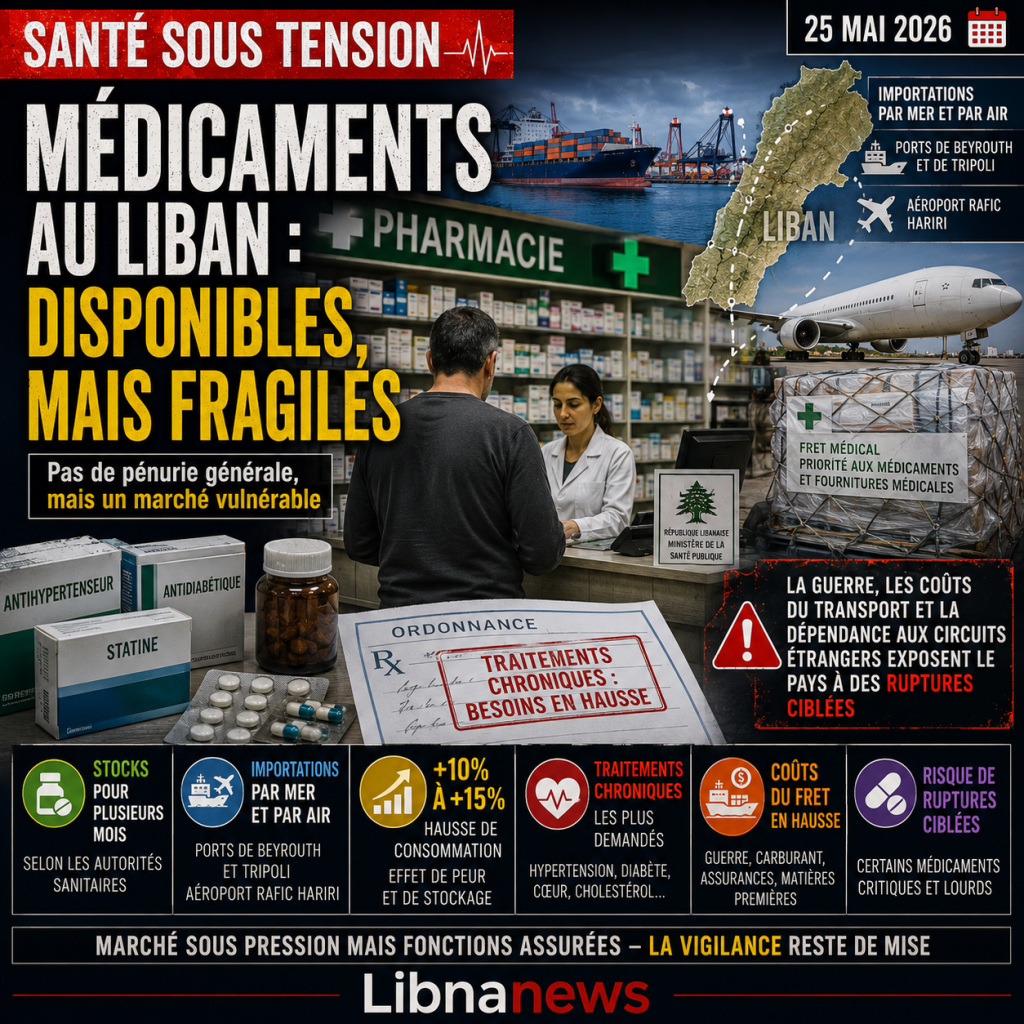
Medicines in Lebanon remain available, but balance remains precarious. Imports continue by sea and air, the stocks announced cover several months and the health authorities ensure the continuity of deliveries. But rising consumption, transport costs, regional war and dependence on foreign channels expose the country to targeted disruptions. In an already weakened health system, the lack of a general shortage is not sufficient to reassure.
Medicines in Lebanon remain available but under duress
At this stage, the market for medicines in Lebanon is not experiencing a general breakdown. Imports continue through Beirut and Tripoli ports, as well as Rafic Hariri Airport. The official channels pass through the importers’ union, in coordination with the Ministry of Health. The stocks of imported medicines are presented as sufficient for several months. This information is important because it avoids immediate panic in pharmacies and in patients with chronic diseases.
However, the continuity of deliveries depends on a fragile balance. The sea lanes are not closed. Air routes were not completely interrupted. The national company has set a priority for the transport of medicines, medical supplies, raw materials for the pharmaceutical industry and products related to dialysis. This organization has limited the effects of the first disturbances. But it is not an absolute guarantee. It depends on maintaining roads, companies, fuel, insurance and authorizations.
The first economic education is clear. Lebanon still has access to the global drug market, but it does not control the main factors that guarantee access. The country imports much of its treatment. It depends on freight, agents, foreign factories, the dollar and logistical decisions taken outside its territory. As long as these elements work, pharmacies hold. If one of these links breaks, the tension appears quickly.
| Indicator | Available data | Economic reading |
|---|---|---|
| Imports | By sea and air | Continuity, but strong dependence on open roads |
| Entry points | Beirut and Tripoli ports, Rafic Hariri airport | Focus on some vital infrastructure |
| Imported stocks | Several months announced | Respite, without lasting security |
| Consumption | Increase from 10% to 15% | Crisis, fear and storage effect |
| Most requested outputs | Chronic medicines | Vulnerability of long-term patients |
| Prices | Fixed by the Ministry of Health | Public supervision, but pressure on imported costs |
Increased consumption reveals household fear
Drug use is reported to have increased from 10% to 15% in the current period. This increase does not only mean that medical needs are increasing. It also reflects precautionary behaviour. Citizens buy more out of fear of not finding certain treatments. Families store what they can. Patients with chronic diseases seek to secure several weeks ahead. The crisis then moves from the pharmacy to the home.
This reflex can be understood. Lebanon has already experienced ruptures, queues, price differentials and times when certain essential drugs became difficult to find. Households have learned to anticipate. But this anticipation has a perverse effect. The more patients buy out of fear, the more they create temporary strain on stocks. The breakdowns can then come not from a real stop in imports, but from a peak in demand concentrated on a few categories. Fear becomes a cause of local shortage.
Chronic drugs form the heart of this tension. Treatments for hypertension, diabetes, cholesterol and heart disease account for a large part of consumption. They cannot be interrupted without risk. A patient who is not receiving treatment for a few days may experience a deterioration. The general availability of the market is therefore not sufficient. What matters for the sick is the presence of the right medicine, the right dosage, the right pharmacy and an accessible price.
This distinction must guide public policy. To say that stocks are sufficient for several months reassures nationally. But this sentence does not answer the patient looking for a specific drug. A real strategy must follow critical molecules, substitution treatments, stocks by therapeutic class and areas where pharmacies are less supplied. Pharmaceutical safety cannot be reduced to an average.
Targeted breaks rather than a total shortage
The players in the sector recognise the possibility of point breaks. They may affect certain chronic or heavy drugs. Causes don’t always come from war. Delays in production, factory problems, technical shutdowns or delays in foreign manufacturers may explain the temporary absence of certain products. Local staff, delivery schedules and transport procedures also play a role. This reality shows that the market is more complex than just an importer-pharmacy scheme.
Local alternatives can cover some of the gaps. That’s a positive point. The Lebanese pharmaceutical industry exists and can meet certain needs. However, it cannot cover the entire range. Specialized medicines, some heavy treatments and very specific products remain import dependent. The country must therefore avoid two extreme speeches. We must not announce a general catastrophe without proof. Nor should the current availability be seen as an acquired security.
The real problem is the lack of public transparency in monitoring. Citizens often experience disruptions by pharmacists, patient groups or private messages. They rarely have an official, simple and up-to-date table showing the drugs in tension, the alternatives available and the expected delivery dates. This lack of information feeds rumours. It encourages storage. It also promotes multiple purchases by those who can afford to pay.
The State should publish regular monitoring of critical drugs. It should distinguish between life-saving treatments, chronic drugs, hospital products and treatments that can be replaced. It should also specify permitted alternatives. Such transparency would reduce panic. It would allow doctors, pharmacists and patients to better plan. In a country where public confidence remains weak, information becomes a health tool.
The price, the main risk for patients
Availability only makes sense if the patient can pay. The price of the medicine is therefore the second front. The Ministry of Health publishes indices and sets official import prices. Trade unions or importers cannot change official tariffs alone. This framework avoids total deregulation. But it does not neutralize external pressures. Freight, fuel, insurance, raw materials and storage costs can go up to the final price.
Regional war has already increased air and sea transport costs at the beginning of the crisis. The closure or tension around the Darmuz Strait has also disrupted global supply chains. Oil, fuel and pharmaceutical raw materials can be affected. If the conflict persists, importers will press for price revisions. The authorities are already discussing a new pricing card if the war continues. This discussion is understandable. It is also dangerous for households.
The risk is to charge patients the full cost of the logistics crisis. In a country where incomes remain tight, health insurance does not always cover needs and where the banking crisis has reduced the savings available, every drug increase can become a cessation of care. More expensive chronic treatment is not an optional expense. The patient cannot simply remove it from his budget. It will have to reduce power, electricity, travel or other care.
| Pressure channel | Probable effect | Impact on the patient |
|---|---|---|
| More expensive air freight | Increased import cost | Higher final price |
| Disturbed sea freight | More expensive delays and security stocks | One-off rareness |
| More expensive fuel | Increased logistical cost | Possible revision of tariffs |
| More expensive raw materials | World price up | Pressure on generics and imports |
| Household storage | Demand peak | Temporary cuts |
| Cost dollarization | Fragility of purchasing power | Unequal access to treatment |
Criticism of a Dependent Model
The drug crisis in Lebanon does not start with the current war. It reveals an ancient dependence. The country has long imported its basic needs without building enough production, storage and planning capacity. The financial crisis then reduced the capacity of households and the state to absorb shocks. Regional war adds external pressure. The result is a market that holds, but holds by chance as well as by organization.
The priority given to medical cargoes by air shows an adaptability. But this capacity remains defensive. It does not change the structure of the system. Lebanon still depends on a few entry gates. It always depends on the importers. It always depends on the price of transport. It still depends on foreign manufacturers. It always depends on public pricing at the expense of the dollar and changes in the world market. The country is full of professionals. It lacks a more robust system.
The official speech must therefore avoid complacency. The fact that the medicines are still entering does not prove that health security is ensured. It only proves that the roads remain open. Real security involves public strategic stocks, diversified contracts, enhanced local production, pooled purchasing mechanisms, digital tracking of breaks and financial protection for patients. Without these elements, the country will move from one alert to another, hoping that the next shock will not be stronger.
Dependence also affects social justice. Affluent households can store several boxes. Small families buy as they go. The former protect themselves better, but they contribute to tension. The latter suffer the breaks and increases. A fair health policy should prevent this difference from becoming a medical injustice. It can do so through temporary quotas on certain treatments, through targeted distributions or through enhanced management of chronic diseases.
The fragile role of the Ministry of Health
The Ministry of Health is at the centre of the scheme. It sets prices, coordinates with importers and monitors the market. This position is indispensable, but it requires more visibility. In a period of war and fear, ad hoc press releases are not enough. Regular, accurate, patient-accessible communication is required. The department must explain what is available, what is missing, what happens and what can replace an absent drug. It must also publish clear criteria for any tariff revisions.
The price review, if necessary, should be accompanied by safeguards. There must be a distinction between increases justified by a real cost and preventive or opportunistic margins. Vital treatments must be protected. Basic medicines must not become inaccessible. Geographic distribution should also be monitored. Tensions do not always affect Beirut and the regions in the same way. Displaced or remote areas may be more fragile.
Pharmacists also play an alert role. They see the breakdowns before the administrations. They know the behaviour of patients. They know what treatments are stored, requested or replaced. But they cannot carry crisis management alone. They need formal information and a clear reporting mechanism. Physicians also need to be involved, as they can refer to alternatives when they are medically acceptable.
The private sector can provide logistics, but the state must set the rule. Health cannot depend solely on the ability of importers to maintain flows. Importers defend their role and cost. That’s normal. But the public interest requires strong supervision. In a country where crises have often been used to justify increases or precautionary margins, transparency becomes a health protection.
Chronic patients, first line of vulnerability
Chronic patients are the most exposed. They don’t need a drug once. They need it every month. They cannot suspend their treatment at the time of arrival. They are therefore directly affected by market instability. Disruption of antihypertensive agents, insulin, cardiac medicine or cholesterol treatment can have serious consequences. Even where alternatives exist, the change must be supervised by a doctor.
The economic crisis has already led some patients to reduce their doses, space consultations or delay analyses. Higher prices can exacerbate these practices. The system may then pay more later. A poorly monitored diabetic patient may end up in hospital. Hypertension without treatment can cause a serious accident. A cost saving on the drug can become a heavier hospital cost. Public health must therefore view the price of the drug as an investment, not as a mere market line.
Dialysis is a sensitive example. Renal washing supplies were identified as a priority for transport. This choice shows that some categories do not tolerate interruption. Dialysis patients depend on a strict schedule, specialized products and functioning centres. Disruption of transportation or electricity can directly threaten their lives. This type of case justifies larger stocks and enhanced public monitoring.
Mental health is also included in the picture, although it is less visible. In times of war, displacement and economic crisis, demand for treatment related to anxiety, sleep or depression may increase. The available sources focus on chronic physical diseases. But the Lebanese experience shows that fear also transforms psychic needs. Any pharmaceutical strategy should include this dimension, without encouraging self-medication.
A market to stabilize without masking faults
The current situation calls for a three-tiered response. The first level is emergency. Delivery routes must be maintained, vital treatments must be prioritized, ruptures must be limited and prices must be monitored. The second level is transparency. It is necessary to publish understandable data on stocks, breaks, alternatives and prices. The third level is reform. There is a need to reduce dependency, support local production and better protect chronic patients.
This reform cannot wait for the end of all crises. Lebanon is living in prolonged instability. Waiting for an ideal period would mean never acting. The authorities can start with simple measures: a public list of critical medicines, class mapping of stocks, a mechanism for reporting ruptures, margin limits on certain essential treatments, targeted support for low-income patients, diversified import contracts and support for locally produced generics when their quality is guaranteed.
The country must also avoid confusing security of supply with private accumulation. Household storage reassures individuals, but it collectively weakens. The state can limit this spiral by guaranteeing information and organizing public stocks. When citizens know that a critical drug is available in a reliable circuit, they store less. When they know nothing, they buy more than necessary. Trust is therefore a tool for regulation.
Medicines in Lebanon are not currently in general breakdown. It’s an important fact. But the drug economy remains exposed to regional war, fragile roads, unstable global costs and impoverished populations. The real test will not only be to spend the next few weeks without shortage. It will be a question of whether the country can turn this alert into a more robust health policy, before the next crisis turns a controlled tension into a real break.




