

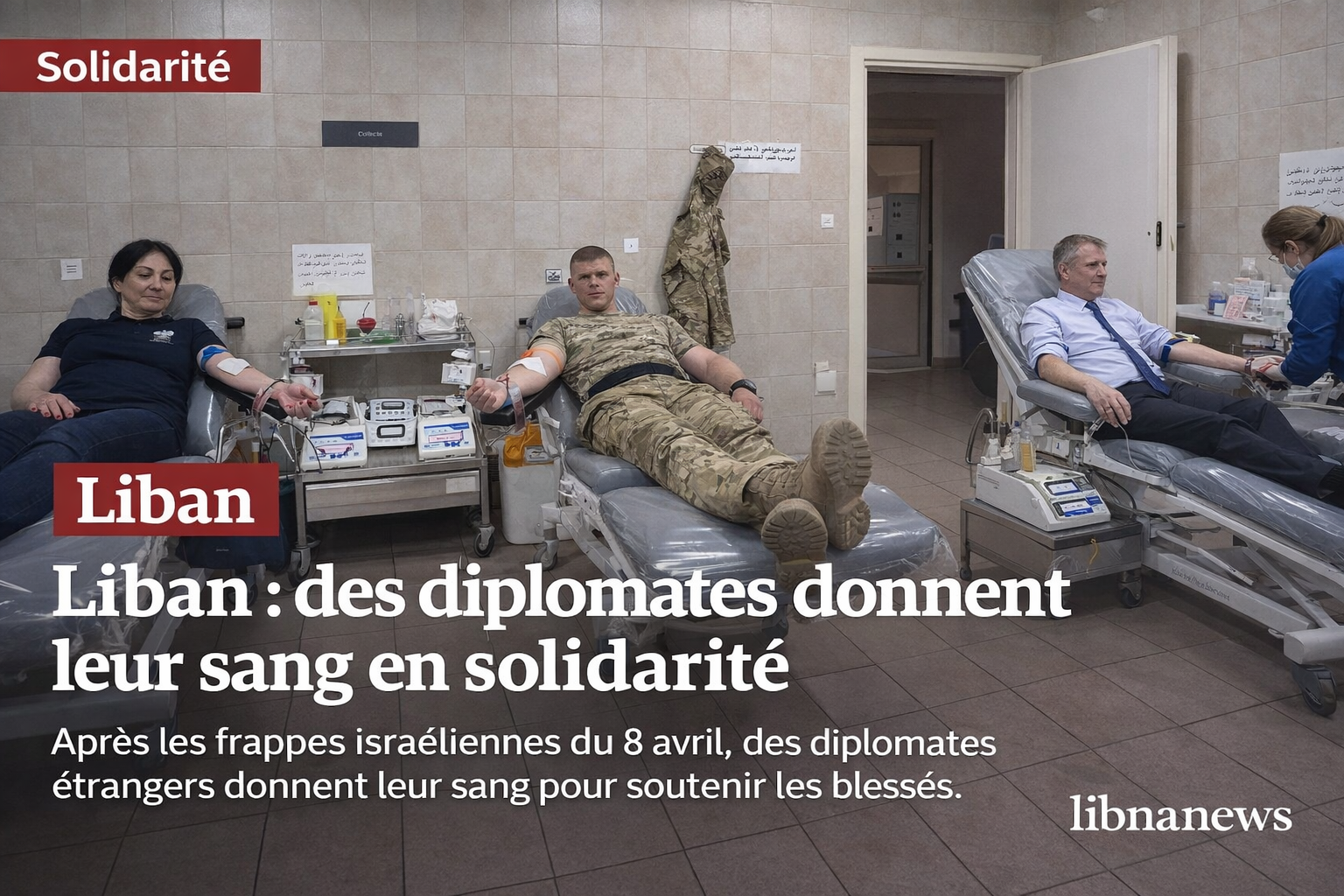
In Lebanon, the hours following the Israeli strikes of 8 April revealed two realities at once. The first is a human shock of rare magnitude, with at least 303 dead and more than 1,150 injured according to the Lebanese Ministry of Health, in what was described as the most deadly day of escalation opened on 2 March. The second is that of immediate, visible, sometimes silent solidarity, expressed in hospitals, collection centres and donor lines. In this movement, diplomats in Beirut chose to give their blood to the wounded, turning a medical gesture into a political and human signal.
The images broadcast by the Polish Embassy in Lebanon gave a face to this mobilization. There are Polish personnel, including a military, involved in blood collection for the victims of the strikes. The message published by the Polish representation is explicit: every drop counts to save lives in Lebanon. A few days earlier, the same embassy had already communicated on the engagement of its diplomats with the displaced in Beirut, in actions of preparation and distribution of meals. In other words, the donation of blood does not arise as an isolated gesture, but as an extension of a presence of land already visible since the beginning of the deterioration of the situation.
Diplomatic mobilization was not limited to Poland. The Australian embassy in Beirut reported that Ambassador Tom Wilson and members of his team had donated their blood to the Lebanese Red Cross to support wounded civilians. The British network also highlighted a blood donation campaign around its embassy in Beirut on its official account, indicating that several chancelleries wanted to participate in the relief effort beyond statements of solidarity. This point deserves to be noted, as the most significant actions of the past few days have come not only from the press releases, but also from physical presences in places where the crisis is measured in blood pockets, ambulances and saturated emergencies.
From April 8 strikes to hospital shortages
On 8 April, Israel launched more than 100 strikes in about 10 minutes on Beirut, the Bekaa and southern Lebanon, according to its own statements repeated by several media and organizations. Reuters reported a first count of 254 deaths and more than 1,100 injuries by the civil defence, while Human Rights Watch subsequently recovered the figure of at least 303 deaths and more than 1,150 injuries reported by the Lebanese Ministry of Health. The Office of the United Nations High Commissioner for Human Rights has spoken of a « horrorous » destruction, and the World Health Organisation has warned the following day that some Lebanese hospitals may miss vital trauma kits within a few days. Three weeks of emergency equipment were consumed in a single day.
These figures give the measurement of the changeover. Over 300 deaths in a few hours mean overcrowded morgues, families looking for relatives, prolonged clearing operations and emergency services forced to sort permanently. More than 1,150 injured also mean dozens of surgical procedures, massive needs for anaesthetics, antibiotics, dressings and blood products. In Beirut, a large establishment quoted by Reuters called for donations from all blood groups in the early hours of the crisis. Al Jazeera then reported that the appeal of the Lebanese Red Cross had been widely relayed and that Lebanese as foreigners had gone to hospitals to give blood. International solidarity has thus almost immediately joined local solidarity.
Donation of blood, simple gesture and strategic resource
In a war or in a series of massive bombings, blood donation is never a mere symbol. It is a critical resource, available locally, quickly mobilised and directly linked to the survival of serious injuries. WHO in Lebanon explained that 400 blood units had been provided by the Lebanese Red Cross in coordination with emergency management teams to support the handling of severe cases. This data illustrates a key point: in the early hours of a disaster, the chain of care depends as much on the competence of doctors as on the country’s ability to rebuild and redistribute its blood supplies.
Blood also has a special temporal value. International financial or logistical assistance is essential, but often requires administrative delays and routing. A collection organized in Beirut can produce effects the same day. A pocket taken in the morning can be used in the operating room a few hours later. It is this immediacy that gives so much weight to embassy initiatives. They are obviously not intended to replace humanitarian agencies, hospitals or the Red Cross. On the other hand, they participate in a short, very concrete chain where the gesture made has direct medical utility. In a crisis where time counts in minutes, this utility explains the strength of the images that circulated.
A global solidarity through Beirut
The striking character of this sequence lies in the diversity of the actors involved. There were the caregivers, who absorbed the wave of medical shock. There were the Lebanese Red Cross and Civil Defence relief workers deployed throughout the country. There were the locals who lined up to give their blood. And there were foreign diplomats who, rather than keeping to the classic register of convictions or messages of support, agreed to enter the very concrete space of care. This alone does not change the military power ratio. This does not replace diplomatic pressure, the demand for a ceasefire or the delivery of equipment. But that changes the nature of the message. An embassy that gives blood claims that the lives of the Lebanese wounded are not an abstraction.
This solidarity also has a narrative impact. For months, Lebanon has been described in dispatches and reports in terms of destruction, displacement and exhaustion. These elements are real and massive. Reuters reported more than 1.2 million internally displaced persons since the escalation resumed in March. But blood donation scenes tell something else in parallel: a country where the response to violence is not only through flight or fear, but also through the pooling of vital resources. For part of the opinion, this memory of gestures will count as much as that of numbers. We keep the balance sheets, of course. We’re also holding back those who showed up when the hospitals called.
When diplomacy leaves the press release
Diplomats’ gestures led to a broader transformation of diplomatic practices in crisis areas. An embassy is no longer just a place of representation or negotiation. In countries weakened by war or by repeated crises, it also becomes an actor of proximity, sometimes discreet, sometimes public, in helping populations. The official website of the Polish government documented the commitment of its diplomats to the displaced in Beirut before even the blood donation episode. The logic is consistent: in the face of a prolonged emergency, some foreign missions choose to be seen not only as political interlocutors, but as partners on the ground.
We must measure what this represents in a country like Lebanon, where confidence in political actors, both national and international, has been deeply damaged by successive crises. In such a context, a gesture of visible solidarity can restore a form of credibility that words sometimes struggle to produce. Giving blood is not just showing compassion. It is physically exposing, accepting an intimate, useful gesture, without guarantee of classical diplomatic visibility. This does not erase the contradictions on the international scene or the Lebanese frustrations at the lack of protection of civilians. But this produces a language that everyone understands immediately: when the wounded come in, some foreign representatives choose to help with what they have more direct to offer.
The figures that structure the event
For the printing and memory of this sequence, a few references must be clearly recalled:
| Indicator | Level established or reported |
|---|---|
| Died April 8 | at least 303 |
| Injured on 8 April | more than 1,150 |
| Hits claimed by Israel | more than 100 |
| Window announced for these strikes | about 10 minutes |
| Moved since the climb of 2 March | over 1.2 million |
These data are from the Lebanese Ministry of Health, Reuters and Human Rights Watch. They converge to make 8 April the most deadly day of recent climbing in Lebanon. They also explain why the need for blood exploded in a few hours. When the shock surge is so brutal, the blood banks become a front-line infrastructure in the same way as operating rooms, ambulances or drug stores.
The central role of the Lebanese Red Cross and hospitals
The 8 April sequence recalled the central role of the health actors already on site. The Lebanese Red Cross deployed 100 ambulances simultaneously, according to several reports relayed by international media. It also provided blood units to hospitals in coordination with health teams. The settlements in Beirut had to absorb the arrival of injured people with heavy trauma, bleeding and burns, sometimes in very short periods of time. WHO warned that continued strikes could further increase mortality due to insufficient supplies. The donation of blood is therefore part of a much larger mechanism: rescue, operate, stabilize, transfuse, and then hold on.
In this landscape, the solidarity coming from the chancelleries has a particular strength because it joins a central Lebanese institution, recognized and immediately useful. Diplomats who give blood do not only provide moral support to the victims. They also indirectly support the capacity of the local health system to continue to function. This dimension is important to understand the positive reception of these gestures. Lebanon does not need distant compassion only. It needs concrete relays, resources and confidence in its relief structures. When an embassy sends its staff to a collection centre, it validates this local response chain.
Solidarity beyond the only diplomatic circle
This mobilization also recalled that solidarity with Lebanon does not come from a single channel. It brings together diasporas, NGOs, international medical teams, multilateral institutions and foreign citizens living in the country. The New Humanitarian, Reuters, WHO and several media have all described increasing humanitarian pressure, with needs that go beyond absolute emergency treatment: shelter for internally displaced persons, continuity of chronic care, protection of civilians and rapid resupply of hospital facilities. In this context, the donation of blood acts as a point of convergence. It is readable by all, immediately useful and able to gather very different people around the same survival imperative.
A strong image in a week dominated by mourning
The photos of blood donations circulated because they break with the usual iconography of the war. Usually, the dominant image is that of ruins, smoke, stretchers and crowds on the run. Here, the decor remains hospitable and tense, but the action shown is a matter of care. A needle, a pocket, a sampling chair, a donor. The symbolic scope is all the stronger as it is sober. There is neither heroic staging nor great speech. Only a concrete gesture in an injured city. This is often the way collective memory is fixed: not by statements alone, but by simple scenes condensing a historical moment.
For Lebanon, this image may remain. It will not remove the debate on responsibilities, the scale of Israeli strikes or the inadequacy of international responses. Nor will it change the weight of the human balance. But it states in the memory of 8 April something other than sideration. It also includes an immediate, tangible response from Lebanese, expatriates and diplomatic personnel who considered that, in an emergency, the most just solidarity was not necessarily the most spectacular. Sometimes it was just to reach out.




