

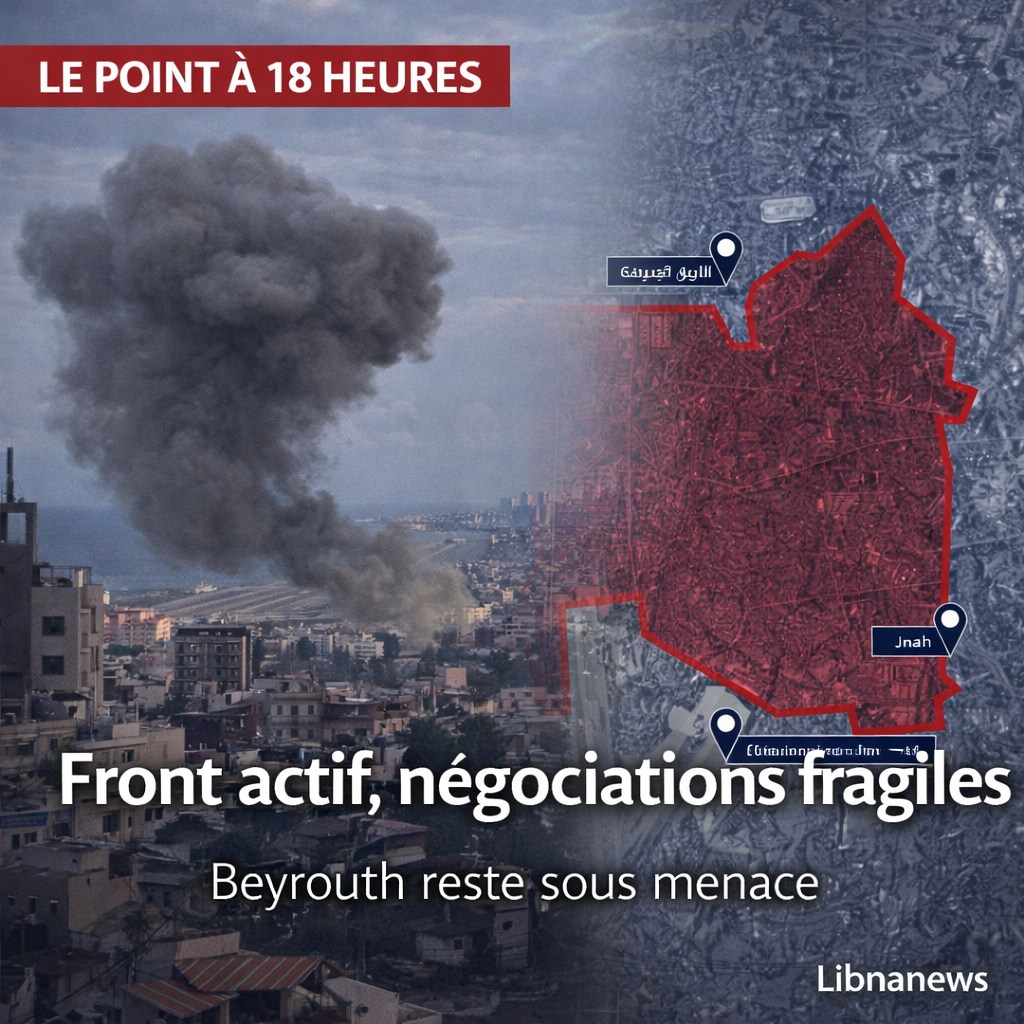
At 6 p.m., Lebanon remained caught between two contradictory dynamics. On the ground, Israeli strikes, exchanges of fire in the south and warnings on the southern suburbs of Beirut continue to exert extreme military pressure. At the diplomatic level, Beirut, Paris and several capitals are pushing to include Lebanon in the ceasefire between Washington and Tehran, while Israel and the United States continue to argue that the Lebanese front is not part of it. In the afternoon, Joseph Aoun claimed that the proposal for a ceasefire with Israel followed by direct negotiations began to receive a « positive response », without a formal agreement being announced.
At the end of this day, three facts dominate. First, the human cost of the Israeli bombings on Wednesday remains the reference point of the entire sequence, with an official Lebanese record of 182 dead and 890 wounded on yesterday’s only day, while other relief services advanced higher figures. Today’s balance sheet is still unknown.
Then, Thursday was not the day of a real de-escalation: Hezbollah claimed several rocket fire at Kiryat Shmona, fighting was reported in Bint Jbeil, and the southern suburbs of Beirut were again placed under threat of evacuation by the Israeli army. Finally, on the political front, the Lebanese Government tightened its line by calling on the army and the security forces to begin immediately to strengthen the total control of the State over Beirut and to reserve arms to the legitimate forces alone, while deciding to seize the Security Council as a matter of urgency.
The military situation at 6 p.m.: no real break on the ground
On the military front, the day did not confirm the idea of appeasement. MTV Lebanon reported in the afternoon that Hezbollah had targeted Kiryat Shmona for the eighth time by rocket, indicating that the exchanges of fire remained active despite the debate about the regional ceasefire. The chain also reported very short-distance clashes in Bint Jbeil between Hezbollah fighters and an Israeli armored force that allegedly attempted to advance in the area of the city market. In other words, the southern front did not freeze. It remains mobile, violent and exposed to rapid developments.
Israel, for its part, continues to publicly assume this separation between the Iranian front and the Lebanese front. According to MTV, the Israeli Defense Minister said in the afternoon that « separating the Lebanese front from Iran is a major success, » a formula that summarizes the Israeli doctrine of the moment. The government of Benyamin Netanyahu clearly considers it a strategic achievement to be able to preserve its freedom of action in Lebanon when a partial truce has been obtained on the Iranian-American issue. This line had already been set out on Wednesday evening by Netanyahu himself and it therefore continues to structure the Israeli position at 1800 hours.
The pressure on Beirut is also very strong. In the afternoon, Adraee published a new threat to the southern suburbs, disseminating a map covering a wide area including Haret Hreik, Ghobeiry, Laylaki, Hadath, Burj al-Barajneh, Tahuitat al-Ghadir, Shiyah and Jnah. MTV then relayed heavy scenes of displacement and bottling from Jnah, proof that the immediate effect of this threat was the panic and departure of many residents. The same channel, however, stated, citing sources from the disaster management unit, that no evacuation measures were under way at the Sports City and that neither the Lebanese Army nor the Red Cross had received any notification from the International Red Cross to that effect.
The South also remains vulnerable by damage to infrastructure. The destruction of the Qasmiyeh bridge, once again struck in the night, had temporarily isolated families south of the Litani River. The passage was finally partially restored this morning on a track, but the episode sums up the current vulnerability: a road can be cut off for hours, people find themselves trapped, and then the rescue and the Lebanese army must work urgently to restore minimal continuity. At 6 p.m., this logistical issue remains central, as it directly affects the evacuation of civilians, the movement of ambulances and the delivery of aid.
The human balance remains very heavy, and hospitals are under stress
The last reference balance on the Lebanese side remains that communicated after the massive strikes on Wednesday: 182 dead and 890 injured according to the Ministry of Health, taken over by AP and MTV. Other services, including Civil Defence, have advanced higher figures, which means that the exact photograph is still moving. But even on the basis of the most prudent official record, 8 April is already among the deadliest in this war phase.
The hospital consequences last Thursday night. The World Health Organization, in its official publications of 3 and 7 April, explained that the Lebanese health system continued to operate, but under increasing pressure, with closed or damaged facilities, extremely high occupancy rates in some public hospitals and an urgent need to rebuild critical stocks in order to avoid treatment disruptions. In the afternoon, the President of the Lebanese Red Cross said, according to MTV, that Lebanon was in urgent need of medical assistance. At 6 p.m., the health issue is therefore one of the most worrying points of the internal situation.
This hospital tension is also part of an environment where health structures have themselves been affected by the war. WHO has identified numerous attacks on health care in Lebanon since the beginning of this phase of the conflict, and warned that access to essential services is becoming increasingly risky without additional support. This means that, even in the absence of a new day of strikes as massive as Wednesday’s, the system remains vulnerable to the delayed effect of bombings: serious injuries to be performed, stocks of war surgery to be renewed, specialized medicines to be redistributed, exhausted personnel to be supported.
Beirut: Lebanese state tries to take back initiative
At the domestic political level, the major decision of the day came from the Council of Ministers. The Government called on the Lebanese army and the security forces to begin immediately to strengthen full State control over Beirut governorate and to reserve arms to legitimate forces alone. This decision was announced by Nawaf Salam following a meeting chaired by Joseph Aoun in Baabda. It is accompanied by an announced tightening of law enforcement and prosecution of offenders.
The political meaning of this announcement was clarified by Joseph Aoun himself. In the afternoon, MTV relayed several of his remarks: « The only solution to the current situation in Lebanon is to get a ceasefire with Israel »; Most importantly, he explained that the proposal for a ceasefire with Israel and the opening of direct negotiations was beginning to receive a « positive response ». The President therefore linked, in the same sequence, the diplomatic sovereignty of Lebanon and the restoration of state authority in the capital. At 6 p.m. it is the clearest political axis of the day on the Lebanese side.
The Government also decided to submit an urgent complaint to the Security Council following the Israeli attacks on Wednesday. This approach aims to formalize the Lebanese reading of events within the UN framework: it is not just a military escalation, but a series of strikes against Beirut and other Lebanese areas at a time when regional efforts were being made to silence weapons. At this stage, this complaint does not change the ratio of military force, but it marks a desire for a more offensive institutional response.
Negotiations at 6 p.m.: a simmer, but no agreement locked
On the negotiating agenda, the most important formula of the afternoon comes from Joseph Aoun. According to MTV, the President said that the proposal for a ceasefire with Israel and the start of direct negotiations « begins to receive a positive response ». This sentence is important because it indicates that in Beirut it is believed that a political channel really exists and that it is not completely closed. But it’s not worth the announcement. No specific date, format, mechanism were made public at this stage.
At the same time, Lebanese diplomacy continues to push for Lebanon to be included in the ceasefire negotiated between Washington and Tehran. Reuters reported this morning that Jean-Noël Barrot felt that Lebanon should also be covered by the agreement, while Emmanuel Macron insisted with Donald Trump and Massoud Pezeshkian that a ceasefire could not be credible without Lebanon. The United Kingdom has adopted a close line, saying that it wishes « strongly » the extension of the truce in Lebanon. In other words, on the diplomatic front, Beirut is not isolated. It enjoys growing verbal support from several western capitals.
The problem remains that this support is not enough at the moment to move Washington and Tel Aviv. The United States continues to argue that Lebanon is not included in the agreement with Iran, and Israel fully accepts this reading. Reuters still noted today that the Israeli bombardment of Lebanon further jeopardized the American-Iranian truce, while France stressed that the exclusion of Lebanon made it politically bleak. At 6 p.m., there was not a single negotiation, but two distinct levels: a possible Lebanese-Israeli canal mentioned by Joseph Aoun, and an international arm on Lebanon’s inclusion in the Iranian-American truce.
Another diplomatic element counted this Thursday: Nawaf Salam contacted his Pakistani counterpart to request that Lebanon be included in the ceasefire. MTV relayed this exchange in the afternoon. This is important because Pakistan played a central mediation role in the ceasefire between Washington and Tehran. Lebanon therefore seeks to act not only towards Paris or the United Nations, but also towards the mediator of the moment. This confirms that at 6 p.m. Beirut is still in a logic of diplomatic opening all azimuts, without firm guarantee of result.
On the Iranian and international side, pressure rises to save the truce
Regional negotiations also remain suspended from the Iranian response. Reuters reported a few hours ago that Massoud Pezeshkian believed that Israeli strikes on Lebanon violated the ceasefire and rendered negotiations meaningless. This statement counts a lot. It means that, for Tehran, the Lebanese front is not peripheral: it now conditions the very credibility of the process with the United States. If the strikes continue in Lebanon, Iran can argue that the agreement has been emptied of its substance.
At the same time, the international scene continues to respond. MTV reported at the end of the afternoon that Russia strongly condemned the Israeli attack on Lebanon, while the Iraqi President reaffirmed his support for Beirut in an exchange with Joseph Aoun. Earlier today, France, the United Kingdom and the United Nations had already raised their voice. This does not yet create a mechanism to stop strikes, but it weighs on the general diplomatic climate. At 6 p.m., Israel retained its freedom of military action, but it was under growing international pressure to deal with the Lebanese front.
Situation at 6 p.m.
At this time, Lebanon remains in a dangerous grey area. There is no effective ceasefire on the Lebanese ground. Wednesday’s bombings left a country bruised, hospitals under tension, fragile infrastructure and a capital still under threat. Thursday showed that exchanges of fire continued, that the southern suburbs could again be placed on mass alert, and that the South remained a space of fighting, destruction and displacement.
At the same time, there is a diplomatic movement. Lebanon is pushing in two directions: to obtain its inclusion in the American-Iranian truce, and to open a direct channel towards a ceasefire with Israel, according to the formula used by Joseph Aoun. Foreign support exists, including French, British and United Nations support. But the central obstacle remains unchanged: Israel and the United States still refuse to recognize that Lebanon is part of the current agreement.
The fact of the day, basically, is perhaps there: Beirut is no longer just in the complaint or waiting. The Lebanese authorities now speak of a positive response to a proposal for a ceasefire and negotiations, while at the same time committing a reassertion of the state in the capital. It remains to be seen whether this political shimmering can survive a new night of strikes or dsultimatums. At 6 p.m., it is the frailty of the Lebanese situation: a beginning of a diplomatic window may exist, but it remains suspended from a war that has not stopped.




