

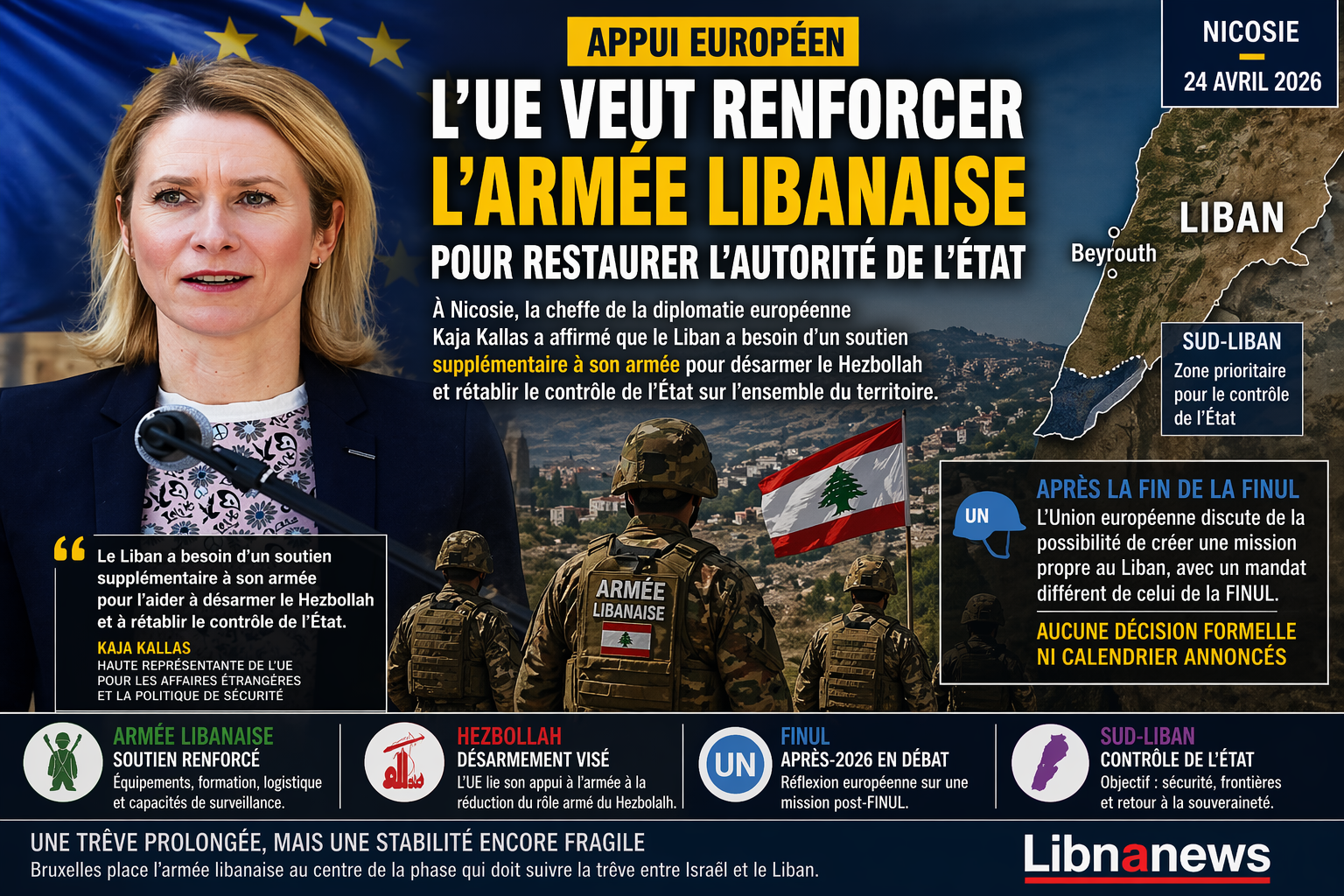
The head of European diplomacy, Kaja Kallas, claimed that Lebanon needed additional support from its army to help it disarm Hezbollah and restore state control over the entire territory. This position was formulated on Friday 24 April, on the sidelines of an informal European meeting in Nicosia, while the truce between Israel and Lebanon has just been extended by three weeks under American sponsorship.
The European declaration comes at a time of strong diplomatic pressure on Beirut. The Lebanese government says it wants to strengthen the army, prevent military operations that escape the state and move towards the public monopoly of weapons. At the same time, Israel makes full withdrawal from southern Lebanon conditional on Hezbollah safeguards. Washington, Paris and Brussels therefore place the Lebanese army at the centre of the phase to follow the truce.
Kaja Kallas also indicated that the European Union was discussing the possibility of establishing a mission in Lebanon after the end of the mandate of the United Nations Interim Force in Lebanon. She stated that this possible mission would not have the same mandate as UNIFIL. Discussions remain open. No formal decisions, operational timetable and detailed format have yet been announced by the European Union.
A European declaration in Nicosia
Kaja Kallas’ remarks were made when he arrived at an informal meeting of European leaders in Nicosia. The High Representative of the European Union for Foreign Affairs and Security Policy placed the Lebanese issue on a broader agenda, marked by regional war, tensions with Iran, security in the Middle East and the aftermath of the Lebanese-Israeli truce.
On Lebanon, his message revolved around three points. The first concerns the need for enhanced support to the Lebanese army. The second concerns the objective of the disarmament of Hezbollah and the restoration of State control. The third opens the discussion on a possible European presence after the end of UNIFIL, in a format still to be defined.
The EU official said that the EU Foreign Ministers and Defence Ministers had already discussed this possibility. She spoke of a European mission that could be set up after the end of the UN mission, without automatically returning to her mandate. This clarification indicates that Brussels envisages a different tool, geared towards the current needs of Lebanon, rather than simply replicating the existing system.
The declaration is not a formal deployment decision. It opens up a political and technical debate within the European Union. Any European mission would require a legal basis, a mandate approved by the Member States, an agreement with the Lebanese authorities, financial resources and a clear definition of responsibilities on the ground.
Lebanese Army: the lever chosen by Brussels
The key word of the European position is the Lebanese army. Brussels considers that the strengthening of this institution is essential to stabilize the country, control borders and move towards a monopoly of force by the State. The logic is simple: no lasting disarmament of Hezbollah can be achieved unless the army has sufficient means to ensure security in the areas concerned.
The Lebanese Army is already at the centre of international applications. The United States presents it as the institutional instrument to replace armed groups in southern control. France also insists on its role in implementing an Israeli withdrawal and in rebuilding the state authority. The European Union repeats this line, explicitly linking it to the disarmament of Hezbollah.
This approach also reflects the position expressed by the Lebanese Government. Prime Minister Nawaf Salam recently claimed that the state monopoly of arms was a Lebanese interest. He added that the only realistic way to disarm Hezbollah was to build the military’s capacity. However, he described disarmament as a process, not a feasible one-night measure.
European support could therefore cover several dimensions. These may include equipment, training, logistical support, monitoring support, mobility assistance, command assistance or indirect funding. No new envelope was announced in Kaja Kallas’ statement. The principle discussed concerns additional support, not yet on an agreed programme.
Hezbollah at the centre of European reading
Kaja Kallas’ statement clearly identifies Hezbollah as the main security obstacle. The European Union believes that the movement must be disarmed and that the Lebanese State must regain control of the military decision. This position is in keeping with recent European statements, which accuse Hezbollah of having led Lebanon into a war that was not that of the Lebanese state.
However, Hezbollah remains a political and military actor structuring in Lebanon. It has MPs, parliamentary alliances, an armed apparatus, a social network and a popular base, especially in Shia regions. Any disarmament measure therefore affects a delicate internal balance, in addition to the security demands made by Israel and Western partners.
The European Union does not present disarmament as a direct operation by foreign forces. The formula used insists on aid to the Lebanese army. It avoids suggesting that Brussels intends to disarm Hezbollah itself. The primary responsibility remains with the Lebanese authorities, with external support to strengthen their capacities.
This distinction has a political significance. A European mission that would be perceived as an instrument of direct confrontation with Hezbollah could be rejected by part of the Lebanese forces. A mission focused on the army, training, surveillance and institutional support can, on the other hand, be described as support for state sovereignty.
UNIFIL between end of mandate and transition
The European debate is also in the perspective of the end of UNIFIL. The UN Security Council extended its mandate one last time until 31 December 2026. The next phase should include the gradual withdrawal of the mission, while examining possible forms of a residual UN presence or other international arrangements.
UNIFIL has been present in Lebanon since 1978. Its mandate was strengthened after the 2006 war with Security Council resolution 1701. It monitors the cessation of hostilities, accompanies the Lebanese army in the South and helps to facilitate humanitarian access. However, it has never received the power to forcibly disarm Hezbollah.
The prospect of its end creates a practical question. Who will provide international support for the stabilization of the South after 2026? The United Nations is working on different options. Lebanon has expressed its desire to maintain an international presence, even if reduced. The European Union is also examining the possibility of a specific mission with a different mandate.
This discussion comes after attacks on peacekeepers and in a degraded security environment. A French UNIFIL soldier was killed in April in southern Lebanon in an attack on a patrol. Three other French soldiers were injured. France and the UN condemned the attack. Hezbollah denied any involvement.
A European mission still hypothetical
The mission mentioned by Kaja Kallas is not yet an agreed project. Discussions focused on the possibility of establishing a European mechanism after UNIFIL. His nature remains open. It could be a mission to train, assist, advise, monitor or support the capabilities of the Lebanese army.
The European Union already has experience of civilian and military missions in several countries. These missions can train local forces, advise ministries, support security sector reform or build border capacity. In the Lebanese case, the content should be adapted to the needs of the army, the situation in the South and internal political constraints.
A European mission would require the agreement of the Lebanese government. It should also be consistent with international law and Security Council resolutions on Lebanon. It should define its relations with the Lebanese army, the United Nations, the United States, France and other actors already engaged in military or security aid in the country.
The mandate would be decisive. A mission limited to training and advice would have a different scope for a border surveillance mechanism. A European presence in the South would raise more serious security questions than a mission based in Beirut or training centres. There is nothing at this stage to conclude with the format chosen.
Truce as an immediate framework
The European declaration comes at a time when the truce between Israel and Lebanon was extended by three weeks. This extension was announced by Donald Trump after discussions at the White House between Lebanese, Israeli and American representatives. It does not constitute a complete truce, as military incidents, localized bombings and destruction in several villages in the South have continued.
For the European Union, the truce opens a useful but insufficient time. The strengthening of the Lebanese army is presented as a condition for lasting stabilization. Without a state force capable of holding the ground, controlling access, securing villages and preventing unauthorized armed actions, the ceasefire may remain fragile.
The Lebanese Government also called for a complete Israeli withdrawal, the refusal of a buffer zone, the return of displaced persons and the reconstruction of destroyed villages. These requests cannot be separated from the security issue. Israel claims that it will only withdraw for a long time if Hezbollah can no longer use the South as a base of attack.
The European position is therefore trying to answer this equation. It supports the strengthening of the army to enable the state to exercise its authority. It calls for the disarmament of Hezbollah. She discusses a post-FINUL device. But it does not replace political negotiations between Lebanon, Israel and American mediators.
What Beirut can expect from the European Union
For Lebanon, European support can be useful at several levels. The army lacks financial resources, modern equipment, monitoring capabilities, mobility and operating guarantees in a country weakened by the economic crisis. Additional support can improve its ability to deploy and maintain sensitive areas.
European aid can also provide political coverage. When the Lebanese army is strengthened with the support of international partners, the government can present this movement as a state consolidation, not as a concession to Israel. This distinction counts in the internal debate, where any discussion of Hezbollah’s weapons causes tension.
Beirut can also seek to use European interest to achieve greater coordination between partners. The United States, France, the European Union and some Arab countries are already supporting, to varying degrees, Lebanese institutions. A dispersed strategy could produce duplicates. A coordinated strategy can better target needs.
However, the Lebanese Government will have to specify its own priorities. It should indicate the military, logistical and institutional capabilities that the army needs. It should also articulate this demand with discussions on Israeli withdrawal, the return of internally displaced persons and reconstruction. External aid cannot replace a national roadmap.
Political limitations of disarmament
The disarmament of Hezbollah remains the most sensitive issue. The European Union, the United States and Israel are calling for progress. The Lebanese government affirms its commitment to the state monopoly on arms. Hezbollah, on the other hand, rejects any approach that would be perceived as an external pressure or an advantage granted to Israel.
The risk is therefore twofold. Too little pressure can leave the current situation intact, with an incomplete truce and disputed sovereignty in the South. Excessive pressure can cause internal crisis or even political or security confrontation in Lebanon. That’s why Nawaf Salam spoke of a process, not an immediate act.
The Lebanese army is at the centre of this tension. It must appear as the national institution capable of protecting the country, not as an instrument of one side against another. Its strengthening therefore requires internal legitimacy, stable financial support and a gradual strategy. Without these elements, international announcements will remain limited.
Kaja Kallas’ position reflects this difficulty. It sets a goal: to help the army disarm Hezbollah and strengthen state control. It does not yet explain the operational path. This path will depend on the security situation, the capacity of the army, the will of the Lebanese government and the guarantees obtained on the Israeli withdrawal.
Future decisions to follow
The next few weeks will see whether the European declaration leads to concrete decisions. The first level concerns assistance to the Lebanese army. The European Union will have to specify whether new funding, assistance or training will be offered to Member States.
The second level concerns the post-FINUL mission. Discussions should determine whether the mission is a civilian, military or mixed mission. They should also specify the mandate, duration, funding, staffing, location of deployment and relations with the Lebanese authorities. Without these elements, the idea remains at the political level.
The third level concerns coordination with the United Nations. UNIFIL does not stop immediately. His term of office runs until the end of 2026, before a withdrawal phase. Any European initiative should therefore avoid duplication and take into account the options explored by the United Nations to maintain a presence after the end of the current mission.
The fourth level concerns the terrain in the South. If the truce remains partial, if the bombing continues and if the Israeli presence remains, the deployment of new aid to the Lebanese army will take on a more urgent dimension. Kaja Kallas’ statement now places the European Union in the discussion on post-FINUL, support for the army and the security future of southern Lebanon.




