

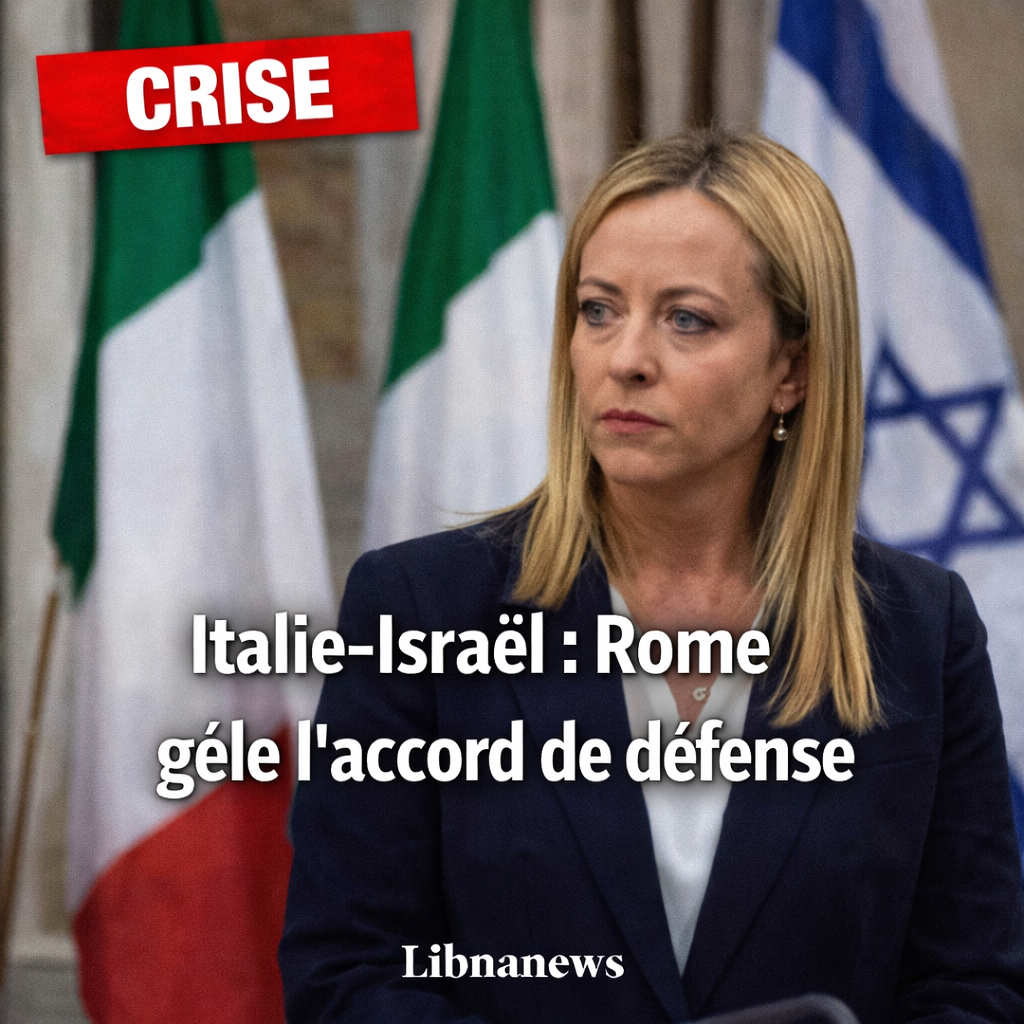
According to official Italian and Israeli statements, the Rome announcement to suspend the automatic renewal of the defence agreement with Israel did not cause an immediate security crisis in Jerusalem. The Israeli Ministry of Foreign Affairs has minimized the practical scope of the decision, while Giorgia Meloni Is presented as a response to the « current situation » in the Middle East. Apparently, the episode may seem limited. In reality, it marks a notable political change in one of the European countries which had hitherto maintained a relatively cautious tone vis-à-vis Israel. It is not the Israeli military architecture that is faltering, but the political relationship with a Western partner that is changing its register. In the current regional climate, this displacement is almost as important as the legal content of the text concerned.
Italy did not announce a general break with Israel. It suspended the automatic renewal of an old bilateral memorandum, signed in 2003, ratified by the Italian Parliament in 2005 and entered into force in 2006. The parliamentary documents show that this text provides a framework for cooperation in the military and defence field, with an automatic renewal for periods of five years, unless otherwise notified by one of the parties. It is therefore this mechanism of extension that Rome chose to block, not all relations with the Hebrew state.
Israel’s choice of words is revealing. The spokesman for the Ministry of Foreign Affairs, Oren Marmorstein, explained that, according to him, there was no substantial security agreement with Italy, but an old protocol without decisive effect on Israeli security. This line aims to dedramatize the episode. On the merits, Jerusalem wants to show that its defence capacity does not depend on Rome or this bilateral framework. On the form, the objective is also diplomatic: to avoid an Italian decision being read as the beginning of a wider European stall.
A political decision more than a military shock
The decision announced by Giorgia Meloni in Verona first has political value. The Italian Government neither presented a sanctions package nor announced a comprehensive embargo. He chose an intermediate gesture, clear enough to send a signal, but more limited than a frontal rupture. This sizing was nothing unusual. Since the beginning of the war in Gaza, then with the extension of regional tensions, Italy has long maintained a more measured line than other European capitals. The freeze on automatic renewal shows that Rome no longer wants to appear as a silent ally when the conflict spills over over into Lebanon and directly affects Italian interests.
This inflection has accelerated over the last few days. Tensions between Rome and Tel Aviv increased following an incident in Lebanon, when Israeli warning shots damaged an Italian convoy of the United Nations Interim Force in Lebanon without causing any injuries. The Italian government summoned the Israeli ambassador. Antonio Tajani then denounced attacks that he found unacceptable against Lebanese civilians, while Giorgia Meloni called for a halt to attacks in Lebanon while continuing to condemn Hezbollah. In this context, the suspension of the renewal of the defence agreement appears less as a surprise than as the next step in an already visible political deterioration.
The weight of the Italian interior scene also counts. The ruling right-wing coalition had previously defended a working relationship with Israel, but the war has raised pressure from the opposition, certain sectors of the majority and some of the opinion. Italian officials urged the government to clarify its position on a text that symbolized formal military cooperation with Israel. For Giorgia Meloni, suspending the automatic renewal allows us to resume the political initiative. It avoids appearing passive, without engaging, for the moment, in a total rupture that would break its majority and complicate its diplomatic balances.
What the Italy-Israel Agreement really contains
The 2003 Memorandum is not a simple protocol document empty of content. The Italian parliamentary files define it as a framework agreement for cooperation between the two States in the military and defence sector. The areas covered range from supply and defence industry policy to personnel training, exchange of expertise, participation of observers in exercises, visits to naval and air units, information technology, certain environmental issues related to military structures and research and development. The text also provides that technical or commercial information exchanged in this context cannot be transferred to third countries without prior agreement.
This content explains why the Italian decision has a real symbolic significance, even if Israel minimizes it. The text is not an alliance treaty comparable to a collective defence guarantee. It does not promise automatic military intervention or mutual protection within the meaning of the major security agreements. On the other hand, it creates a legal and political framework for sensitive exchanges between defence institutions. The suspension of automatic renewal means that this framework has no longer, for Rome, the obvious character that it had had for twenty years. It is not a military earthquake, but it is a political stall. This is an analysis based on the very nature of the memorandum and the official Israeli response.
The duration arrangements also show why the case is more subtle than a simple yes or no. Article 9 of the memorandum provides for a five-year validity, which is automatically extended for further periods of five years, unless notified in writing by one party to the other. In the event of denunciation, the text shall cease to be in force six months after receipt of such notification. In other words, mechanics are subject to the law of bilateral agreements, not an instant gesture. This also allows Israel to assert that the security of the country will not be affected in the short term: the memorandum is not, by nature, an operational pillar comparable to a critical supply in real time.
| Element | What we know |
|---|---|
| Signature | Paris, 16 June 2003 |
| Italian ratification | Law promulgated in 2005 |
| Entry into force | 2006 |
| Duration | 5 years, with automatic renewal |
| Device output | Written notification, effective 6 months later |
| Areas covered | procurement, defence industries, training, exercises, research, technical exchanges |
Why? Rome hardens its tone now
The most immediate trigger is Lebanon. Italy is directly involved in the United Nations mission in the south of the country and has more than 750 troops in UNIFIL. When an Italian convoy is hit by warning shots, even without injury, the case is no longer confined to an abstract diplomatic reading of the conflict. It affects the protection of Italian soldiers and the credibility of the government before its opinion. In the European States committed to Lebanon, the security of troops remains a political red line. Rome therefore considered that the situation no longer permitted the maintenance of an automatic renewal of a military cooperation framework as if nothing had changed.
But Italian evolution is also explained by a broader context. The Meloni government, initially perceived as one of the most benevolent towards Israel among the major European states, found itself confronted with the accumulation of open fronts in the Middle East. Gaza had already eroded the patience of many Western partners. Lebanon added a new dimension, both regional and European, as several EU states have soldiers on the spot or direct interests of stability. As the war spreads, the political cost of the status quo increases. Suspend the renewal of a defence agreement then becomes a way of translating, at a controlled diplomatic cost, a sharper take-off. This interpretation is based on the chain of events reported in recent days.
The Italian decision should also be read as a message to the European Union. Several countries have been seeking the right level of pressure on Israel for months without completely breaking the relationship. In this landscape Italy occupied a special place because of its past prudence and the often raised political proximity between part of the Italian right and the Israeli government. The fact that Rome now chooses to freeze the automatic renewal of a defence text changes the general tone. This does not mean that a unified European front already exists, but it reduces Israel’s political space with an important partner in southern Europe. This is an analytical reading based on the official Italian repositioning.
Why Israel minimizes impact
The Israeli reaction responds to a very clear logic of communication. To recognize a strong scope for the Italian decision would be to accredit the idea of Israel’s growing isolation from Western partners. By claiming that the text did not have substantial content for its security, the Israeli Foreign Ministry is therefore seeking to contain the narrative. Israel wants to avoid the Italian announcement being presented as a diplomatic victory for its critics or as the beginning of a series of comparable suspensions elsewhere in Europe. This reading derives directly from the formulation adopted by Jerusalem.
This minimization also has some institutional truth. The Italy-Israel memorandum is a framework for cooperation, not an indispensable link in Israel’s immediate defence. The Israeli forces do not depend on Rome for their operations, their deterrent posture or their chain of command. Even in the event of a complete shutdown of the device, the effect on short-term safety would remain limited. On the other hand, diplomatically, the gradual erosion of European support weighs differently: it alters the political climate, industrial partnerships and international legitimacy. This distinction between operational impact and political impact stems from the content of the Israeli text and the Israeli response.
The Israeli message finally has a preventive dimension. In a time when Israel seeks to project the image of a master state of its choice, admitting that a European partner can produce a real security effect would be politically costly. The official line therefore consists in strictly separating two plans: on one side, an Italian decision presented as marginal; on the other, a national security that Jerusalem says completely out of reach. Again, the immediate scope of the measure is not null and void on the diplomatic ground, but Israel wants to prevent it from becoming too heavy a symbolic precedent. This is an inference based on the official communication of the Israeli ministry.
A signal for Defence Europe
The Italian episode reveals above all a wider reality: in Europe, the relationship with Israel is entering a phase of increased differentiation. Not all governments will adopt the same line or pace. Some still favour maintaining military channels, while others seek to increase legal, political or economic pressure. Italy chooses a middle lane here. It does not reverse its doctrine overnight, but it withdraws its automatic character from defence cooperation with Israel. In diplomatic language, this type of gesture often weighs more than its immediate material significance, because it alters the trajectory. This assessment is an analysis based on the nature of the decision taken by Rome.
The potential industrial and administrative effect of such suspension must also be measured. The memorandum outlines a series of activities that go beyond political declarations: technical exchanges, consultations, possible programmes, flow of expertise and framework of contacts between defence apparatus. Although many cooperations can, in theory, continue through other channels or other legal instruments, the absence of renewal weakens the stability of the framework. For governments and industry alike, uncertainty becomes greater. This is how substantive revisions often begin: not by an instant embargo, but by questioning automation. This reading is based on the fields covered by the Italian parliamentary text.
At this point, therefore, it is not essential to know whether Israeli security will be affected tomorrow morning. The main point is that an important partner of the European Union considered that the automatic pursuit of a defence agreement with Israel was no longer politically sustainable in « the current situation ». This formula leaves a margin, but it also sets a threshold. She said that the regional context, the strikes in Lebanon, the UNIFIL incident and the pressure of opinion had changed the Italian calculation. What Rome will do next will depend on the military and diplomatic evolution of the coming weeks, and how other European capitals decide whether or not to open up their own agreements.




