

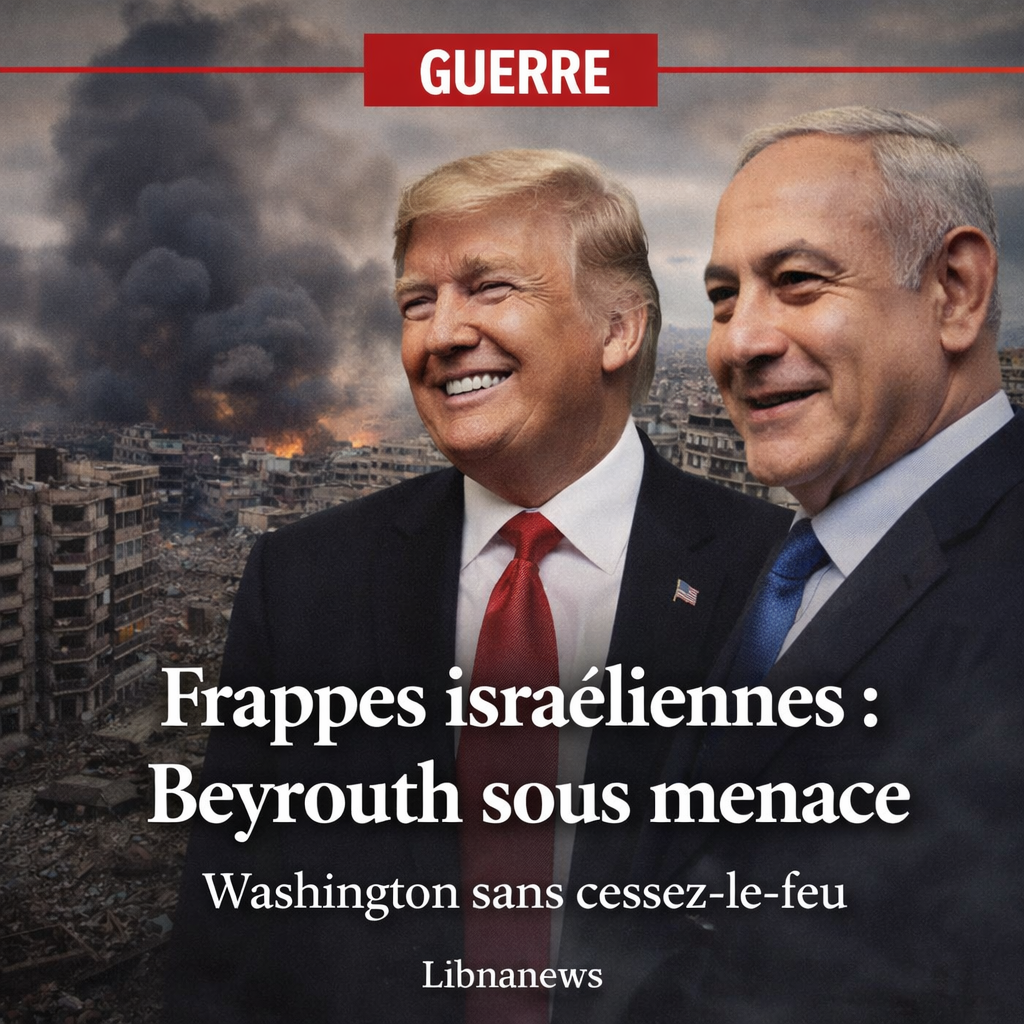
On the eve of the discussions planned in Washington between the Lebanese and Israeli representatives, the gap is complete. Beirut wanted to make the ceasefire the core, if not the prerequisite, of the meeting. On the contrary, Washington has validated a reading that leaves Lebanon out of the regional pause, while Israel continues its offensive and keeps the capital under threat.
Negotiations have not yet begun as its imbalance becomes apparent. On Tuesday, 14 April, in Washington, the Lebanese and Israeli ambassadors must find themselves under American mediation for a meeting presented as unprecedented. But on the eve of this meeting, the political framework is already set against Beirut. The Israeli strikes were not frozen. Lebanon was explicitly excluded from the two-week break on the Iranian front. And Donald Trump took back the idea that the Lebanese theatre was a separate file. The question is no longer only military. It becomes diplomatic: how to pretend to open a channel of discussions while the party who receives the blows continues to receive them, and that the mediator accepts in advance that the ceasefire does not impose as a rule of entry into the meeting? For Beirut, the signal is clear. Washington did not protect the Lebanese scene from the continuation of the Israeli offensive; He has, in fact, validated his save.
The heart of the sequence is there. By excluding Lebanon from the negotiated break with Tehran, the Trump administration did not only take note of an Israeli reading of the conflict. It has created a situation in which Israel can continue to strike Lebanon, including Beirut, while entering a Washington-sponsored discussion. No US official uses the word « authorization ». But, politically, the effect looks like it. When the White House claims that Lebanon is not included and takes up the thesis of a separate front, it withdraws from the Lebanese government the diplomatic benefit that could have been offered by a wider regional de-escalation. It is therefore not only the continuity of the bombings that counts. This is the principle now assumed: the war in Lebanon can continue while the United States talks about negotiations. For a country that first calls for an end to the strikes, American dissociation acts as a strategic permission left to Israel.
Israeli strikes and Lebanese mandate
On the Lebanese side, however, the official line is much narrower. It has almost one sentence: a ceasefire. President Joseph Aoun put the order on 9 April saying that the only way out was to stop fighting between Israel and Lebanon, followed only by direct negotiations. On 13 April, Ghassan Salamé clarified that the Lebanese representative was allowed to address only one substantive issue in Washington: the ceasefire. On the same day, Foreign Minister Youssef Raggi repeated that Beirut was seeking, through this direct channel, a cessation of hostilities. In other words, the Lebanese Government does not come to the table with an open agenda on normalization, disarmament or strategic reform of the border. It comes with a minimal, urgent, vital demand: silence the weapons. From there, the contradiction appears in all its nakedness. Lebanon views the meeting as a means of stopping the war. Israel wants to negotiate without stopping the war.
This contradiction was not an abstract one. It already deprives the meeting of part of its credibility. If one delegation goes to Washington to obtain a ceasefire and the other announces in advance that it will not discuss a ceasefire, it is no longer a symmetrical negotiation. It is a face-to-face imposed between one party who wants to stop the bombs first and another who wants to use the discussion to talk about the day after while maintaining his freedom of military action. It is this asymmetry that feeds, in Lebanon, the impression that the conditions imposed by Beirut are not only ignored by Israel, but already neutralized by the very format desired by Washington. The mediator does not arrive with a shared requirement. It brings together two incompatible positions by letting the most powerful militarily pursue its advantage on the ground. In such a framework, diplomacy does not suspend the balance of power; She’s organizing it.
Beirut remains exposed
The capital concentrates this concern. Recent days have shown that Beirut is not protected by any solid diplomatic lock. The most deadly strikes on Wednesday resulted in hundreds of Lebanese deaths, and the capital paid a particularly heavy price. On Monday, no new raids had yet been reported on Beirut since that day, but this does not mean that a political threshold was crossed against a resumption of the bombings. Neither Israel nor the United States said that the capital was now out of the field. On the contrary, by excluding Lebanon from the regional break, Washington endorsed the idea that Beirut could remain in the Israeli operational orbit as diplomatic preparations continued. The essential is therefore not only the number of hours since the last raid. Essentially, there is no guarantee. Beirut does not enjoy any political protection clearly recognized by the American Ombudsman. It remains threatened by an immediate resumption of Israeli strikes.
This vulnerability of the capital weighs on the entire Lebanese scene. A negotiation can theoretically open up in a climate of tension. It can sometimes even move forward despite incidents. But it changes in nature when one of the parties knows that its capital can become a target again at any time and the mediator has not demanded that this possibility be frozen beforehand. Threat is no longer a background noise. It becomes an instrument for structuring the meeting itself. It is in this sense that we can talk about an American political green light. Not because a decree would have been signed in Washington to strike Beirut, but because the White House accepted the logic that the Israeli offensive in Lebanon could continue while a round of discussions began. For Beirut, the consequence is concrete: negotiations begin in the shadow of the next possible strike, not under the cover of a clear cessation of hostilities.
A negotiation under military pressure
On the ground, this pressure is not theoretical. It materialized Monday in the South, with the Israeli assault on Bint Jbeil. The Israeli army completed the encirclement of the city before launching a land offensive to take control of it. This military choice, on the eve of the Washington meeting, is a heavy one. He states that Israel does not enter into the discussion in ground freezing mode, but in ground shaping mode. He doesn’t suspend his campaign to give diplomacy a chance. Instead, it seeks to reach the table after consolidating or even expanding its operational gains. For Beirut, the message is brutal: while the Lebanese government reduces its mandate to a cease-fire, Israel advances with a reverse logic, that of creating new military facts before opening the conversation. However, in any negotiation, military facts accumulated the day before often become the arguments of the next day. The war therefore does not stop at the threshold of the hall; She’s going in with the cards that’s already broken.
The Hebrew state doesn’t really hide it. Benjamin Netanyahu explained that the direct discussions he wished with Lebanon should focus on the disarmament of Hezbollah and the establishment of peaceful relations between the two countries. This objective is not the same as that of Beirut. It does not respond to the urgency of the ceasefire; It seeks to include in the negotiations the political and security architecture desired by Israel. It’s a way to move the center of gravity of the meeting. Where Lebanon wants to talk about the immediate end of Israeli strikes, Israel already wants to talk about the structural settlement, the Lebanese internal power ratio and the post-conflict strategic order. This amounts to imposing its temporality: first military pressure, then discussion of the required transformations. In this configuration, the Lebanese condition is not simply denied. It is pushed back to the background by a larger Israeli agenda and sponsored, at least procedurally, by Washington.
Washington endorses dissociation
The problem for Beirut is that this dissociation is not only Israeli. She’s American. However, several external actors had argued for reverse logic. Pakistan, the key mediator for the regional break, argued that the agreement also included Lebanon. Emmanuel Macron himself explained to Donald Trump and Massoud Pezeshkian that the inclusion of Lebanon was a necessary condition for making the ceasefire credible and sustainable. This insistence was nothing ornamental. It recognized that regional de-escalation is not being built by leaving the most flammable front behind Iran’s. By maintaining the Lebanese exception, Washington chose to save the diplomatic framework that was right for it on the Iranian issue while abandoning Lebanon to a more brutal, unstable and more favourable logic for Israel. This choice mechanically weakens the Lebanese position. It means that Beirut must negotiate its ceasefire not in the wake of a recognized regional truce, but against an exception that the American mediator himself has validated.
The scope of this decision goes beyond the mere schedule of Tuesday’s meeting. It affects the very credibility of the American role. A mediator may be perceived as biased; It’s common. But when he admits from the outset that one of the files under his supervision is not protected from further strikes, he ceases to play a minimal stabilization role. He becomes the organizer of a dialogue under domination. Distinction is essential. Had the United States demanded a pre-emptive halt to the Israeli strikes on Lebanon, the Washington meeting could have been seen as an even fragile attempt to de-escalate. In the state, it looks rather like a political space offered to Israel as its offensive continues. That’s why the debate is not just about getting something in Washington anymore. It also concerns the political price paid by Beirut to go there without its first condition, the cessation of Israeli strikes, being respected.
Lebanon negotiates without consensus, under bombs
Within the country, this situation further worsens the fractures. The main Shiite poles, Hezbollah and Nabih Berri, reject the idea of negotiations with Israel until a ceasefire has been achieved. A familiar source of their position was a dry summary: Lebanon should not sit at the table while our people are killed. The formula is hard, but it joins a question that goes beyond their only side. What remains of a State’s diplomatic sovereignty when it agrees to enter into a discussion while its territory continues to be bombed and its sole requirement has not been met? The Lebanese government can argue that it has no choice but to try to break down the cessation of hostilities through all available channels. The argument is defended. But it does not solve the central problem: the current format allows Israel to continue the war while transforming the Lebanese demand for a ceasefire into a simple starting point for a discussion which it intends to direct towards other objectives.
The human cost makes this sequence even heavier. Since the resumption of the Israeli offensive following the 2 March Hezbollah fire, the Lebanese authorities have made more than 2,000 deaths and 1 million internally displaced persons. Other recent counts suggest at least 2,055 deaths, including women, children and rescue workers. These figures give its true measure to the debate on Lebanese conditions. It is not a procedural arm. The question is whether a State can still demand a stop to fire before negotiating when it has already experienced weeks of escalation, massive destruction and population displacement at the national level. The more the cease-fire is postponed in the name of negotiations that are supposed to make it possible, the more the balance of power moves towards the bomber. That is why, in Beirut, the question is no longer just what will be said in Washington. She asked whether Lebanon was arriving at that meeting to defend its central condition or to see that it had already been ruled out by Israel and its American sponsor.




