

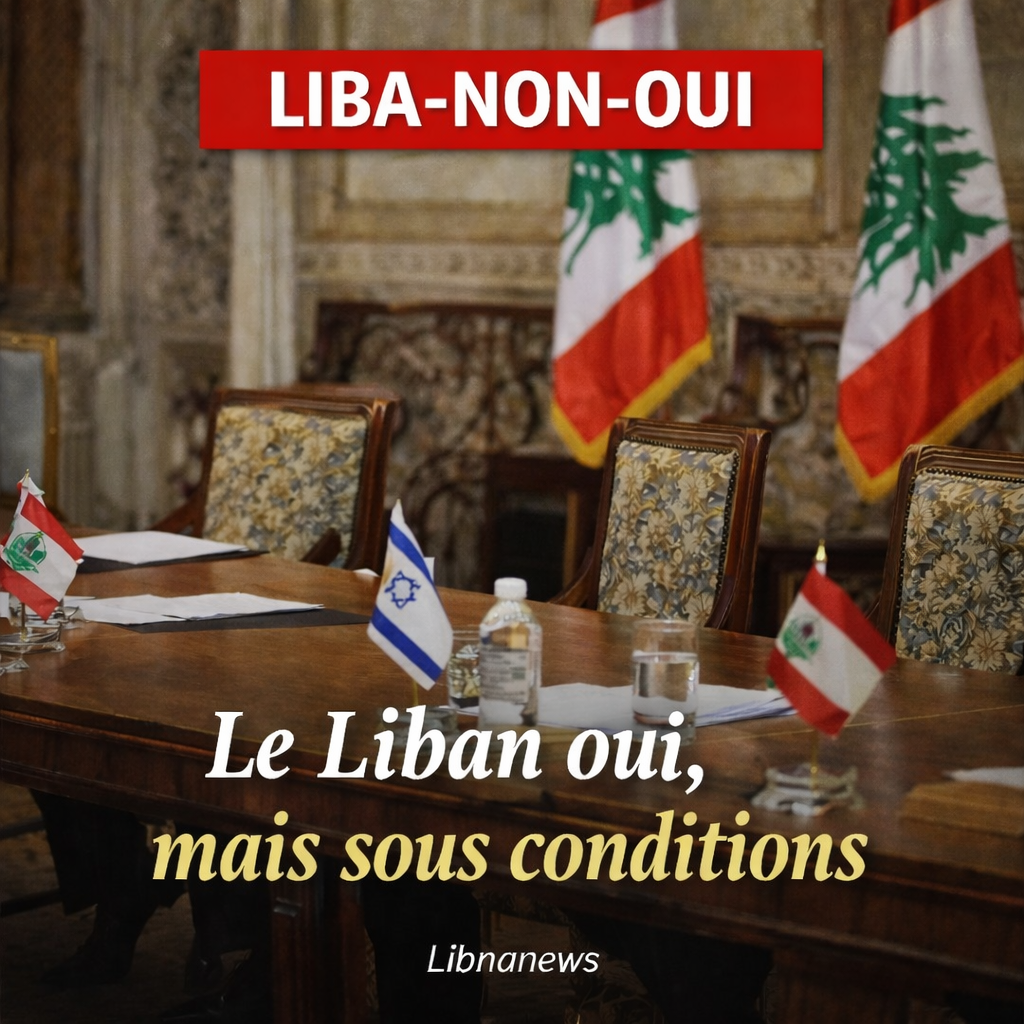
Diplomacy has been at the centre of the Lebanese debate, but it does not yet gather on the essentials. Following the preliminary meeting held in Washington on 14 April between Lebanese and Israeli representatives under American sponsorship, reactions published in Beirut showed a more subtle political movement than mere support or frontal rejection. On one side, several voices greeted the opening of a direct, rare and heavy channel. On the other hand, each tried to set its own conditions, limits and definition of what an acceptable process might be for Lebanon. The Israeli-Lebanese negotiations thus become a revealing factor. They measure both the wear and tear of war, the international pressure, the internal power relations and the ambiguities of a country that wants to emerge from the test without yielding to sovereignty or rekindling its domestic fractures.
The timing is all the more sensitive as negotiations are not moving forward in a full calming climate. Israeli military operations were continuing in southern Lebanon and Hezbollah, too, continued to place its refusal in a confrontational logic. In this context, each statement issued in Beirut is of particular value. It does not only say what a party or institution thinks of a meeting in Washington. It also says what each camp considers possible, desirable or dangerous in the phase that opens. The reactions of the Maronite League, Ibrahim Kanaan and Gebran Bassil make up a useful triptych. They share a language of prudence, but they differ on the depth of the compromise envisaged, on the place of the state and on how to address the issue of Hezbollah.
Israeli-Lebanese negotiations change status
For a long time, the mere idea of direct contact between Lebanon and Israel was enough to trigger political and symbolic controversy. The conflict, the lack of formal peace, the weight of past occupation and the centrality of the Palestinian file had frozen the issue in an almost exclusively taboo register. Washington’s appointment doesn’t reverse this story, but it changes the framework. For the first time in decades, Lebanese and Israeli officials have found themselves around the same table, with the United States as the assumed sponsor, in a context where Beirut is first seeking a ceasefire, humanitarian relief and a gradual return to a form of border stability.
This change in status explains the measured tone of several Lebanese reactions. No one among the leaders who spoke on Thursday celebrated a peace in progress. Nor did anyone deny the seriousness of such contact. But all admitted, directly or indirectly, that diplomacy had taken on a central role. This does not mean that consensus is achieved. Rather, it means that the mechanical rejection of any exchange is no longer the only politically tenable attitude. The exhaustion of the country, the extent of destruction, the fatigue of the displaced and economic fragility now weigh as much as ideological reflexes. The Israeli-Lebanese negotiations are not seen as automatic normalization. They are seen as a possible tool, the use of which remains disputed.
This development is also due to the way in which Beirut presents the case. The official line is not that of global bargaining on regional peace. It is to affirm that priority is given to the ceasefire, the full implementation of the commitments of November 2024, the Israeli withdrawal from Lebanese territory, the return of the displaced and the restoration of clear State sovereignty over the entire country. On the other hand, Israel insists on another hierarchy. The Israeli authorities are talking about peace, but they are part of an agenda that emphasizes the weakening and disarmament of Hezbollah. It is this initial, deep shift that gives Lebanese reactions their real density. They don’t just comment on an event. They seek to define the very meaning of the process.
Maronite League poses moral legitimacy to diplomacy
The Maronite League communiqué is the most explicit reaction to an exit through dialogue. The text presents the negotiations as a crucial opportunity to promote diplomatic solutions over the logic of wars and military confrontations that have exhausted Lebanon. The choice of words is important. It is not just about approving a meeting or welcoming an American initiative. The League seeks to confer both national and moral legitimacy on the diplomatic path. It says, in a hollow, that the country no longer has the capacity to live under the regime of permanent war and that a political horizon, even if fragile, must be reopened to break the impasse.
This is not an abstract pacifism. It is based on specific political conditions. The communiqué recalls the urgency of a ceasefire and the requirement to fully implement the cessation of hostilities announced in November 2024. It also stresses the territorial integrity of Lebanon and the full sovereignty of the State, regardless of any other negotiation process. Clearly, the Maronite League supports diplomacy, but refuses to dissolve it in a larger regional agenda or subject to calculations that would exceed the direct interests of Lebanon. That precision counts. It allows us to support dialogue without giving the feeling of political abandonment or of a shift towards an imposed peace from the outside.
The text goes further by stressing that direct negotiations can help to reduce tensions and create prospects for calm, stability and peace. Again, the wording deserves attention. It does not announce any historic reconciliation or imminent agreement. Rather, it argues that a mechanism for discussion can produce concrete, even limited, effects in an environment saturated by violence. This approach to peace is characteristic of part of the current Lebanese Christian scene. It is not just based on a geopolitical reading. It embraces a vision of the survival of the country, its communities and its border territories, particularly in the Christian areas of the South that are caught between military instability, depopulation and the fear of a lasting stall.
The Pope’s Place and the Battle of Language
The reaction of the Maronite League is not only about the Israeli-Lebanese negotiations. It is also part of a broader battle of language. By denouncing statements that were considered offensive to the pope, the League introduced a symbolic dimension that went beyond the only diplomatic issue. It presents the pontiff as a universal spiritual and moral reference, a voice of conscience calling for truth, justice and peace among peoples. This passage is not incidental. It shows that, for part of Maronite circles, the defence of dialogue also requires the protection of those who publicly embody a speech opposed to the escalation and brutalization of the debate.
This sequence comes at a time when the Pope himself has recently multiplied calls against war and in favour of dialogue. The Maronite League seized it to recall that the era required a language of reason and wisdom, far from confrontation and overbidding. In Lebanon, where words used in public space often precede political divides, this insistence is not annoyed. It reflects concern about the deterioration of political speech. It also suggests that diplomacy can only progress if a minimum of moral legitimacy is restored to the very principle of discussion. When any compromise is presented as a capitulation, any mediation as a weakness and any call to peace as a naivete, the political space is reduced to the logic of confrontation.
The League finally links this posture to the reality of the terrain. His statement highlights the visits of the Maronite patriarch to border villages and the Jezzine region. It’s not just a pastoral gesture. It is a reminder that negotiations only make sense if they affect the lives of the inhabitants, their retention on their lands and the continuity of the villages. In this reading, diplomacy is not an abstraction of chancery. It must be used to protect the human presence, the social fabric and the ability of people to stay in their homes despite the destruction, displacement and chronic insecurity.
Kanaan focuses debate on state and stability
The reaction of Ibrahim Kanaan is on another register. After his meeting in Baabda with President Joseph Aoun, the MP stressed an immediate priority: internal stability and the strengthening of an active presence of Lebanon on the international scene. The point is more institutional, more collected, but it also illuminates the current sequence. Kanaan formulates a double red line that sums up quite well the sensitivity of a part of the sovereignist and reformist camp: no war serving external agendas, no peace on the back of sovereignty. This sentence is almost as a synthesis of Lebanese malaise. It rejects the logic of regional integration, while refusing to allow a settlement to take place under duress and at the cost of diluting the national decision.
By claiming that there is no alternative to the state and its institutions, from the presidency to the army, to all citizens, Kanaan places the issue in a classic framework, but has become central since the worsening of the crisis. Lebanon, in this reading, cannot be saved by parallel arrangements, armed balances or informal guardianship. It can only be through the restoration of a political and institutional authority capable of negotiating, protecting the territory and restoring a minimum of confidence. This is not a lexical detail. It is a way of responding, without naming them, to all those who continue to think the security of the country outside the state or next to it.
Perhaps the most significant sentence of Kanaan concerns the following. By referring to the ceasefire as a gateway to a new stage in preparation, as a prelude to a form of settlement that would not be distant, it implicitly recognizes that the phase opened in Washington is beyond the mere humanitarian objective. He suggested that a broader recomposition should be considered. This idea corresponds to signals from the United States, which present the discussions as the beginning of a process and not as a one-time exchange. But Kanaan takes care not to detail the nature of this next step. This reserve is consistent with ambient caution. In Lebanon, any overly frank anticipation of the contours of a future arrangement could rekindle normalization or abandonment proceedings.
Basil seeks a balance between peace, rights and civil risk
Gebran Bassil adopts a more developed and exposed position. In his televised interview, he stated that the Lebanese Government must adopt a just and balanced position between the reality imposed on the ground and its desire to achieve peace. This sentence obviously seeks to occupy a median space. It recognises military compulsion, acknowledges the need for a political outcome and refuses, in the same movement, the illusion of disincarnate voluntarism. For Basil, a just solution requires two simultaneous elements: that Israel’s security be guaranteed and that Lebanon recover all its rights, see its territory liberated, obtain a halt to attacks and allow the displaced to return home. The structure of his argument deserves attention. He does not speak of peace in purely rhetorical terms. It requires reciprocity.
The former minister pushes this logic further when he says that a sign of Israeli goodwill must first involve a complete withdrawal from Lebanese territory, in accordance with the commitments already known, before any broader discussion on the basis of a just and lasting peace. This hierarchy partially distinguishes it from other officials who refer mainly to the principle of negotiation. At Bassil, dialogue only makes sense if it is backed by material gestures on the ground. Otherwise, it may appear as the diplomatic translation of a balance of power imposed by war. This insistence also allows it to respond to a Lebanese opinion that is deeply distrustful of any process that does not begin with the concrete end of the attacks and the minimal restoration of normalcy in the South.
But it is on the issue of Hezbollah’s weapons that Basil delivers the most delicate part of his position. He reiterates his desire for the exclusive return of weapons to the State. Yet he insists immediately on a crucial point: such disarmament cannot be achieved by pressing a button, especially when the party is backed by a dense social, political and community environment. By adding that he did not want Lebanon to be led to a civil war, Basil tried to reconcile two objectives which, in the Lebanese debate, were often presented as incompatible. On the one hand, the restoration of a sovereign state with a monopoly of force alone. On the other hand, the absolute refusal of an internal confrontation that would break the country even further.
Hezbollah in the background of all reactions
Even when it is not at the centre of phrases, Hezbollah passes through all these reactions. It is the implicit question behind almost every word about the state, sovereignty, peace, stability or war. The Israeli-Lebanese negotiations have not only reopened a diplomatic channel between two enemy countries. They also revived an internal debate on the very definition of Lebanese strategic decision. The Shiite movement rejected the direct discussions and denounced their usefulness. This position reinforces the reading of a Lebanese scene crossed by two competing temporalities: that of a State seeking to stop escalation through a diplomatic process, and that of an armed actor who continues to regard the ratio of military force as the determining language.
That is precisely why reactions from the Maronite League, Kanaan and Bassil are politically important. They do not form a homogeneous front, but they draw a common direction: Lebanon can no longer afford to be merely a theatre of regional confrontation. They say, each in its own way, that the centre of gravity must return to the state, to an institutional logic, to the border, to the ceasefire, to the right of the inhabitants to live outside the permanent war. Even Bassil, which deals most directly with the complexity of the Hezbollah case, does so in terms of political integration, international guarantees, security strategy and neutrality, not in terms of military crushing or expeditious settlement.
However, this partial convergence should not be overestimated. Disagreements remain profound on the nature of peace, on the timing of concessions, on the place of external mediations and on how to resolve the duality between State and non-State arsenals. Political Lebanon therefore moves towards diplomacy with caution, sometimes with necessity, but without a perfectly unified vision. The Israeli-Lebanese negotiations offer an opening. They have not yet produced a shared national doctrine. They have, on the other hand, revealed that a significant part of the political class and the community relays now consider that no serious exit can be thought out of a diplomatic, institutional and sovereign framework, even though the ground continues to remind, every day, how fragile this ambition remains.




