

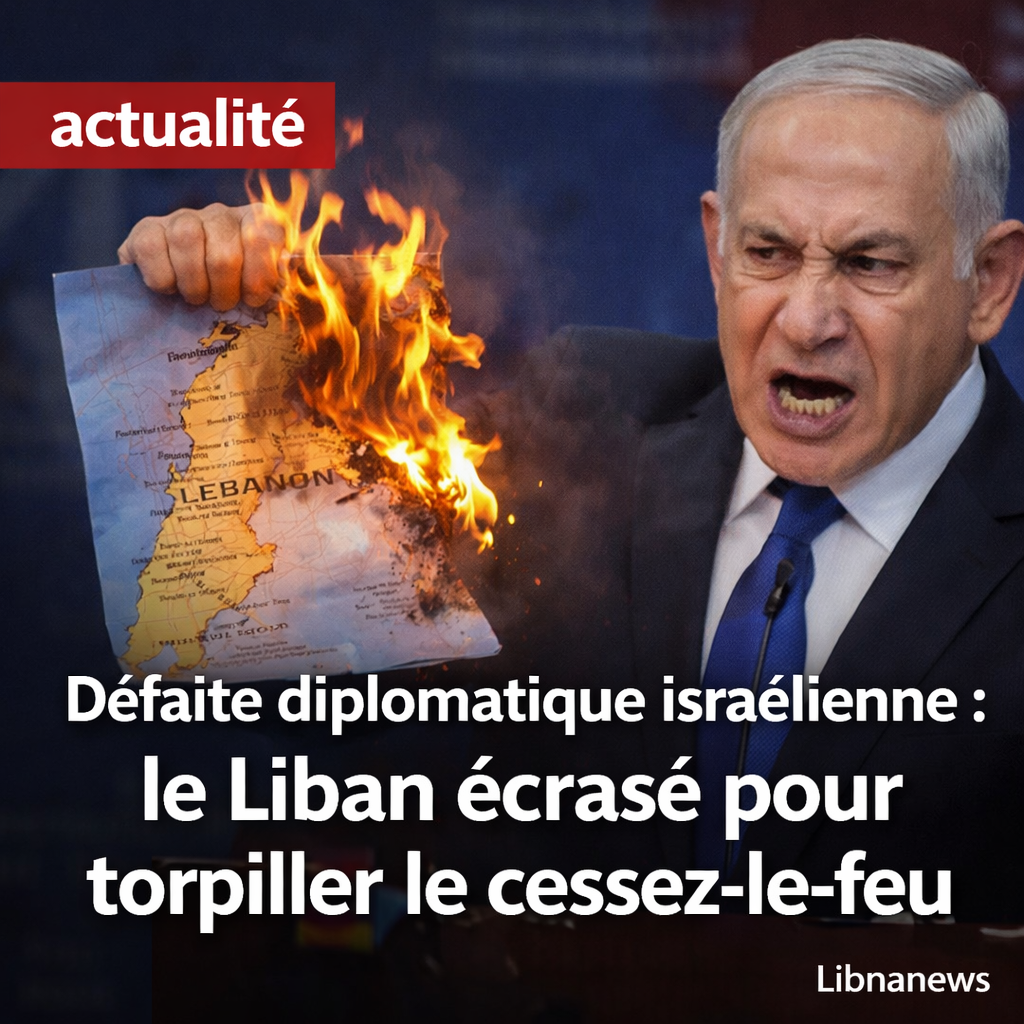
The announcement of a ceasefire between the United States and Iran gave rise briefly to the hope of regional de-escalation that could also protect Lebanon. That hope was swept away in a few hours. While Pakistan, Tehran and several European capitals argued that the Lebanese front should be included in the truce, Israel and Washington affirmed the opposite. In the aftermath, the Israeli army launched the most deadly strike campaign of this war phase on Lebanon. Seen from Beirut, the sequence tells less of a simple diplomatic misunderstanding than an Israeli political failure followed by a massive and disproportionate use of force to erase this setback, crush Lebanon and prevent an Iranian-American ceasefire from producing real effects on the ground.
A cease-fire announced and immediately amputated from Lebanon
The crisis is due first to a very short, but politically decisive chronology. The United States and Iran agreed to a two-week break to avoid a wider escalation. In the hours that followed, Pakistan, which played a central role in mediation, argued that Lebanon should be part of this de-escalation. Emmanuel Macron also publicly insisted that the cease-fire should apply « on all fronts », explicitly stressing the Lebanese case. Reuters reports that Paris asked Washington and Tehran to honour a truce including Lebanon, while Israel was already carrying out exceptionally intense strikes on Beirut and other parts of the country.
Israel reacted almost immediately by claiming that the Lebanese front was not concerned. Washington then resumed this reading. The political effect of this correction was immediate. In Lebanon, many saw it not as a normal clarification, but as a late rewrite of the terms of the truce under Israeli pressure and after the raids began. TheWashington PostNotes that Iran, Pakistan, France and other actors supported the inclusion of Lebanon, while the United States and Israel denied it. This contradiction created a deep doubt about the reality of the ceasefire: was it a real regional agreement, or was it a text whose perimeter could be forcibly redesigned over Lebanese cities?
For Beirut, therefore, the problem lies not only in the letter of the compromise, but in its political architecture. A regional truce that leaves Lebanon in a grey zone does not protect anyone. On the contrary, it confirms the place assigned to the country in the regional balance of power: that of a secondary theatre, available for the auction, even at the time when other capitals speak calmly. It is this fault that explains the Lebanese reading of the sequence. Lebanon was not forgotten by accident. It was left in an ambiguity which allowed it to become the site of military correction.
The Israeli diplomatic defeat, recognized even in the Israeli debate
Talking about Israeli diplomatic failure is not a controversial formula from Beirut or Tehran. Criticism was expressed at the very heart of the Israeli public debate.The Guardianreports that Yair Lapid denounced a « political disaster » and accused Benyamin Netanyahu of having failed politically and strategically. Yair Golan also spoke of « strategic failure ». The same article notes that Netanyahu is now described, in part of the Israeli debate, as the great political loser of a war without clear victor. This assessment is not only based on partisan opposition. It reflects the feeling that at the decisive moment, Israel did not alone impose the terms of de-escalation with Iran.
This malaise is reinforced by analyses carried out around the Israeli press.The Guardianquotes Amos Harel, military correspondent ofHaaretz, which sees in this sequence a new demonstration of the weaknesses of the political system led by Netanyahu: risky bets, superficial plans, ignorance of the warnings of experts, and repeated promises of « total victory » that do not lead to any clear strategic outcome. The formula is very meaningful. When a government promises to reshape the regional balance for a long time and then finds itself challenging, after the fact, the perimeter of a truce negotiated without it in the centre, there is a diplomatic setback, even if it retains a superior capacity for military destruction.
The Worldalso stresses that Israel has opposed the idea of stopping operations in Lebanon despite the announcement of a ceasefire with Iran. This refusal sheds light on the nature of the problem. The Israeli government did not only want to pursue a war against Hezbollah. He refused that an Iran-American agreement would create the slightest political precedent that would limit his freedom of action on the Lebanese front. There lies the heart of the diplomatic failure: not the total absence of Israeli influence, but the inability to prevent Western mediators and allies from publicly mentioning a ceasefire including Lebanon.
Why Lebanon’s crashing was used as a political response
The violence of the strikes then gives its meaning to the whole. Reuters reports that the 8 April bombings were Israel’s largest campaign in Lebanon since the beginning of this war. The Office of the United Nations High Commissioner for Human Rights described the civilian casualties as « fearable » and considered that these attacks undermined an already extremely fragile peace process. According to Reuters, the Lebanese civil defence reported 254 deaths, while an ambulance in Qlaileh and an area near Hiram Hospital near Tyre were also struck.
The Associated Press adds that Israel hit more than 100 sites in Lebanon, especially in central Beirut, without warning, and that residential and commercial areas were hit in a city already saturated with displaced people. The agency is talking about the most deadly day of this war. This is essential to understanding the scope of the response. It is not simply a matter of an ordinary continuation of hostilities. The synchronization between the announcement of the truce, the debate on Lebanon’s inclusion and military deflagration turns the offensive into a political message: no ceasefire will impose on Lebanon without explicit Israeli validation.
Seen from Lebanon, this demonstration took the form of a crash. The word is not rhetorical. He describes a method. When massive strikes fall in a few minutes on several regions at once, at the very moment when a diplomatic window seems to open, the logic is no longer that of simple military pressure. It becomes that of a crash intended to produce political truth. This truth, Israel wanted to impose it as follows: Lebanon will not benefit from any diplomatic dividend resulting from a truce between Iran and the United States if this truce is not in accordance with Tel Aviv’s security interests. It is this articulation between diplomatic defeat and the crushing of Lebanon that gives the sequence its coherence.
Israel doesn’t want a ceasefire that really compels it
The bottom line is there. The facts suggest that Israel does not exclude any truce, but rejects any truce that effectively reduces its ability to coerce Lebanon or that even indirectly devotes Iranian political gain.The WorldNotes that Netanyahu continued the war against Hezbollah despite the announced truce with Iran. Other accounts report the same logic: the ceasefire may exist on one front, but not if it changes the parameters that the Israeli government considers essential on another. In other words, the truce is tolerated only if it does not become a constraint.
This doctrine explains the immediate reversible nature of any lull. It also explains why Lebanon remains a strategic adjustment variable in the current Israeli reading. If a negotiation with Tehran is to take place, it must not set a precedent on the Hezbollah front. If mediators say Beirut is entering the ceasefire, there must be a denial. If this denial is not enough, then it must be proved by force. The result, for the Lebanese, is terrible: the ceasefire is not only denied in its application. It is contradicted materially, by strikes that make its existence politically implausible on the ground.
This reading is all the stronger as Hezbollah, according to Reuters, suspended its attacks as part of the American-Iranian truce before the wave of Israeli strikes. This means that, at least in the immediate facts, one of the actors on the Lebanese front was in a logic of pause, while the other imposed a rise in power. It is understandable why, on the Lebanese side, many consider that the objective was not only to deny Lebanon’s inclusion in the agreement, but rather to torpedo its very credibility. This interpretation remains a political reading of the facts, but it stems directly from the chronology observed.
An increasingly difficult American ally to contain
The sequence also says something essential about the relationship between Israel and the United States. The facts do not allow us to speak of an ally completely uncontrollable in the strict sense. On the other hand, they clearly show that Israel is becoming an increasingly difficult partner for Washington. The United States agreed to a break with Iran to avoid widespread burning. But this pause immediately lost part of its regional scope because Israel refused to apply it to Lebanon. Washington eventually resumed this reading, but only after the initial ambiguity and after the strikes. The result is politically costly: the American word seems to be able to announce a de-escalation without being able to fully guarantee its perimeter.
It’s not an isolated episode. The Associated Press recalls that the current regional explosion accelerated after the American and Israeli strikes on 28 February against Iran, and then Hizbullah entered the confrontation. This reminder is central, as it shows that the current crisis does not arise from a series of independent misunderstandings, but from a dynamic in which the Israeli military initiative, alone or jointly, contributes to widening the conflict, and then compels Washington to deal diplomatically with the consequences of an escalation that it no longer fully controls.
For regional actors, the signal is bad. If the United States enters into a truce and, a few hours later, their main ally the emptiness in part of its substance by continuing a war on another front yet linked to the agreement, then the American credibility s’erode. Pakistan, France, Iran, as well as the Gulf States and Lebanon can legitimately wonder what an American guarantee is worth if it remains suspended from Israel’s interpretation of regional red lines. This doubt will weigh on future mediation efforts, far beyond the current episode.
The consequences: Ormuz, Hezbollah, the credibility of the truce
One of the first visible consequences concerns the Strait of Ormuz. Reuters and the Associated Press report that, in this context of the disputed truce and the continuation of the strikes on Lebanon, the issue of navigation in the strait immediately rested, to the point that Paris had announced to work with some 15 countries to facilitate the resumption of maritime traffic. The mere fact that a coalition is mobilizing so quickly shows the degree of concern about the fragility of the ceasefire and the risk of global economic repercussions.
The other consequence concerns Hezbollah. If the movement had indeed suspended its attacks under the truce, the continuation of Israeli bombings created clear pressure for a resumption of hostilities. The more Israel strikes, the more Hezbollah can argue that the ceasefire has been emptied of all reality on the Lebanese front. The more Hezbollah responds, the more Israel can claim that Lebanon was still outside the scope of the agreement anyway. The circle is formidable. It feeds the idea in Lebanon that part of Israel’s strategy is not only to refuse the truce, but to ensure that it fails politically by climbing.
Finally, the most profound consequence affects Lebanon itself. Beirut tried to fit into the logic of de-escalation. AP reports that the Lebanese government has indicated its readiness to move towards negotiations to end the hostilities. Yet, in the absence of an explicit and universally recognized guarantee, Lebanon has been left in a position of extreme vulnerability. It was not only excluded from an agreement. It was used to show the limits. For Lebanese, this is the bitterest lesson of the day: when diplomatic architecture remains blurred, it is always Lebanese territory that becomes the laboratory of violent correction.
What this sequence changes for Lebanon
The sequence of the last hours leaves little room for doubt about its political meaning. Yes, there was an Israeli diplomatic failure, because a ceasefire was announced in a context where the inclusion of Lebanon was publicly mentioned by European mediators and leaders, and because influential Israeli voices spoke of strategic failure and political disaster. Yes, this failure was followed by a military response of such magnitude that it took, seen from Lebanon, the form of a crash designed to erase a political setback by a bloody fait accompli. And yes, this logic threatens not only Lebanon, but also the credibility of any future ceasefire in the region.
Perhaps the most serious thing for Beirut is that this day has revealed an implicit rule of the current regional order. When Israel loses the diplomatic battle, even partially, Lebanon may still pay the physical price. When a ceasefire appears to open up protection, Lebanon can remain the only front where such protection does not apply. And when the United States is seeking a break with Iran, there is no guarantee that this break will preserve Lebanese civilians if Israel chooses to unilaterally redraw its perimeter. It is this reality that today dominates all the others in Beirut: the fear that Lebanon will continue to be the space where it burys by bombs what diplomacy has failed to lock.




