

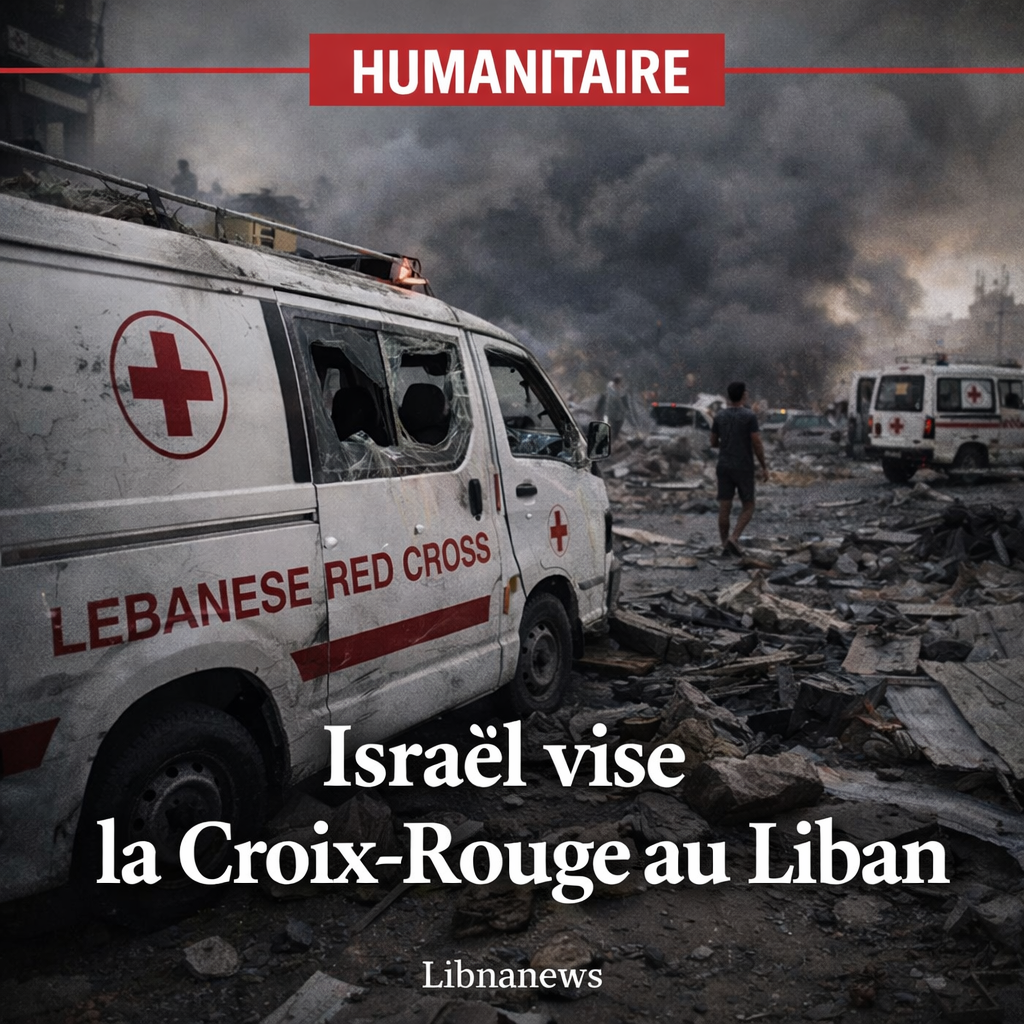
In less than 24 hours, two attacks hit the Lebanese Red Cross in the south of the country. Sunday evening, in Beit Yahoun, an Israeli drone hit a humanitarian team and killed the rescuer Hassan Badawi. On Monday morning, in Tyre, another strike targeted a Red Cross centre during the transfer of an injured man, killing him and damaging several vehicles. Beyond the shock, these two episodes revive a central question: when ambulances, first aid workers and rescue centres are affected while wearing protective emblems, the definition of war crime ceases to be a political formula and becomes a major legal hypothesis.
International humanitarian law specifically protects medical personnel, health transport and health units. This protection only disappears in specific cases. If an attack intentionally targets clearly identified personnel or medical means, using the emblem of the Red Cross in accordance with law, it may be a war crime within the meaning of the Rome Statute. In the Lebanese case, an independent investigation remains necessary to determine the criminal case. But the facts known at this stage already make this qualification plausible, serious and legally founded.
Two strikes in 24 hours
Targeting took place over less than 24 hours, and that is precisely what gives it its political and legal strength. On Sunday evening, a Lebanese Red Cross team, engaged in a humanitarian mission on the Beit Yahoun road in Bint Jbeil district, was hit by an Israeli drone. The first aid worker Hassan Badawi was killed, another volunteer was slightly injured, and both were transported to Tebnine Government Hospital. On Monday morning, a new raid targeted a Red Cross centre in Tyre while an injured person was transferred there. According to the Lebanese National Information Agency, the strike killed the wounded and damaged several rescue vehicles. Taken together, these two episodes draw a more serious picture than an isolated blunder. They touch the very chain of relief, from pick-up to evacuation, from ambulance to operational centre.
The Lebanese Red Cross stressed a key point in its communiqué on the attack on Beit Yahoun. Its ambulances and teams wore clearly visible protective emblems from all sides, including enlightened ones, and the mission had been previously coordinated with UNIFIL to ensure a safe passage, with information provided to the International Committee of the Red Cross. In the law of war, this detail is not secondary. It’s central. The protections granted to personnel, transport and medical units are based precisely on their identification and their exclusively humanitarian function. When an organization explains that the markings were visible and that the coordination channels had been activated prior to departure, it does not only describe its modus operandi. It establishes the elements that then enable the gravity of a strike to be legally assessed.
The attack on Tyre further reinforces this reading. This time, it is not just a moving crew, but a Red Cross centre itself struck during the transfer of an injured, with the destruction or degradation of several vehicles according to the first elements relayed by the Lebanese official press and taken over by Reuters. The fact that death is the patient and not a rescuer does not reduce the scope of the event. Humanitarian law also protects the injured and the sick, as well as the places and means for their care. A rescue centre is not an ordinary collateral damage in law reading. It is a specially protected space, because it is used precisely to subtract lives from violence. When he is struck in turn, the message sent to civilians is immediate: even the place intended to treat is no longer safe.
This chronology summarizes the two incidents documented so far by the Lebanese Red Cross, the Lebanese official agency and Reuters.
| Date | Location | Target affected | Immediate consequence |
|---|---|---|---|
| 12 April 2026 | Road to Beit Yahoun | Lebanese Red Cross team and ambulance | Hassan Badawi killed, another rescuer wounded |
| 13 April 2026 | Tyre | Red Cross Centre during transfer | One injured killed, several vehicles damaged |
A medical network already under attack
We must therefore correctly name the issue. To say that Israel is targeting the Red Cross is not just a controversial formula. This is the factual question posed by repeated attacks on teams, ambulances, centres and, more broadly, against the Lebanese medical ecosystem since the start of the March offensive. On 11 March, WHO reported that it had already verified 25 attacks on health care in Lebanon, with 16 deaths and 29 injuries. On 17 March, the organization reported 28 verified attacks, resulting in 30 deaths and 35 injuries. Then, on 25 March, Reuters reported that at least 42 paramedics had been killed since 2 March and 64 attacks on medical facilities had been recorded. On 8 April, twelve first aid workers were still among the deaths of a single day of massive strikes. On Monday, the Lebanese Ministry of Health, relayed by the AFP, reported at least 87 caregivers or first aid workers killed since 2 March.
This continuum changes the nature of the debate. A strike on an ambulance always gives rise to the possibility of error, defective identification, defective information or operational interference. Two strikes in less than 24 hours against the Red Cross, one against a coordinated and marked mission, and the other against a centre in Tyre, however, took place in a wider sequence where Lebanese care structures were already under heavy pressure. On 9 April, Reuters reported that the World Health Organization was afraid of imminent disruptions of trauma supplies in Lebanese hospitals, following the massive influx of wounded people and the deterioration of supply chains. In such a context, touching relief is not just about adding victims to a balance sheet. It also worsens future mortality, because every vehicle destroyed, every team decimated, every center hit reduces the ability to save the next injured.
Hassan Badawi, the proper name of a changeover
The Hassan Badawi case alone sums up the moral change of this war. The rescuer killed in Beit Yahoun was not engaged in a military operation or an ambiguous mission. According to the Lebanese Red Cross, he was involved in a relief mission. In the logic of humanitarian law, it belongs to the very category of people whom the belligerents have an obligation to protect, because they keep the minimum principles of humanity alive in the midst of the fighting. When an ambulance or first aid worker becomes a target himself, the war does not just go beyond its rules: it attacks those who still make them concrete on the ground. This is also what IFRC had already stressed in March after the death of another Lebanese Red Cross relief worker, Youssef Assaf, while also carrying out his humanitarian mission.
This phenomenon is not only Lebanese, but its repetition in Lebanon takes on a particular resonance. WHO explained in March that attacks on health care in Lebanon do not only cost lives at the moment. They also deprive communities of care at the same time as they need it most. This formula describes exactly what is happening in the South. Strikes do not just eliminate individuals. They disrupt the health transport circuits, force the teams to slow down or delay their interventions, multiply the fear of a second strike on the rescuers, and eventually turn the emergency response into a deadly bet. Reuters I showed in his report of 25 March in Nabatiyah: the first responders explained that they had to deal with the haunted repetition strikes, which delayed evacuations and made each departure more dangerous. When a rescue system operates under permanent threat, the border between attacks on targets and war against care becomes thinner.
Tyre, when health shelter becomes target
Israel presents its campaign in Lebanon as a war against Hezbollah centres and infrastructure. This framework of communication must be recalled, because it has structured the Israeli military argument since the beginning of the escalation. But it does not in itself answer the precise question posed by the strikes against the Red Cross. Under the law of war, it is not enough to invoke the presence of an enemy in a theatre of operations to erase the special protection granted to ambulances, rescue workers and medical centres. In each case, however, it must be demonstrated that protection had ceased because of actual hostile use, or that the attack was aimed at a lawful military objective in accordance with the principles of distinction, precaution and proportionality. At this stage, the public elements consulted on Beit Yahoun and Tyre are mainly those of the Lebanese Red Cross, the Ministry of Health and international organizations. They therefore require, at a minimum, an independent investigation.
It is here that the term « target » takes on its full weight. It does not only mean « to reach ». It means directing violence to an identified relief link. The events of 12 and 13 April suggest precisely this: a Red Cross team spotted on the ground and then a Red Cross centre hit in Tyre. Although investigations will have to establish the exact circumstances, the sequence already has an obvious strategic effect. It deters rescuers from moving forward, terrorizes families awaiting evacuation, delegitimizes the idea of a safe corridor, and makes it clear that uniform, ambulance and emblem no longer offer the guarantee they are supposed to offer. For a civilian population under attack, this perception has immediate consequences. We’re slow to call 911. We’ll evacuate later. There are more injuries that can be treated. And cities like Tyre, already under pressure, see their response centres turn into potential targets.
The Tyre raid also struck a major urban and humanitarian symbol. The city is not just a point on the map of the South. It is one of the main health crossing points for southern localities, while living under the direct threat of strikes and evacuation orders. When a Red Cross centre is affected by a transfer, the impact exceeds the immediate victim and damaged vehicles. It is the capacity of an entire population pool that is weakened. Destruction or decommissioning of ambulances reduces the number of possible interventions within the following hours. Fear among teams changes the departure times. Public confidence in the emergency points is cracking. And the city itself loses a little more its function of relative refuge for the South.




