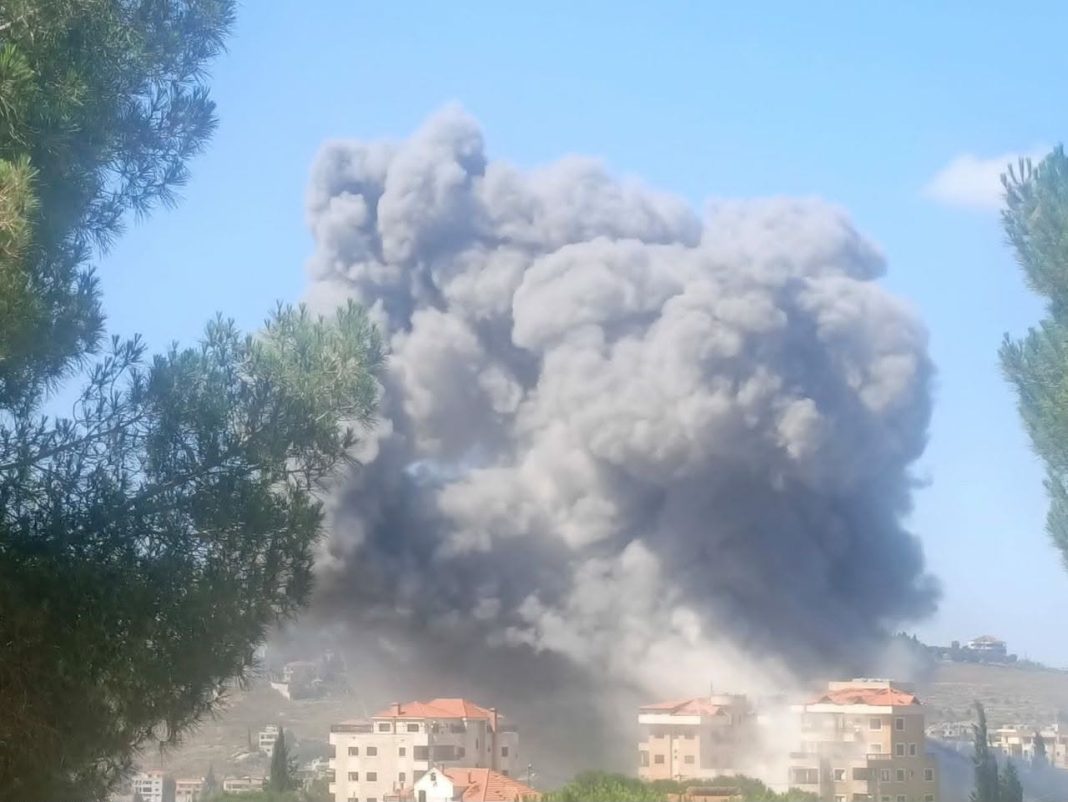






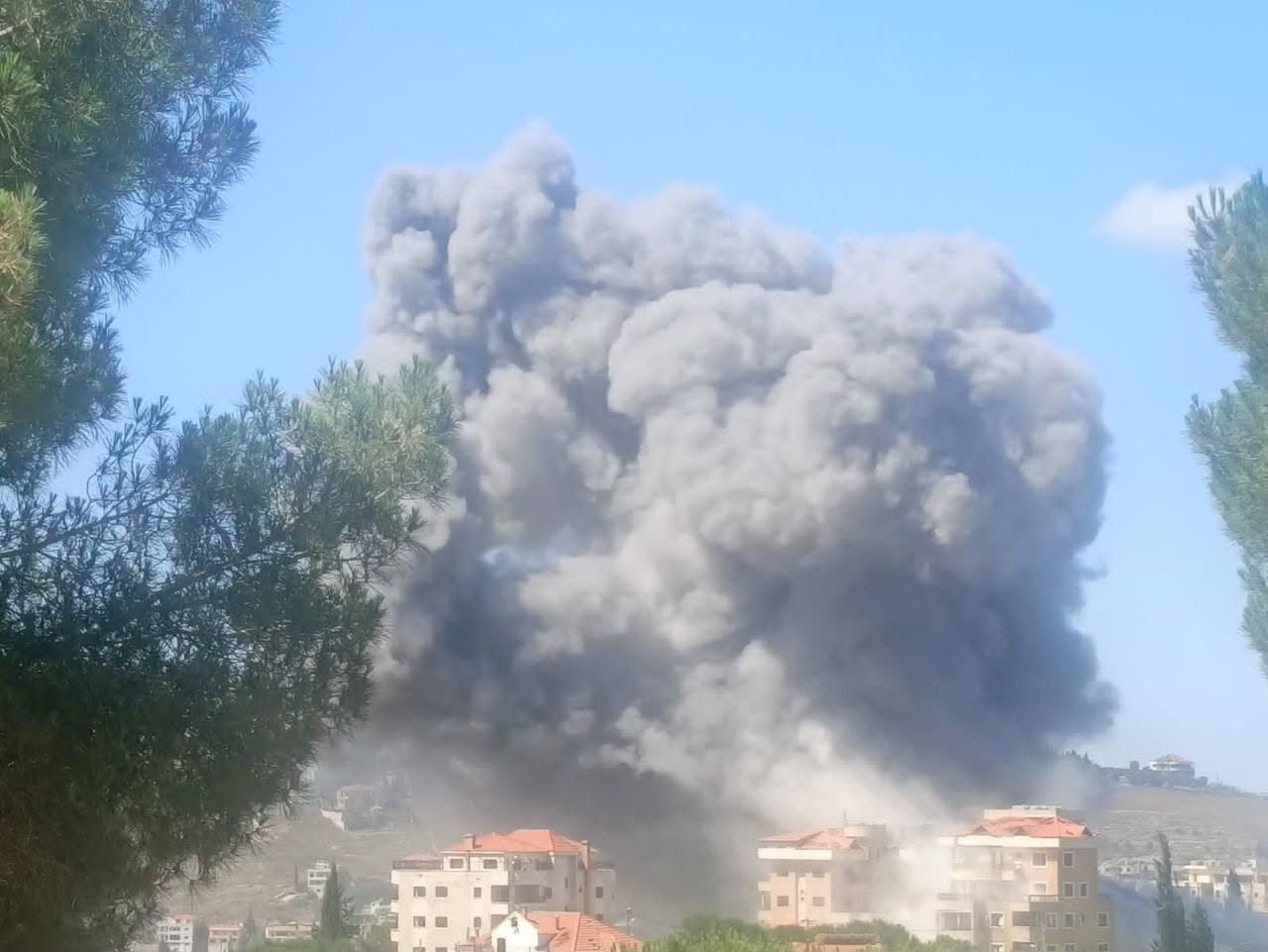
The ceasefire announced on Friday at 4 p.m. in southern Lebanon was quickly put to the test by new Israeli bombardments in the Nabatiyah area and on Mount al-Rafi. In Beirut, these strikes are denounced as violations of the truce, while Benjamin Netanyahu claims that Israel will not withdraw from the buffer zones in southern Lebanon.
The cease-fire announced on Friday at 4 p.m. in southern Lebanon was quickly put to the test by new Israeli bombardments reported in the Nabatiyah area and on Mount al-Rafi in the Iqlim al-Tuffah area. In Beirut, these strikes are denounced as Israeli violations of the truce, at the very moment when Benjamin Netanyahu claims that Israel will not withdraw from the buffer zones in southern Lebanon. The sequence summarizes the gap between Washington’s diplomatic announcement and the reality of the southern villages.
According to Reuters, Israel and Hezbollah had agreed to a cease-fire to enter into force on Friday at 4 p.m. local time, after mediation with the involvement of the United States and Qatar, and with the help of Iran. This announcement was to contain the escalation caused by the death of four Israeli soldiers near Kfar Tebnit and by the massive response of the Israeli army. But the first reports from the field immediately weakened the scope of the truce. Press correspondents reported raids in Nabatiyah governorate and on the heights of Iqlim al-Tuffah, in a south already struck by night and morning.
For the inhabitants, the question is not just whether an agreement has been announced. She asked whether the aircraft really stopped hitting, whether the drones were leaving the sky, whether ambulances could move and whether families could get out of shelters. In a number of locations, relief workers were still seeking to reach affected homes when the announcement of the ceasefire was circulated. The Lebanese record of the day was already heavy, with 30 deaths reported in the latest available information and many injured.
Nabatiyeh still targeted after the announcement
The Nabatiyah region was at the heart of the Israeli wave. Strikes were reported in Nabatiyah itself, but also in nearby or near-front localities, including Kfar Tebnit, Harouf, al-Doueir, al-Sharqiyah, Kfar Sir, Jibchit, Adchit, Toul, al-Qsaybeh, Kfar Dajjal, Kfarjuz, Kfar Rummane, Zibdine, Nabatiyah al-Fawqa, Habbush, Sajd and the Rihan heights. After 4 p.m., reports of Mount al-Rafi and Nabatiyah district gave the truce an immediately uncertain character.
The Israeli army presents its operations as a response to repeated violations of the ceasefire by Hezbollah. In its communiqués, it claims to have struck more than 80 command centres, launching positions, fighters and infrastructure in the Nabatiyah region and other southern areas. It also claims to have targeted two command centres in the Bekaa, while Hizbullah members were there. Finally, it claims to continue the dismantling of underground infrastructure in the Beaufort area.
On the Lebanese side, this version is not enough to dispel the feeling of a violation. The strikes affect a sovereign territory. They hit villages, roads, inhabited areas and areas where civilians are still trying to survive or return. The Israeli concept of « target » does not always correspond to what people see: empty houses, cars destroyed, land made inaccessible and families forced to leave. The cease-fire, therefore, cannot be reduced to a diplomatic formula. It must be verified by stopping the bombings.
Kfar Tebnit, starting point of climbing
Friday’s escalation was triggered by an ambush claimed by Hezbollah near Kfar Tebnit, in the area of Ali al-Taher hill. The Israeli army acknowledged the death of four soldiers, including Dor Gedalia Ben Simhon, commander of the 52nd battalion of the 401th Armoured Brigade. Hezbollah claims to have targeted an Israeli force that was advancing in the area, destroyed three Merkava tanks with guided missiles, and then hit another force that was evacuating the dead and wounded.
This attack caused a political shock in Israel. It also gave the Netanyahu government the framework for a wide-ranging response. But the Israeli response was not limited to one sector. It hit Nabatiyah, other parts of the South and the Bekaa. In Lebanese villages, this extension is seen as a collective punishment, even when the Israeli army claims to be targeting Hezbollah. The human situation and the increasing number of sites hit fuel the charge of Israeli violations of the ceasefire.
Netanyahu refuses to remove buffer zones
Benjamin Netanyahu’s statement further reinforced this concern. According to Israeli Channel 12 and Israeli media, the Prime Minister said that Hezbollah would pay a « very high price » and that Israel would not withdraw from buffer zones in southern Lebanon. He reiterated that Israel would remain in the security zone « as long as necessary » to protect northern localities. In Beirut, this sentence is read as a claim of military retention in Lebanese territory.
The issue of buffer zones has become central. Israel presents them as a security necessity. Lebanon sees this as a direct violation of its sovereignty. A cease-fire without Israeli withdrawal could stabilize a de facto occupation instead of ending it. The villages concerned are not empty spaces. These are localities, farmland, roads, houses and places of life. For internally displaced persons, no truce can be considered real unless it allows safe return.
This concern is particularly concentrated on Maroun al-Ras, a border village on a strategic height. Lebanese information has referred in recent days to a newly established Israeli position in the area. The available evidence does not make it possible to establish with certainty the construction of a permanent base. They, however, fear a military fact. In southern Lebanon, the historical experience gives special weight to these signals. A temporary position can become sustainable. A safe area can become a prolonged occupation.
The threats of Ben Gvir and Smotrich
The comments of Itamar Ben Gvir and Bezalel Smotrich also weighed Lebanese perception. The Israeli Minister of National Security stated that « all Lebanon must burn ». The Minister of Finance called for « talking with fire » and « open the gates of hell. » These statements, coming from two Israeli far right figures, are received in Lebanon as threats against an entire country. They blur the distinction between Hezbollah, the Lebanese state and the civilian population.
This rhetoric comes in a tense electoral and political context in Israel. Benjamin Netanyahu depends on his far right allies to maintain his coalition. Ben Gvir and Smotrich seek to appear as guarantors of a hard line, especially after military losses. Lebanon thus becomes a political demonstration ground. The more the Israeli right demands a strong response, the narrower the margin for a lasting ceasefire. From Beirut, this dynamic exposes Lebanese villages to the internal calculations of a fragile Israeli coalition.
Iran-USA agreement weakened by violations
The regional context adds an additional dimension. The ceasefire announced on Friday is part of the efforts related to the agreement between the United States and Iran. According to Reuters, the discussions planned in Switzerland were postponed after the escalation in Lebanon. Washington sought to preserve a broader diplomatic sequence, while Tehran conditioned its participation to a complete cessation of hostilities. The Lebanese front therefore becomes one of the most sensitive tests of the regional regulation.
In this context, the Israeli violations reported after the announcement of the truce have a scope beyond southern Lebanon. They threaten the credibility of the entire process. If Israel continues to bombard after the announced time of the ceasefire, and Netanyahu refuses to withdraw from the buffer zones, the agreement can be emptied of its contents on the ground. Hezbollah can then justify further attacks in the name of Lebanese sovereignty. Israel will invoke these attacks to continue its strikes. The cycle of climbing will remain intact.
For Beirut, the risk is to become the breaking point of a regional agreement that goes beyond it. Lebanon needs a real halt to the bombings, a withdrawal of Israeli forces and a verifiable monitoring mechanism. Without these elements, the ceasefire remains fragile. It can even become dangerous if it freezes the front lines while allowing Israel to control Lebanese areas and strike beyond these areas.
A truce judged on the ground
The Bekaa reinforces this concern. The Israeli strikes announced against two command centres widen the perimeter of the confrontation. This region does not fall within the immediate line of the border front. Targeting it at the moment when a truce is announced gives the impression that all Lebanese territory remains exposed. For the Lebanese authorities, this weakens the idea of a limited ceasefire in the South and raises the question of a common rule applicable to all regions.
In the villages, the stakes remain very concrete. Families are waiting to identify the dead. The wounded must be evacuated. Rescue workers must be able to reach the rubble. Internally displaced persons want to know whether they can return or whether they should stay in schools, with relatives or in temporary housing. A violation of the ceasefire is not only measured in military communiqués. It is measured by the impossibility of movement, treatment, burial and reconstruction.
The next few hours will tell if the 16-hour announcement opens a real de-escalation or if it joins the long list of truces immediately weakened. In Nabatiyah, on Mount al-Rafi, around Kfar Tebnit, in the Beaufort area and in Maroun al-Ras, the inhabitants will not judge the agreement on American, Israeli or Iranian statements. They will judge him on the actual cessation of the Israeli bombings, the end of the truce violations and the possibility of returning to their villages without living under an imposed buffer zone.