

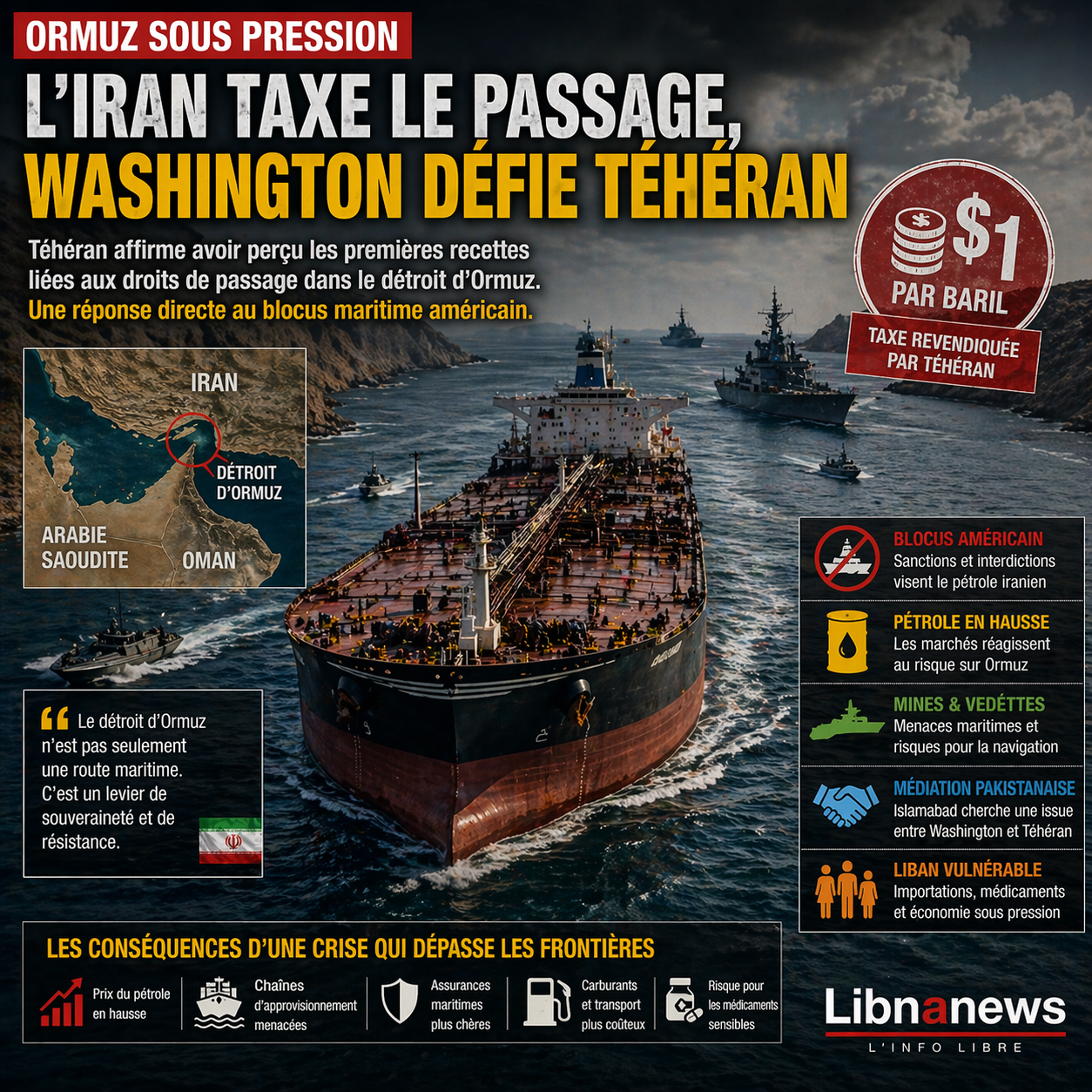
Tehran claims to have received the first revenue from the transit rights in the Strait of Ormuz. This announcement changes the nature of the arm of arms with Washington. Iran is no longer merely threatening navigation. It is trying to transform a vital marine passage into a fiscal, strategic and political tool. The Strait thus becomes a pressure station, but also a possible source of income in full confrontation with the United States.
Ormuz becomes a lever of Iranian sovereignty
The Strait of Ormuz is not simply a maritime corridor. It connects the Gulf with the Oman Sea and the Indian Ocean. It allows for the release of a major part of the oil and gas produced in the region. For Iran, controlling it, even partially, means weighing it on world markets. This also means that the American economic war can receive a geographical response.
The Iranian announcement on rights of way must be read in this context. Tehran does not completely close the strait. Nor is it limited to a military threat. He tells maritime actors that the passage now has a price. This price is not just financial. It carries a political message. Ships using the sea lane must take into account Iranian power on one of the most sensitive passages in the world.
This decision came as Washington imposed a maritime blockade against Iranian exports. The United States wants to reduce Tehran’s revenue. Iran responds by taxing a space that markets cannot ignore. The logic is therefore that of an exchange of constraints. Washington is blocking. Tehran bills. Shipping companies, insurers, importers and consumers pay the risk.
A tax as a response to the US blockade
The Iranian measure is like a counter-sanction. The United States is seeking to prevent Iranian oil from reaching markets. Tehran wants to show that it can make the passage of all regional flows more costly. The tax becomes a means of saying that the blockade will not remain unilateral. It also allows Iran to circumvent some of the financial pressure.
The amount mentioned in the press kit is one dollar per barrel through the strait. Perception could be done through digital mechanisms, in order to escape the financial circuits monitored more easily. If this system is confirmed, it will give Iran a new funding tool. It will also introduce a grey zone into maritime commerce, where operators will have to arbitrate between legal risk, military risk and commercial cost.
However, the actual effectiveness of this tax will depend on several factors. Tehran must be able to monitor the flow. Ships must also agree to pay, or their charterers must fear enough reprisals to comply. Finally, the United States must not be able to break the mechanism by force, sanctions or pressure on transport companies.
The sea becomes an economic battlefield
The current conflict shows that economic war is no longer confined to banks. It passes through ports, ships, roads and straits. Washington uses its navy to limit Iranian exports. Tehran uses geography to make this pressure more expensive. The sea thus becomes an area of forced taxation, military control and political messages.
This development reminds us that world trade is based on narrow passages. Disruption in Ormuz can affect oil, gas, transport and insurance prices. It can also affect sectors unrelated to Iran, such as medicines, industrial parts, food, fertilizers or manufactured goods. A maritime delay quickly turns into a social cost.
Markets have already incorporated part of the risk. The increase in the barrel shows that operators do not believe in a limited crisis. Oil responds to attacks, announcements, mine threats, ship seizures and uncertainty over negotiations. The Iranian tax adds a layer. She says even a non-attack vessel can be caught in a new cost regime.
Washington wants to keep control of the passage
The American response is based on the naval force. Donald Trump says the United States controls the Strait. He also gives very hard orders against any ship suspected of laying mines. This posture aims to reassure markets and allies. It seeks to show that Washington can guarantee freedom of navigation despite Iranian pressure.
But the control of a strait is not decreed. He proves himself every day. Ormuz is narrow, frequented and vulnerable. Mines, drones, fast boats, coastal missiles and electronic attacks make total domination difficult. The United States has superior military power. Iran has asymmetric tools. In such a sensitive passage, small means can create great effects.
The US strategy must therefore face a challenge. She can intercept ships. She can escort certain flows. It can punish companies. But it cannot completely eliminate the risk without opening a wider war. Tehran knows that. The tax on passage follows this logic. It creates a permanent challenge rather than a unique confrontation.
Mining and fast boats change the calculation
The threat of maritime mines gives the crisis particular gravity. A mine is cheap. Yet it can immobilize a vital passage. It forces the marines to deploy heavy means of detection and clearance. It increases insurance premiums. It slows down the roads. It makes shipowners hesitate.
Iranian rapid stars add another form of pressure. They can harass ships, approach convoys, create incidents and test American rules of engagement. They are more difficult to neutralize than a large naval unit. They correspond to a doctrine of saturation and uncertainty. The goal is not always to sink. It can be to disrupt, delay or raise prices.
In this context, the Iranian tax cannot be separated from the military threat. It is based on an implicit capacity of constraint. If the passage was perfectly safe and free, the ships could ignore the demand. If the risk is real, the payment becomes a form of political insurance.
Direct pressure on Asia
The major Asian importers are the first presentations. Much of the oil that crosses Ormuz goes to Asia. China, India, Japan and South Korea have a direct interest in the stability of the transition. For these countries, the Iranian tax creates a dilemma. They want to keep access to hydrocarbons. They also want to avoid a direct confrontation with Washington.
Importers can absorb a small tax for a period of time. But they fear the instability around this tax. If the amount changes, if the payment methods are opaque, if the US sanctions target those who pay, trade becomes more risky. Companies do not like legal uncertainty. States do not like energy uncertainty.
Liquefied natural gas is also concerned. Qatar relies heavily on Ormuz for its exports. A prolonged disruption would therefore affect the gas market, especially in Asia. Europe would be less directly exposed in volumes, but it would still have an impact on world prices and supply chains.
Oil as a political thermometer
The increase in the barrel acts like a thermometer. When the tension rises in Ormuz, the price rises. Markets do not only respond to the volume actually blocked. They react to the risk of blockage. They buy a fear premium. This premium then affects fuels, transport, electricity, imported products and public budgets.
For the United States, this increase creates internal pressure. It affects households and businesses. It also weakens the discourse that Washington controls the situation. The higher the oil, the more Iran can claim that the US blockade also costs Western allies and consumers.
For Iran, the increase in the barrel is an indirect weapon. Even if its own exports are targeted, tension can increase the value of the oil it manages to sell. It can also push some actors to seek a compromise to avoid a wider crisis. Tehran plays on two sets. It resists the blockade and makes the blockade more expensive for others.
Pakistani diplomacy seeks an exit
Pakistan is trying to open a path of de-escalation. Islamabad sought to bring together the American and Iranian delegations. The ideas mentioned concern a partial lifting of the maritime blockade in exchange for a reopening or normalisation of the passage through Ormuz. This mediation is based on a simple observation. Neither side can easily win. American pressure has not yet forced Iran to give in. Iranian pressure threatens markets and roads, but it can also provoke a dangerous response.
The Iranian tax complicates mediation. It becomes a bargaining currency. Tehran may agree to suspend or reduce the mechanism in exchange for relief. Washington can demand a complete halt to perception to prove freedom of navigation. The sea passage thus becomes an object of merchanting.
Pakistan played a useful role, as it could speak to both sides. But his margin remains limited. The crisis is beyond the strait. It affects sanctions, Iran’s regional programme, Israel’s security, Hezbollah, Iraq, the Gulf and energy roads. A solution to Ormuz can calm the markets. It does not resolve the whole confrontation.
Lebanon suffers from a distant strait
Lebanon is far from Ormuz. Yet he suffers the consequences. Oil increases affect transportation, generators, imports and prices. It also reduces the government’s budgetary margin. A fragile economy, heavily dependent on imports, does not support energy shocks. Every increase in the barrel becomes a social risk.
The maritime crisis can also affect medical supplies. Some heat-sensitive drugs depend on fast and controlled supply chains. If ships remain blocked, delayed or redirected, the most fragile products can be affected. Vaccines, insulin and some heavy treatments require strict storage. The economic war then turns into a health risk.
The Ormuz file therefore indirectly joins the Lebanese crisis. The country is negotiating a truce in the South. It monitors the exchange rate. It tries to maintain wages and imports. At the same time, it is experiencing global tension on energy and transport. The Strait is becoming an additional fragility factor for Beirut.
Taxation at the border of law and power
The legal issue is central. A coastal State has rights in its territorial waters. But passage through the straits used for international navigation is governed by specific rules. Freedom of transit is a major principle. A tax imposed under military compulsion or in a context of contested blockade can therefore be highly contested.
Tehran presents its measure as a right linked to the economic war situation. Washington sees this as an obstacle to freedom of navigation. Shipowners see this as a risk. This difference in reading makes the crisis difficult to stabilize. International maritime law provides principles. The balance of power often decides on their application in moments of tension.
The Iranian tax is therefore in a grey area. It does not need to be fully recognized to produce effects. It is enough that it scares, complicates insurance, changes roads or slows down business decisions. In a globalised economy, uncertainty is sometimes as valuable as a blockage.
The confrontation between two forms of power
The crisis of Ormuz contrasts two forms of power. The United States has the fleet, sanctions, the dollar, insurance networks and diplomatic pressure. Iran has geography, proximity, asymmetric means and the ability to make flows risky. The relationship is unbalanced, but it is not simple.
Washington can hit hard. Tehran can prolong instability. The United States can ban. Iran can bypass. The United States may seize a ship. Iran can make the passage more expensive. Each camp tries to show that time is playing for it. Each camp also seeks to convince markets that the other is responsible for the crisis.
The Ormuz tax illustrates this battle of patience. It may not be intended to last as it is. It already serves to prove that Iran has options. She says the American blockade won’t be free. It also obliges mediators to include navigation in any compromise.
A challenge to markets as much as in Washington
The Iranian decision is addressed to the United States, but also to the markets. Tehran wants to show that global oil cannot be secured against it. He wants to remind us that energy roads are not only dependent on aircraft carriers. They also depend on the cooperation or restraint of riparian States.
Markets respond by increasing prices, prudence and seeking information. Companies must assess the cost of the crossing, the cost of insurance, the risk of sanction, the risk of delay and the risk of incident. The crisis therefore becomes a daily calculation. It is not just a statement from Washington or Tehran.
This uncertainty is precisely the heart of Iranian pressure. Even without full closure, Ormuz can become more expensive. Even without open war, transportation can become more risky. Even without stopping flows, prices can rise. The Iranian tax turns this uncertainty into a political instrument.
An escalation that can still be restrained
The crisis is not irreversible. Mediation can reduce risk. Partial agreement on the blockade can calm navigation. A maritime notification mechanism may limit incidents. A guarantee on freedom of passage can lower prices. But these measures require a minimum of confidence. But this trust is lacking.
Washington wants Iran to stop turning Ormuz into a lever. Tehran wants the United States to lift some of the pressure. So both sides talk about the same space, but not the same problem. For the United States, the problem is Iranian constraint. For Iran, the problem is the US blockade. The transit tax becomes the symptom of this divergence.
The Strait of Ormuz will therefore remain one of the most sensitive points of the crisis. As long as the blockade continues, Tehran will seek answers. As long as Iran taxes, threatens or disrupts the passage, Washington will maintain its military pressure. In between, markets, importing countries and fragile economies will continue to absorb the cost.




