

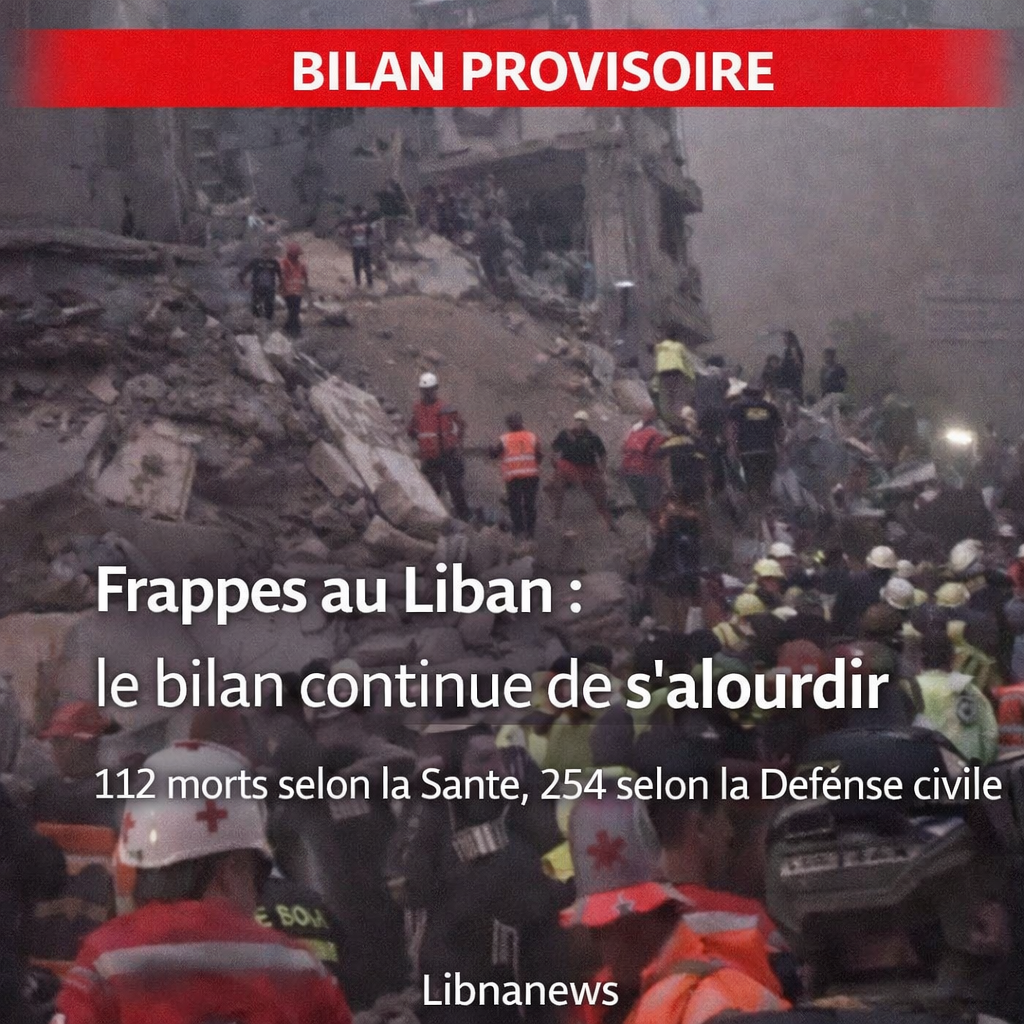
The results of the Israeli strikes in Lebanon on Wednesday continue to grow, in a confusion that alone says the magnitude of the shock. According to an updated interim assessment by the Lebanese Ministry of Health, 112 people were killed and 837 injured as a result of bombings in Beirut and other areas. For its part, the Lebanese Civil Defence has a much heavier record of 254 dead and more than 1,129 injured. In both cases, these are interim assessments that include many civilians. Research continues under the rubble, while many families continue to seek their loved ones in hospitals, morgues and emergency centres.
Two results, one certainty: the day turned into horror
The difference between the figures provided by the Ministry of Health and those advanced by the Civil Defence illustrates the disorder of a day marked by simultaneous strikes in many parts of the country. The first assessment, published by the Ministry, reported 112 deaths and 837 injuries. The second, relayed by the Lebanese Civil Defence, speaks of 254 dead and more than 1,129 injured. This gap does not necessarily mean political contradiction. It can also translate different counting methods, a lag in data reporting, or faster integration by first aid workers of victims still not registered by hospital structures.
What is no longer in doubt, however, is the national dimension of carnage. The strikes targeted Beirut, its suburbs, Saida, Bekaa, Tyre, Hermel, Zahlé and many southern localities. AP reported that Israel presented this sequence as its largest coordinated operation of the war in Lebanon, with over 100 targets announced in a few minutes in Beirut, Bekaa and the South. Reuters also described this offensive as the most intense since the beginning of the current phase of the conflict.
Still provisional reports, with victims under the rubble
The provisional nature of the figures is a central element. In this type of offensive, the balance sheets evolve for hours, sometimes for days. Rescue teams continue to intervene at several sites at the same time. Victims can still be trapped under the rubble. Others arrive in hospitals well after the first estimates. This explains why the figures reported over the course of the day rise in successive stages.
The situation in several neighbourhoods of Beirut and in some localities in the South and the Bekaa has been aggravated by the intensity of the strikes, urban density and difficult access to relief. Reuters reported earlier today an initial assessment of 89 deaths and 700 injuries according to the Lebanese Ministry of Health. The fact that the new interim balance sheets rise significantly above this threshold confirms that the first few hours only gave a partial picture of the disaster.
Families looking for loved ones in hospitals
The other strong image of this evening, beyond the figures, is that of families still looking for their loved ones. In massive bomb attacks, the human information chain is often slower than the destruction chain. Injuries are transferred from one institution to another. Bodies are not immediately identified. Relatives move from one hospital to another, sometimes from one morgue to another, before getting confirmation of the fate of a relative. This reality gives a particular depth to the word provisional: as long as families seek, the balance sheet is never completely frozen.
Blood donation calls, which have multiplied throughout the day, also confirm the extreme pressure on hospital structures. In urban bombardments, these calls usually occur when emergencies receive a large number of serious injuries in a short time requiring transfusions, surgery and intensive care. The press reports and health reports published in recent days show that the Lebanese health system was already working under heavy pressure before this new wave of strikes.
A day of total war across the country
The geographic dispersion of the strikes largely explains the magnitude of the losses. It is not a single deadly raid, but a sequence of bombings affecting several depths of the territory at the same time. This mechanically saturated ambulances, firefighters, access roads to hospitals and sorting centres for the wounded. Earlier in the day, the safety and rescue authorities had already asked the population to limit the movement to the maximum in order to allow ambulances and rescue teams to pass through.
In this context, each new partial balance sheet must be read as a snapshot, not as a final photograph. The figures of 112 dead and 837 wounded by the Ministry, like those of 254 dead and more than 1,129 wounded by the Civil Defence, say one thing: Lebanon lived one of the bloodiest days of this war. The large agencies have confirmed the exceptional magnitude of this offensive, although detailed counts continue to evolve.




