






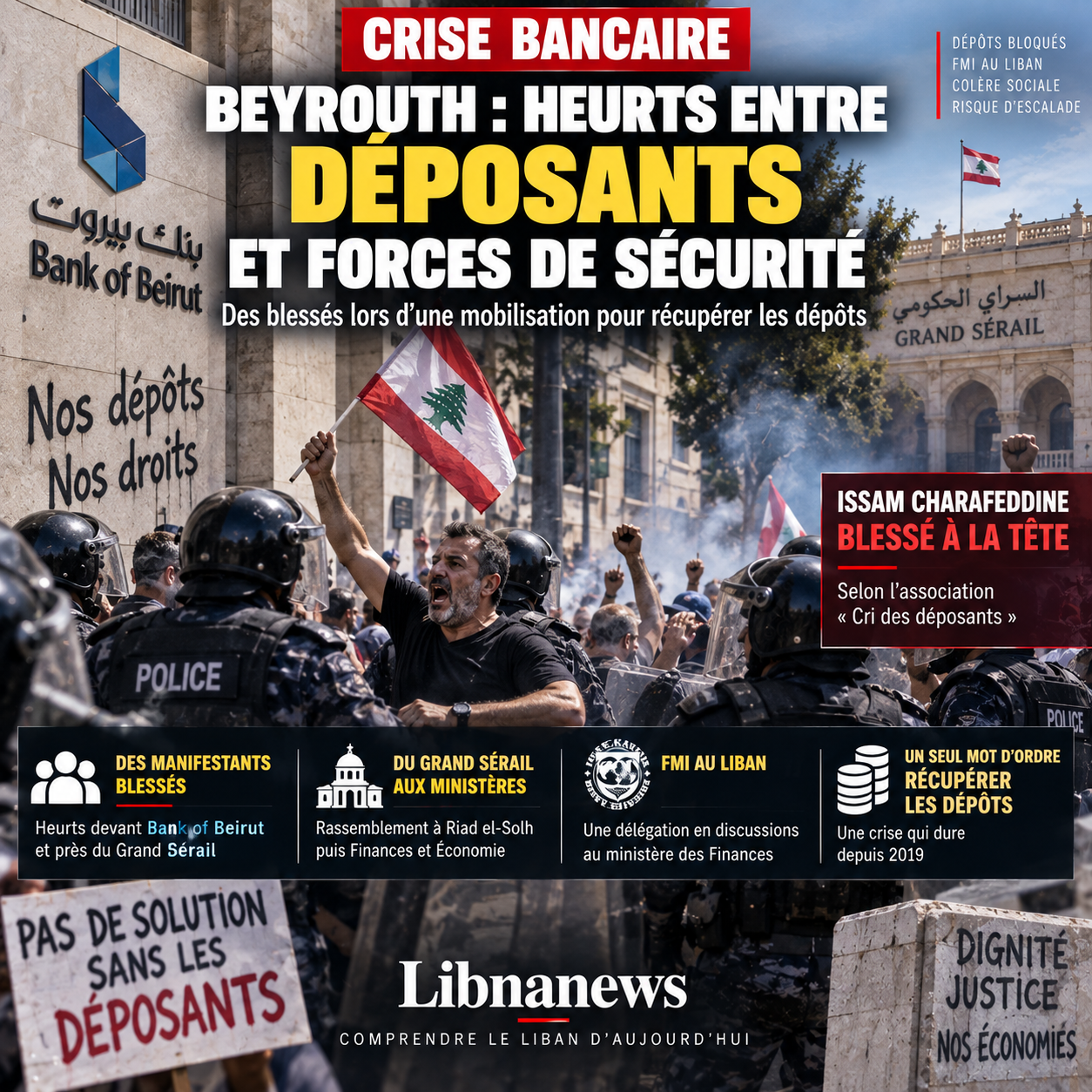
On Thursday, September 17, 2026, clashes were held between Lebanese depositors and security forces in central Beirut, especially in front of Bank of Beirut, near the Grand Serail. Several protesters were injured during a mobilisation demanding a solution to recover bank deposits blocked since the financial crisis of 2019. The movement moved from Riad al-Solh Square to the Ministry of Finance and then to the Ministry of Economy. New incidents broke out during this journey. Former Minister Issam Charafeddine was injured in particular in the head, according to the president of the association « Scream of depositors », Alaa Khourchid.
The mobilisation takes place at a particularly sensitive time for the banking file. A delegation from the International Monetary Fund is in Beirut and met with officials of the Ministry of Finance. Depositor associations contest the treatment of their assets in the context of financial restructuring and call for direct involvement in discussions that will determine the fate of deposits.
Bank of Beirut in Beirut
The first incidents were reported in the centre of the capital, near the Grand Serail. Depositors gathered in Riad al-Solh Square before continuing their movement in several administrative areas of Beirut.
The event had been organized by applicant associations, with the participation of groups representing, inter alia, applicants established abroad. The objective was to question the government and Parliament on the draft resolution of the banking crisis.
Tension has risen in front of Bank of Beirut, near the seat of the Council Presidency. Bullying and subsequent clashes between demonstrators and the security forces in the area.
Several Lebanese media reported that the demonstrators were injured. However, there was no clear official record of the number of people affected within the first few hours of the incidents.
The information available therefore does not make it possible to establish a definitive balance sheet. On the other hand, they confirm that the incident went beyond mere verbal exchanges and that several participants were injured.
Tires were also burned in Riad al-Solh Square, in front of the Grand Serail. The security forces intervened at various times of the rally, especially when demonstrators tried to occupy or block certain areas.
The confrontation with Bank of Beirut did not end the mobilization. The applicants continued their journey towards the ministries concerned with the financial file.
From Riad el-Solh to the Ministry of Finance
The movement had begun in front of the Grand Sérail, seat of the Presidency of the Council. The demonstrators then took over the direction of the Ministry of Finance.
This move was not trivial. The Ministry is one of the centres for discussions on financial and banking restructuring. Most importantly, a delegation from the International Monetary Fund met with departmental officials at the time of mobilization.
The applicants therefore wanted to bring their claims as close as possible to those responsible for the financial negotiations.
They are calling for a solution that will allow them to recover the money held in banks since the outbreak of the crisis in autumn 2019. They also request that their representatives participate in discussions on reimbursement mechanisms.
After their visit to the Ministry of Finance, the demonstrators continued their movement towards the Ministry of Economy and Trade.
It was during this part of the journey that a new incident broke out with the security forces.
Issam Charafeddine injured in head
The former Minister of Displaced Issam Charafeddine, who had been involved for several years with groups of depositors, participated in the mobilisation.
Alaa Khourchid, president of the association « Cri des depositeurs », claimed that Issam Charafeddine had been beaten during a confrontation with the security forces as the demonstrators moved from the Ministry of Finance to the Ministry of Economy.
According to his account, the security forces blocked the road when the incident occurred. Khourchid claims to have seen the former minister be beaten.
Issam Charafeddine was allegedly hit in the head and bleeding.
This version must however be attributed to the organizing association. The information available in the immediate future does not allow for an independent assessment of the exact sequence of actions that caused his injury or for a detailed version of the Internal Security Forces on this episode.
The injury of the former minister nevertheless constituted one of the most tense moments of the demonstration.
The journey continued to the Ministry of Economy, where another incident was reported.
New incident before the Ministry of Economy
Tension resumed when the demonstrators arrived near the Ministry of Economy and Trade.
Participants tried to burn tires. The security forces intervened to prevent them, causing further confrontation.
According to Alaa Khourchid’s account, this incident ended and calm returned to the area.
The day was marked by several distinct episodes: tensions near the Grand Sérail and Bank of Beirut, the incident during the movement between the Ministries of Finance and Economy, and the confrontation caused by the tyre fire in the vicinity of the Ministry of Economy.
These different episodes are linked to the same mobilization and to a central demand: the fate of bank deposits.
Depositors contest the treatment of their savings
Behind the Thursday incidents is the unresolved file of the deposits blocked since 2019.
From the beginning of the financial crisis, the Lebanese banks imposed strong restrictions on withdrawals and transfers. As a result, depositors have lost free access to a large part of their accounts, particularly those denominated in foreign currency.
The issue has become one of the main obstacles to restructuring the financial system.
The issue is not just how much money can be returned to applicants. It is also necessary to decide at what rate, in what form and according to which distribution of losses between the State, the Bank of Lebanon, commercial banks and their shareholders.
At the end of 2025, the Government approved a draft law on financial organization and the return of deposits. According to the official presentation made at the time by Prime Minister Nawaf Salam, depositors with less than $100,000 must recover their assets over four years.
The Government indicated that this category represented about 85% of the applicants.
For accounts above this threshold, the mechanism is different. Depositors must recover a first tranche, while the balance must be treated, inter alia, through negotiable instruments.
This architecture remains strongly contested by several applicant associations.
A battle around the « 85% »
Thursday’s mobilisation also highlighted a significant divergence in the presentation of figures.
In its communiqué after the gathering, the association « Screaming of depositors » claimed that the government project would lead to the conversion of approximately 85% of deposits into bonds whose guarantees it contests. It also denounces the possibility of reducing certain claims for interest payments in the past.
This presentation, however, does not correspond to that given officially by the government when it adopted its draft.
The 85% figure put forward by the Government concerned the estimated proportion of depositors with less than $100,000 and not the share of all deposits to be converted into securities.
This distinction is important.
The Government states that depositors below the $100,000 threshold must fully recover this amount according to the schedule. For those depositors who have more than that, the balance above this threshold must be treated differently.
Associations, for their part, dispute the security and real value of certain mechanisms proposed for higher amounts. They refuse that the restructuring should lead, directly or indirectly, to a share of the depositors which they consider excessive of the losses accumulated by the financial system.
It is this disagreement that feeds much of the current mobilization.
IMF in Beirut at the time of the event
The calendar of the event adds a particular dimension to the incidents.
A delegation from the International Monetary Fund is in Lebanon for a further round of discussions with the authorities. The Thursday movement coincided directly with a meeting between IMF representatives and officials of the Ministry of Finance.
The applicants wanted to take advantage of this presence to make their position visible.
For several years, the IMF has called on Lebanon to implement a restructuring of the financial sector, to recognize accumulated losses and to define their distribution. The resolution of bank liabilities remains one of the key issues for any sustainable reform of the system.
But this distribution is precisely the most conflicting point.
Applicants refuse to be considered as the adjustment variable of a system for which they feel they are not responsible. At the same time, the Government must deal with significant financial losses between the State, the Bank of Lebanon and banks.
Discussions with the IMF thus give Thursday’s movement a reach that goes beyond confrontation in front of a downtown bank.
The demonstrators sought to intervene politically at a time when the modalities of processing their assets remained under discussion with international institutions.
A banking crisis that has lasted since 2019
The Beirut incidents occurred almost seven years after the start of the Lebanese financial crisis.
In the fall of 2019, as capital inflows were slow and demonstrations were increasing in the country, banks began to restrict access to accounts.
The restrictions then continued.
The Lebanese pound lost most of its value compared to its former exchange rate. Depositors with dollar accounts were unable to freely withdraw their assets in their original currency.
Over the years, the Bank of Lebanon has adopted several mechanisms allowing for limited withdrawals according to specific ceilings and conditions. These arrangements did not resolve the substantive issue: the recognition of receivables, the allocation of losses and the modalities for a sustainable repayment.
This lack of settlement has regularly led to mobilization.
Some targeted banks directly. Depositors have also used individual shares in institutions since 2022 to claim access to their own accounts.
The 17 September demonstration is part of this long sequence, but it comes at a time when the debate has shifted to the concrete modalities of legislative restructuring.
Associations announce further mobilisations
After the incidents, « Scream of applicants » announced its intention to continue its actions.
The association states that it rejects any mechanism which, according to its interpretation, would lead to the deletion of part of the deposits or the transfer of assets to instruments whose repayment would be uncertain.
It also called for the participation of depositor representatives in discussions on restructuring.
This claim should remain at the centre of future mobilisations. Associations consider that those whose accounts are blocked must be able to intervene in the development of solutions that will determine the repayment of their debts.
Thursday’s incidents now add a security dimension to this financial confrontation. Several people were injured, while the accusation that Issam Charafeddine was beaten by the security forces will have to be confronted with any official clarification of the exact circumstances of the incident.
In Beirut, calm came back after the various confrontations reported in the city centre. The file which provoked them remains entirely open: financial negotiations continue, the final treatment of deposits is not completed and associations are already announcing new movements against any formula which they would consider a reduction of their rights.