

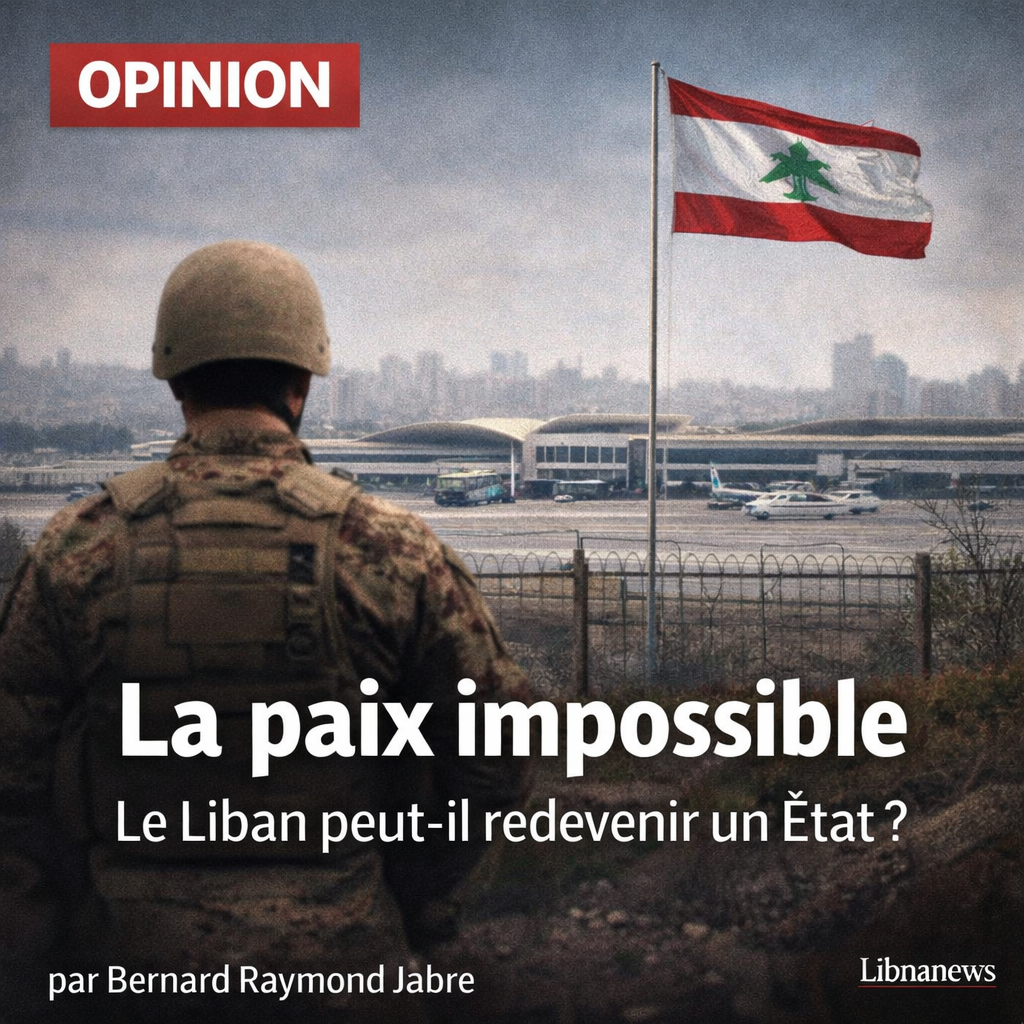
There are words that we repeat until we empty them of their meaning. Peace is part of it. We invoke it in conferences, we sign it in agreements, we proclaim it in communiqués, as if it were a controlled language, of a well executed diplomatic art. But peace is neither a formula nor a wish. It’s an architecture. It is based on a simple, almost brutal reality: someone must be able to control violence.
Without that, there is no peace. There is only one precarious suspension of the conflict.
Lebanon, today, is precisely in this unstable in-between where words continue to exist but where the structures that give them meaning have slowly dissolved. He speaks as a State, he is recognized as a State, but he no longer acts fully as such. Its sovereignty has not disappeared, it has become fragmented. It circulates between official institutions and parallel powers, between proclaimed law and effective force.
In this cracked space, a question becomes inevitable: how could a State that does not control the use of force on its territory guarantee peace to another State?
The answer, however uncomfortable it may be, imposes itself: it cannot.
For peace, in its most concrete form, is nothing but a credible promise of non-violence. And a promise of value only if it is backed by a real ability. Promising without being able to impose is moving the problem, not solving it. It’s replacing a speech with a reality.
For Israel, the issue is neither moral nor rhetorical. She’s strategic. Who controls the border? Who decides the war? Who can prevent a local incident from becoming a regional flare? If these questions do not have a single answer, then there is no guarantee. The doubt becomes structural, and with it a logic of permanent distrust.
But this external look, however hard it may be, only reflects a deeper internal reality. Lebanon is not only suffering from a power deficit. He suffers from a breakdown of the decision. It is crossed by several security logics, several perceptions of danger, several implicit command centres. Violence is not shared. She’s centralizing, or she’s dispersing.
And when it disperses, it produces permanent uncertainty.
In such a system, the state becomes paradoxically responsible for what it does not control and powerless in the face of what is charged to it. It carries the consequences without holding the causes. He is required to guarantee what he does not control. And that is where the fundamental contradiction that prevents lasting peace arises.
It was long believed that this balance could last. That the coexistence of parallel forces could produce a form of stability through cross-dissuasion. But this balance is a fragile illusion. It is based not on real mastery, but on the absence of a major event. It is enough to have an unexpected sequence for the whole structure to wave.
Peace, then, reveals what it really is: not an acquired state, but a contained tension.
Faced with this, it is not enough to comment. We have to transform. And any transformation begins with a truth that Lebanon must tell itself: no State survives long-term without having a monopoly of force on its territory. This principle, rigorously formulated by Max Weber, is not an academic theory. It’s a historical law.
But this truth, to become effective, must be translated into a trajectory.
The reconquest of Lebanese sovereignty cannot be a slogan. It must become a structured process, a progressive mechanics, a complete architecture linking political decision-making, military capacity, territorial control and flow control. Because weapons are never isolated. They circulate with money, goods, men and networks.
To take back the weapons is to take over all this at once.
This begins with a clear doctrinal statement: there is only one armed legitimacy on Lebanese territory, that of the State. As long as this is not clear, any reform remains suspended. But this statement cannot remain symbolic. It must be followed by a political process capable of gradually integrating existing realities into a logic of exceedance. Weapons do not disappear by decree. They must be absorbed by the State, transformed from parallel power into public power.
But no disarmament is possible without credibility.
The State must therefore simultaneously rebuild its capacity to protect. A strong army, effective security forces, coherent territorial intelligence, a real presence throughout the territory. Sovereignty is not a declaration. It is a daily practice of controls, orders, controlled borders and enforced laws.
This is where the most concrete and decisive dimension begins: full flow control.
Control of land borders first, not only at official points but also on informal passages which constitute the invisible structure of traffic. It’s not just about deploying men, it’s about creating persistent, mobile, intelligent surveillance that can make any parallel road costly and risky.
Control of ports and airports then, because any war economy goes through logistics. Every container, every cargo, every flight must be in a logic of traceability and risk analysis. A modernized, digitized, audited customs system connected to intelligence becomes an instrument of sovereignty.
Maritime and air control too, because sovereignty does not stop at visible borders. It includes airspace, territorial waters, invisible flows that bypass conventional devices.
But the real heart of the system is elsewhere: it is financial.
For no armed structure holds without funding. Resuming sovereignty therefore implies rapid, precise and legal control of financial flows. Every transfer, every financing channel, every opaque structure must be able to be analysed, connected, understood. This requires an advanced intelligence capability capable of establishing immediate links between an individual, network, transaction and organization.
In this context, a mechanism for the temporary freezing of suspicious flows must exist, legally framed, controlled and traceable. Not to establish arbitrariness, but to allow the state to interrupt immediately what threatens its sovereignty, time to verify its nature.
To take back arms is to take back money, roads, ports, borders and information.
Such a transformation has a cost. It requires resources, infrastructure, technology, training, information systems and human capacities. A credible sovereign winback program would realistically range from hundreds of millions of dollars over a few years. Not as an expense, but as an existential investment.
For sovereignty is the first asset of a state.
Lebanon could not make such an effort alone. It should build on its international partners, be they the European Union, the United States, the World Bank, the IMF or specialized bodies capable of providing expertise, financing and support. But this aid would only make sense if it is part of a clear Lebanese will.
That is why the creation of a sovereign fund dedicated to security and sovereignty is a strategic necessity. A strictly supervised, audited, transparent fund intended exclusively for the financing of border, customs, intelligence and critical infrastructure control capabilities. An instrument that transforms external aid into internal capacity.
In essence, sovereignty is not delegated. She’s rebuilding.
But no technical architecture will hold without a deeper foundation. Lebanon must redefine the very meaning of protection. As long as certain parts of society consider that their security depends on a force outside the state, sovereignty will remain incomplete. A pact must therefore be rebuilt. A pact in which the State becomes the ultimate guarantor for all.
That’s where the real swing is played.
The issue is no longer only military, neither security, nor even political. It’s existential. It touches on the very definition of what Lebanon is: a space crossed by competing forces, or a political nation capable of assuming its destiny.
Only then can peace change its nature.
It will no longer be a fragile promise to the outside world, but a consolidated internal reality. It will no longer depend on the restraint of the actors, but on the capacity of the State. It will no longer be a managed uncertainty, but a built stability.
For peace does not depend on what Lebanon says. It depends on what it is.
And history, relentless, recognizes only one thing: the states that control their power.
The question is therefore asked, naked, straight away.
Does Lebanon want to become a State again?
Because this answer depends on everything. Not only peace on its southern border, but its very survival as a sovereign entity in a world that leaves no lasting place for grey areas.




