

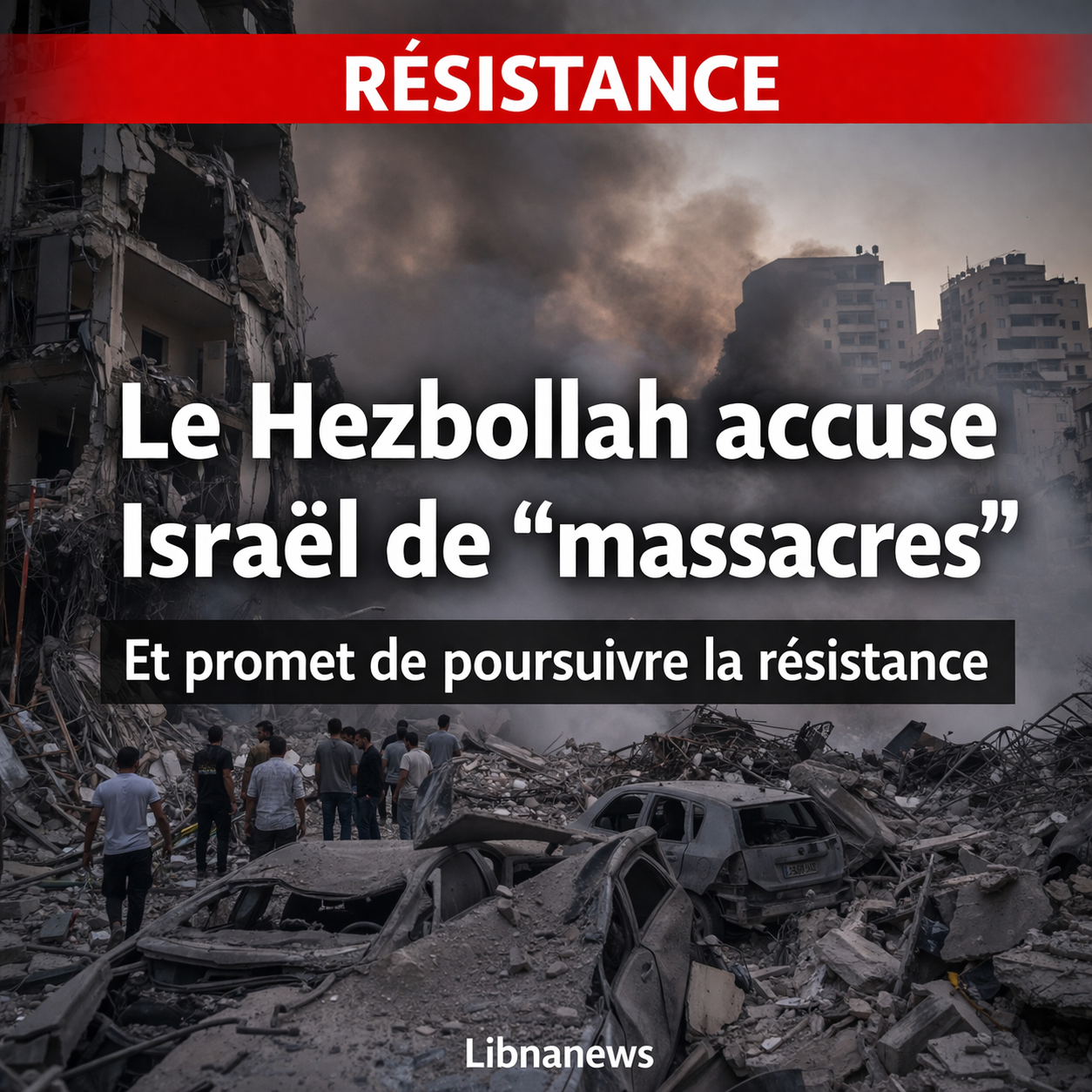
Hezbollah issued a strong statement on Wednesday evening following the wave of Israeli strikes that hit Beirut, its suburbs, Saida, South Lebanon and Bekaa. The movement accuses Israel of having committed a series of « mobile massacres » against civilians, claims that the raids hit densely populated civilian areas and claims that this offensive reflects Israel’s failure to achieve its objectives. This position comes at the end of a day marked by the most intense strikes of this phase of war in Lebanon, when Hezbollah had suspended its attacks after the announcement of the ceasefire between Washington and Tehran, a ceasefire which Israel continues to say does not apply to Lebanon.
A communiqué focusing on targeted civilians
In its text, Hezbollah states that the « Zionist enemy » carried out « tens of savage raids » against civilian areas in the southern suburbs, Beirut, Saida, South and Bekaa, causing « hundreds of martyrs and wounded » among children, women and the elderly. The movement describes these bombings as a series of massacres against innocent civilians and presents this day as a new episode of unlimited Israeli violence. This rhetoric is part of a sequence in which the strikes have indeed affected several densely populated urban areas, particularly in Beirut and its periphery.
As a matter of fact, AP reported on Wednesday that at least 89 people had been killed and 700 injured in today’s Israeli strikes, according to the Lebanese Ministry of Health. Reuters described the strikes as the most intense since the beginning of this phase of the conflict between Israel and Hezbollah. Higher assessments by political or partisan actors, including the Hezbollah communiqué, were not yet consolidated in major sources at the time of these publications.
Hezbollah speaks of war crimes and genocide
The movement goes further in its statement by calling the strikes of « proven war crimes » and « genocidal crimes » because of the alleged targeting of crowded civilian sites, markets and businesses during the peak hours. This is a very heavy political and legal accusation. The major international agencies report, for their part, that Israel claims to have targeted more than 100 Hezbollah military sites in Beirut, Bekaa and the South, while recognizing that many strikes have hit populated areas. The Israeli army claims that Hezbollah uses these areas as cover, which the Shiite movement rejects in its communication.
This battle of qualification is central. Israel presents its raids as a coordinated military operation against command centres, fire infrastructure and Hezbollah positions. Hezbollah responded by describing them as deliberate massacres against civilians. Between these two accounts, the evidence confirmed by the agencies shows at least that the strikes have reached highly urbanized areas and caused a very heavy human impact.
An offensive described by Hezbollah as an Israeli failure
The statement does not stop at the loss. It also seeks to give political meaning to the day. Hezbollah claims that this offensive is a « desperate attempt » to avenge the population after the failure of all attempts to break and subdue Lebanese society. He further contends that the strikes reflect Israel’s failure to achieve its objectives on the various fronts, as well as the inability of the Israeli army to change the equations imposed, in his view, by the tenacity of the Iranian and Lebanese peoples. This reading is part of the classical strategy of the movement: turning survival under bombardments into proof of successful resistance.
This speech comes in a context in which Israel claims to continue its war in Lebanon without being bound by the truce with Iran. AP reports that Donald Trump himself declared that Lebanon was not part of the agreement, calling the Lebanese file « separate skirmish ». In this context, Hezbollah seeks to show that the Israeli violence of the day is not the mark of a victory, but that of military and political frustration.
A social base to hold despite losses
Hezbollah also insists on the reaction of its base. He claims that the brutality of aggression only reinforced the determination, consistency and commitment of the population to resistance. This part of the text has an obvious internal function. After a day of mass bombing, the movement must preserve the cohesion of its social and political environment. By saying that the considerable sacrifices have not weakened the camp of resistance, he seeks to prevent any reading of collapse or rupture between the population and the organization.
This element joins other recent Hezbollah statements. Earlier that day, the movement had asked the displaced people from the South, the Bekaa and the southern suburbs of Beirut not to return until an official and definitive announcement of a ceasefire in Lebanon, while saying that they were « close to a historic victory ». The new communiqué is part of the same register: linking the restraint imposed on civilians, the denunciation of Israeli strikes and the reaffirmation of a horizon of resistance.
« The blood of martyrs will not be shed in vain »
The passage most directly oriented towards the future is that where Hezbollah states that « the blood of martyrs and wounded will not be shed in vain » and that the massacres of the day confirm its « natural and legal right » to resist occupation and respond to aggression. The text adds that these crimes will strengthen its determination to continue the confrontation to defend the population, the country and its security. This formulation clearly reaffirms that the movement does not regard the day as a diplomatic parenthesis, but as an episode of war that calls for continuity of resistance.
This position comes as Reuters reported on Wednesday that Hezbollah had suspended its attacks after the announcement of the American-Iranian ceasefire. The movement did not at this stage formalize an immediate resumption of strikes. But his statement closed the door to any reading of political withdrawal. It maintains the principle of response and confrontation, even though the actual military tempo remains suspended from the developments of the ceasefire and the Iranian position.
A text that forms part of the collapse of the truce framework in Lebanon
The Hezbollah communiqué must finally be read in the wider context of an already deeply weakened truce on the Lebanese issue. Reuters and AP show that the two-week agreement between the United States and Iran was immediately challenged by the continued Israeli strikes on Lebanon. Pakistan maintains that Lebanon should be included in the arrangement. Israel says exactly the opposite. Tehran now threatens, according to press reports, to question the truce if the attacks against Lebanon continue. In this space of rupture, Hezbollah presents the day not as an isolated incident, but as evidence that the ceasefire does not protect Lebanon.
By calling massacre strikes, talking about war crimes, insisting on Israeli failure and promising that the blood shed will not remain unanswered, Hezbollah is therefore seeking to impose a political reading of the day. The movement wants to make this sequence the demonstration that the war in Lebanon continues despite the de-escalation announced elsewhere, and that its own legitimacy now lies in the ability to hold, denounce and promise a future response.




