

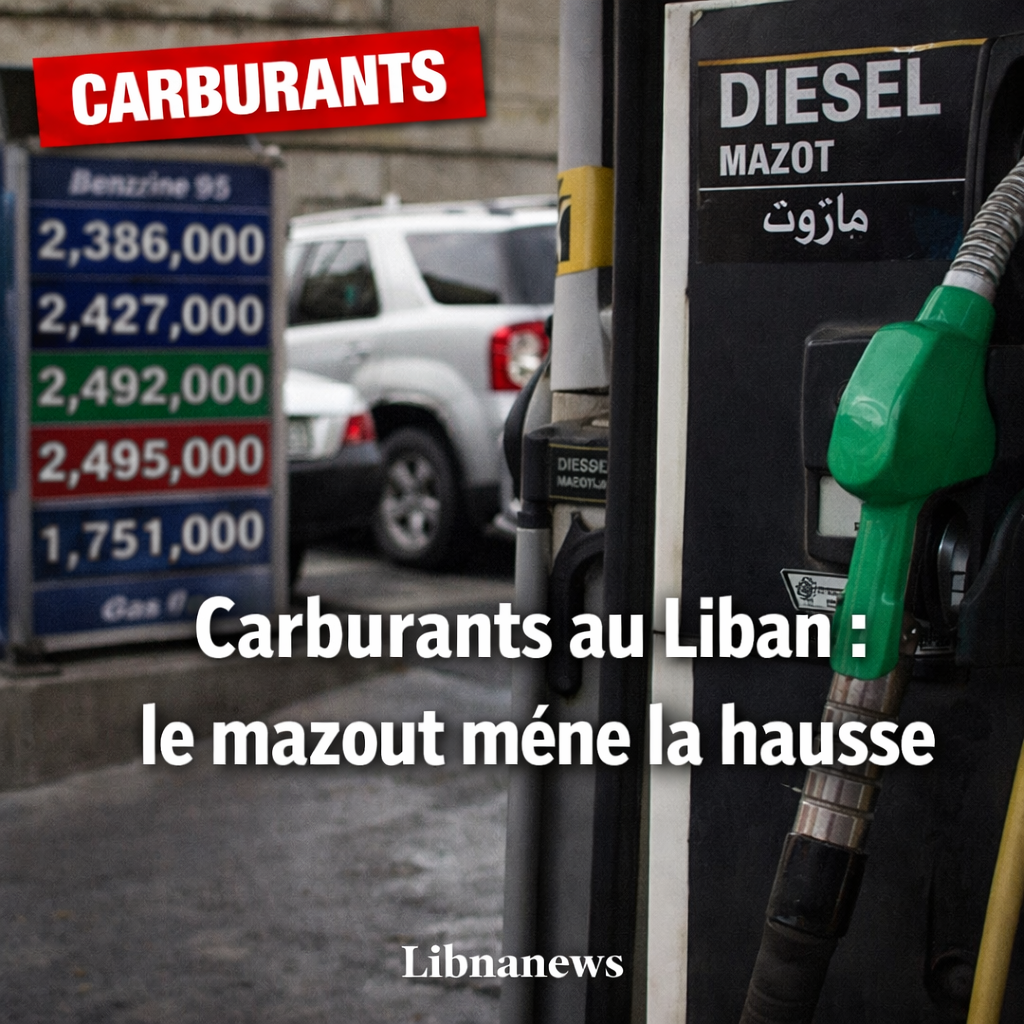
The Lebanese fuel market is rising, but not uniformly. The new grid published on Tuesday morning shows a very legible movement: gas 95 and 98 octane increases by 10,000 Lebanese pounds per can, oil climbs much more strongly, by 53,000 pounds, while gas can drops by 20,000 pounds. The new tariffs are set at £2,386,000 for 95 octane, £2,427,000 for 98 octane, £2,495,000 for oil and £1,751,000 for gas. At first glance, this is a technical update among others. In reality, the very structure of this increase already says something more important: it is not all the oil products that tend at the same rate, but above all the oil, that is, the post that irrigates the professional, logistical and energy uses of everyday life as quickly as possible.
This difference in pace changes the day’s economic reading. A parallel increase in all fuels would have been a mere general increase. Here, the signal is more targeted. The increase in gasoline remains moderate, almost contained at the scale of the grid, while the increase in fuel oil immediately emerges as the dominant element. Conversely, the drop in gas introduces a counterpoint that prevents us from talking about a uniform movement throughout the energy chain. For households as well as for small professionals, this means that the new pricing will not produce the same effect according to usage: the private car will receive a limited increase, diesel-dependent activities will be more exposed, and households that regularly buy gas cans will see a slight relaxation on this specific post.
Two-speed fuels
The first useful reading is to place new prices in their immediate variation. 95 octane increased from 2,376,000 to 2,386,000 pounds, an increase of about 0.42%. The 98 octane rises from 2,417,000 to 2,427,000 pounds, or nearly 0.41%. Fuel oil climbs from 2,442,000 to 2,495,000 pounds, a jump of about 2.17%, much higher than the movement observed on gasoline. Gas fell from 1,771,000 to 1,751,000 pounds, a decrease of about 1.13%. These differences are decisive because they show that the new grid is not just an increase in fuel. This is an increase almost entirely driven by fuel oil, with gasoline growing at small steps and gas moving in the opposite direction.
The grid published this morning can be summarized as follows:
| Product | New price | Day change | Previous price | Developments |
|---|---|---|---|---|
| Gasoline 95 octane | LL 2 386 000 | +10 000 LL | LL 2,376,000 | +0.42 % |
| Gasoline 98 octane | LL 2,427,000 | +10 000 LL | LL 2,417,000 | +0.41 % |
| Oil | LL 2,495,000 | +53 000 LL | 2 442 000 LL | +2.17 % |
| Gas | LL 1 751 000 | -20 000 LL | 1 771 000 LL | -1.13% |
This hierarchy appears even more clearly when comparing products between them. Prior to the revision, fuel oil cost 66,000 pounds more than 95 octane and 25,000 pounds more than 98 octane. The gap now stands at £109,000 with the 95 and £68,000 with the 98. In a single revision, diesel is therefore significantly removed from the two gasoline qualities. This shift is not insignificant. It means that the greatest pressure is not on car fuel in the narrow sense, but on a more transversal product, used far beyond the traffic of private cars alone. At the other end of the grid, the drop in gas maintains a significant distance from other products and acts as a partial shock absorber for part of domestic consumption.




