

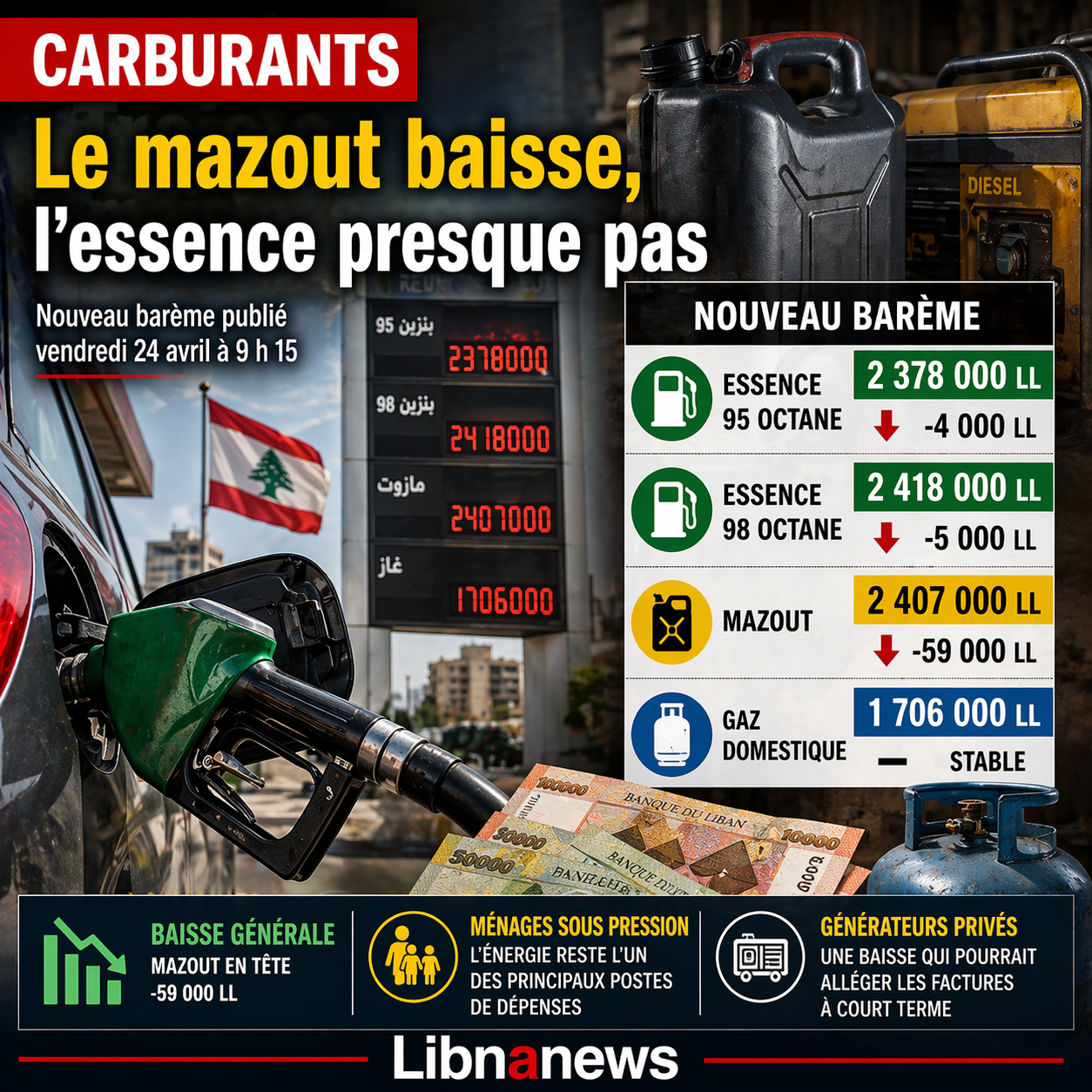
The new fuel price grid in Lebanon, published on Friday, 24 April, at 9.15 a.m., shows a decrease in the two categories of petrol and fuel oil, while the price of gas can remains unchanged. The most marked movement is fuel oil, whose plate drops by 59,000 Lebanese pounds, against a decrease of 4,000 pounds for 95 octane gasoline and 5,000 pounds for 98 octane gasoline.
After adjustment, the 95 octane petrol plate stands at 2,378,000 Lebanese pounds. Gasoline 98 octane reaches £2,418,000. The fuel oil is set at 2,407,000 pounds. The domestic gas can still stands at 1,706,000 pounds. These prices shall be the rate applicable to service stations and distributors after the last update of the competent authorities.
The variation of the day confirms a sharper relaxation on the fuel oil than on gasoline. It alone does not alter the high level of energy expenditure incurred by households, motorists, businesses and businesses. Prices remain in millions of Lebanese pounds, in a country where energy remains one of the most sensitive items in the daily budget.
The new scale published Friday morning
The scale announced on Friday morning distinguishes four products: petrol 95 octane, petrol 98 octane, oil and gas. The first three are down. The fourth one remains stable. The decline in gasoline remains limited in absolute terms, especially when compared to the final price paid at the pump. The decline in fuel oil, on the other hand, is more visible for households and businesses that consume large volumes of fuel oil.
For petrol 95 octane, the decrease of £4,000 reduces the price from £2,382,000 to £2,378,000. For 98 octane gasoline, the drop of 5 000 pounds reduces the price from 2,423,000 to 2,418,000 pounds. Fuel oil increased from 2,466,000 to 2,407,000 pounds, a decrease of 59,000 pounds. Gas remains at the same level, at 1,706,000 pounds.
Percentage reading highlights the difference between products. The decline in petrol 95 represents about 0.17% of the previous price. Gasoline 98 is about 0.21%. Oil is declining by around 2.39%. The gas does not change. The correction of the day is therefore mainly concentrated on fuel oil, while the fuel used by private cars does not change very much.
| Product | New price | Change | Estimated previous price | Estimated change |
|---|---|---|---|---|
| Gasoline 95 octane | LL 2 378 000 | -4 000 LL | 2 382 000 LL | -0,17 % |
| Gasoline 98 octane | LL 2,418,000 | -5 000 LL | LL 2,423,000 | -0.21% |
| Oil | LL 2,407,000 | -59 000 LL | LL 2,466,000 | -2,39 % |
| Domestic gas | 1 706 000 LL | 0 LL | 1 706 000 LL | 0 % |
These figures show a differentiated decline. The consumer who buys gasoline will see a very limited variation during full capacity. On the other hand, fuel oil users benefit from a more significant fall per unit purchased. However, the actual impact will depend on the volume consumed, distribution costs and practices applied at each point of sale.
Fuel prices: a decline mainly driven by fuel oil
Oil is particularly important in the Lebanese economy. It supplies private generators, industrial equipment, shops, residential buildings, schools, hospitals, bakeries and transportation activities. A decrease of 59,000 pounds per plate is therefore more visible than the limited adjustments observed on gasoline.
This may reduce some of the costs incurred by regular users in the short term. It can also ease purchases by some companies that consume fuel oil on a daily basis. However, the effect remains conditional on the volume purchased and the way in which suppliers pass the new scale on to their invoices.
For households dependent on private generators, the effect will not always be immediate. Generator bills are often calculated using mechanisms specific to each neighbourhood, supplier or municipality. The official price of fuel oil is an important benchmark, but it does not automatically turn into an equivalent drop on the final invoice.
Transport professionals, equipment operators, small industrialists and traders are also following this development carefully. A reduction in fuel oil may reduce some operational costs. It does not necessarily compensate for other expenses, such as maintenance, exchange charges, rents, wages and the cost of imported parts.
Gasoline drops slightly at pump
The decrease in gasoline is more modest. For petrol 95 octane, the drop of 4,000 pounds represents a marginal change from the final price of 2,378,000 pounds. For 98 octane petrol, the drop of 5,000 pounds is also limited. In both cases, the adjustment is too low to profoundly change the cost of a full one.
However, motorists will see a symbolic decline after several weeks of regular variations. The price of petrol remains a very monitored indicator, since it directly affects daily travel, the cost of individual transport, taxis, delivery services and part of the indirect prices borne by consumers.
The gap between the two qualities of petrol remains 40,000 pounds. Gasoline 98 octane remains more expensive than gasoline 95 octane. This difference reflects the usual structure of the scale, where higher quality maintains a higher tariff. For the majority of motorists, the choice depends on the vehicle type, the manufacturer’s technical recommendations and the final price.
The limited decline in gasoline therefore does not change the general trend in transport expenditure. Households still have to balance travel, fuel, vehicle maintenance and other essential expenses. In a context of pressure revenue, even a small change in pump price remains closely monitored.
Domestic gas remains unchanged
The price of the gas can remains at £1,706,000. This stability distinguishes gas from other products on the scale. It means that households using domestic gas for cooking or certain heating uses will not see an immediate change in the official price.
Gas stability is important for households. Bonbonne remains a basic product, used in kitchens, food shops, small restaurants and several craft activities. Maintaining the price avoids an additional increase on an essential item, but it does not represent a drop in the burden on consumers.
Gas has experienced less dramatic movements in recent months than other products according to available updates. Nevertheless, its price remains high in Lebanese pounds. For many families, it must be planned with other household expenses, including electricity, water, telecommunications, food and school fees.
The stability of the day may also reflect a differentiated adjustment of the components of the scale. Petroleum products do not always react identically to the calculation parameters. Gasoline, fuel oil and gas meet separate supply chains, costs and references. This is why their prices can evolve in different directions in the same publication.
A household scale
Fuel prices in Lebanon remain a daily issue for households. Cars are still essential in many regions, due to the weakness of public transport and the dispersion of workplaces, studies, care and services. The slightest displacement therefore results in direct expenditure on petrol.
Oil also weighs on domestic spending. Despite the ad hoc improvements in the electricity grid, private generators remain present in many neighbourhoods. When a family pays a subscription to a generator, the price of fuel oil affects the costs reported by operators and the amounts claimed by subscribers.
The drop published on Friday can bring limited relief. It does not alter the structure of the energy problem. Households continue to pay for several sources of energy: transport fuel, private generator, electrical subscription, domestic gas and sometimes batteries or solar panels. This accumulation explains the social sensitivity of each new scale.
The absolute level of prices remains the main point. Even when the variation is negative, buying a petrol plate, a fuel oil plate or a gas cylinder is a high expense. For revenues paid in pounds, energy continues to capture a significant part of the available budget.




