

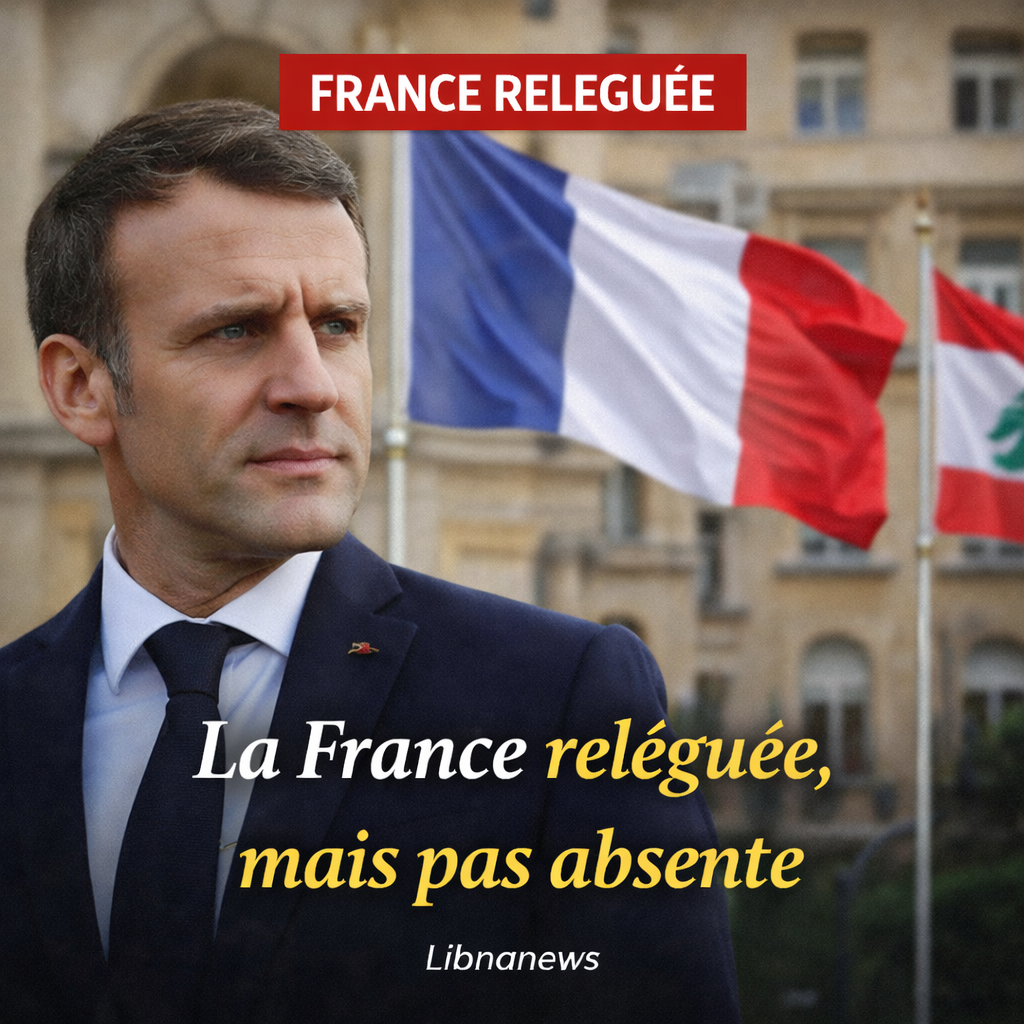
A disconnect that has signal value
The fact passed almost as a procedural detail, while he said a lot of the real state of diplomacy around Lebanon: when the direct channel between Lebanese and Israeli representatives was reopened in Washington under American sponsorship, Paris was not at the centre of the sequence. However, France was not a peripheral actor in the case. It was part of the follow-up architecture created after the last ceasefire arrangement, it has an old military and diplomatic presence in the South, it is a permanent member of the Security Council, it has a privileged relationship with the Lebanese army and it has long been considered one of the few Western capitals able to speak in Lebanon other than in strictly security language. The fact that it did not hold the hand of the new phase therefore immediately raised a question: has France been downgraded or simply moved to another position?
The right answer is probably in between. Yes, Paris clearly lost the centrality that it hoped to keep on the Lebanese file. But no, she didn’t disappear. It is no longer the place where the immediate sequence is decided. However, it remains a power of context, guarantee, European relay and possible reconstruction. This slide is crucial. It means that we no longer talk about the same kind of role. France is no longer the main engine of negotiation. It remains one of the actors capable of preventing it from closing into a purely American-Israeli formula, too narrow to be absorbed by Lebanon.
The malaise comes precisely from there. For years, Paris wanted to hold three functions together: political protector of the Lebanese cadre, privileged partner of the institutions and Western power able to maintain a certain autonomy of tone vis-à-vis Israel. This triple position gave him a special value. In the current sequence, each of these functions remains useful, but none alone is sufficient to produce the decision. But in wartime, what counts first is the ability to impose a stop to fire, to weigh on the adversary and to shorten the diplomatic chain of command. That’s where Washington imposed itself, and that’s where Paris retreated.
Why Israel prefers to bypass Paris
The suspicion of an Israeli will to reduce the French role is not only based on a Lebanese impression. There is a political logic behind this distance. France is not perceived in Tel Aviv as a totally hostile actor, but it is no longer seen as an easy partner. For months, Paris has taken positions considered less docile than those of other Western capitals on the conduct of war, on the protection of civilians, on the maintenance of a multilateral framework in the South and on the need to preserve a political outcome rather than simply military management of the problem.
This nuance is already enough to create an Israeli irritation. In a sequence where the Hebrew state wants to keep as much room as possible on the ground, any capital that insists too much on the limits to military action, on the role of the United Nations or on the need for a broader framework than a simple security arrangement becomes a less convenient partner. France does not refuse the principle of a safe redevelopment in the South. But it does not think so only in terms of crushing, border control or bilateral heads-to-heads under American guardianship. It maintains a preference for approaches combining the Lebanese Armed Forces, monitoring mechanism, international guarantees and the maintenance of a European or United Nations presence in the sensitive area.
This approach hits a part of the current Israeli vision. For on the Israeli side, the immediate objective is not only to restore calm. It is also to ensure that no diplomatic formula comes too quickly to limit freedom of military action or to maintain international safeguards deemed binding. In this context, France appears to be a power that complicates more than it simplifies. It introduces law, multilateralism, political time, where Israel seeks first of all security efficiency and a rapid translation of its balance of power.
A more concrete element must be added. After the massive bombings targeted dozens of sites in Lebanon in a very short period of time, Emmanuel Macron contacted Donald Trump to alert him about the seriousness of the situation and the risks of burning. This approach, on the French side, was an attempt to reintroduce restraint and recall the importance of the international framework. On the Israeli side, it could be read as an additional clue to a France too inclined to slow down at the very moment when Tel Aviv wanted to keep the initiative. In this type of crisis, disagreements of tone quickly produce disagreements of place.
Washington won because he holds the lever, not because he has the best project
French exclusion is not only the product of an Israeli will. It is also due to a much harsher truth: in the current sequence, only Washington has the concrete leverage over Israel. It is this reality that has moved the diplomatic centre of gravity. One may prefer the prudence of Paris, its more balanced formulations, its sensitivity to the Lebanese framework, its concern for the role of the army or the maintenance of a multilateral dressing. But when we get a real stop to operations, none of these assets are worth the weight of the American relationship with Tel Aviv.
France pays here a structural weakness. It remains influential in discussions, formulations, conferences and international frameworks. It is much less decisive when it comes to changing a military sequence within hours or days. It cannot threaten, guarantee, compensate or reward Israel across the United States. It has neither the same strategic depth nor the same organic relationship nor the same power of injunction. In an active war, it is enough to make all the difference.
The paradox is that a part of the Lebanese continues to expect a role from Paris that it can no longer assume on its own. Many would like France to speak on behalf of historical Lebanon, protect institutions, carry Beirut’s voice in the major capitals and correct the brutality of American logic. But the real hierarchy of actors has changed. When you have to get a meeting, open a channel, push Israel, hold hands with the process and set the tempo, Washington decides. Paris can accompany, advise, alert, prepare after. He can no longer claim the first seat as long as the heart of the crisis remains military.
This does not mean that France no longer serves. This means that its usefulness is no longer that of an actor of coercion. It’s a stabilization actor. In the present phase, however, stabilization is not yet the dominant language. The dominant language remains that of lever, balance of power and urgency. This is precisely what relegates Paris without cancelling it.
What France keeps, despite everything
Reducing France to a decommissioned power would be a mistake. Because even weakened in the immediate phase, it keeps several cards that neither Washington nor Riyadh completely replace. The first is institutional. Paris is a member of the Security Council. This does not give the power to dictate the ground, but it gives the power to place the Lebanese case in a context where international law, the United Nations presence and the legitimacy of monitoring mechanisms remain living variables.
The second map is military and territorial. France is not just a distant observer. It has a direct history with the United Nations Interim Force in Lebanon and with the question of the European presence in the South. However, this issue could become central as a more stable formula approaches. If the current sequence leads to a truce, it will be necessary to discuss who verifies, who monitors, who guarantees, who observes the violations and who accompanies the Lebanese army. In this discussion, Paris becomes immediately relevant again.
The third map is political. France maintains channels with almost all components of the country. She can speak to the President, the Prime Minister, the army, Christian parties, many Sunni actors, certain figures in the Shiite camp, economic networks, civil society and cultural actors. This relationship depth is not enough to produce a breakthrough in wartime. But it becomes valuable when it comes to preventing a military arrangement from turning into an internal political crisis.
Finally, the fourth map is the next one. If the front calms, Lebanon will immediately enter another ordeal: reconstruction, financing, support to the institutions, revival of vital services, aid to the army, reinvigoration of European partners, maintenance of international attention. In this phase, France still has the know-how and legitimacy that the United States does not have in the same way. Washington knows how to impose a sequence. Paris often knows how to dress, expand and make it presentable in more acceptable international settings for Beirut.
The risk of a Lebanese case treated without Paris
The real danger of French marginalization is therefore not sentimental. This is not a case of wounded prestige or Franco-Lebanese nostalgia. The risk is more concrete. If the Lebanese file is processed only by the Washington-Tel-Aviv matrix, with some regional relays, it can become an exclusively secure file. However, Lebanon is never long in a purely security logic. This country does not absorb too narrow solutions. It needs, more than others, a political, institutional, international and even symbolic package.
A formula obtained without Paris can certainly produce a truce. It may also launch negotiations. But it may be lacking in depth on several essential points: the place of the army, the inner acceptability of the arrangements, the role of Europeans, the future of the United Nations Force, the framing of violations, the link between security and reconstruction, the possibility of not immediately turning de-escalation into an internal confrontation on arms and on Hezbollah. France alone does not guarantee the resolution of these issues. On the other hand, its weakening makes them more difficult to deal with in a balanced framework.
This is where the analysis of those who consider it excessive to speak of total French deletion deserves to be taken seriously. France is no longer the operational centre of the moment, it is true. But the current sequence could very quickly show its limits if it pretends to be sustainable. Lebanon is not just a front to calm down. It’s a system to stabilize. And France remains one of the few Western powers able to understand this dual level.
Paris may not decide the truce, but it can still weigh on its form
Basically, the Lebanese case has simply changed its hierarchy. France is no longer the power that opens the door. It can still be the one that prevents us from closing it too quickly or too brutally. Its role moves from the centre of the immediate decision to the final form of the framework. It’s less visible, but not necessarily less important.
If the truce is confirmed, if a new mechanism emerges, if the question of the South comes back to the table with that of the Lebanese army, of the points at issue, of international surveillance and of a possible enlargement of the European role, Paris will almost naturally return to play. Not as the sole contractor, but as a structural power. This is where France must be located today: neither outside nor in front. Relegated, yes. Absent, no.
This displacement also says something broader about the state of the relationship between Lebanon and its external partners. The times when Paris could hope to hold both historical proximity, diplomatic initiative and political leadership have passed. But the time when Lebanon could be sustainably managed without Europe, without France and without a minimum multilateral framework is not there either. Between these two realities, a place remains. It is less glorious than the one Paris sometimes imagines for himself. Nevertheless, it remains real. And in a crisis as fragile as this one, the mere fact of remaining an actor that one cannot completely bypass is already a form of power.




