

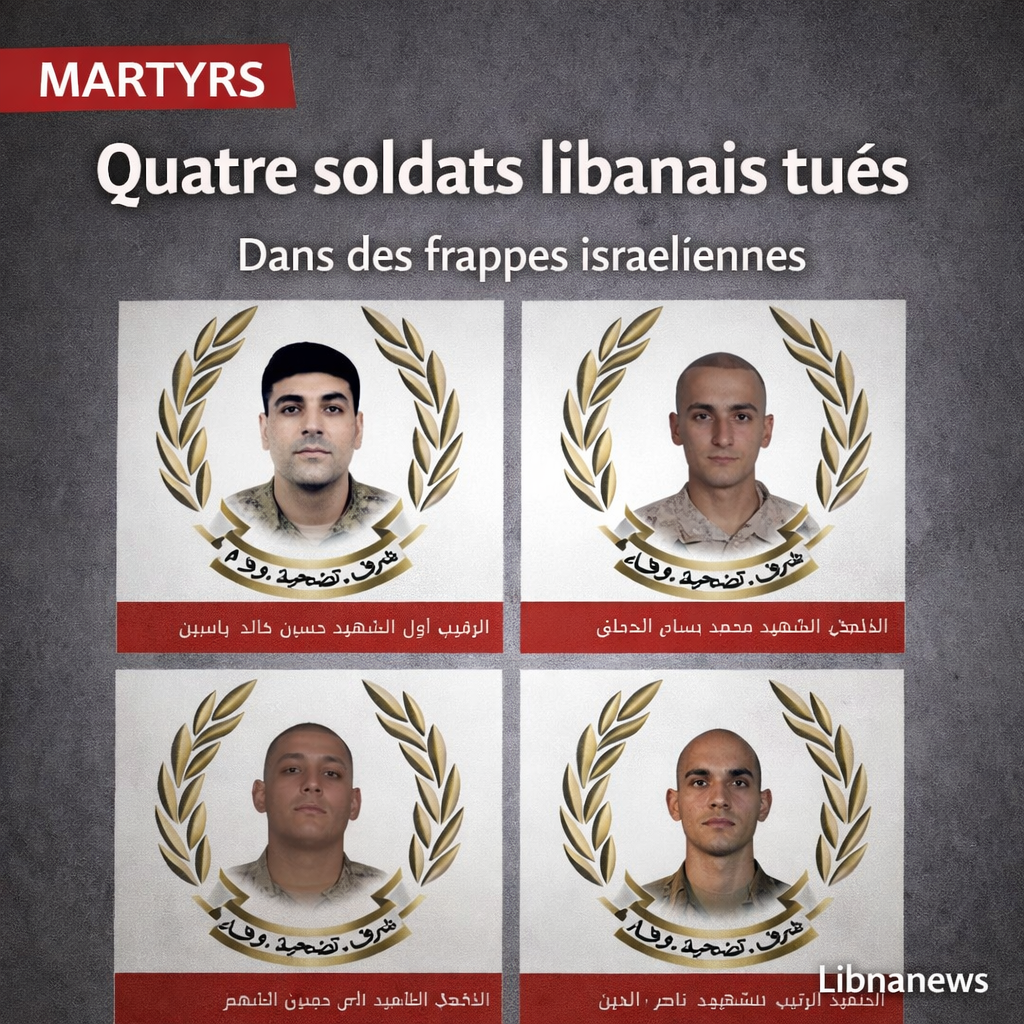
On Thursday, the Lebanese army announced the death of four of its military personnel, killed the day before in Israeli strikes in Saida, Bekaa and Hermel. Beyond the human balance, this announcement marks a new political threshold in the ongoing escalation: Israeli bombings no longer reach only civilian areas and infrastructure, they also directly strike the military institution of a state already weakened by the war.
The announcement came from the Army Orientation Directorate. In an official communiqué, the command mourned four soldiers who fell on 8 April 2026 « as a result of an Israeli aggression ». The soldiers killed were Sergeant-Chief Hussein Khaled Yassin, who was beaten in Saida, First Class soldier Mohammad Bassam Chheitli in Chmistar-Baalbeck, recruit Ali Hassan Qassem in Chmistar as well, and student-grade Ali Nassereddine in Mansoura-Hermel. The text leaves little room for doubt about the institutional seriousness of the event: it is the national army itself that announces the loss of four of its men in one day.
This fact changes the reading of April 8th. So far, the focus has been on the scale of Israeli strikes, the heavy civilian toll and the diplomatic battle around the Washington-Theran ceasefire. With the death of these four soldiers, another reality is required: the Lebanese army, already caught in an environment of war that exceeds it, also becomes a direct victim of the bombings. In a country where the military institution remains one of the last relatively transversal national cadres, touching uniformed soldiers does not only refer to human loss. This affects the very idea of state, sovereignty and public authority. This latter assessment is a political analysis based on the place of the army in the Lebanese system.
Four soldiers killed by Israeli strikes
The military statement details the identities of the four men. Master Sergeant Hussein Khaled Yassine was born on 17 August 1993 in Kfour, Nabatiyah District. The army said that he had received several decorations and several congratulations from the commander-in-chief. Married and father of a child, he was killed in Saida. His funeral was announced on Thursday 9 April at noon, as an initial farewell to the Haret Saida cemetery, before the subsequent organization of final ceremonies according to the date and place of burial fixed by his family and military institution. (
First-class soldier Mohammad Bassam Chheitli was born on 15 May 1996 in Chmistar-Baalbeck. Like Hussein Khaled Yassine, he had received several congratulations from the army commander. The press release states that he was single. The official announcement states that the details of his funeral were to be clarified at a later date. This expectation, in a moment of strong national tension, also recalls the brutality of the wartime: the army announces death, but the families still have to organize mourning in a country where displacement is made more difficult by strikes and destruction.
Recruit Ali Hassan Qassem was born on 20 April 2006 in Mazraat al-Dallil, Baalbeck region. He too had received several marks of satisfaction from the command. Single, he was one of the youngest victims of this series of strikes against the army. His body was to be transferred Thursday morning from Abdallah Hospital in Riyadh to his village, where mourning was to be observed the same day at noon before burial at the local cemetery. The death of such a young soldier increases the emotional reach of the announcement. It recalls that, behind the drought of military communiqués, it is also barely begun trajectories that break.
The fourth military student, Ali Nassereddine, was born on 29 July 2003 in Al-Kouakh, Hermel. He was single too. The communiqué states that his funeral took place on Thursday morning at 10 a.m. in the cemetery of Cherbine el-Fouqa, Hermel. His status as a graduate student recalls that the army also loses men still in training, that is, part of its future. In a few lines, the command text thus creates a very clear picture: the strikes of 8 April did not only affect an abstract combatant force, but soldiers of different ranks, of different ages and from different regions of Lebanon.




