

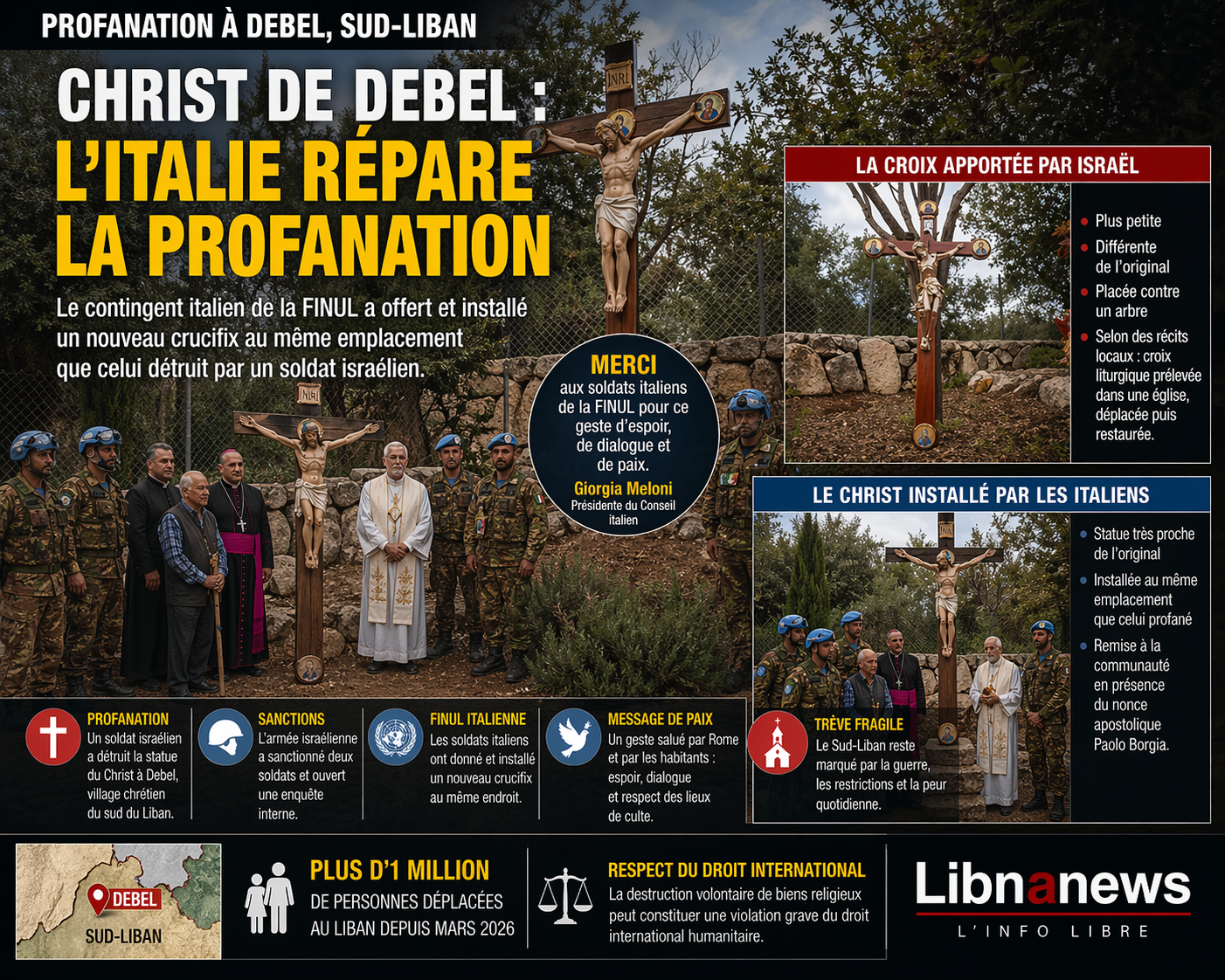
The statue of Christ destroyed by an Israeli soldier in Debel, in southern Lebanon, was replaced by the Italian soldiers of UNIFIL, not by the Israeli army in the sense used by the inhabitants and by the images published after the incident. The Italian contingent offered and installed a new crucifix very close to the original, in the same location as the one that had been desecrated a few days earlier.
The Israeli army had announced that it had replaced the crucifix in coordination with the local community. But the device shown by Israel was smaller, different from the work destroyed and placed in another place, against a tree. According to local accounts and images relayed in Lebanon, this cross would have been a liturgical cross or procession taken from a church, then moved or returned after the Italian intervention.
The episode took on a diplomatic dimension. The President of the Italian Council Giorgia Meloni thanked on Thursday Commander Diodato Abagnara and the entire Italian contingent of UNIFIL for giving a new crucifix to the village. She considered that the images of the statue’s delivery and its installation in the same place as the old one had a message of hope, dialogue and peace.
A statue destroyed in a Christian village in the South
The incident occurred in Debel, a predominantly Christian village in southern Lebanon, close to the border with Israel. An image broadcast on social media showed an Israeli soldier striking a statue of Jesus crucified, fallen from his cross, with a heavy tool. The image was located in Debel by a news agency. It triggered a wave of religious and political condemnations.
The statue was located in a small sanctuary in the garden of a family, at the entrance or on the outskirts of the village, according to local testimonies. Father Fadi Falfel, priest of Debel, described the act as a desecration of a Christian religious symbol. Ecclesiastical leaders of the Holy Land have denounced a serious violation of the Christian faith.
The Israeli army confirmed that the soldier visible on the picture belonged to its ranks. She indicated that an internal investigation had established that a member had damaged the Christian symbol, while a second had photographed or filmed the scene. Six other soldiers were on site without intervening or reporting, according to the Israeli military communication.
The case took place in a context of fragile truce between Israel and Lebanon. Debel is one of the southern localities where residents have been subjected to traffic restrictions, access difficulties and a de facto Israeli military presence. For the local population, therefore, the destruction of Christ is not an isolated incident. It adds to a situation of war, occupation and daily fear.
Israel announces a disputed replacement
After the image was distributed, the Israeli army announced that it had replaced the damaged statue. She published a photograph of a new crucifix, claiming that the operation had been conducted in coordination with the local community of Debel. This communication was to show that the army acknowledged the incident and sought to repair the damage.
However, this version was quickly challenged. The crucifix presented by the Israeli army did not resemble the destroyed statue. It was smaller, more decorated and installed in a different position. Observers also noted that it had not been placed in the original base, but placed or fixed near a tree, unlike the original sanctuary.
Lebanese media and local publications later claimed that the cross brought by the Israeli army was not a new statue intended for the outside world. According to these accounts, it would have been a procession cross or liturgical cross, with iconographic elements taken from a church. This claim was not confirmed by an official Israeli or United Nations statement.
Caution is therefore required on the term flight. Local relays claim that the cross was taken without corresponding to the object destroyed and without constituting a valid restoration. What is established by the available images is that the Israeli replacement did not correspond to the original and that it was moved after the installation of the new crucifix by the Italian contingent.
Italian contingent resettles Christ close to the original
The restoration deemed effective by the local community came from the Italian contingent of UNIFIL. The Italian military gave the village a new crucifix and placed it in the same place as the old statue. The images broadcast after the intervention show a work closer to the original, by its size, form and integration into the place of devotion.
Father Claudio, an Italian priest serving with UNIFIL, explained that he had contacted the UN mission to request the restoration of the religious symbol at the same location. The request was accepted. The new crucifix was then transported, handed over to the community and installed by Italian soldiers in the presence of inhabitants.
The Apostolic Nuncio in Lebanon, Bishop Paolo Borgia, went to Debel to bless the image. His presence gave the event a religious and diplomatic significance. The gesture was not limited to the physical repair of a statue. It was presented as a sign of proximity to a proven community and as an effort to restore respect for places of worship.
The difference between the two sequences is therefore central. Israel announced a replacement and published an image of a different crucifix. The Italians of UNIFIL provided and installed a statue similar to the one destroyed in the same place. It was this second intervention that was hailed by Rome, several media and locals as the real restoration of the sanctuary.
The cross brought by Israel would have been removed
After the installation of the new Christ by the Italian soldiers, the cross brought by the Israeli army was seen displaced by members of the community, according to images relayed by local media and accounts. Lebanese publications claimed that it was taken over and then returned to the church from which it came. This latter clarification remains locally reported and has not been publicly confirmed.
The point remains important as it makes it possible to distinguish an official communication from an accepted restoration. In Christian tradition, a procession cross or liturgical object does not replace an external statue fixed in a sanctuary. The uses, function and symbolism are not the same. The object cannot be treated as a mere material equivalent.
The inhabitants therefore saw in the Italian intervention the reparation conforming to the place and symbol destroyed. The new crucifix was installed at the initial location, in a form similar to that known to the faithful. The cross brought by Israel, on the contrary, was seen as an improvised, insufficient and inadequate response.
This distinction explains why the case was not closed by the Israeli communiqué alone. The heart of the event is not only the presence of a cross after desecration. It covers the nature of the object replaced, its origin, its location and the recognition of the local community in the act of reparation.
Meloni thanks the Italian soldiers
Giorgia Meloni publicly welcomed the gesture of the Italian contingent. In an official statement, she thanked Commander Diodato Abagnara and all the Italian UNIFIL soldiers for their decision to give a new crucifix to the Lebanese village of Debel. She emphasized the symbolic value of community delivery and installation in the same place as the destroyed statue.
The head of the Italian government spoke of a message of hope, dialogue and peace. This is in line with Italy’s tradition of UNIFIL, where its contingent has played an important role for years. Rome often presents its presence in Lebanon as a commitment to stabilization, protection of civilians and support for local communities.
The Italian gesture also takes place in a sensitive moment for the UN mission. UNIFIL remains deployed in southern Lebanon, but its operational environment has become more difficult. Peacekeepers must deal with movement restrictions, residual hostilities, destruction in villages and direct risks against their patrols.
In Debel, the action of the Italian contingent took on a concrete dimension. It did not consist of a general declaration. She restored a destroyed symbol in a specific place. It also enabled Rome to stand out clearly from the Israeli version that the replacement had already been accomplished.
Israeli sanctions and international convictions
The Israeli army announced disciplinary sanctions against the military involved. The soldier who damaged the Christian symbol and the one who documented the act were removed from combat operations and placed in military detention for 30 days. The other six soldiers present during the incident were summoned as part of the disciplinary proceedings.
Israeli Chief of Staff Eyal Zamir described the act as unacceptable behaviour and moral failure. Prime Minister Benjamin Netanyahu said he was shocked and saddened by the incident. Israeli Foreign Minister Gideon Saar apologized to Christians whose feelings had been injured. The American ambassador to Israel called for rapid and public consequences.
Christian reactions were strong. Catholic leaders in the Holy Land have denounced a serious breach of faith. The Vatican followed the matter carefully, in a context where Pope Leo XIV has multiplied calls for the protection of civilians, respect for religious symbols and a culture of peace.
In Lebanon, indignation surpassed the community of Debel. The destruction of a Christian symbol by an Israeli soldier was seen as an act of desecration, but also as an additional sign of the lack of control over soldiers operating in Lebanese villages. The incident occurred while houses, roads, mosques, shrines and churches were damaged in several parts of the South.
Debel in the heart of an incomplete truce
The crucifix affair takes place in a prolonged but incomplete truce. The United States obtained a three-week extension of the cessation of hostilities between Israel and Lebanon. But on the ground, bombardments, demolitions, fire and traffic restrictions have not completely ceased. The inhabitants of Debel and neighbouring villages continue to live in precarious conditions.
According to testimonies gathered in the region, movements to and from Debel remain difficult. Houses on the outskirts of the village remain inaccessible. People may not always move freely between nearby Christian localities or towards the main axes. Relief services and humanitarian organizations often need to coordinate their travel.
This reality gives particular significance to the restoration of the crucifix. The statue is not only a religious object. It is one of the visible landmarks of a village that tries to preserve its continuity despite the war. Its destruction was experienced as an attack on the link between the inhabitants, their territory and their faith.
Italian reparation obviously does not address military matters. It does not replace a withdrawal, restore destroyed houses and guarantee freedom of movement. But it shows that a concrete gesture can count in a village where the truce remains fragile and where the population expects the destruction to end.
A religious, legal and political issue
The destruction of a religious symbol in wartime raises questions that go beyond military discipline. Religious property has special protection under international humanitarian law. Their deliberate destruction, without military necessity, can be considered a serious violation. However, the legal qualification depends on the exact facts, the context, the intention and the existence or not of a military justification.
In the case of Debel, the Israeli army did not present the statue as a military target. It recognized behaviour contrary to the values expected of its soldiers and sanctioned two military personnel. Such disciplinary recognition does not necessarily mean recognition of an international criminal qualification, but it confirms that the act was not justified by a demonstrated operational necessity.
The incident occurs in a climate of high confessional sensitivity. Southern Lebanon includes Shia, Sunni, Christian and Druze villages. Military operations, differentiated evacuations and the Israeli presence can fuel local tensions. Lebanese elected officials have already expressed their concern that certain actions may exacerbate the community divide.
The replacement by the Italian contingent therefore had a calming function. He restored a Christian symbol and recalled the role of UNIFIL as an international stabilization presence. It also highlighted the difference between compensation imposed by the perpetrator of damage and reparation accepted by the community concerned.
What remains to be established
Several points are established. A statue of Jesus crucified was damaged in Debel by an Israeli soldier. The Israeli army acknowledged the incident, sanctioned two soldiers and announced a replacement. The crucifix presented by Israel was different from the original. The Italian contingent of UNIFIL then gave and installed a new Christ at the same location as the destroyed statue.
Other elements remain reported by local sources. The cross brought by Israel would have been a procession cross or liturgical cross taken in a church. It was then recovered and returned to its place of origin. These points are circulated in Lebanese stories and images published online, but have not been confirmed by official communication from UNIFIL or the Israeli army.
The article must therefore distinguish between levels of certainty. The actual replacement by the Italians is confirmed by Giorgia Meloni’s statement, by Italian media and by field images. The Israeli replacement was claimed by the Israeli army, but it was challenged because of the object used, its size, its style and its location.
The file remains symbolically open. For Debel, the statue has recovered its location thanks to the Italian contingent. For Israel, the case is dealt with by disciplinary sanction and a statement of regret. For the people of the South, the incident remains linked to a broader issue: the protection of villages, civilians and religious places in a truce that has not yet brought about full security.




