

At a time when an Iranian-American ceasefire seemed to be opening up, even in a fragile manner, Israel was exposed to a new political risk. As long as the entire region was slipping into flames, Tel-Aviv could put its own war in a readable strategic continuity: Iran was threatening, Hezbollah was prolonging this threat, and the general escalation provided a supporting framework. But as soon as a cooling logic developed between Washington and Tehran, this frame began to crack. The continuation of the war in Lebanon ceased to appear as the mere extension of an imposed confrontation. It could begin to be seen as an Israeli political choice at the same time as elsewhere was seeking a de-escalation movement. It is this shift in perception that constitutes, in this reading, the first Israeli discomfort.
This discomfort is not only the result of the ceasefire itself. It is in a much older situation of diplomatic isolation, settled from Gaza and further aggravated by the spread of the war in Lebanon. International convictions, calls for detention, requests for investigations into strikes against civilians, journalists, rescue workers or protected infrastructure do not therefore begin after 8 April. They preexisted. The Lebanese sequence only prolongs and deepens an already begun deterioration of Israel’s international image. Even in the United States, the climate has changed: a poll published on 7 April shows that 60% of Americans now have an unfavourable opinion of Israel, while the distrust of Benyamin Netanyahu is still growing, especially among young people. The war took place in the same political environment only at the beginning of the cycle of escalation. It now weighs on Israel as a diplomatic cost, an image cost and, increasingly, as an acceptable cost in its own Western camp.
This is where the shade becomes decisive. An Iran-American ceasefire, even a limited one, does not remove Israeli security arguments. It does not remove the threat of Hezbollah or the centrality of Iran in the security doctrine of the Hebrew state. But he withdraws part of his narrative margin from Israel. It introduces a formidable question into the international debate: why continue climbing at the precise moment when a cooling window seems to open? In contemporary diplomacy, this question changes a lot. For an actor who continues to strike while others seek, even imperfectly, to freeze the conflict takes the risk of being seen not as the one who responds, but as the one who prevents the attack. In an environment where its political capital has already deteriorated sharply since Gaza, this risk is becoming much heavier.
A de-escalation that put Israel in a bad position
The problem for Israel was therefore not only military. It was temporal. The momentum created around a ceasefire between Washington and Tehran created a new regional rhythm, a rhythm that was no longer that of pure escalation, but that of suspension, breathing, and an attempt at diplomatic recovery. But Israel was already out of step with this tempo. Benyamin Netanyahu clearly stated that there would be no ceasefire in Lebanon, while opening up the prospect of direct discussions with Beirut in the same movement. This combination is politically revealing: it means that Tel-Aviv wanted to retain its freedom to strike without accepting the political logic of the truce. Israel wanted to talk under fire, and above all to continue to structure the balance of power even before any negotiations were stable.
But this setback is not only due to the desire to preserve a strike capacity. It is also part of a much longer field strategy. Several elements are converging towards the idea of an Israeli project for the long-term occupation of a security zone in South Lebanon, up to the Litani, with the systematic destruction of border villages, the forced evacuation of large areas and the maintenance of a military depth beyond the border. Israeli officials explicitly spoke of a « buffer zone » on the Gaza model, while others, more radical, pushed to claim annexation from southern Lebanon. This logic requires time. It involves emptying, destroying, prohibiting return, and reconfiguring the military presence line. In this context, a rapid de-escalation with Iran became embarrassing: it threatened to freeze an operation which, on the ground, had not yet reached its desired political form.
Massive population displacement must be read from this perspective. More than 1.1 million Lebanese have been displaced according to several recent counts, and some estimates are over 1.2 million. This figure is not only humanitarian. He’s strategic. It indicates that a decisive part of the South is being emptied, or at least put under pressure to prevent a normal life. When a territory is bombed, evacuated, its houses destroyed and its roads cut off, it is no longer just a one-off strike logic. One enters into a logic of remodeling space. And a remodeling of space does not easily accommodate an early ceasefire.
Another factor must be added. Gaza is now relatively calmed down compared to the previous months, while Hezbollah has become Israel’s main open land front. This is where the strategic depth of the war is played, where Israel’s ability to impose a new security doctrine based on the creation of buffer zones and the forced removal of threats is measured. In this context, Lebanon is not a secondary front. It is the stage where Israel is assessing the possibility of turning a war of wear and tear into a lasting change in the terrain. This made regional de-escalation even more problematic for Tel Aviv.
Hezbollah less politically isolated in the Lebanese game
The second dimension of the analysis concerns Lebanon itself. A ceasefire between the United States and Iran would not automatically strengthen Hezbollah on the military ground. It would not have restored its losses, repaired its infrastructure or dispelled Israeli pressure. On the other hand, it could offer an indirect but real political benefit. Since the beginning of the war, Hezbollah has been under strong pressure to lock it in the image of an actor who exposes Lebanon to a confrontation decided elsewhere. A part of its Lebanese opponents attempted to oppose a « reasonable State » to a « axis of war ». But if Washington and Tehran entered into a logic of de-escalation themselves, this opposition would lose some of its sharpness. Hezbollah ceased to appear as the only actor against the regional moment.
This displacement became all the more important since, in the reality of the moment, Hezbollah is for Israel the open land front. Gaza no longer offers the same level of operational intensity. The front that remains active, the one that justifies the continuation of a deep war, the one that allows Israel to defend its logic of a safe and non-ceasefire zone, is Lebanon. If this front is also that of Hezbollah, then any regional diplomatic evolution that reduces the possibility of political isolation of the movement mechanically weakens the Israeli strategy. The more Hezbollah seems integrated into the general contradiction of the moment, the less easy it is to treat it as a pure Lebanese anomaly.
The Lebanese government was then caught up in a more serious contradiction than it seems. Either he aligned himself with the logic of appeasement and demanded that Lebanon be included in the ceasefire. Either he continued to demand alone, without any real lever, a halt to the Israeli strikes. In both cases, something was moving. Hezbollah was no longer alone in saying that the fronts could not be artificially cut. Official Lebanon, in fact, was led to ask the same question: how can a regional agreement freeze the confrontation between Washington and Tehran while leaving Lebanese territory exposed to total war? It was this partial convergence, even involuntary, that could loosen political power around Hezbollah.
A more difficult point must be added here. In this reading, Israel never really wanted a ceasefire with Lebanon. What Tel Aviv wanted was not a stabilized truce, but a Lebanese political capitulation under military pressure. The difference is great. A truce implies a reciprocal freeze, a clear framework, guarantees and a hierarchy of steps. What is put on the table today is « negotiations » with no tangible content: no prior ceasefire, no suspension of strikes, no credible sequencing, no announced withdrawal, no guarantee mechanism already visible. Many analysts thus describe the same contradiction: Israel speaks of discussions while maintaining operations, and even claiming that they will continue. This is less like a settlement architecture than a coercive diplomacy.
This lack of substance is also due to a strategic contradiction which everyone sees but which few Western actors can make frankly. Israel is well aware that the Lebanese army alone does not have the material, political and operational means to disarm Hezbollah by force within short periods of time. The Israeli injunctions to « disarm Hezbollah » are therefore less realistic than an impossible, useful requirement to maintain pressure. This impossibility was not an abstract. For years, in Israeli security circles, part of the establishment has explained that a strengthening of the Lebanese army may directly or indirectly benefit Hezbollah. In other words, Israel requires a weakened Lebanese State to perform a task that it itself contributes to making materially out of reach.
The paradox is even stronger if one looks at the Lebanese interior scene. Decisions have already been taken in Beirut to reaffirm that autonomous military activities are illegal and that the choices for war and peace are the responsibility of the State. But the existence of a decision is not the same as the ability to implement it. The Lebanese government can lay down a principle. However, in the real balance of power, it does not have the means to turn it immediately into effective disarmament. In these circumstances, speaking of « peace talks » is mainly about dressing up a strategic impasse.
It was precisely this interference that could disturb Israel. For a Lebanese scene where Hezbollah appears less politically isolated is a scene where pressure on it becomes more difficult to convert into a strategic shift. Israel needs, in order to fully weigh, an opponent who is both militarily weakened and politically locked up. If the second part collapses, the overall pressure efficiency drops. And if, at the same time, official Lebanon also calls for the inclusion of its territory in the logic of truce, the Israeli margin becomes more narrow.
Create a shock to break the sequence
It is here that the central hypothesis arises: Israel might have an interest in recreating a brutal shock to break a political sequence that became unfavourable to Israel. In this reading, a scale strike is not only used to destroy targets, or even to display military superiority. It is used to reset the political moment. She put war back at the centre as diplomacy threatened to settle there. It obliges all actors to leave the cooling ground to return to the security emergency, the fear of burning, the vocabulary of retaliation and red lines. Military fact becomes the only audible language.
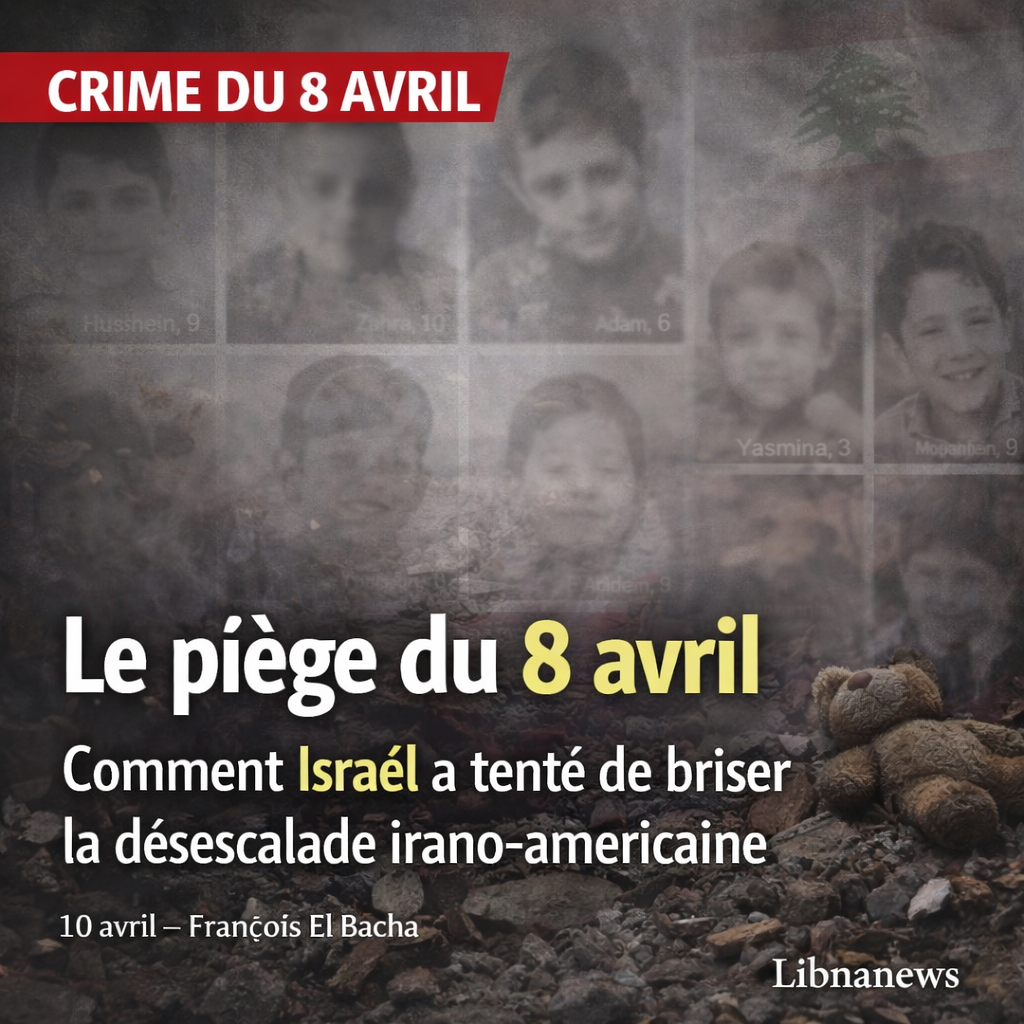
But here we have to be very concrete. April 8 was not just an intensification. There were more than 100 strikes in 10 minutes in Beirut and other areas, and then 254 deaths according to a provisional assessment issued after the first relief operations, before other counts exceeded 300 deaths and more than 1,100 injuries. The strikes affected densely populated neighbourhoods, commercial and residential areas, vital roads, a major bridge, ambulances and areas where local residents and officials denied the existence of identifiable military targets. United Nations agencies, human rights institutions and international authorities have spoken of horrific destruction, « horrific » civilian reviews, and have called for independent investigations into possible serious violations of international humanitarian law. In other words, the magnitude of the April 8 sequence makes it difficult to talk about a simple demonstration of force. There is a mass operation in an already exhausted territory, with a level of civilian casualties and the targeting of inhabited areas that seriously weighs the characterization of war crimes.
In this scheme, the goal was not only to hit hard. It was also a matter of bringing Hezbollah and, above all, Iran to respond strongly enough to break the Iranian-American process in appearance. This is where the idea of a political trap becomes truly specific. It is not just about saying that Israel has climbed. It is a question of saying that climbing could be conceived as a mechanism intended to provoke an adverse response, precisely to transfer to this response the visible responsibility for the rupture. An important response, an explicit challenge to the truce or a reopening of a direct front between Tehran and Washington would have been enough to move the entire center of the story. The Israeli bombardment was said to have wiped out a calming phase. It is said that Iran or Hezbollah « relaunched » the crisis, « broken » the spirit of the ceasefire or « derailed » the process desired by Washington. The first blow would have been relegated behind its strategic consequence.
Bringing the political cost of the break to Hezbollah and Iran
This is where the keystone of reasoning lies. In contemporary regional crises, the decisive battle is not just about the destruction inflicted. It deals with the political attribution of the rupture. Who is held responsible for the moment when the de-escalation sequence collapses? He who strikes first is not always the one who pays the heaviest diplomatic price. Often, the one who loses is the one on whom the final account of the rupture is fixed.
In this case, what Israel was potentially looking for was less a symbolic response than a politically costly response for Tehran and Hezbollah. If Iran responded too loudly, it gave Washington a reason to harden the discussions or even suspend them. In both cases, the response of the pro-Iranian axis became the visible event, the one that absorbed media and diplomatically the sequence. 8 April was to be read not only as a day of massive bombing, but as an attempt to force the other side to produce, itself, the act that would break the Iranian-American dynamic.
You have to be very specific here. The goal was not only to « transfer responsibility » in an abstract way. The aim was to get Iran to commit the concrete act that would have broken the Iranian-American process from outside. This meant forcing Tehran to harden its position before Islamabad, or pushing a reaction such that Washington could no longer maintain the fiction of an autonomous and stable negotiation. In this reading, the Israeli escalation was therefore aimed at producing a practical incompatibility between the continuation of the discussions and the resumption of the war. The rupture would not simply have been attributed to the other side. It would have been built to be politically attributable to him.
This mechanism is all the more effective as it is part of a diplomatic system dominated by urgency. Within hours of a strong response, markets are moving, embassies are alarming, televisions are changing their framing, and chanceries are reshaping their priorities. What occupied the centre fifteen hours earlier disappeared. The chain of causes crashes behind the strength of the last spectacular event. That’s why the bet of the trap doesn’t need to completely erase the first act. It is enough to produce a second act that is louder, more anxious, more immediately exploitable.
But an important element must be added: Tehran has not fallen into this trap. Despite the violence of the Israeli strikes in Lebanon and despite Iran’s accusations of the breach of the truce, Iran did not opt for an immediate frontal reply that would have offered Israel and its supporters the story sought. This restraint is not a sign of automatic impotence. It can also be read as a political choice: not providing oneself with the gesture that would publicly break the process of de-escalation. Several Iranian officials also argued that the Israeli attacks in Lebanon violated the spirit and even the very scope of the negotiated ceasefire, since Tehran considered that Lebanon should be included in this calming logic. In other words, the Iranian line is to say: it was not we who broke the sequence, it was Israel who raped him.
This Iranian restraint is also explained by the existence of a strategic lever already available: the Strait of Ormuz. Tehran maintains a major pressure capacity on this point without the need to immediately return to a direct military escalation. Traffic in the Strait remains highly disturbed, Iran continues to closely control its transit conditions, and both Western powers and market players still regard Ormuz as one of the central vulnerabilities of the sequence. In other words, Iran did not necessarily have an interest in responding to the Israeli trap on the ground where Israel wanted to train him. It already had a considerable geo-economic pressure instrument, capable of influencing markets, diplomacy and US strategic computing, without offering the opponent the image of a frontal military rupture attributable to Tehran.
Islamabad as an indirect target
The next knot is Islamabad. The discussions between Iran and the United States were not a secondary diplomatic setting. They were the heart of the new sequence. The Pakistani Canal had become the hotbed of an already fragile truce, notably because of the disagreement over Lebanon’s place in the agreement. The Israeli strikes on Lebanon therefore directly threatened the political survival of the ceasefire.
In this pattern, climbing is not only used to regain control of the military front. It is used to pollute a specific diplomatic channel. The pace, minimum confidence and ability to justify dialogue in front of the political and security apparatus of each camp are the basis of negotiation. A dramatic outbreak of violence at the wrong time is enough to make this justification almost impossible. The message then becomes simple: how to negotiate while Israel is bombing Lebanon? Or, symmetrically on the American side, how can we negotiate with Iran if Tehran lets its allies blow up the truce by proxy? The goal of the trap is precisely to make these two issues simultaneously toxic.
The presence of JD Vance in Islamabad adds an important layer. Vance not only represented the American delegation. It embodies, within the American power, a more reluctant line to endless military adventures and more concerned with the strategic cost paid by Washington in peripheral wars. Several reports recalled his old scepticism about external interventions and his caution in the recent Iranian sequence. This does not mean that he would turn against Israel. This means that a diplomatic success in Islamabad could strengthen, in Washington, supporters of a closure of the front and a reduction in American exposure. For Netanyahu, such a dynamic could have become doubly embarrassing: it reduced his freedom of manoeuvre against Iran and, at the same time, strengthened in the United States a sensitivity that increasingly looks at military support without limits as an excessive cost to Washington.
In this sense, Islamabad was not simply a diplomatic appointment. It was a possible place for redistribution of power relations in Washington. If Vance returned with a credible negotiation dynamic, it consolidated those who wanted to freeze the escalation. If, on the contrary, the negotiations were poisoned before they even started with a strong resumption of hostilities, the line of security firmness would regain the advantage. Israel therefore had an interest, in this case, in preventing the Pakistan Canal from producing too quickly a new balance which it would not control either pace or terms.
The Lebanese-Israeli scene: a theatre without a real basis for settlement
We must also return to the negotiations announced between Israel and Lebanon. Their weakness is structural. They are being launched just as Israel says there will be no ceasefire in Lebanon. They are based on a central demand, the disarmament of Hezbollah, which the Lebanese State does not have the immediate capacity to implement. And even as the Lebanese scene has already produced legal and political signals of disapproval of Hezbollah’s military autonomy. The problem is therefore not the absence of principles. The problem is the lack of resources. This removes any tangible foundation from these discussions. They are more like an Israeli political projection than a process based on feasibility.
From this perspective, Israel is not seeking a realistic Lebanese-Israeli peace in the short term. It seeks to maintain a diplomatic alternative, visible enough to respond to international pressures, but unrealistic enough not to freeze the military option. The negotiation works here as a dress of constraint. It does not have the primary function of regulating. It is used to show that Israel « spokes », even while it is bombing, and that it can thus return to Beirut, or indirectly to Hezbollah and Iran, the responsibility for the absence of an outcome.
Geoeconomic background: Ormuz, ports and corridors
The top floor of the analysis goes beyond immediate safety. The crisis also concerns raw material circulation routes, ports, energy corridors and the regional logistics hierarchy. Ormuz is not just a sensitive military point. It is a space where a major part of the world’s oil and gas circulation is fixed. When tension becomes sustainable, the value of alternative routes changes. Hubs are gaining in centrality, others are losing in attractiveness, and the economic geography of the region is recomposed.
In this context, maintaining a lasting tension around Ormuz is not only a danger. It is also a possible mechanism for redistribution of value. The more uncertain the Gulf becomes, the more bypass solutions, ports connected to other corridors and alternative logistics platforms become more important. This dimension does not replace security logic. She adds to it. It enshrines the war in a long time when confrontation with Iran is associated with a competition on the future place of infrastructure, energy routes and commercial opportunities.
That is why the Israeli strategy must be read in two ways at the same time. In the short term, it seeks to prevent an Iranian-American truce from closing in an unfavourable diplomatic position. In the medium term, it wants to prevent Hezbollah from benefiting from a relaxation of its political isolation in Lebanon. And in the longer term, it is part of a regional vision where Iran’s strategic marginalization and Israel’s economic centralisation come under the same matrix. In this matrix, war is not just destruction. It is also selected for future corridors, hubs and dependency relationships.
A sequence strategy more than just a strike strategy
In essence, what emerges from this reading is that Israel does not only reason in terms of military objectives, but in terms of sequences. It is not just about how many targets are hit, how many frames are eliminated, or how many days of relative calm can be imposed. The question is what political moment is opening up, who controls it, and who pays the symbolic price. An Iranian-American ceasefire threatened to create a time that was partly beyond Israel’s control. Breaking this moment, or at least polluting it before it stabilizes, was therefore a priority again.
This is why the escalation of 8 April can be understood in this analysis as much more than military intensification. It can be read as an operation aimed at resuming political initiative, preventing the establishment of a de-escalation that would marginalize Israel, forcing Hezbollah and Iran to choose between costly passivity and trapped response, jeopardizing the Islamabad Canal, and preserving a regional architecture where Tel Aviv continues to impose the pace rather than suffer it. Publicly established facts do not allow this hypothesis to be transformed into definitive evidence. On the other hand, they draw a context in which it becomes politically coherent.
The central question remains, and it remains open: how long can such a strategy work in a context of growing diplomatic isolation, stronger international rejection, growing American fatigue and mass destruction in Lebanon? For a political trap can succeed once, sometimes two. But when it becomes too visible, it stops being a trap. It becomes a method. And a method that ends up being identified loses part of its effectiveness, especially when the human, diplomatic and economic costs of war themselves become impossible to relegate to the background.




