

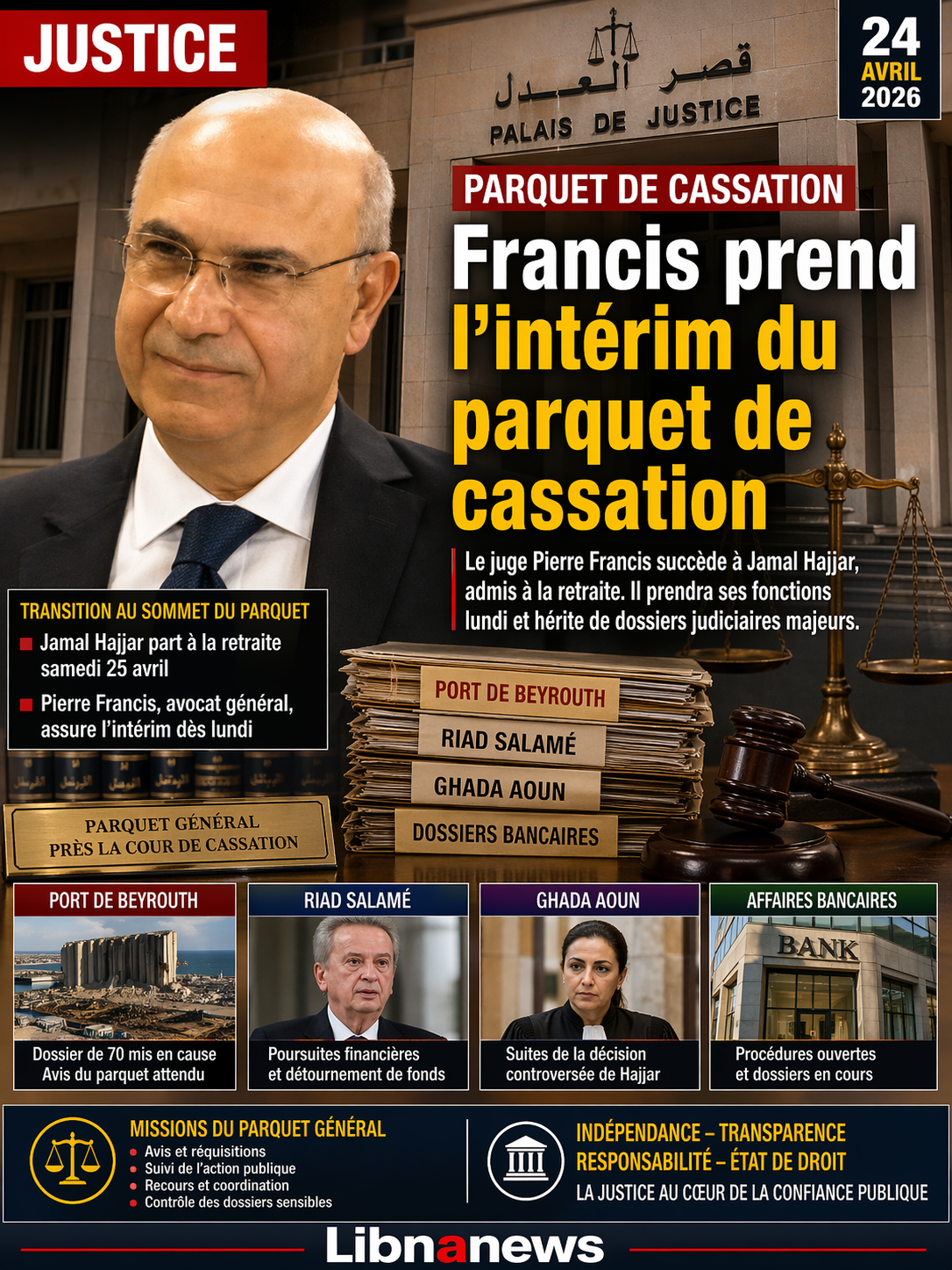
The appointment of Judge Pierre Francis as Acting Attorney General of the Court of Cassation opens a transitional phase at the head of the highest prosecutorial office in Lebanon. The magistrate succeeded Judge Jamal Hajjar, who had reached the age limit and was called to retire on Saturday, 25 April. He is expected to assume his duties on Monday, as the highest rank among the judges of the Public Prosecutor ‘ s Office who are authorized to act in the interim.
This succession occurs at a sensitive time for the judicial institution. Several heavy files are still within the scope of the Office of the Public Prosecutor or its procedural orbit. The most exposed remains the explosion of the port of Beirut, transmitted at the end of March to the Attorney General for advice. In addition, the financial procedures related to the former Governor of the Bank of Lebanon, Riad Salamé, the follow-up of the decisions taken by Jamal Hajjar in the files of Judge Ghada Aoun and several banking or financial cases still followed by the prosecution offices.
Pierre Francis does not take these cases back as an investigating judge. He takes over the function of Acting Attorney General and, with her, the powers of the Attorney General’s Office before the Court of Cassation. Its role will therefore depend on the procedural status of each case: opinions, requisitions, appeals, follow-up of public proceedings, coordination with specialized prosecutors or transmission to the competent judges.
An Acting Appointment After Jamal Hajjar’s Departure
The appointment of Pierre Francis was announced on Friday, April 24. The magistrate, previously a General Advocate at the Court of Cassation, was appointed as interim Attorney General following the departure of Jamal Hajjar. The latter is reached by the age limit and must be officially admitted to retirement on Saturday, 25 April.
The new manager is due to take office on Monday. The formula chosen is that of acting, pending the appointment of a holder. Pierre Francis’ choice is based on his rank in the hierarchy of the Public Prosecutor’s Office. He is presented as the highest ranking among the magistrates who can assume this responsibility.
This solution avoids a vacancy at the head of the general prosecutor’s office. It does not address the question of the appointment of an incumbent Attorney General. It is governed by a separate institutional mechanism, through a decision taken by the Council of Ministers, on a proposal from the Minister of Justice, in accordance with the rules applicable to this post.
The transition is therefore made in two stages. The administrative emergency is covered by the interim. The political and institutional choice of a holder remains open. In the meantime, Pierre Francis will exercise the prerogatives attached to the post, unless later decided to change the situation.
The central role of the Public Prosecutor ‘ s Office
The General Prosecutor ‘ s Office at the Court of Cassation occupies a major place in the Lebanese judicial organization. It represents the summit of the Public Prosecutor’s Office. It acts with the support of the Advocates-General at the Court of Cassation and maintains coordination with the financial, military and appeal prosecutors.
The Attorney General of the Court of Cassation may receive files, formulate opinions, issue requisitions, monitor public action and intervene in sensitive proceedings. However, he is not an investigating judge. He does not conduct the investigation in the same way as an investigating magistrate seized of a criminal case.
This distinction is important in the current succession. Not all of the cases under Jamal Hajjar are mechanically and completely transferred into the hands of Pierre Francis. What is transmitted is the authority of the Public Prosecutor’s Office and the acts still expected of that authority in cases where it retains jurisdiction.
The new Acting Attorney General will therefore be called upon to manage files to varying degrees of advancement. Some require advice or requisition. Others are already with an investigating judge or in another jurisdiction. Still others relate to the administrative follow-up of decisions taken by the Attorney-General’s Office.
The Beirut Port file, first test
The case most immediately associated with the succession is that of the explosion of the port of Beirut of 4 August 2020. At the end of March, investigating judge Tarek Bitar closed his investigation and forwarded the case to the Attorney General of the Court of Cassation for advice on the merits, observations and possible requests.
There are approximately 70 persons involved in this case, according to the information provided during the transmission. It comprises several thousand pages and covers one of the most deadly disasters in Lebanon’s contemporary history. The explosion killed more than 200 people, injured thousands more and destroyed a significant part of the capital.
The role of the Attorney-General’s Office, at this stage, is to examine the case and put its position back before the investigating judge can proceed to the next stage. This stage may lead to an indictment and referral to the competent court, depending on the decisions taken by the investigating magistrate.
If this analysis is not completed at the time of Jamal Hajjar’s departure, Pierre Francis inherits it as interim attorney general. He will then have to ensure the continuity of the examination, without changing the role of Judge Bitar. The port file thus becomes the first visible test of the transition to the public prosecutor’s office.
The file Riad Salamé and Optimum Invest
The second sensitive group concerns the former Governor of the Bank of Lebanon, Riad Salamé. Jamal Hajjar played a direct role in his arrest in September 2024, following an interrogation, including suspicions of financial crimes related to Optimum Invest. The facts examined concerned financial transactions carried out during the period when Riad Salamé was head of the central bank.
After the arrest, the case was forwarded to the financial prosecutor and then to the competent investigating judge. Riad Salamé was prosecuted for acts presented by judicial sources, including misappropriation of public funds, falsification, illicit enrichment or suspicious financial transactions. The former governor has always challenged the charges against him.
The Optimum case then continued its journey before the competent courts. In April 2025, a Lebanese judge reached a procedural stage by issuing a presumptive decision paving the way for a charge. In September 2025, Riad Salamé obtained bail with a travel ban, according to judicial information.
Pierre Francis therefore does not resume the examination of the case as if he were the judge seized. It takes over the functions of the Public Prosecutor’s Office in the follow-up to the proceedings still pending: follow-up of the prosecution, possible requisitions, possible appeals, coordination with the other public prosecutors’ offices and control of the measures under the Public Prosecutor’s Office.
Other financial components related to the Bank of Lebanon
Salamé is not limited to Optimum Invest. Proceedings in Lebanon and abroad have also covered other financial aspects, including charges against Forry Associates, a company linked to the brother of the former governor, Raja Salamé. These procedures have fed several requests for mutual assistance and European investigations.
The French, German and Luxembourg authorities have investigated suspicions of illicit enrichment and money laundering involving Riad Salamé, relatives and associated structures. These cases have had repercussions in Lebanon, where the Attorney-General ‘ s Office can be requested on letters rogatory, requests for judicial cooperation or measures related to local prosecutions.
The transmission to Pierre Francis here concerns the function, not a decision already announced. The new Acting Attorney General may be required to follow up on actions still pending if requests for mutual assistance, domestic remedies or procedures go through the Public Prosecutor ‘ s Office.
The sensitivity of these cases is due to their economic and political dimension. The Lebanese financial crisis has profoundly affected depositors, banks and the state. Any decision related to the former Governor of the Bank of Lebanon therefore remains beyond the judicial framework.
Follow-up to the decision on Ghada Aoun
Jamal Hajjar also marked his passage by a controversial decision concerning Judge Ghada Aoun, Attorney General of Appeal of Mount Lebanon. In June 2024, he decided to divest her of the files she was investigating and sent a circular to the security services asking them to stop carrying out her instructions in old or new cases.
This led to public and judicial controversy. Ghada Aoun challenged the measure, finding it illegal. Organizations and political actors have also criticized or defended the decision, according to their reading of the role of the magistrate in financial and banking matters.
For the Public Prosecutor ‘ s Office, the issue is not limited to a personal conflict between judges. It concerns the organization of the public prosecutor’s office, the hierarchy between prosecutors’ offices, the execution of instructions addressed to the judicial police and the distribution of the financial files that were previously the responsibility of the prosecutor of Mount Lebanon.
Pierre Francis thus inherits the administrative and judicial framework created by this decision, in so far as he will have to ensure the continuity of the public prosecutor’s office. He may be confronted with challenges, requests for clarification or procedural follow-up related to the files withdrawn from Ghada Aoun.
Related bank and financial records
Beyond the most well-known cases, the Public Prosecutor ‘ s Office remains concerned with financial cases involving banks, heads of institutions, transfers of funds or alleged economic offences. Under Jamal Hajjar, several decisions have been reported concerning summonses, travel bans or prosecutions in the banking sector.
One of the examples cited in the press is the former Chairman of Creditbank’s Board of Directors, Tarek Khalife, who was subject to a summons and a travel ban in a case where suspicions of fraudulent, false, money laundering and tax fraud were mentioned. As in other cases, the facts reported remain subject to the presumption of innocence.
Not all of these cases will be handled directly by Pierre Francis. Some of them are under the jurisdiction of investigating judges, financial prosecutors or specialized courts. But the Attorney General’s Office retains a role of coordination, guidance and sometimes recourse. As such, the new interim prosecutor may be called upon to intervene.
Continuity will be particularly observed by depositors and economic actors. Lebanon remains marked by the financial collapse of 2019, banking restrictions and accusations of privileged transfers. The decisions of the Public Prosecutor ‘ s Office in this area can therefore be symbolically strong.
A succession that does not suspend proceedings
Jamal Hajjar’s retirement does not suspend the ongoing proceedings. The files do not disappear with the departure of a magistrate. They remain in the judicial circuits where they were placed. The function of interim prosecutor-general makes it possible to avoid a break in the treatment of the acts expected of the prosecutor.
The question is more about rhythm. A new manager must be aware of the files, identify emergencies, check deadlines and set priorities. Big business, such as the port of Beirut, requires a thorough examination. Financial affairs also require a technical mastery of bank, accounting and international coins.
Pierre Francis therefore takes up his duties with an immediate charge. It will have to ensure continuity, without giving the impression of an improvised recovery or an administrative slowdown. The Public Prosecutor ‘ s Office is at the crossroads of cases where victims ‘ families, applicants, litigants and politicians are waiting for clear actions.
The acting term may last a few days, a few weeks or more, depending on the executive’s ability to appoint a incumbent. The longer this period continues, the more the role of Pierre Francis becomes decisive in the day-to-day management of sensitive files.
Temporary limits
The interim nature of the mandate is important. Pierre Francis has the necessary powers to operate the Public Prosecutor’s Office. But its installation is not the same political scope as a definitive appointment. First, it aims at the continuity of the judicial service.
This situation can have two effects. It can encourage prudent management, focusing on essential actions and procedural deadlines. It may also postpone certain sensitive decisions if the authorities await the appointment of a prosecutor. It will depend on the timing and status of the files.
In the port file, excessive expectation would expose the public prosecutor to strong criticism, due to the years of blockade already accumulated. In financial matters, any slowdown would also be monitored, as public opinion links these procedures to the issue of economic impunity.
The new interim prosecutor will have to find a balance. It will have to preserve the due process, respect the role of the judges seized and prevent the acting from becoming a ground for freezing. Judicial continuity is the first obligation to take up office.
The files Francis is called to follow
The files transmitted or followed by the Public Prosecutor ‘ s Office can be distinguished into several categories. The first group concerns cases where an opinion of the Attorney General’s Office is expected. The port of Beirut is one of them, following the closure of the investigation by Tarek Bitar and the transmission of the file to Jamal Hajjar.
The second group deals with financial cases already before judges or other prosecutors, but in which the Public Prosecutor ‘ s Office retains a monitoring, requisitioning or appeal role. The procedures related to Riad Salamé and the financial operations of the Bank of Lebanon fall into this category.
The third group concerns decisions on the organization of the Public Prosecutor’s Office, including the follow-up to the action against Ghada Aoun. These issues relate to functional discipline, the execution of instructions by the security forces and the division of files between prosecutors.
The fourth group includes banking cases, financial complaints and requests for judicial cooperation that go through the top level of the prosecution. These cases are less visible than the port or Salamé, but they help define the credibility of the Attorney General’s Office in a period of high demand for accountability.
A transition under surveillance
The appointment of Pierre Francis comes in a climate of strong expectation towards justice. The port file remains an open wound for the victims’ families. Financial affairs remain central for depositors and for the image of the State. Internal tensions within the judiciary have also weakened confidence in the institution.
Jamal Hajjar’s departure concludes a sequence that began after the end of his predecessor’s term. He left behind important decisions, notably in the Salamé case and in managing conflicts around certain prosecutors’ offices. He also left uncompleted files, the follow-up of which would have to be assumed by his interim successor.
Pierre Francis took up his duties in a strategic position. Its first challenge will be to ensure continuity of procedures. The second will be to clarify the priorities of the Attorney General’s Office. The third will be to preserve the regularity of the most sensitive cases, so that the next steps are based on legally sound acts.
The future will also depend on the executive branch. The appointment of a full attorney general remains pending. Meanwhile, the Public Prosecutor’s Office will operate under the responsibility of Pierre Francis, with an already busy agenda: the port of Beirut, the financial files related to the Bank of Lebanon, the follow-up of the decisions taken against Ghada Aoun and the banking procedures still open.




