

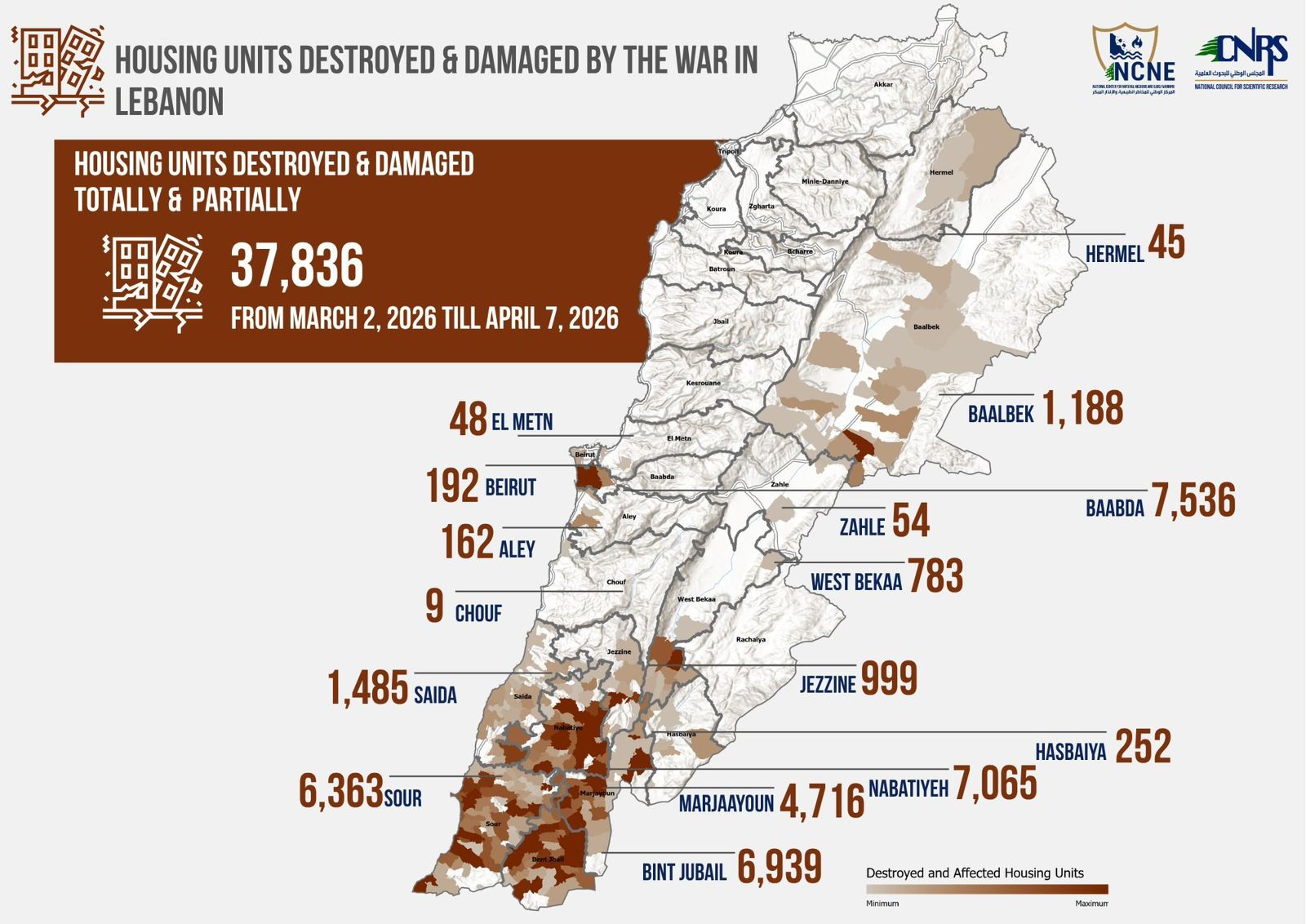
The latest update of the CNRS-L sharply tightens the focal point. Between 2 March and 7 April 2026, 37,836 housing units were identified as destroyed or damaged in Lebanon. This figure, distributed as part of the CNRS-L and NCNE tracking systems, illuminates a clear acceleration of residential destruction.
Acceleration in 35 days
The latest update of the CNRS-L sharply tightens the focal point. Between 2 March and 7 April 2026, 37,836 housing units were identified as destroyed or damaged in Lebanon. This figure does not come from a political balance sheet or an improvised count. It appears in the series of institutional publications published by the National Council for Scientific Research in Lebanon, first with the launch of an interactive platform on the war in Lebanon on 6 March, then with the presentation on 31 March of a national platform for almost real-time monitoring of damage and needs, finally with the publication of 7 April documenting a month of attacks between 2 March and 2 April, supplemented by the detailed map of the housing sector. The last survey, therefore, is not only a continuation of the war. It shows a strong enough acceleration to move the centre of gravity of the Lebanese file to housing, housing and reconstruction.
The total of 37,836 affected units is first hit by its accumulation rate. In its consolidated paper, the CNRS-L refers to approximately 40,000 homes totally destroyed or heavily damaged in 35 days and states that this sequence represents nearly 16% of the damage recorded during the previous phases of the war. The formula is very meaningful. She says that in just over a month, a significant part of the already accumulated destruction has been replicated again. For Lebanon, which barely left the documented phase until the ceasefire of 27 November 2024, this changed the very nature of the problem. It is no longer just a matter of repairing old damage, nor of consolidating an already fragile return. It is now necessary to think of a new wave of residential destruction on an already largely underdeveloped housing stock, in a country whose financial and administrative capacity remains very weak.
A very concentrated geography
The last survey also shows where violence is concentrated. Baabda leads with 7,536 homes destroyed or damaged. Next come Nabatiyah with 7,065 units, Bint Jbeil with 6,939, Sour with 6,363 and Marjaayoun with 4,716. At a much lower level are Saida with 1,485, Baalbek with 1,188, Jezzine with 999, West Bekaa with 783 and Hasbaya with 252. Then come Beirut with 192, Aley with 162, Zahlé with 54, Metn with 48, Hermel with 45 and Chouf with 9. This territorial hierarchy is essential. Destruction does not spread uniformly across the country. It follows a very identifiable axis, from the southern suburbs of Beirut to southern Lebanon, with an extension to certain areas of the Bekaa. It already refers to areas where the greatest needs for shelter, clearing, technical expertise, compensation and network rehabilitation will be concentrated.
| Caza | Affected housing |
|---|---|
| Baabda | 7,536 |
| Nabatiyah | 7 065 |
| Bint Jbeil | 6,939 |
| Smile | 6,363 |
| Marjaayoun | 4,716 |
| Saida | 1 485 |
| Baalbek | 1 188 |
| Jezzine | 999 |
| Western Bekaa | 783 |
| Hasbaya | 252 |
CNRS-L/NCNE data from the latest housing update.
Behind this picture, two housing crises already appear. The first is urban and metropolitan. It is read in Baabda, which is largely in the southern suburbs of Beirut, where a single building can move many families, interrupt the commercial activity of a neighbourhood and weaken both schools, transport and community services. The second is territorial and diffuse. It is seen in the South, in Bint Jbeil, Sour, Nabatiyeh or Marjaayoun, where the affected dwellings are located in local towns, villages and small centralities. There, the destruction of a house or building is never isolated. It affects the access road, the nearby grocery store, the farm, the neighbourhood school, the very continuity of local life. The national figure aggravates these realities, but the last survey bruises them. This reading is a deduction based on the spatial concentration of damage reported by CNRS-L.
This explains the place of housing in the current reading of the conflict. A destroyed home is not abstract damage. It concentrates property loss, household savings, basic necessities, sometimes economic activity, and especially the possibility of return. As long as the housing is not repairable, or as long as its immediate environment remains impracticable, the return remains theoretical. This is also why the CNRS-L presents its work as a tool for evidence-based recovery planning, national and international reporting, rapid damage assessment and scientific documentation for accountability. The last survey is not only a strong image. It is a basis for public decision. In a country with low budget margins and multiple emergencies, the quality of the data determines the quality of reconstruction.
What the 2023-2024 report adds to the reading
The method used also gives this update a scope that goes beyond simple institutional communication. CNRS-L explains that its data is generated by its national monitoring platforms by combining remote sensing, artificial intelligence, public input, field verification and advanced data analysis. On 31 March, at a coordination meeting at the Ministry of Finance on the Rapid Damage and Needs Assessment, the institution presented an integrated national platform for near-real-time monitoring of damage and needs, thought of as a continuous system ranging from monitoring destruction during the war to recovery, reconstruction and impact assessment. The most recent housing survey makes sense in this context. It is not an isolated snapshot. It fits into a mechanism designed to track damage, prioritize and maintain a chain of evidence as the conflict evolves.
The 2023-2024 ratio remains indispensable to measure this acceleration, but it comes here in the background. Published by CNRS-L on December 23, 2024, this document covers the period from October 8, 2023 to November 27, 2024. The Council presents it as a complete reference to the Lebanese authorities. On the official page of publications, it is described as a synthesis report covering the entire period. It was this document that laid down the first major framework for reading the offensive, its spatial extension and its effects on civilian infrastructure. The last statement, however, does not repeat this substantive work. It shows what happens after, when the destruction of the residential park goes back at a sufficiently fast pace to add to the already considerable balance.
The comparison is enlightening. The 2023-2024 report already described a war marked by the destruction of houses and residential units, particularly in the South. The subsequent international assessments confirmed this diagnosis. In its interim assessment published on 7 November 2024, the World Bank estimated that 99,209 housing units had been damaged by 27 October 2024, with $2.8 billion in damage to the housing sector alone. Four months later, in the RDNA published on 7 March 2025, the same institution estimated the reconstruction and recovery needs related to the conflict from 8 October 2023 to 20 December 2024 at $11 billion. Housing appeared to be the hardest hit sector, with $4.6 billion in damage and $6.3 billion in needs, or 57 per cent of the estimated total. The new update of the CNRS-L is therefore taking place on a ground already deeply damaged.
This is where the last survey changes scale. Adding 37,836 units affected in five weeks to a stock of destruction already measured to several tens of thousands of dwellings amounts to moving the stakes from the housing register to that of sustainability. Lebanon no longer faces a heavy bill. He confronts the rapid repetition of a damage that undermines, at each wave, the very repair capabilities. At the same time, the country must document, relocate, secure, clear, evaluate, finance and prepare for reconstruction. However, each of these tasks becomes more difficult when the number of housing units affected continues to grow, while aid schemes remain slow, fragmented and dependent on political and financial arbitrage. The novelty of the last reading is therefore less in the size of the figure than in the speed at which it adds to the rest. This is an inference based on CNRS-L and World Bank data.




