

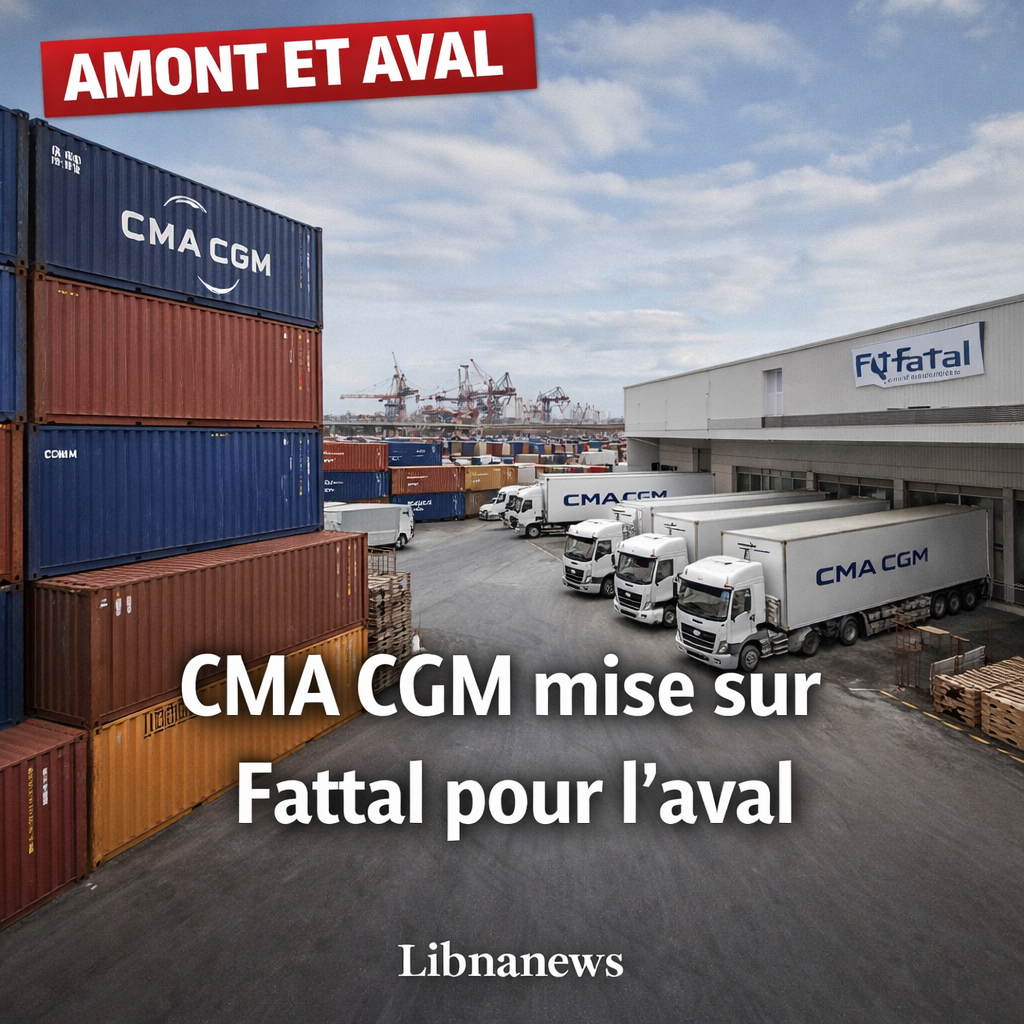
The agreement announced on 14 April in Beirut goes beyond a simple capital operation. CMA CGM and the shareholders of the Fattal Group have entered into an agreement for the acquisition of 100% of the regional distributor by Rodolphe Saadé and its subsidiaries. The transaction remains subject to regulatory authorities and is expected to be finalized in the third quarter of 2026. Behind this legal formula is a clear strategic inflection: CMA CGM continues its transformation into an integrated group, capable of covering not only maritime, land, air and logistics transport, but also a much more direct part of the distribution in the MENA region.
The operation also has a particular scope by the very profile of the target. Founded in 1897 by Khalil Farès Fattal, the Fattal group was built as a regional distributor of international brands, with a historic anchor in Beirut and a presence now extended to eight countries. His profession combines storage, promotion, distribution and commercial coverage of often fragmented markets. In the joint press release, CMA CGM insists that the integration of this platform must strengthen its « downstream » capacity, as close as possible to markets and end consumers. Everything is there: it is not just about adding one more asset, but about getting closer to the moment when the commodity becomes a product actually sold, delivered and tracked in local circuits.
A consistent acquisition with CMA CGM’s trajectory
Taken in isolation, the purchase of Fattal could be considered an opportunistic diversification. Taken in the recent sequence of the group, it appears instead as a logical brick. CMA CGM is now a global player in maritime, land, air and logistics solutions. Its communiqué recalls its presence in 177 countries, its 160,000 employees, a fleet of more than 700 vessels and more than 420 ports served. He also states that in 2025 the group transported more than 24 million TEU containers and that CEVA Logistics, one of the top five global players in the sector according to this presentation, operates 1,000 warehouses and managed 15 million shipments.
The group’s 2025 annual results shed light on the overall mechanics. CMA CGM indicated that it had achieved $54.4 billion in revenues and reaffirmed a long-term strategy based on strengthening its trades beyond pure shipping. The group cites the acquisition of Santos Brasil, the creation of United Ports and the strengthening of its logistics activities with Borusan Lojistik and Fagioli. In this context, Fattal is not a detour out of the core business. This is an additional extension to segments where logistics continues in distribution, commercial execution and direct access to the final market.
This logic is important because maritime transport, however powerful it may be, is no longer sufficient to summarize value creation in the supply chain. Large customers now want more integrated, less fragmented offers with fewer intermediaries and better end-to-end visibility. For a group like CMA CGM, controlling the ship and port remains essential, but also controlling part of the storage, preparation, distribution and marketing flows becomes an additional commercial advantage. The purchase of Fattal is precisely part of this upscaling towards a more continuous chain. This is an analysis based on the objectives explicitly formulated by CMA CGM and on recent developments in its portfolio of activities.
Why Fattal weighs more than just a distributor
The Fattal Group is not just an old company. It is a regional commercial infrastructure already in operation. The press release issued on 14 April describes him as a specialist in the storage, promotion and distribution of products and services for consumers, professionals and direct customers. It highlights three major sets: consumer and consumer electronics, pharmaceuticals and health, as well as perfumes, makeup and cosmetics. On its official website, Fattal also describes a wider portfolio, ranging from food to medical equipment, appliances, beauty and direct sales.
This positioning changes the nature of the acquisition. When a shipowner purchases a terminal, it consolidates the continuity of the harbour passage. When he buys a regional distributor, he moves much further in the chain. It no longer stops unloading or storage. It is close to the retailer, the pharmacy, the professional network, the promotion channels and the end consumer. In other words, it settles in the commercial downstream, where the real presence of a brand on the market, the speed of inventory rotation, the quality of local execution and a significant part of customer loyalty are decided. This analysis stems directly from the nature of the trades described by Fattal and CMA CGM.
The Lebanese group also brings concrete geography. Its official website mentions operations in Lebanon, Iraq, Jordan, the United Arab Emirates, Algeria, Egypt, France and Cyprus. This map combines consumer markets, commercial hubs and areas where local execution remains decisive. For CMA CGM, which wants to strengthen its presence in the dynamic markets of the MENA region, this coverage is worth time, teams, relationships and experience. Building such a country-by-country footprint from zero would have taken years. Acquisition allows for the integration of a single movement, even if operational integration takes time.
What the transaction changes immediately
- For CMA CGMThe agreement adds a distribution platform already installed in several markets in the MENA region, beyond international transport alone.
- For Fattal, the shareholder change opens up access to a global group with a much wider maritime, logistical, air and digital strike force.
- For the region, the operation reports that a major international player still considers logistics and commercial avalanches to be a structural growth ground in MENA. This reading is analytical, based on the meaning given to the acquisition by both groups.
From shipping to organized distribution
The key term in the press release is probably « integrated logistics solutions covering the entire supply chain ». Rodolphe Saadé presents the acquisition as a step in the ambition to become a world leader in this integrated logic. In this sentence, Fattal appears as the tool that allows CMA CGM to get closer to markets and end consumers. This vocabulary is nothing ornamental. He says that the value is no longer thought only at the scale of the transported container, but at that of the complete product path.
That shade changes everything. A container that arrives at destination is not yet a successful sale. It is then necessary to manage reception, storage, preparation, distribution, relationship with sales channels, compliance with local standards, sometimes temperature or traceability constraints, and finally the availability of the product on the market. In areas such as pharmacy, health, high consumption or beauty, the latter segment creates a large portion of the service value. By purchasing Fattal, CMA CGM is a member of an organisation already specialized in this daily execution. This gives the file a deeper scope than a mere acquisition of logistical assets.
The role of CEVA Logistics here deserves to be emphasized. The announcement was published in the framework of CEVA, which shows that the centre of gravity of the rapprochement lies less in the maritime activity stricto sensu than in the construction of an integrated offer. CEVA operates 1,000 warehouses and managed 15 million shipments in 2025, according to the group’s official presentation. With Fattal, this base can be extended to occupations that are not only contractual logistics, but also local commercial animation and multichannel distribution. For a large international customer, the promise becomes more legible: the same group can organize international routing, storage, and then some execution on the ground.
The most visible complementarities
| CMA CGM / CEVA | Fattal Group | Effect sought |
|---|---|---|
| Global maritime network, air freight, warehouses, contractual logistics | Local distribution, promotion, market coverage, brand portfolio | A more integrated chain from import to point of sale |
| Global presence and investment capacity | Regional anchoring, local teams and market knowledge | Acceleration in the MENA Region |
| Multi-business logistics offer | Strong position in FMCG, health, beauty and consumer electronics | Increased presence in downstream and in contact with the consumer |
Summary table based on the information published by the two groups.
A regional bet and a signal for Lebanon
The press release gave Lebanon a place that it could have avoided. Rodolphe Saade is not just defending the industrial interest of the operation. It also states that it reflects CMA CGM’s continued confidence in Lebanon and its commitment to support its long-term development. This sentence has weight because Fattal is historically driven from Beirut and the group continues to present itself as a regional enterprise rooted in Lebanon. The message is clear: the acquisition is not just about taking control of assets scattered in the region, but also assumes an explicit Lebanese dimension.
On the analytical level, this signal counts almost as much as financial mechanics. In an unstable regional environment, groups able to combine local settlement, fine market reading and regional projection become more valuable. Fattal offers exactly this type of profile. For CMA CGM, which has already strengthened its logistical presence in other strategic areas, taking over a regional distributor based in Beirut amounts to internalizing not only capacities, but also relational capital. The latter is not included in the asset tables, although it is often decisive in the distribution. This interpretation is based on Fattal’s business map and CMA CGM’s focus on MENA’s dynamic markets.
A more discreet element must also be noted. Fattal remained in the hands of the founding family for about 130 years. Caroline Fattal therefore presents the sale as a carefully thought-out decision, taken to entrust the future of the group to a global player in shipping, logistics, digital innovation and sustainable growth. This formulation shows that, from the sellers’ point of view, the issue is not just the liquidity of a transaction. It is about choosing an industrial owner capable of opening a new phase of growth. This is an important point in the reading of the file, because not all transfers of centennial family groups obey a logic of strategic continuity so clearly put forward.
What Fattal gains by changing scale
For the Fattal Group, the transaction can first be read as an access to a higher investment capacity. In the distribution, health and availability sectors, size becomes a concrete advantage. Investment is needed in information systems, automation, advanced inventory management, compliance, traceability, demand control and sometimes controlled temperature chains. By joining a group that presents itself as global, present in 177 countries and organized around CEVA Logistics, Fattal can theoretically accelerate on these levers without having to finance them alone. This analytical reading is based on the documented scale gap between the two groups.
The second potential gain is the integration of flows. A regional distributor depends heavily on the fluidity of international supplies. But CMA CGM already controls a very large part of this mechanics, from the maritime to the air, through warehouses and contractual logistics. This may reduce some friction between the arrival of products and their spread on the markets in the region. Again, everything will depend on execution. But on paper, the industrial logic is clear: bringing the world closer to upstream and downstream in the same architecture. This interpretation is based on the official scope of CMA CGM and Fattal activities.
The third gain is more commercial. Major international constituents often seek partners who can provide coherent regional coverage. Fattal was already doing it in his markets. Under the umbrella of CMA CGM, the argument can become even stronger, especially for groups that want a contact person able to handle both import, storage, compliance, distribution and sometimes part of local demand management. In this sense, the transaction does not only alter the ownership of Fattal. It can transform its commercial narrative in the face of international brands. This is an analysis based on the trades officially described by the two groups.
Open questions before finalization
No such operation is automatic. The first lock is regulatory. The release clearly reminds us that the transaction still has to receive the necessary authorizations and its completion is expected in the third quarter of 2026. This step may be purely procedural or more attentive depending on the countries, sectors and activities concerned. In this case, the presence of Fattal in several jurisdictions and in segments such as health and pharmacy will mechanically make the examination more sensitive than for simple generic storage activity.
The second issue will be human and commercial integration. Fattal is based on local teams, an intimate knowledge of markets and long-term relationships with brands and sales channels. CMA CGM, even if it remains a family group in its governance, operates on a much more industrialized scale. The challenge will therefore be to combine the standardization, tools and financial power of a large group with the field agility of a regional distributor. Too centralizing might weaken what makes Fattal worth. Failure to integrate enough would limit the synergies sought. This is an analysis derived from the very nature of the two organizations.
The third subject concerns the marks represented by Fattal. In the regional distribution, the decisive asset is not only the warehouse, but the confidence of the applicants. They will want to know whether the shareholder change changes the quality of service, the neutrality of execution or the ability to defend their positions in each market. For CMA CGM, the issue will therefore not only be to close the operation. It will have to be demonstrated that entry into a global group enhances the quality of distribution without dissolving the commercial proximity that has made Fattal strong. This analytical reading is consistent with Fattal’s central focus on its brand partners and regional anchoring.
One more piece in the Saade strategy
Basically, the acquisition of Fattal confirms above all the direction chosen by Rodolphe Saadé for several years. CMA CGM no longer wants to be judged solely on the size of its fleet or on its performance in marine freight. The group methodically expands its presence in terminals, logistics, air, and then finer segments of commercial execution. The 2025 results and official press releases show a group that continues to invest to strengthen the resilience and performance of the global transport chain. The agreement announced on 14 April is part of this densification logic, not a rupture.
Perhaps the most interesting point is elsewhere. By buying back Fattal, CMA CGM discreetly redefines what a large logistics group in the Middle East can be. Power is no longer only measured by the number of ships, ports or warehouses. It also measures the ability to enter the fabric of markets, to talk to distributors, retailers, pharmacists, sales chains and brands, with an offer that links international flows to local execution. In this perspective, Fattal is not a peripheral acquisition. It is a contact piece, the one which brings the group closer to the final market and which, if integration is carried out without breaking the existing tool, can sustainably transform its position in the MENA region. This interpretation is based on the trades described in the official sources and the strategic meaning that CMA CGM itself gives to the operation.




