





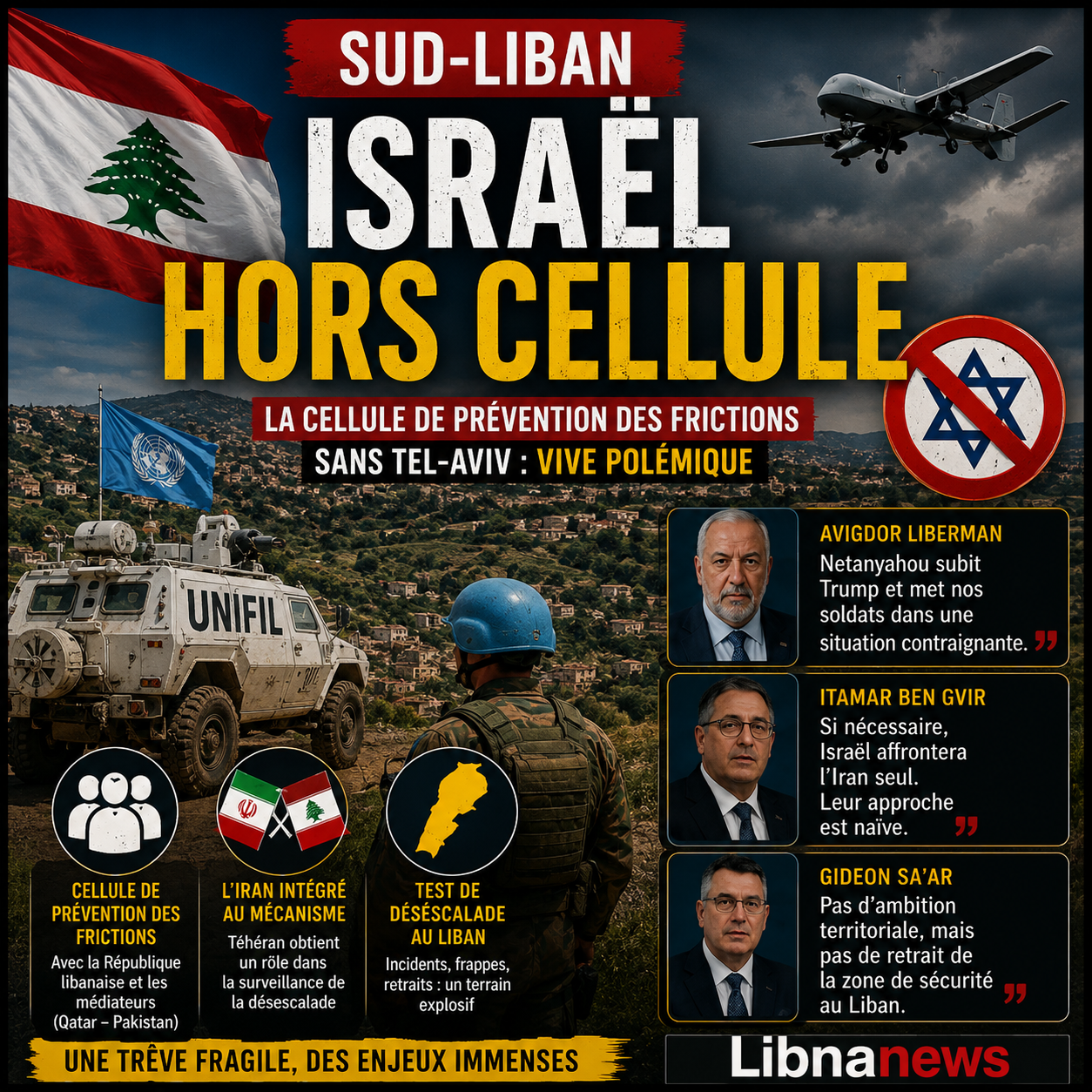
South Lebanon becomes the most immediate point of friction in the negotiations between Iran and the United States. Following the Swiss talks, Qatari and Pakistani mediators announced the establishment of a friction prevention unit to ensure compliance with the cessation of military operations in Lebanon. The formula places Beirut in the mechanism, but does not cite Israel as a stakeholder. This absence already feeds an intense debate in the Hebrew media, where several politicians denounce an arrangement that limits Israeli freedom of action without, in their view, responding to the threat of Hezbollah.
The Iranian declaration added a political dimension to this apparent imbalance. Foreign Minister Abbas Araghchi spoke of great progress towards the end of the war in Lebanon. Comments close to the Iranian line immediately presented the sequence as a Tehran victory over Washington and Israel. This reading is a political narrative. It does not efface the shadows of the mechanism or the reality of the ground, where the strikes, military positions and capabilities of Hezbollah remain the real criteria of the truce.
South Lebanon as a de-escalation test
The mechanism announced is based on a simple idea: to avoid a local incident causing the regional process to fail. A friction prevention cell is used to receive alerts, verify accusations, transmit messages and reduce misunderstandings. In the Lebanese case, this function is of particular importance. Military operations may be based on an overflight, an isolated fire, a targeted strike, a movement of troops or a different interpretation of a contact line. Without a fast channel, each incident becomes a climbing tool.
The novelty lies in Iran’s announced presence in this system. For Tehran, this means that the Lebanese case is no longer only dealt with between Washington, Beirut, UNIFIL and Israel. He entered the Iran-USA strategic negotiation. For the Israeli opponents of the agreement, this is tantamount to recognizing an Iranian role in Lebanon’s security. For Beirut, it creates an opportunity and a risk. The opportunity is to get a firmer stop to operations. The risk is that Lebanese sovereignty will be discussed over national institutions.
The fact that Israel is not named as part of the cell fuels this tension. The Ombudsmen’s statement refers to the parties, the Lebanese Republic and Qatari facilitation. It does not specify how decisions or alerts will be transmitted to the Israeli army. This omission does not mean that Israel will be without influence. Rather, it means that its role does not appear in public architecture. However, the ceasefire cannot hold if the actor who leads the strikes or maintains positions in South Lebanon remains outside the monitoring mechanism.
An Israeli reading of marginalization
In the Hebrew media, this point was interpreted as a signal of marginalization. Several comments point out that the United States and Iran are discussing Lebanon while the Israeli government is not formally included in the scheme. This perception comes after weeks of tension between Washington and Tel Aviv over the conduct of the war, the management of the Lebanese front and the need to avoid a break in the process with Tehran. It reinforces the idea, both in the Israeli opposition and in a part of the right, that the Prime Minister is now undergoing the American agenda.
The leader of the Israel Beiteinu party, Avigdor Liberman, expressed this criticism in particularly harsh terms, according to Hebrew media. He accused Benjamin Netanyahu of being pressured by Donald Trump and of placing Israeli soldiers in a situation where their actions would be forced. This attack targets two political weaknesses of the Prime Minister. The first is its dependence on American support. The second is the gap between the strong discourse before Israeli opinion and the limitations imposed by American diplomacy.
Itamar Ben Gvir defends a different but equally critical line. He claims that Israel will ultimately face Iran alone if the country’s nuclear security demands it. He said he respected American partners, while judging their naive approach. This position targets its hardest electorate. She refused the idea that the United States could decide on the level of risk acceptable to Israelis. It also opposes any mechanism that restricts Israeli military freedom in Lebanon or against Iran.
These reactions show a deeper Israeli fracture. Some officials want to maintain coordination with Washington, because the Israeli army depends on its ally for diplomatic support, weapons, ammunition and international coverage. Others believe that the agreement under discussion is sacrificing war objectives. They fear that Hezbollah will retain its arsenal, that Iran will save time and that South Lebanon will become a frozen front rather than a secure front. This divergence may affect the implementation of the cell.
Sa-ar maintains the safety zone line
Israeli Foreign Minister Gideon Sa-ar gave the clearest official line. He claims that Israel has no territorial ambition in Lebanon. But he also said that his country would not withdraw from the security zone, in order not to expose its inhabitants to Hezbollah attacks. This formula seeks to neutralize the charge of occupation while justifying the continuation of a military presence. For Beirut, it remains problematic. A security zone on Lebanese territory remains an infringement of sovereignty, even though Israel claims to be acting to protect its civilians.
South Lebanon is therefore at the heart of two opposing narratives. The Israeli account insists on the need to remove Hezbollah from northern localities and prevent another attack. The Lebanese story insists on withdrawal, cessation of strikes and the return of state authority. The Iranian account presents the Lebanese front as a lever that forced Washington to negotiate. These three stories may coexist in the communiqués. They cannot coexist permanently on the ground without rules, timetables and guarantees.
The friction prevention unit will therefore have to solve a practical question: what about an alleged violation? If a drone flies over a village, who alerts the cell? If a strike targets a vehicle, who determines if it violates the truce? If Hezbollah moves men or equipment, who checks the information? If Israel refuses to leave a position, what procedure begins? Without precise answers, the mechanism will remain a diplomatic mailbox more than a stabilization instrument.
The Lebanese Armed Forces and UNIFIL at the practical centre
The place of the Lebanese army will be decisive. It represents the sovereign institution that can speak on behalf of the state on the ground. She knows the roads, villages and areas of tension. It is already working with UNIFIL under resolution 1701. If the cell clearly associates, Beirut can strengthen its documentation and withdrawal request capacity. If it excludes or reduces it to a symbolic role, Lebanon risks becoming the setting for an arrangement between powers.
UNIFIL is the other point of support. Its mission is to monitor the cessation of hostilities, support the Lebanese army in the South and assist the return of State authority. It cannot impose a truce alone if the main actors refuse to cooperate. But it has experience, observers, links and an international presence. A friction prevention cell without connection to UNIFIL would lose part of its ability to verify incidents.
Residents of South Lebanon will judge the mechanism to be simpler. They would like to know whether the strikes stopped, whether the drones were silent, whether the roads remained open, whether the villages became accessible and whether families could return. The debates about Iran’s victory or Israel’s marginalization weigh less than daily security. A cease-fire that leaves people in uncertainty does not produce any lasting return, reconstruction or restoration of local services.
The presence of an Iranian triumphalist discourse can complicate this stage. If Tehran presents the mechanism as an Israeli defeat, the Netanyahu government will have more difficulty accepting visible concessions. If the Israeli opposition accuses the Prime Minister of submitting to Trump, he may be tempted to tighten his position in South Lebanon to prove his autonomy. Political communication becomes an operational risk. Each camp speaks to its audience, but the messages have an impact on the border.
Washington faced three conflicting objectives
Washington will have to arbitrate this contradiction. The United States seeks to preserve negotiations with Tehran, avoid an outbreak around Ormuz and maintain the strategic relationship with Israel. These objectives do not always align. Demanding the cessation of operations in Lebanon may reassure Iran and Lebanon, but irritates part of the Israeli government. Guaranteeing Israeli freedom of action can reassure Tel Aviv, but ruin the credibility of the truce. The friction prevention cell will succeed only if Washington agrees to translate its pressures into coherent actions.
Hezbollah, finally, remains the actor without which no truce can hold. It is not a signatory State, but it is at the centre of the front. Iran can influence its choices, but Lebanese conditions matter. The movement will require the stop of visible strikes and withdrawals. Israel will require safeguards over its positions, weapons and movements. The Lebanese State will have to try to put this confrontation in the context of 1701, without causing an internal crisis that would further weaken its institutions.
The opening phase will therefore not only be diplomatic. It will be military, legal and political. Participants, procedures, response times, means of verification and the relationship with parties not mentioned in the declaration will need to be identified. Israel’s public absence from the cell can be read as an Iranian success or as a flaw in the device. The answer will depend on the facts. If operations cease, the mechanism will have value. If they continue, it will become the symbol of an agreement unable to control its most critical actor.
The time of villages against the time of chanceries
The difficulty also lies in the timing. Mediators talk about a 60-day roadmap. For diplomats, this time frame provides a margin for negotiation. For the villages of the South, it may seem too long. Displaced people need quick decisions on access to communities, road repairs, the presence of mines or hazardous debris and the resumption of services. A cell can prevent escalation, but it will not replace concrete decisions on the ground.
This tension between diplomatic and civil times explains the Lebanese insistence on consolidating the ceasefire. The power in Beirut cannot be content with an arrangement that would reduce the intensity of the fighting without restoring circulation and public authority. Municipalities will need to know who can enter the affected areas, at what times, with what means and under what protection. The friction prevention mechanism will only make sense if it facilitates these ordinary operations, which are often more important for residents than announcements from Switzerland.
The issue of maps will also be central. Israel is talking about a safe area. Lebanon speaks of national territory. UNIFIL refers to the Blue Line and the area of operations. Hezbollah understands its positions, areas of influence and deterrence. If the cell does not have accepted cards, the parties may not talk about the same space. A position presented by Israel as defensive can be considered by Lebanon as an occupation. A local Hezbollah movement can be described by Israel as an immediate threat.
The statements from Israel finally show that the inner battle is just beginning. Ben Gvir seeks to prevent any limitation of military freedom. Liberman attacks Netanyahu on his dependence on Trump. Sa的ar is trying to formulate a more institutional government position. These three registers can coexist as long as the truce remains theoretical. They will become incompatible if a withdrawal decision, even if partial, is placed on the table. The Lebanese cell would then be at the centre of an Israeli political crisis as well as a regional security crisis.
The South Lebanon will thus serve as a test bench for the Iran-USA negotiations. Araghchi’s statements, Liberman’s criticisms, Ben Gvir’s warnings, and the line defended by Sa Yet they converge to the same point: no one considers the Lebanese front as secondary. The next sequence will be played in the details of the cell, in Israeli army decisions, in Hezbollah’s attitude and in Beirut’s ability to assert its sovereignty without being absorbed by the rivalry between Washington and Tehran.