

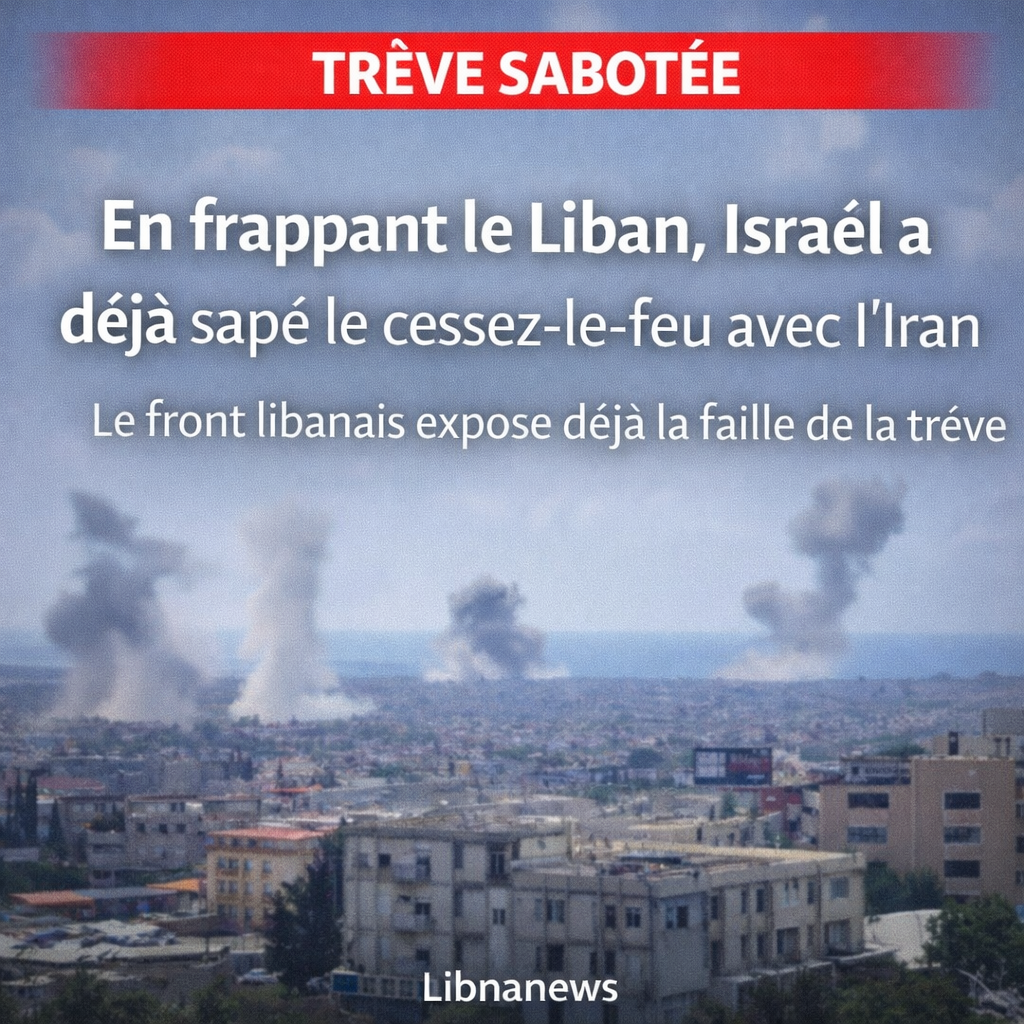
Barely announced, the ceasefire between Washington and Tehran struck the Lebanese front. Israel continued its strikes in Lebanon, while affirming that the truce with Iran did not apply. But this reading is far from consensus. Pakistan, the compromise mediator, said that Lebanon was included. Iran defended the same line. France called for Beirut to be fully integrated into the truce. In these circumstances, the continuation of Israeli bombings in Lebanon does not only appear to be the continuation of a separate military campaign. In the eyes of some of the actors in the crisis, it looks like a direct challenge to the ceasefire itself.
A truce already divided on its perimeter
The starting point for the problem is simple. The two-week ceasefire announced between the United States and Iran has never been interpreted uniformly. Israel quickly said that it supported the pause on the Iranian front, but that it did not concern Lebanon. Benyamin Netanyahu thus validated the American decision while tracing a red line: the war against Hezbollah would continue. At the same time, Pakistani Prime Minister Shehbaz Sharif claimed that the agreement also included a cessation of hostilities in Lebanon, and Iranian officials and nearby Hezbollah relays supported the same reading. This discrepancy does not affect a detail. It concerns the very geography of the ceasefire.
The question is no longer whether a text was concluded between Washington and Tehran. She asked whether the text was regional in scope, particularly in Lebanon. However, several signals show that, for some of the mediators and diplomatic actors, the answer is yes. Emmanuel Macron called for Lebanon to be fully included in the peace framework. Other European capitals stressed the need to expand de-escalation to the Lebanese front. This shows that, in the eyes of several partners, Lebanon cannot be left outside a regional agreement.
Israel has chosen to impose its own reading of the ceasefire
Faced with this ambiguity, Israel did not wait. He imposed his own definition of things by the facts. The Israeli army continued its operations in Lebanon, maintained evacuation orders and confirmed that « the battle continues » against Hezbollah. Strikes were reported in Tyre, Saida, the southern suburbs of Beirut, Bekaa and several southern Lebanese localities. Arab-speaking spokesman Avichay Adraee even claimed a large-scale operation against about 100 sites and infrastructure attributed to Hezbollah in Beirut, Bekaa and in the south of the country. In practice, therefore, Israel has transformed its political interpretation into a military reality.
This method changes everything. When a ceasefire is contested on its scope, it is not the communiqués alone that settle. It’s also power relations. In continuing the bombing, Israel claims that Lebanon is not covered. But it is not just a position. It seeks to impose it even before a broader diplomatic consensus is formed. This is precisely what feeds the accusation of violation: for those who consider that Lebanon was part of the arrangement, Israeli strikes are not merely a continuation of a separate front, they are the very negation of the logic of the ceasefire.
Pakistan and Iran argue that Lebanon was included
Pakistan’s role is central to this sequence. Islamabad was at the heart of the mediation, which helped to avoid a further direct escalation between the United States and Iran. Shehbaz Sharif publicly stated that the agreement also included a cessation of hostilities in Lebanon. This formulation is not marginal: it comes from the actor who precisely carried the ceasefire between Washington and Tehran. If the mediator says that Lebanon is included in the scheme, then the Israeli argument of a completely separate front ceases to be self-evident.
Iran, for its part, defended the same architecture. Several press reports show that Tehran has insisted that attacks against its allies also cease, and therefore that Lebanon be included in the spirit of compromise. Moreover, this was recalled by officials close to Hezbollah, explaining that the movement had suspended its attacks after the announcement of the truce. If Iran considers that Lebanon is entering the ceasefire, then Israeli strikes on Lebanese territory can be read, from an Iranian perspective, as a violation of the agreement or, at least, as an attempt to empty it from its substance.
Hezbollah suspended its attacks, Israel continued its strikes
There is another factor in the debate. According to sources close to Hizbullah relayed by a large news agency, the movement suspended its attacks against Israeli forces after the ceasefire was announced. At the same time, Israel continued its operations, including attacks on localities in southern Lebanon and increasing its pressure on the southern suburbs of Beirut. This asymmetry feeds a simple narrative: one camp held fire, the other continued. Even if this story remains disputed, it gives added weight to the idea that the truce was undermined, or at least severely weakened, by the Israeli decision to maintain the war in Lebanon.
Hezbollah also called on the displaced people from the South, the Bekaa and the Dahiyé not to return until an official and definitive announcement of a ceasefire in Lebanon. The movement was said to be close to a historic victory, but it also explained that Israel could seek, in the last hours, to produce an artificial image of military success. This caution shows that, from the Hezbollah point of view, the war is not over on the Lebanese ground, even if the American-Iranian truce does exist.
Israel has a history of truce violations in Lebanon
This debate does not arise in a vacuum. It is part of a very heavy Lebanese history. After the 2006 war, the ceasefire under resolution 1701 was followed by repeated Israeli violations of Lebanese airspace. An agency dispatch recalled that UN peacekeeping forces and Lebanon viewed these overflights as a violation of resolution 1701, which ended the 2006 war. Another press summary reported tens of thousands of violations of Lebanese airspace reported by Beirut since 2006.
The most recent precedent goes in the same direction. Following the November 2024 truce between Israel and Hezbollah, violations were reported almost immediately. As early as 2 December 2024, Israeli dispatches reported deadly strikes in southern Lebanon, while Hizbullah reported a defensive warning strike in response to repeated Israeli violations, including strikes and bombings. In other words, the idea of an Israeli non-compliance with the truce in Lebanon is not merely a current political argument. It relies on a documented, old and recent sequence.
This time, Israel also tests Iran’s will
The novelty of 2026 is elsewhere. By continuing its strikes in Lebanon while the ceasefire with Iran has just been announced, Israel is not merely repeating a pattern of violations already observed. It is also testing the Iranian will to see Lebanon effectively affected by the truce. Tehran suggested that continued Israeli operations against Lebanon could threaten the balance of the ceasefire. Pakistan argued that Beirut was part of the compromise. By continuing the bombings, Israel therefore checks how far Iran is ready to go to defend this regional reading of the agreement.
This gives the episode its strategic reach. It is not just a question of whether Israel is still bombing a separate front. It is also a question of whether it can impose, by force, a reduction in the perimeter of the ceasefire without causing a direct Iranian reaction or a wider break in the truce. In this sense, Lebanon has become a test ground: test of the strength of the agreement, test of Iran’s ability to defend its allies, and test the possibility for Israel to unilaterally redefine the limits of de-escalation.
Violation of the letter or spirit, the credibility of the truce is already reached
The strictest legal formula is to say that the violation is contested, as Israel denies that Lebanon is part of the ceasefire. But politically and diplomatically, the diagnosis is much more severe. If Pakistan, Iran and several European partners believe that Lebanon should be covered, if Hezbollah has stopped its attacks, and if Israel has nevertheless continued massive bombings, then the truce has already been undermined. Whether it is a violation of the letter or a violation of the spirit, the result is the same: the credibility of the ceasefire is weakened from the very beginning.
And this is the central point. By striking Lebanon, Israel not only continued a military campaign. It prevented American-Iranian de-escalation from becoming, even temporarily, a regional de-escalation. For Tehran and the mediators, this amounts to breaking the fragile balance on which the agreement was based. For Europeans, this proves that the truce is incomplete. And for Lebanon, that means that the peace announced elsewhere continues to escape it.




