

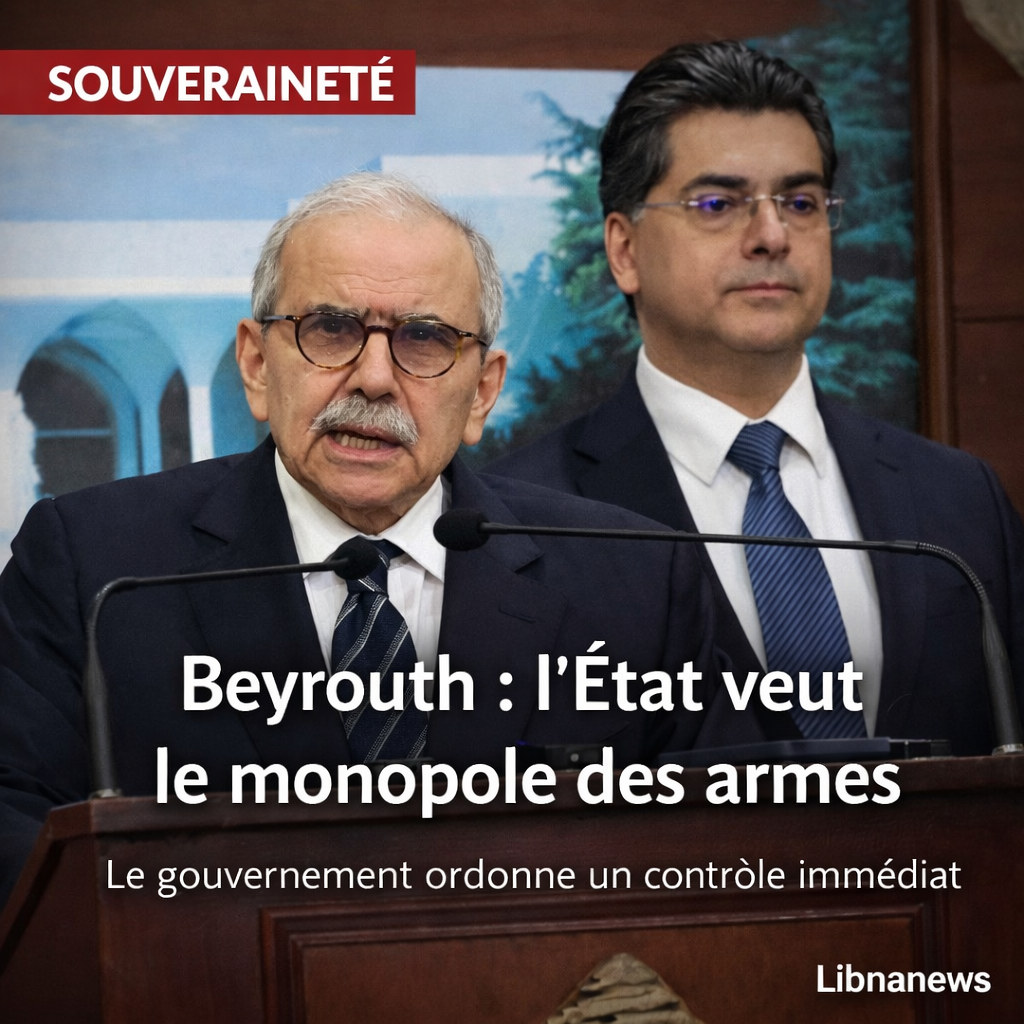
On Thursday, the Lebanese Government reached a major political stage. At the conclusion of a Council of Ministers held at the Baabda Palace under the chairmanship of the Head of State Joseph Aoun, the Executive called on the Lebanese Army and the security forces to immediately begin to strengthen the total control of the State over Beirut governorate and to reserve arms there for legitimate forces only. At the same time, Nawaf Salam’s cabinet decided to lodge an urgent complaint with the United Nations Security Council after the Israeli strikes on Wednesday, particularly on the capital. The two-way decision comes in the aftermath of a day marked by a heavy human balance, a strong diplomatic tension around the regional ceasefire and a tightening of the official Lebanese discourse on state sovereignty.
The tone was set at the opening of the session. Joseph Aoun expressed the weariness of power in the face of convictions without concrete effects. « We are tired of sentencing formulas, » he said at the beginning of the Council of Ministers. The President recalled that all Lebanese officials hoped that the ceasefire would include Lebanon, before noting that public statements were moving in another direction. At the same time, he insisted on contacts with Nawaf Salam with several friendly countries in order to obtain for Lebanon « the same chance » as that granted to the United States and Iran, i.e. a possibility of going towards a cessation of hostilities and then towards negotiations.
But it was above all another sentence by Joseph Aoun that gave his political meaning to the day. « We are a state, we have an entity, we exist, and it is the state that negotiates. We do not accept that someone else negotiates for us. This statement summarizes the line adopted by the Lebanese government: sovereignty is not limited to territory or international law, it also concerns political speech, diplomatic representation and, now, the issue of arms in the capital. In a few words, the Head of State linked the two dimensions of the crisis. On the one hand, no one should speak on behalf of Lebanon at the regional level. On the other hand, the State intends to reaffirm that in Beirut the weapon must be the sole responsibility of the legitimate authorities.
An immediate decision on arms in Beirut
At the end of the meeting, Nawaf Salam outlined the government’s decisions in a very direct formulation. « In order to preserve the security of citizens, their safety and their property, the army and the security forces are called upon to begin immediately to strengthen the total control of the state over Beirut governorate and to limit weapons to legitimate forces alone, » said the Prime Minister.
The choice of words is important. The government does not speak of a distant perspective or a general objective. He gives immediate instruction. It does not only require more security. He called for « start immediately » to strengthen total state control. And he is not talking about a gradual reduction of weapons in general. It demands that in Beirut weapons be limited to « only legitimate forces ».
The decision is explicitly based on the national agreement document, known as the Taef Agreement, as well as previous decisions of the Council of Ministers. In the government statement, this reference is not decorative. It aims to put the measure in an institutional continuity and not in an improvised gesture born of the emotion of the moment. The government wants to show that its decision is both political, security and legal.
The text goes further. It also calls for tougher law enforcement, « all necessary measures » against offenders and their referral to the competent court. In other words, the decision is not limited to a display. It also announces an implementation component, at least with intent, with judicial follow-up for the violations found.
Why Beirut is targeted first
The fact that the measure first concerns Beirut gives the decision its most visible scope. The capital concentrates on institutions, seats of power, diplomatic representations and much of the national activity. It is also the space where state sovereignty is most observed, inside and outside. By choosing Beirut as an immediate field of application, the government is clearly seeking to send a strong signal.
In the current sequence, this choice also has practical meaning. Beirut was hit by the Israeli strikes on Wednesday. The government therefore wants to prevent the capital from appearing only as a hit, injured or vulnerable city. He also wants to present it as the place where the State reaffirms its authority. This is not a communication detail. At a time when Lebanon is trying to convince its partners that there is still a credible political and institutional interlocutor, mastering the capital becomes a central argument.
The formula used by Nawaf Salam, « strengthening the total control of the state », shows the ambition of the message. It is not just about securing sensitive neighbourhoods or increasing patrols. A principle must be reaffirmed: the capital must be under the exclusive authority of legitimate forces. In the Lebanese context, this sentence obviously has a broader political scope than its only administrative reading.
Joseph Aoun: « We do not accept that someone should negotiate for us »
The speech of the President of the Republic sheds light on the meaning of the government decision. Joseph Aoun insisted that Lebanon cannot be treated as a mere subject of regional negotiations. « The state is the one that negotiates, » he hammered. « We don’t want anyone negotiating for us. It’s something we don’t accept. »
This declaration is part of a time when Lebanon felt left at the margin of a ceasefire announced between Washington and Tehran, and quickly redefined without it. By saying that no one can speak on behalf of Lebanon, Joseph Aoun seeks to restore a clear hierarchy: decisions concerning the country must go through its institutions. His words are valid in the diplomatic field. But it also sheds light on the decision on arms in Beirut. For a state that claims the exclusive right to negotiate also logically claims the exclusive right to exercise armed authority over its capital.
The President also praised the work of the ministries, the army, the security forces, the fire brigade, the Civil Defence, the Red Cross and international organizations that helped mitigate the consequences of the Israeli attacks. He paid tribute to those who fell while fulfilling their duty. This passage is important. Joseph Aoun wanted to show a state at work, solidarity in emergency, capable of collective action despite the violence of the strikes.
Nawaf Salam opens two fronts: internal security and complaint to the UN
The Council of Ministers has not only taken a decision on Beirut. It also decided to file « an urgent complaint to the Security Council » against the Israeli attacks and their extension on Wednesday, 8 April, « in particular in the capital Beirut », in the words of the Head of Government.
In his statement, Nawaf Salam stressed that this escalation had occurred « in the face of all international and regional attempts to stop the war in the region ». He also accused Israel of trampling on the principles of international law and international humanitarian law, and even of aggravating the violation.
Again, the government logic is clear. The Lebanese Government does not want to separate the internal response from the external response. It combines a decision on state authority in Beirut with a diplomatic offensive against Israel before the United Nations. In other words, it responds to war on two levels at the same time: the internal order and the international scene.
The office of Nawaf Salam gave this approach a very harsh tone. According to its wording, it is « to mobilize all the political and diplomatic resources of Lebanon to stop the Israeli killing machine ». This very strong sentence shows that the government does not want to limit its response to technical or procedural language. He wanted to politically describe the strikes of the day before and turn that shock into a diplomatic initiative.
A decision after a bloody day
The context is essential to understand the scope of the government meeting. On Wednesday, Lebanon suffered a series of particularly deadly Israeli strikes. The Lebanese Ministry of Health reported 182 deaths and 890 injuries. Other figures were then circulated, but this official assessment is sufficient to measure the scale of the tragedy that preceded the Council of Ministers.
Nawaf Salam explicitly linked the cabinet’s decisions to this day of April 8. The complaint to the Security Council concerns « the Israeli aggressions yesterday », he said, insisting on their intensification and extension, particularly in Beirut. The government is therefore seeking to make 8 April a political date, not just a tragic date. He wants to turn Wednesday’s strikes into a tipping point, both on the diplomatic scene and on the issue of state control in the capital.
This link is central. The decision on arms in Beirut is not presented as an abstract reform. It intervenes in a moment of war, just after a day of massive strikes. This gives him a special weight. For the government, strengthening state authority in the capital also becomes a way of responding to the fragility highlighted by the bombings.
The language of power has changed
The words of Joseph Aoun and Nawaf Salam show a hardening of official language. The president said he was tired of the simple convictions. The Prime Minister speaks of « Israeli killing machine ». The Government refers to an immediate recourse to the Security Council. Above all, the executive gives explicit security instruction on Beirut.
This change of tone is notable. For a long time, the Lebanese official word has often oscillated between condemnation, call for calm and request for external assistance. On Thursday, the vocabulary remains diplomatic, but it also becomes more assertive. The state says what it wants on its territory. He says who has to negotiate on his behalf. He tells whom to return the weapons to his capital.
The fact that these messages emerge from a Council of Ministers chaired by Joseph Aoun also gives them a broader institutional meaning. This is not an isolated statement by a minister or party official. It is a formalised line at the highest level of the executive.
An explicit reference to the Taef Agreement
The government statement takes care to mention the national agreement document, known as the Taef Agreement. This point deserves to be stressed, as it shows that the executive seeks to anchor its decision in the founding framework of the Lebanese post-war era.
In recalling Taef, the government is not only talking about an emergency linked to Israeli strikes. It sets its decision in the historical logic of strengthening the state and the monopoly of the police. This also makes it possible to present the measure not as a short-term initiative against a particular actor, but as an application of a principle already recognised in the Lebanese political system.
In fact, everyone understands that the issue of arms in Lebanon refers to a much broader and more sensitive issue. But at the institutional level, the executive has chosen a clear formulation: the decision concerns Beirut, it is based on Taef, it is aimed at the security of citizens and it reserves arms to legitimate forces.
The government wants to relocate the state to the centre
Joseph Aoun emphasized the joint efforts of ministries, security forces, the army, civil defence, the Red Crescent and international partners to mitigate the impact of the strikes. This passage should not be overlooked. It completes the rest of the sequence. The President seeks to create the image of a state that acts, helps, coordinates and decides.
It is in this sense that the order given to the army and the security forces must be read. The goal is not only to produce an announcement effect. It is also to place the state at the centre of the national narrative, at a time when war and non-State armed actors have often occupied the forefront.
Nawaf Salam follows the same line. His speech combines protection of citizens, complaint to the UN and restoration of legitimate authority in the capital. The state, in this presentation, is no longer just a crisis manager or diplomatic relay. He is a direct actor in the restoration of law and order and sovereignty.
A political step, not yet an end
The journalistic nature requires a distinction between the announcement and its implementation. What the government decided on Thursday is undoubtedly important. But what remains to be observed now is the concrete steps that will be taken in Beirut.
The official text speaks of an immediate beginning. It will therefore be necessary to look at how the army and the security forces will translate this order: enhanced presence, increased control, judicial measures, stricter enforcement of laws. At this stage, the Council of Ministers has set a policy direction and framework. Enforcement will be the responsibility of the security apparatus and government monitoring.
This does not remove the weight of the decision. In Lebanon on 9 April, as the country emerges from a day of deadly strikes and attempts to make itself heard on the international scene, the fact that the government explicitly binds Beirut, legal weapons and state authority is already a turning point.
A capital under the sign of sovereignty
The message of the day can simply be summed up. For the Lebanese Government, Beirut must no longer be an ambiguous space on the issue of arms. It must become again the most obvious place of public authority. At the same time, Lebanon no longer wants others to speak diplomatically. It wants to bring its own complaint against Israel before the Security Council and defend itself in any regional negotiations.
In a few hours, Joseph Aoun and Nawaf Salam have therefore articulated three strong ideas: the state alone negotiates, the state alone must exercise legitimate force in Beirut, and the Lebanese state will politically respond to Israeli strikes. It is this consistency that makes the Thursday session an important moment in the current sequence.
The continuation will depend on the actions. But on the political front, the signal is already clear: in the aftermath of the bombings, the Lebanese authorities chose to respond not only by complaint and condemnation, but also by a direct reaffirmation of the state’s authority in its capital.




