

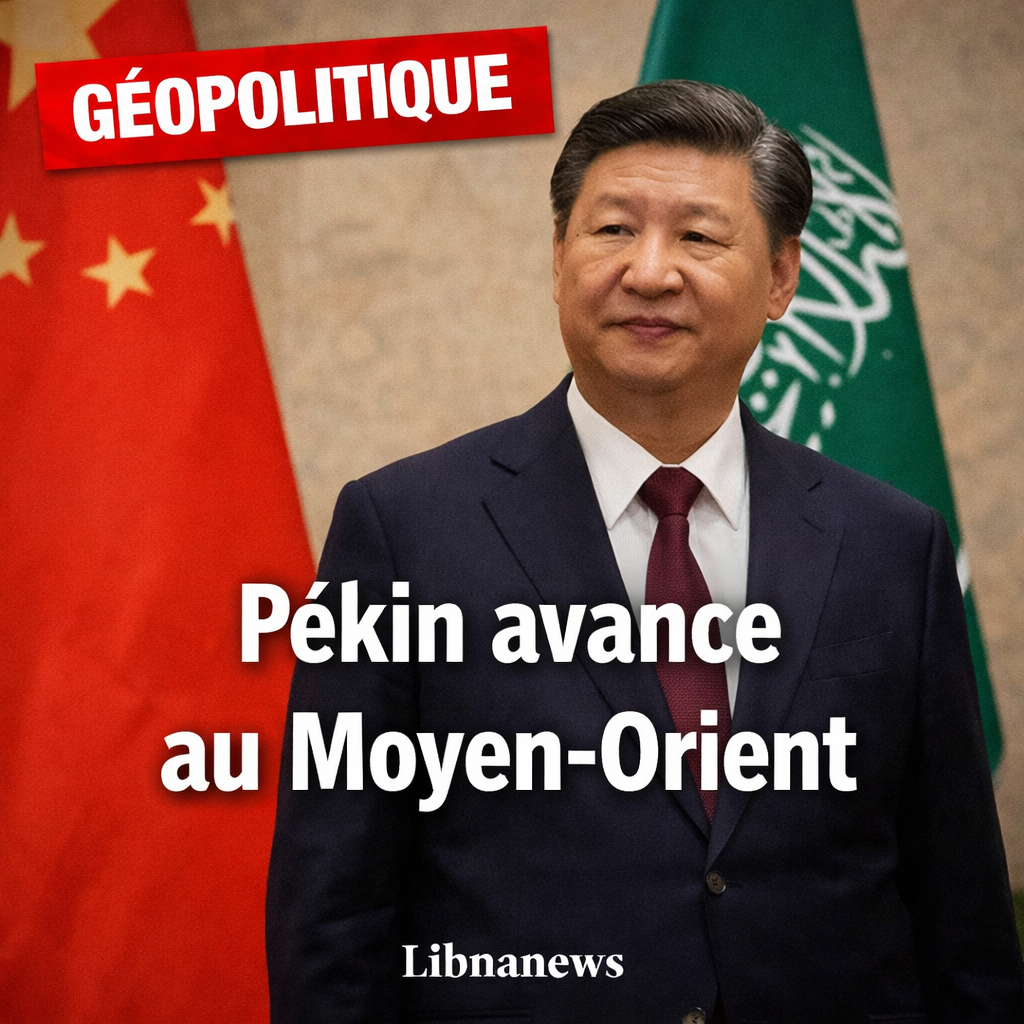
The crisis around Iran, the Strait of Ormuz and the American maritime blockade not only reveals a new phase of confrontation between Washington and Tehran. It also sheds light on Beijing’s exact role in the Middle East of 2026. China has not become the military power that replaces the United States in the Gulf. On the other hand, it increasingly appears to be the power that benefits from the cracks of the American system, maintains channels with all camps and transforms each regional crisis into diplomatic, energy and commercial leverage. Its influence on Iran is real, but it remains selective. Its attractiveness to the Gulf monarchies grew, but it did not yet translate into a guarantee of security. It is precisely this ambiguity that today makes its strength.
A power present without protection
The Chinese advantage begins with a paradox. For years, Beijing has built a dense but light presence in the Middle East. China trades with Iran, invests in Gulf countries, speaks to Riyadh, Abu Dhabi, Tehran, Ankara and, to some extent, Israel. However, it does not cover the costs of protecting power. Several Western and regional analyses converge on this point: China’s economic presence in the region has long flourished away from the stability guaranteed, directly or indirectly, by the US military presence. In short, Beijing benefited from the Washington strategic umbrella without bearing the political, budgetary and military bills.
This explains much of China’s current position. Beijing does not seek to become the Gulf gendarme overnight. China still lacks projection capabilities comparable to those of the United States in the region, does not propose a defence treaty to the Arab monarchies and still repulsive of being confined to rigid alliances. His method is different. It consists of increasing competing partnerships, maintaining maximum room for manoeuvre and making crisis diplomacy an instrument of influence rather than a security commitment. China wants to be indispensable, not exposed.
Chinese influence on Iran remains asymmetric
On Iran, this logic produces a relationship that is both solid and limited. Strong, because China remains Tehran’s main energy outlet despite Western sanctions. Available energy data show that in 2024 Iran was the largest source of crude oil exports to China, and that about 90% of these volumes were absorbed by independent Chinese refineries. Other US estimates also indicate that China had captured nearly 90 per cent of Iranian crude and condensate exports in 2023. For Tehran, this link is not marginal. It is an economic valve and a form of business continuity at the very moment when Western circuits are locked.
But this influence should not be confused with control. Beijing has never made Iran an exclusive strategic bet. Its global trade, energy supplies and major regional projects are much wider than the only Iranian-Chinese relationship. Experts who have been observing the crisis since the beginning of the year point out that Iranian oil is useful to China, but not irreplaceable. Beijing can turn to Russia, Saudi Arabia, Iraq, the United Arab Emirates, Oman or Brazil. Asymmetry is therefore clear: Iran needs China much more than China needs Iran. It is this imbalance that gives Beijing real influence, but also great caution.
This caution is reflected in the current sequence. On the one hand, China publicly rejects US accusations that it is providing military aid to Iran. His Department of Foreign Affairs described these allegations as manufactured and warned that further US tariff escalation would lead to countermeasures. On the other hand, Beijing does not break with Tehran, condemns the American blockade of Iranian ports as dangerous and irresponsible, and continues to call for a lasting ceasefire and a political solution. This double message is central. It means that China does not want to abandon Iran, nor to be dragged into a frontal confrontation with the United States on behalf of Iran.
Therefore, the Chinese role in the crisis must first be read as an interested stabilizing role. Beijing wants to prevent a regional collapse that threatens its supplies and investments. He also wants to avoid Washington turning the war against Iran into a broader strategic test against China. But he does not want to pay the price of direct protection from Tehran. This applies not only to the military field, but also to diplomacy. Beijing can offer words, channels, meetings and partial political coverage. It does not provide, at this stage, the equivalent of a defence umbrella.
Beijing Diplomatic Capital
The Chinese diplomatic force comes from another capital: its ability to speak to all those who no longer speak. The most important precedent remains the resumption of diplomatic relations between Saudi Arabia and Iran, announced in Beijing in March 2023 with the direct support of the Chinese authorities. Beijing then maintained this success in December 2023 at the meeting of the China-Saudi Arabia-Iran trilateral committee, showing its readiness to continue supporting the improvement of relations between the two regional powers. This balance sheet is limited, but it counts. In a region saturated with Western interventions, China succeeded in anchoring the idea that it could achieve at least one result that Washington had not produced.
In the current context, this diplomatic acquis is again valuable. When Pedro Sánchez told Beijing that China could play an important role in resolving the conflict, he did not speak of a power capable of sending aircraft carriers to secure the Gulf. He talks about an actor who retains political access to capitals that the West has lost or weakened. That’s where Beijing is gaining ground. Not because it replaces American power, but because it exploits the political vacuum created when American power convinces less than before.
A blockade against Tehran and China
The American blockade is a perfect illustration of this shift. Legally and operationally, the arrangements announced by the United States Central Command do not constitute a total closure of the Strait of Ormuz. The US text refers to ships entering or leaving Iranian ports and states that freedom of navigation to non-Iran ports should not be impeded. This nuance is decisive. She explains why Washington-sanctioned vessels were still able to cross the Strait. Rich Starry, linked to a Chinese company that had been under US sanctions since 2023 for its trade relations with Iran, crossed the Strait on Tuesday while it was not on its way to an Iranian port. Another sanctioned vessel, the Murlikishan, former M.K.A., also headed towards the passage while it was to load in Iraq.
In other words, the US blockade is not formally directed against China. But, in fact, it affects a commercial ecosystem where China is omnipresent. The 2023 US sanctions against Shanghai Xuanrun Shipping and the then named Full Star, now Rich Starry, like those of 2025 against the M K A for transport of Iranian and Russian oil products, show that Washington targets a grey logistics that connects Iran to Asian markets. When Donald Trump then threatens Beijing with additional tariffs if it is established that China is militarily assisting Iran, he adds a commercial dimension to this maritime pressure. The message is clear: to raise the cost of any Chinese support, whether real, supposed or simply tolerated.
At this stage, the public record available mainly shows an American conditional threat and a Chinese denial, not an open demonstration of military deliveries released on Tuesday. On the other hand, it is already visible that Washington is seeking to link three dossiers into one: Iran, the Gulf maritime routes and rivalry with China. This coupling changes the nature of the crisis. It is no longer just a matter of containing Tehran. It is also a question of telling Beijing that the Middle East, long regarded as a secondary ground in the Sino-American competition, can become a field of direct economic coercion.
The Gulf seeks further balance
This evolution occurs at a time when American influence in the Gulf appears less automatic. The United States remains the only power able to act militarily on a large scale in the region. But war has shown the political limits of this superiority. Analyses published in recent days point out that the Arab Gulf States have managed to intercept much of the Iranian strikes, but that they still know they are vulnerable. Above all, they find that being under American umbrella does not shelter them from being targeted, precisely because they house American bases and are integrated into the Western security system.
This sentiment feeds a double alternative search. The first is not a shift to China as a military protector, because Beijing does not offer this service. The second is not a conversion to the Iranian camp either. It is more like a strategy of de-escalation with Tehran and diversification beyond Washington. The first signals are visible. Saudi Arabia and Iran have resumed official contact since the beginning of the conflict. At the same time, regional voices are advocating for expanded partnerships with Turkey, Pakistan, India and other middle powers. Broader strategic studies are, moreover, well beyond the Gulf alone, a growing tendency of non-Western states to diversify their security partners beyond Western actors.
Beijing is moving forward in this space. China does not need to replace America to gain influence. It suffices to appear as the interlocutor who does not bomb, who does not condition everything to a complete political alignment, and who can speak simultaneously to Iran and the Gulf monarchies. It takes advantage of regional fatigue in the face of the cost of wars, but also of the doubt about the American ability to offer both protection, de-escalation and predictability. For Gulf leaders obsessed with business continuity, energy, logistics corridors and major technological projects, this argument counts as much as the military balance of power.
No change or replacement
The centrality of the Strait of Ormuz further reinforces this movement. In 2024, about 20 million barrels per day passed through this passage, equivalent to 20% of the global consumption of petroleum liquids. More than four fifths of the flow of crude oil, condensates and liquefied natural gas passing through Asia is destined for Asia. China, India, Japan and South Korea are among the major recipients. This means that any crisis in Ormuz weighs more economically on Asia than on the United States. In such a context, Beijing cannot remain a mere spectator, even if it does not want to become a belligerent. Gulf security is not a distant issue for him. It is a matter of energy, logistics chains and now strategic rivalry with Washington.
The real recomposition that is emerging does not therefore oppose an American bloc to a Chinese bloc. It is based on finer adjustments. Iran seeks to monetize its nuisance capacity to survive, obtain diplomatic openings and recall that no stable regional order can be built against it. The Gulf monarchies sought to reduce their exclusive security dependence on the United States without breaking with them, while reopening canals with Tehran to avoid being the battlefields of others. Finally, Beijing seeks to consolidate a pivot position: close enough to Iran to count, bound enough to reassure, cautious enough not to assume the war, and present enough to appear as a political remedy when Washington worries more than he reassures.
It is for this reason that the passage of ships linked to Chinese interests despite the blockade, US tariff threats, Beijing denials and Gulf reactions must be read together. The current crisis does not prove that China has already supplanted the United States in the Middle East. Rather, it shows that American power no longer structures all decisions alone. In the sequence that opens, Beijing is not yet the protector of the Gulf. But it becomes increasingly the partner to which one turns when the order guaranteed by Washington ceases to appear as safe, legible and sufficient.




