

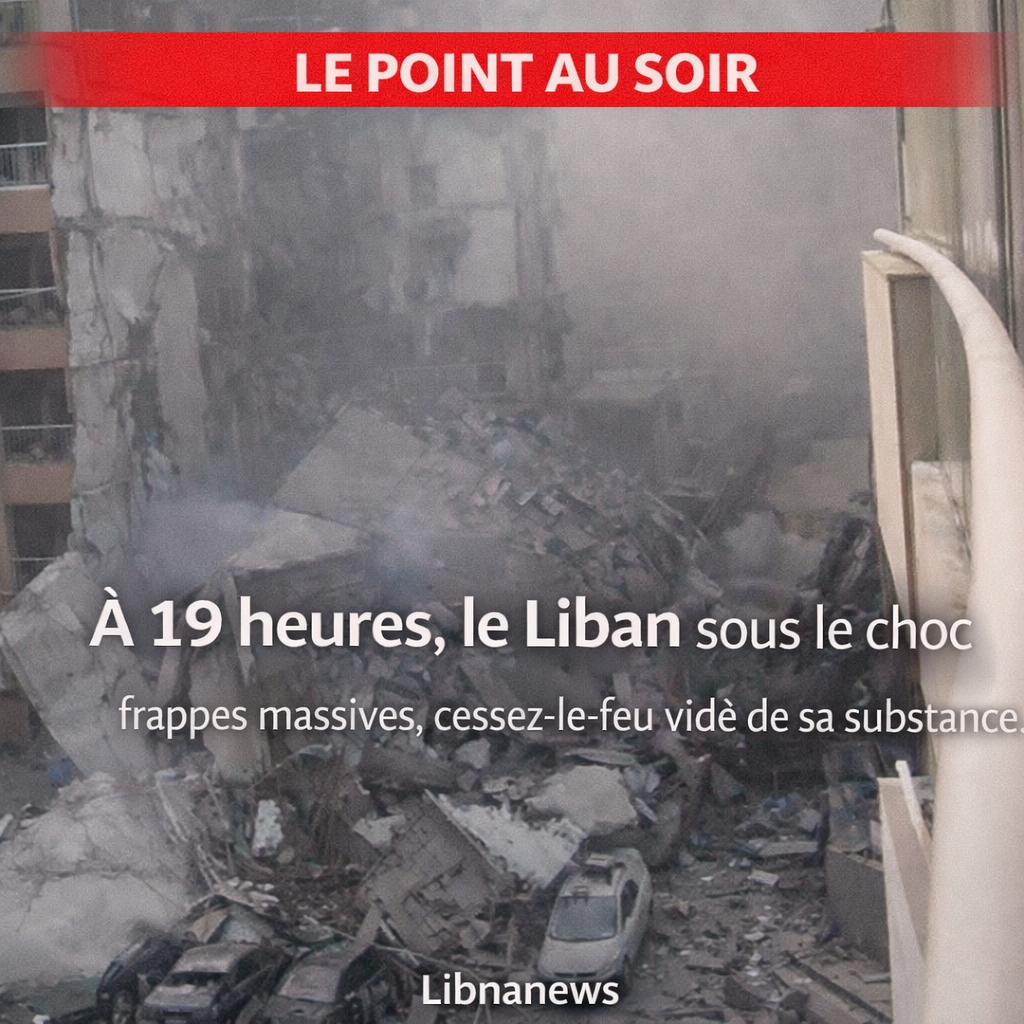
At 7 p.m., Lebanon emerged from a day that changed the regional sequence. The Israeli army carried out the largest wave of strikes of this war phase, affecting Beirut, its suburbs, Saida, Bekaa, Tyre, Hermel, Zahlé and many southern localities. Officially, the strongest consolidated record available at this time is 89 deaths and 700 injuries, according to the Lebanese Ministry of Health, relayed by Reuters. Officially, much heavier reports are circulating, exceeding 300 deaths according to several Lebanese local news outlets and media outlets, but this figure is not confirmed at this stage by a consolidated official source.
The day began with a political contradiction that became military. A two-week ceasefire was concluded between Washington and Tehran. But Donald Trump allowed the Israeli reading that Lebanon is not part of it. Benyamin Netanyahu said straight away, and the Israeli army continued its operations against Hezbollah. On the other hand, Pakistan, the mediator of the agreement, argues that Lebanon should be included, just like Iran. In a few hours, this divergence of interpretation has become a de facto rupture on Lebanese ground.
The Israeli offensive of the day was presented by the IDF as the biggest coordinated strike of this campaign in Lebanon. According to AP, more than 100 targets were targeted in about 10 minutes in Beirut, Bekaa and the South. Reuters confirms that the Israeli army continued its war in Lebanon despite the truce with Iran. This gives the day of 8 April a special scope: it is not just a further escalation, but the moment when regional de-escalation has stopped protecting, even symbolically, Lebanese theatre.
On the human level, the official figure of 89 deaths and 700 injuries, including 12 rescuers among the deaths according to Reuters, is probably not yet telling the full extent of the shock. Libnanews, based on local upwellings and statements by the Minister of Health Rakan Nassereddine, refers to hundreds of deaths and injuries across the country, as well as a much higher informal assessment than already consolidated figures. But at 7 p.m., the following line of rigour must be kept: the threshold of the 300 dead is credible in the field accounts and in several Lebanese relays, not yet in the verified official balance sheet.
The drama of Chmistar summarizes the brutality of the day without exhausting it. In this village of the Bekaa, ten people were killed and four injured near the cemeteries while waiting for the arrival of a funeral procession, according to information relayed by Libnanews from the National Information Agency. But Chmistar is just one episode in a much wider sequence, which also affected Beirut and its suburbs, Saida, Tyre, Hermel and other parts of the country. It is precisely this national character of carnage that marks the end of the day.
In Beirut and its periphery, the day was marked by attacks on dense urban areas, urgent calls for blood donation and strict traffic instructions to allow ambulances and rescue personnel to pass through. AP describes strikes on densely populated central neighbourhoods, while the stories relayed by Libnanews emphasize hospital saturation and the multiplication of emergencies. The capital was not only reached: it was handed over to the centre of the battlefield.
Politically, President Joseph Aoun strongly condemned the Israeli offensive, holding Israel fully responsible for its consequences and calling on the international community to intervene. This reaction is part of a Lebanese attempt to take hold of a sequence where the country was spoken by others more than he spoke for himself. But at this hour, the Lebanese official word weighs less than military events: the strikes have been imposed faster than diplomacy.
The most serious point at 7 p.m. is the sequence itself. First, a truce is announced between Washington and Tehran. Then Washington and Israel exclude Lebanon from its real perimeter. Then Israel launched its largest wave of strikes in Lebanon since the beginning of this war phase. Finally, Iran threatens to challenge the truce if the attacks against Lebanon continue. The ceasefire may not yet be legally dead on paper. But on the Lebanese front, it is already politically and militarily emptied of its substance tonight.
The 19-hour observation is therefore double. On the one hand, the confirmed official record is already very heavy: 89 dead and 700 injured. On the other hand, there is evidence that this figure is still going to grow and that it still does not reflect the full extent of the day. What is certain, however, is that Lebanon has now absorbed the main shock of an incomplete regional truce. And only in the evening of 8 April does the very idea of a cease-fire exist in Lebanon in the press releases of others.




