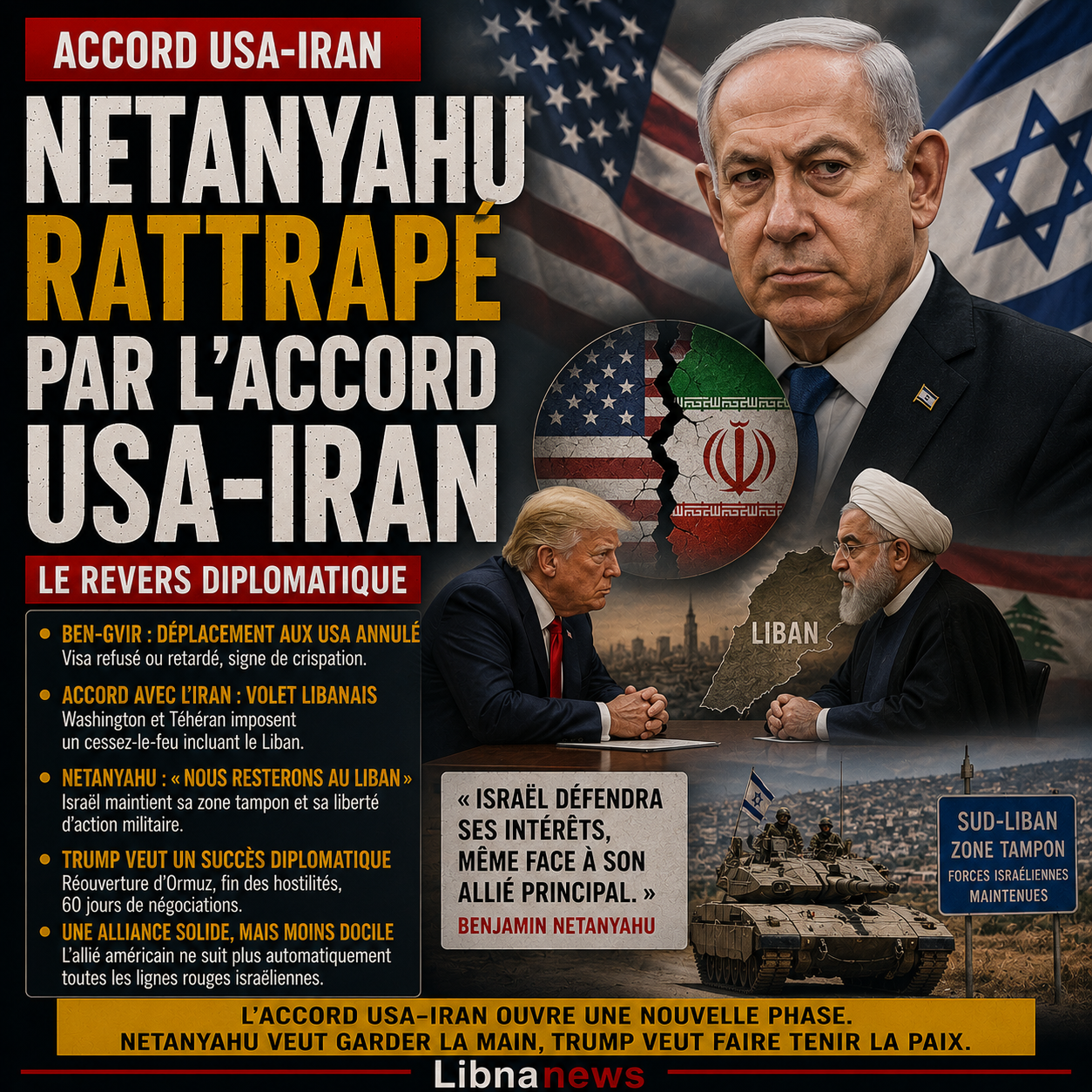
Benjamin Netanyahu finally reacted to the deal between Washington and Tehran. The Israeli Prime Minister claims to defend Israel’s interests, maintain his army in Lebanon and preserve his relationship with Donald Trump. But his speech reveals above all the scale of the diplomatic setback: Israel has not imposed its objectives on Iran and is now in danger of its freedom of action being challenged in Lebanon.
Benjamin Netanyahu finally reacted to the agreement between the United States and Iran, but his speech did not dispel the contradictions. She made them more visible. The Israeli Prime Minister says he wants to transform Israel into a « superpower », preserve the relationship with Donald Trump, prevent Iran from obtaining nuclear weapons and maintain the Israeli army in the buffer zone created in Lebanon. He ensures that the relationship with the US President is a partnership, not a competition. But his speech comes after a protocol that Israel has not mastered and whose Lebanese side directly threatens his freedom of military action.
This reaction is part of a moment of political fragility. Netanyahu had presented the war against Iran as a battle to neutralize an existential threat. However, the agreement announced by Washington and Tehran does not proclaim the fall of the Iranian regime or the definitive destruction of its strategic apparatus. It opens a period of negotiations, suspends hostilities and includes Lebanon in the field of a ceasefire. For Israel, this is an ambiguous result. The army claims success. The government claims to have hit Iran hard. But the final diplomatic framework bears Trump’s signature.
Netanyahu therefore tries to resume the initiative by the verb. He says he’ll win the next election. He refuses to recognize a layoff. He maintains that the Americans appreciate his firmness on Lebanon. He repeats that Israel will defend its interests, even against its main ally. Yet the sequence shows something else. Washington is trying to stop the war. Israel wants to keep its margins in Lebanon. Iran wants this front to be included. Hezbollah rejects all Israeli freedom of movement. The Israeli Prime Minister finds himself in the middle of this node, forced to defend a victory that the agreement makes incomplete.
Netanyahu tries to save the power story
Netanyahu claims a position of strength. It presents Israel as a country capable of becoming a regional, military and technological superpower. The formula flatters an Israeli opinion committed to strategic autonomy. It also responds to internal criticism that the government has allowed Washington to impose an agreement. But it masks an obvious addiction. Israel remains linked to the United States through military assistance, arms deliveries, diplomatic coverage and operational coordination. When Trump decides to suspend the war with Iran, Netanyahu can protest, but he cannot ignore the American choice.
This tension explains its formula on « partnership ». The Prime Minister wants to avoid the image of a direct confrontation with Trump. He claims that everyone stands up for his responsibilities: the US President for the United States, the Israeli head of government for Israel. This development seems logical. It also shows that the personal relationship is no longer enough. For several days, the two leaders have pursued different objectives. Trump wants a quick deal, the reopening of Ormuz and a diplomatic success. Netanyahu wants to prevent this success from engulfing Israeli action in Lebanon.
The word partnership thus becomes a way of denying a hierarchy that is actually necessary. The agreement was negotiated between Washington and Tehran, with regional mediations. Israel has not set out the main terms. He discovered a text that could limit his military conduct on the Lebanese front. By refusing the word competition, Netanyahu seeks not to provoke Trump. By refusing the word taxation, he seeks not to appear weakened in front of his electorate. The formula protects the image, but it does not regulate the balance of power.
Iran, maximum objective and incomplete result
The most sensitive point remains Iran. Netanyahu claims that he did not say that his goal was to directly overthrow the Iranian regime, but to help the Iranians do so. This accuracy resembles a path correction. During the war, Israeli discourse often suggested that the survival of the Tehran regime was part of the strategic problem. On returning to this nuance, the Prime Minister tries to avoid the accusation of failure. If the Iranian regime remains in place, it can say that the goal was not a regime change operation led by Israel.
This line remains fragile. Helping a foreign population to overthrow its leaders is, however, tantamount to putting Israeli policy in a state of destabilization. It also exposes Netanyahu to a contradiction. If he says that the Iranians must decide themselves, why present war as the main lever of their liberation? And if the central objective was only nuclear, why insist so much on the regime? The speech seeks to reconcile two stories: an existential war against the Iranian state and a limited pressure to prevent the bomb.
The Iran-US protocol weakens this construction. Trump says Iran will not have nuclear weapons. Netanyahu reiterates that he remains committed to this goal. But he also admits not to be sure of the details of the agreement between Washington and Tehran. This sentence is politically heavy. A Prime Minister who has engaged his country in a major confrontation with Iran admits that he does not know exactly the terms of a post-war text. He may present this reservation as prudent. Its opponents will see it as a sign of marginalization.
The other figure, that of 14,000 air strikes with the United States against Iran, is part of the same legitimization effort. Netanyahu wants to show the intensity of the military campaign and the extent of cooperation with Washington. But a volume of strikes alone is not a strategic victory. The decisive question is not the number of operations. She knew what objectives had been achieved. The Iranian regime is still there. The nuclear issue remains referred to negotiations. The ballistic programme remains an open subject. So the war did not produce the announced rupture.
Lebanon as a weak point in the Israeli response
Lebanon concentrates the most immediate failure of the Israeli strategy. Netanyahu claims that Israel will remain in Lebanon « no matter what. » It promises to maintain the buffer zone created by the army. He claims freedom of military action against Hezbollah. This posture is to be reassuring for the inhabitants of northern Israel. It also meets the demands of the Israeli right, which refuses any withdrawal. But it strikes the Lebanese clause of the Iran-American agreement, which Beirut and Tehran present as binding.
The Israeli Prime Minister is trying to turn this contradiction into a demonstration of firmness. He says the Americans appreciate his position in Lebanon. However, the information available indicates a real tension between Washington and Tel Aviv on this point. Trump wants the ceasefire to hold. Iran has made Lebanon a central element of the protocol. Hezbollah links its attitude to Israeli respect for the ceasefire. In these circumstances, Netanyahu’s assertion seems less like diplomatic certainty than an attempt to force American interpretation.
The formula of the four fighters killed near Israeli forces illustrates this logic. Netanyahu wants to show that the army will continue to act at the slightest risk. Tactically, this message targets Hezbollah. On the diplomatic level, he tests the limits of the agreement. Every Israeli operation in Lebanon can now be interpreted as a possible violation of the protocol. Each response can be used to justify maintaining the buffer zone. The freedom of action claimed thus becomes the main obstacle to stabilization.
This position also exposes Lebanon to an extension of uncertainty. The displaced inhabitants of the South are waiting to know if they can return. The Lebanese army calls on them to remain cautious, given the risk of violations and unexploded ordnance. The Lebanese authorities are seeking recognition of the cessation of aggression against the entire territory. If Netanyahu maintains its forces and strikes, the announced ceasefire will remain incomplete. Lebanon will become the ground to measure the sincerity of the agreement and Trump’s ability to weigh on his ally.
Prime Minister under Internal Pressure
Netanyahu’s criticism is not just from his foreign opponents. It also goes up to Israel. The opposition accuses him of having waged a war without obtaining the stated objectives. Some officials believe that military gains may be erased by an externally imposed agreement. Others point out that dependence on Trump makes Israel vulnerable to American decisions. In this context, the promise to win the next election takes a defensive tone. It responds less to confidence than to political threat.
Netanyahu knows that Lebanon can become its electoral heel. If he withdraws the Israeli forces, the right will accuse him of abandoning a safe area conquered at the price of blood. If he refuses to withdraw the army, he risks colliding with Trump and weakening the deal with Iran. If he continues the strikes, he can revive a regional escalation. If he suspends them, he will have to explain why war was necessary. The political margin is narrow. His speech seeks to mask her by formulas of power.
The communication strategy is clear. Netanyahu customizes resistance. He presents himself as the one who says no to pressure, who protects the north, who stands up to Iran and speaks equal to Trump. But this story has a cost. It reduces diplomacy to a demonstration of will. It leaves little room for verification mechanisms, guarantees for civilians, the role of the Lebanese State and the need to avoid a war of wear and tear. The Prime Minister talks about power. The ground, on the other hand, speaks of blocking.
A diplomacy Netanyahu no longer controls
The Iran-American agreement imposes a new reality. Israel is not absent from the balance of power, but it no longer controls the timetable alone. Trump wants to publish the terms, reopen Ormuz and start 60 days of discussions. Iran wants to test Israeli behavior in Lebanon before locking the signature. Hezbollah observes and conditions its restraint. Europeans and several Arab countries welcome the de-escalation while demanding guarantees. Netanyahu may refuse to be bound, but it cannot prevent other actors from considering Lebanon as a central part.
The paradox is therefore profound. Netanyahu claims to defend Israeli sovereignty against any imposed decision. But its strategy in Lebanon is based on a lasting violation of Lebanese sovereignty. He invokes the security of northern Israel, but he agrees to prolong instability in southern Lebanon. He talks about a balanced relationship with Trump, but he admits that he does not know the details of an agreement that determines the future of the conflict. He says he’s targeting the superpower, but he depends on American arbitration.
Another point deserves attention: Netanyahu speaks of the agreement as if he could choose the useful clauses and ignore others. This method works in the Israeli internal debate, where national sovereignty serves as a watchword. It works much less in regional negotiations. If each party reserves the right to respect only those passages which arrange, the protocol loses its value. This is precisely the risk created by the Israeli position on Lebanon.
The Prime Minister’s reaction finally reveals a fundamental difficulty: he does not propose a political exit. He talks about staying, hitting, guaranteeing, warning. He does not say how Lebanon regains its border, how the displaced return, how the Lebanese army resumes its role, or how Hezbollah is integrated or forced into a lasting arrangement. His answer remains military in a diplomatic sequence. This discord may seduce some of Israel’s opinion, but it complicates Trump’s task and increases Lebanon’s exposure.
This shift weakens his reaction. It does not appear as a clarification, but as an attempt to resume a sequence already gone elsewhere. Netanyahu wants to show that he didn’t lose his hand. But the US-Iran deal shows that Washington has chosen its own calendar. He wants to prove that the war has achieved its goals. But nuclear remains in the negotiations, the Iranian regime still stands and the Lebanese front remains open. He promises freedom of action. This freedom is precisely what the protocol seeks to regulate.
The follow-up will depend on very concrete facts. Will Israeli forces remain in the buffer zone in Lebanon? Will the strikes continue despite the ceasefire? Will Trump accept this Israeli interpretation or will it require a full application of the text? Will Iran sign without any real guarantee on the Lebanese front? Will Hezbollah maintain its restraint if Israel continues to act? Netanyahu’s reaction opens these questions without answering them, while the southern border of Lebanon remains the first place where his speech will be checked.