

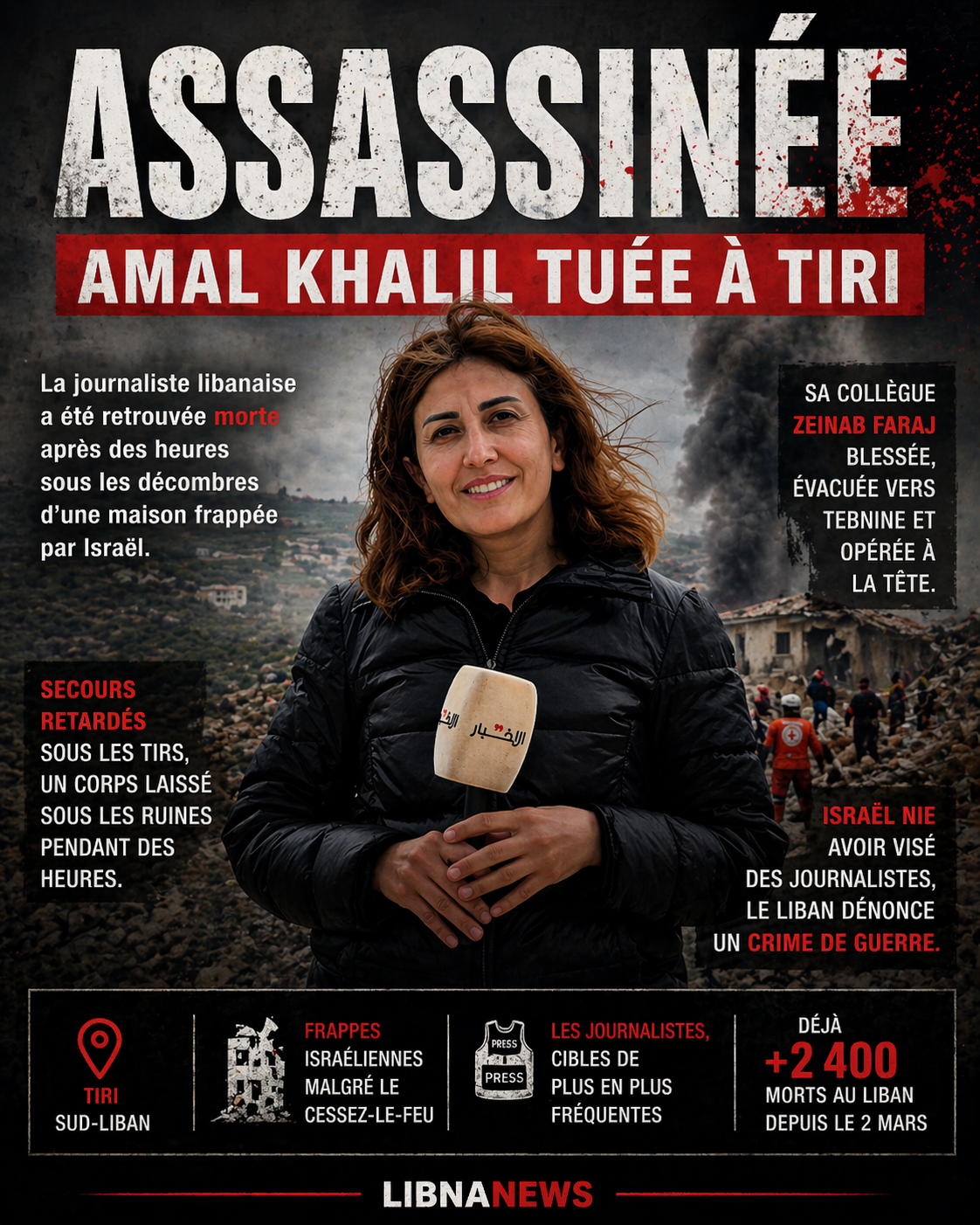
Lebanese journalist Amal Khalil was found dead after hours spent under the rubble in Tiri, southern Lebanon, where she covered on Wednesday the consequences of further Israeli strikes. Her colleague, photographer Zeinab Faraj, was injured and then evacuated to Tebnine Hospital, where she underwent a head surgery and where her condition was then presented as stable.
For Lebanon, the case has immediately become more than an individual drama. It concentrates in one episode three realities of the moment: the continuation of Israeli strikes despite the ceasefire, the extreme vulnerability of journalists in the south of the country, and the inability of the Lebanese state to protect, extract and secure its own information professionals when they find themselves trapped on the ground.
The facts at this stage are heavy. A first strike targeted a vehicle in the town of Tiri, killing its occupants. Amal Khalil and Zeinab Faraj, who came to cover the aftermath of the attack, took refuge in a nearby house. This house was then hit in turn. Helpers were able to reach Zeinab Faraj, seriously wounded, but not Amal Khalil, who remained under the rubble for hours.
According to the Lebanese Ministry of Health and the accounts taken by international news agencies, the relief efforts were delayed by further fire and obstruction by Israeli forces. The Israeli army denies deliberately targeting journalists and contests having prevented the rescue teams from accessing the site. But between his version and the concrete result, there remains a crude fact: a journalist who covered the ground was left under the ruins for hours before his body was finally recovered.
The case is all the more serious as it does not fall from the sky, either politically or militarily. For weeks, the protection of journalists in the South has been a well-known, identified and discussed issue between the Government, UNIFIL and international bodies. The Ministry of Information had announced a coordinated mechanism with the Lebanese Armed Forces to organize access for journalists to the affected areas. He had resumed discussions with UNIFIL on security measures. He had seized a UN Special Rapporteur after previous murderers.
All this existed before Tiri. However, at the time of the actual test, nothing in this arrangement prevented a press team from being hit, and then a body remained under the rubble for several hours in an area where neither the Lebanese army nor the relief or the civilian authorities had succeeded in imposing safe and rapid access.
In Tiri, a series of strikes that burden Israel
The chronology as it emerges from the overlapping elements is already sufficiently precise to ask very serious questions about the Israeli army’s behaviour. A first strike hit a vehicle in the locality of Tiri. The Lebanese Ministry of Health and the National Information Agency reported two deaths in the attack. The Israeli army, for its part, claimed to have targeted vehicles linked to a Hezbollah military structure in an area which it now considers to be part of an enhanced security system.
It was after that first strike that the two journalists found themselves in the area. Amal Khalil, a journalist from Al-Akhbar, and Zeinab Faraj, a photographer, covered developments on the spot. While they were near the site, a new bombardment hit the area. Both women sought refuge in a house. This house was then hit as well. It is this second time that considerably increases the file.
Israel maintains that its operations were aimed at military objectives and that it did not target journalists. The problem is that the sequence observed in Tiri does not resemble a simple isolated collateral damage. A press team arrives at the scene of a first strike. She folds into a house. The house is in turn affected. The aid then ensures that it has been slowed down or prevented from acting freely.
Even if the Israeli army rejects the accusation of deliberate targeting, the facts leave behind them a more serious impression: that of a theatre where the distinction between military objective, civilian space, improvised refuge and relief corridor is no longer respected in practice.
The Lebanese Ministry of Health accused the Israeli army of having chased the two journalists to the building where they had sheltered. The term is hard. It does not originate from an activist or partisan media, but from an official institution. It is further reinforced by the rescue accounts, which claim to have been able to extract Zeinab Faraj before being then kept at a distance, to the point that Amal Khalil remained under the rubble until a very late stage of the evening.
Concordant accounts also refer to deafening grenades and firings used to delay access by rescuers. Opposite, the Israeli army denies obstruction. But it does not erase the image left on the ground: a site struck several times, a journalist injured barely saved, another abandoned under the ruins for hours.
This behaviour is all the more shocking as it comes under the cover of a cease-fire supposed to have been in force since 16 April. For several days already, Lebanon has maintained that Israel is emptying the truce of its meaning by continuing strikes, demolitions and restrictions in the South. Tiri provides the rawtest illustration. If a journalist can die in a house where she took refuge after a first bombardment, and if the aid says she could not intervene immediately, then the word ceasefire becomes almost fictitious for those who continue to work, live or circulate south of the Litani.
A journalist left under the ruins for hours
The death of Amal Khalil is not just about the strike itself. It is also due to the time elapsed before the rescue can reach the entire area. That’s where the case takes an even more overwhelming turn. Zeinab Faraj was evacuated at the cost of serious head and leg injuries. Amal Khalil was not released in time. His body was recovered only after long hours of waiting and searching, with the intervention of the Civil Defence, the Lebanese Red Cross and the army.
The fact that a body remains under rubble for so long, while the whole country almost knows live that a journalist is trapped, is already a humanitarian scandal. That this delay is attributed, on the Lebanese side, to firing, deafening grenades and the impossibility of obtaining safe access only worsens the file.
Even in a war, even in a disputed area, preventing or slowing down access to a buried person is an act that immediately places military conduct under a very heavy suspicion. Another element must be added. According to local accounts relayed on Wednesday evening, the rescue vehicle that carried Zeinab Faraj carried traces of fire himself. This element still needs to be documented with all the precision desired by the strongest official channels. But it is part of a general atmosphere already very clear: in Tiri, relief workers have not worked in a simply dangerous environment. They worked in an environment where access to the site remained under fire.
The Israeli army objected that its troops were operating in a prohibited area which it considered necessary for the security of northern Israel, and that individuals present in Tiri had violated the terms of the ceasefire by approaching a buffer zone. However, this line does not answer the central question. A self-proclaimed security zone, drawn unilaterally within Lebanese territory, does not abolish humanitarian law. It does not allow journalists, first aid workers, civilians and shelters to be treated as elements of the same military landscape.
The heart of the scandal is there: Israel speaks a language of total security control; On the ground, this language is translated into violence with the most basic protections.
Lebanese authorities spoke quickly, acted weakly
Criticism, however, cannot stop at Israel. It must also target the Lebanese State, its army and political authorities. For while Amal Khalil was killed under Israeli strikes, she was also abandoned for hours in a space where Lebanon, too, failed to impose anything. This incapacity is not only short-term. It is part of an older, deeper weakness, and now more difficult to make up by the press releases.
Political reactions were swift. Joseph Aoun followed the case, asked the Red Cross to coordinate with the army and international forces to speed up the rescue, and then denounced the repeated targeting of journalists as an attempt to hide Israeli violations in Lebanon. Nawaf Salam spoke about war crimes and promised to prosecute these crimes in international forums. Paul Morcos denounced a flagrant crime against the press and a violation of international humanitarian law.
None of these words matter. But they were all pronounced after the barest reality was imposed: the Lebanese State was not able to protect journalists before the attack, nor was it able to impose their immediate extraction after the strike.
This weakness is all the more difficult to excuse as the authorities knew. They knew the journalists were exposed. They knew that the South had become an increasingly closed space, subject to new Israeli maps, prohibited areas, multiple strikes and increasingly dangerous access routes. They also knew that journalists had already been killed in late March.
They had, officially, begun to establish protection mechanisms. On 27 March, the Minister of Information announced a mechanism piloted with the army to coordinate access for journalists to the affected areas. On 30 March and then on 15 April, the Special Committee welcomed the discussions with UNIFIL and the steps towards the United Nations. Yet, in Tiri, this whole device was revealed without real effect.
The Lebanese army, too, comes out weakened from this episode. Not because she would have wanted the fatal outcome, but because she was not able to impose a corridor of extraction in a case known to all, followed at the state summit, and concerning journalists identified on mission. In fact, Lebanon protested, asked, coordinated, called, but did not order. He begged for access more than he guaranteed.
This reality is brutal, but it is impossible to circumvent: when a journalist remains buried for hours in a southern town, while the presidency, the primature, UNIFIL, the Red Cross and the army are following the case, the problem is no longer only military. He’s a state.
A precedent announced, never prevented
The most overwhelming for Beirut is that Amal Khalil’s death was nothing like an unpredictable accident. It occurs after a long series of alerts. At the end of March, three journalists had already been killed in southern Lebanon. Official indignation had been immediate. The Minister of Information had intensified his interaction with UNIFIL. A referral had been sent to a UN Special Rapporteur. The government was already talking about protecting journalists as a specific emergency.
This means that when Amal Khalil was struck, the state could not claim to discover the nature of the risk. He had identified the danger, named the adversary, questioned international organizations, announced coordination mechanisms, and yet allowed a system in which a press team continued to travel to a strike area without any real guarantee of security or credible capacity for rapid extraction.
This contradiction destroys an important part of the official discourse. On the one hand, the authorities rightly describe a targeting of journalists. On the other hand, they fail to transform this denunciation into concrete protection. It is not enough to be legally or politically right if, materially, nothing prevents the repetition of the scenario.
The case of Amal Khalil also strikes with its symbol. The journalist was not a novice parachuted on the ground. It had long covered the South, its destruction, its roads cut off, its villages hit and its dead. Already in September 2024, she had released a threat received from an Israeli number ordering her to leave southern Lebanon. His name was known, his profile was known.
His death thus gives the file additional intensity. She touches a journalist who had already told the war, already remembered other confreres killed, and who ends up being absorbed by the story she documented.
Tiri, or the failure of both official narratives
Israel claims not to target journalists. Lebanon claims to protect the press and mobilize all available means. Tiri disassembles both stories at once.
The Israeli story collapses because it fails to explain convincingly why a press team who came to cover a first bombardment is then struck in a shelter, then locked up for several hours in an area inaccessible to rescue. Even if the original objective was military, the sequence produces such a serious result that it challenges the very way the Israeli army conducts its operations in southern Lebanon. The repeated strikes, the lack of safe access and the treatment of the rescue give this case an overwhelming burden that the denial of the Israeli army is not enough to dispel.
The Lebanese story collapses differently. Not because the authorities lie about the gravity of Israeli targeting, but because their protective apparatus proved powerless in the decisive moment. Between the communiqué and the actual extraction, between the promise of coordination and the ability to open a corridor, between diplomatic condemnation and actual rescue, the vacuum is immense. It was this vacuum that swallowed Amal Khalil after the strike.
It would be convenient for Beirut to stick to Israel’s only denunciation. It would be politically comfortable, legally defensible, and morally based on many points. But that would not be complete. The other, equally disturbing, question remains: what is the point of a state that knows that journalists are targeted, that announces protection mechanisms, that coordinates with UNIFIL and the army, and that, at the critical moment, cannot secure the ground or prevent a journalist from being left under rubble for hours?
A death that already weighs on the truce and on Washington
The death of Amal Khalil also occurs at a very specific moment. It comes at the heart of an already contested ceasefire and on the eve of a new sequence of discussions between Lebanon and Israel in Washington. It recalls, with extreme brutality, that the truce does not protect civilians, not journalists, not even relief when the southern areas remain subject to unilateral Israeli strikes and restrictions.
For Beirut, this case reinforces the argument that the ceasefire must be prolonged and respected, and that Israel must put an end to the strikes and destruction in the South. But it also weakens the Lebanese state at the very moment it claims to negotiate. A country that could not get out in time a journalist buried in a village in the South speaks from a position of heightened weakness: weakness against the Israeli army, weakness of its means of protection, weakness of its authority on the ground.
This is also why the case goes beyond the press file. She says something more general about today’s Lebanon. The authorities know how to name crimes, but not prevent them. They know how to open diplomatic channels, but not secure roads. They can speak in Paris, Washington, at the UN, but not urgently impose a corridor on their own territory. Amal Khalil died under Israeli strikes. But she also died in a country where the state, once again, was able to see after the fact.
The name of Amal Khalil now joins that of other journalists killed in Lebanon in recent weeks. And, on this list, he takes a special place, because his death is not only that of a journalist hit on a front line. It is that of a journalist who has been beaten after having fled, left under the ruins while everyone knew, and in a few hours became the most raw proof of a South Lebanon where the Israeli army strikes without sufficient restraint and where the Lebanese state, despite its words, has still not turned its promises of protection into a real ability to intervene.




