

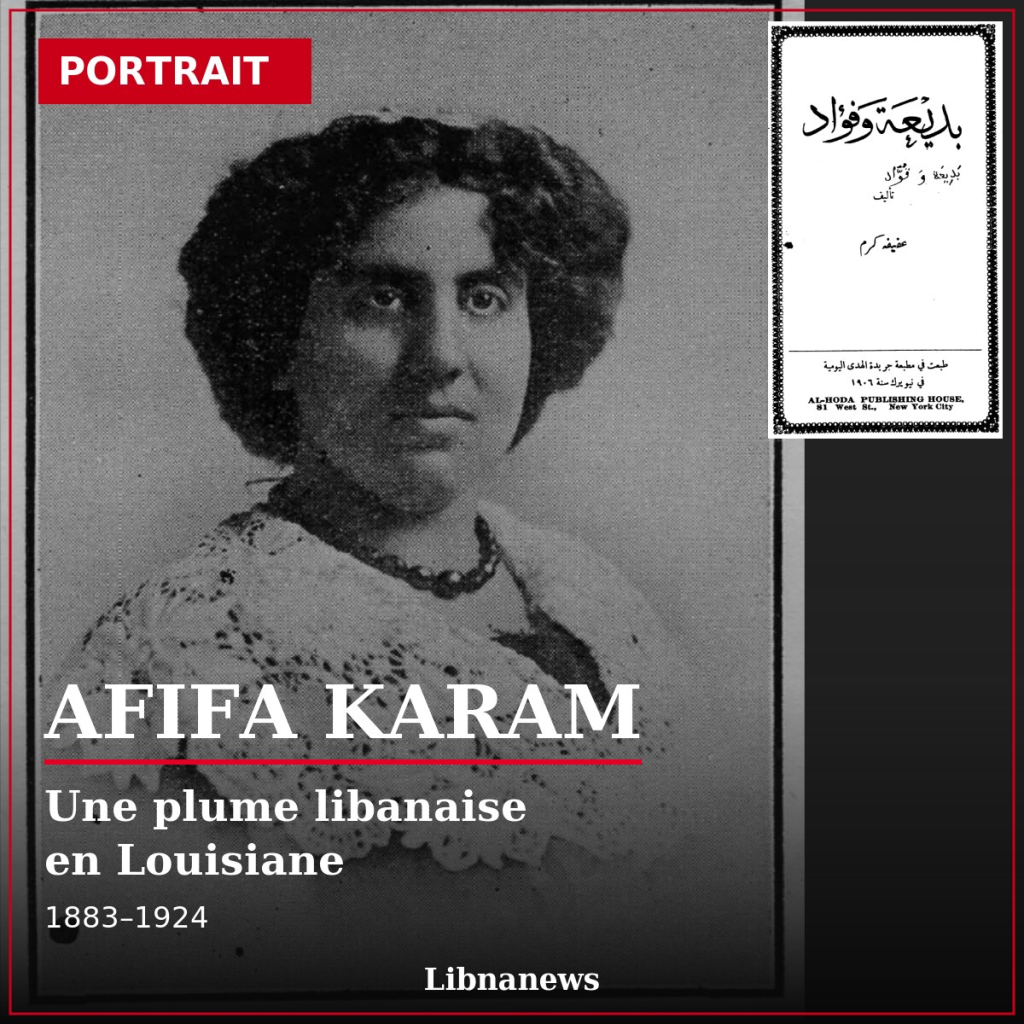
Born in Amchit in 1883, who died in Louisiana in 1924, Afifa Karam turned novel and journalism into instruments to defend women. His three Arab novels, published in New York between 1906 and 1910, shed light on a little-known chapter of Lebanese literature on emigration. A university monograph published in September 2026 invites us to return to this work.
On the ancient pages, his name appears in Arabic and then in English. Afifa Karam signs books, directs a publication and addresses readers. These documents show a woman fully engaged in the intellectual life of her time. They also allow you to follow a journey between three places: Amchit, where it grows; Shreveport, where it settles; New York, where his texts find their publishers.
Afifa Karam, from Amchit to Louisiana
Afifa Karam left Mount Lebanon in 1897, when he was fourteen years old, after his marriage. She crossed the Atlantic with her husband, known in the United States as John, her mother and her sister. The family settled in Shreveport. This city of Louisiana remained its main place of residence until his death in 1924.
Accuracy matters. The books have a New York address, but their author does not live primarily in Manhattan. His activity links the South American with the Arabic-speaking newspapers in New York. Emigration therefore does not interrupt its participation in the debates of the Levant. It provides him with other experiences, other interlocutors and a new audience.
At that time, the terms « Syrian » and « Syro-Lebanese » frequently refer to immigrants from the Ottoman Levant. Their use in newspaper titles and American documents precedes contemporary borders. It is necessary to keep this context to read the story of a woman born in the present Lebanon.
A journalist who addresses women directly
Afifa Karam collaborates in the Arab-speaking newspaper al-Hoda, founded by Naum Mokarzel. She leads a section on women’s issues. Education, the situation of immigrant women and relations between women and men occupy a central place in her work.
Its role exceeds that of an occasional contributor. In 1913, she was the editor of the newspaper for six months, during Mokarzel’s absence. It is also developing publications for women, including al-Imra’a al-Suriyya and al-Alam al-Jadid al-Nisa’i. A number retained from the latter is explicitly mentioned in the English version of a monthly journal published and directed by Mrs. Afifa Karam.
This device gives his ideas a regular circulation. The newspaper allows to intervene in a discussion, answer objections and find the readers at the next issue. The novel then gives him more space to show the effects of social rules on an existence.
Three novels, three ways of telling the constraint
Published in 1906,Badida wa Fouad, orBadi and Fouadfollows a modest young woman. His love for the son of an affluent family runs counter to social differences. The departure to the United States moves the plot and the possibilities offered to the characters. The question of marriage is thus part of a history of class and migration.
Fatima al-Badawiyya, generally translated byFatima the Bedouinappeared in 1908. The story brings together Fatima, an immigrant from Lebanon, and Alice, a wealthy American. Their exchanges confront two female experiences and mutual prejudices. Solidarity is built through speech, reception and listening.
The novel does not reduce this dialogue to an American lesson given to an Arab woman. Fatima can respond, criticize and move the judgment of her interlocutor. However, mutual aid does not remove their differences in wealth or social position. This tension gives the book a more precise scope than simply praise of the understanding between cultures.
In 1910,Ghadat Amchit,The Young Girl of Amchitbring the story back to the country left. Forced marriage and domestic violence structure the fate of heroin. The author also examines the gap between reformist discourse and the real emphasis on women. The three books thus address the same problem in different situations: who decides their lives?
A place in the history of the Arabic novel
These dates place Afifa Karam among the pioneers of modern Arabic novel. His three books beforeZaynab, published in 1914 by Egyptian Mohammed Hussein Haykal and long presented as a decisive beginning of the genre. This, in turn, is not enough to give him an exclusive title as an Arab novelist.
Rather, the interest of her work lies in her having to expand the narrative. The Arabic novel develops in several cities, with different audiences, thanks to women and men. New York and the emigrant communities belong to this history, as do the literary centres of the Levant and Egypt.
Language is another landmark. Located in the United States, Karam writes his novels in Arabic. His work thus falls into both Arab literary history and American experience of immigration. Putting it in a single national tradition makes part of this journey less visible.
Translate, then find a scattered work
To his novels add translations. In particular, it publishes in ArabicNancy Stair, d’Elinor Macartney Lane, 1914. Other translations follow, including a work by Alexander Dumas in 1918 and a historical novel by Luise Mühlbach in 1919. This activity extends its work of circulating stories between several cultural spaces.
Afifa Karam died in July 1924 at the age of forty-one. She’s buried in Shreveport. Its recognition in the press of emigration does not prevent its progressive erasure of the most widely disseminated literary stories. The preservation of books and periodicals becomes an essential condition for their rediscovery.
This rediscovery continues today. In September 2026, Syracuse University Press publishedA Bridge Too Soon: Afifa Karam and the Arabic Novel in the United States, Elizabeth Claire Saylor. The book resumes a long-term research devoted to its novels and articles.
Copies ofFatima the BedouinandThe Young Girl of Amchitalso appear in an academic collection of texts of Arabic-speaking women emigrated. These volumes place Afifa Karam in a collective history. To pay tribute to her, her three titles remain the starting point: stories written in Arabic, published in New York, where women discuss the conditions of their freedom.





Comments