

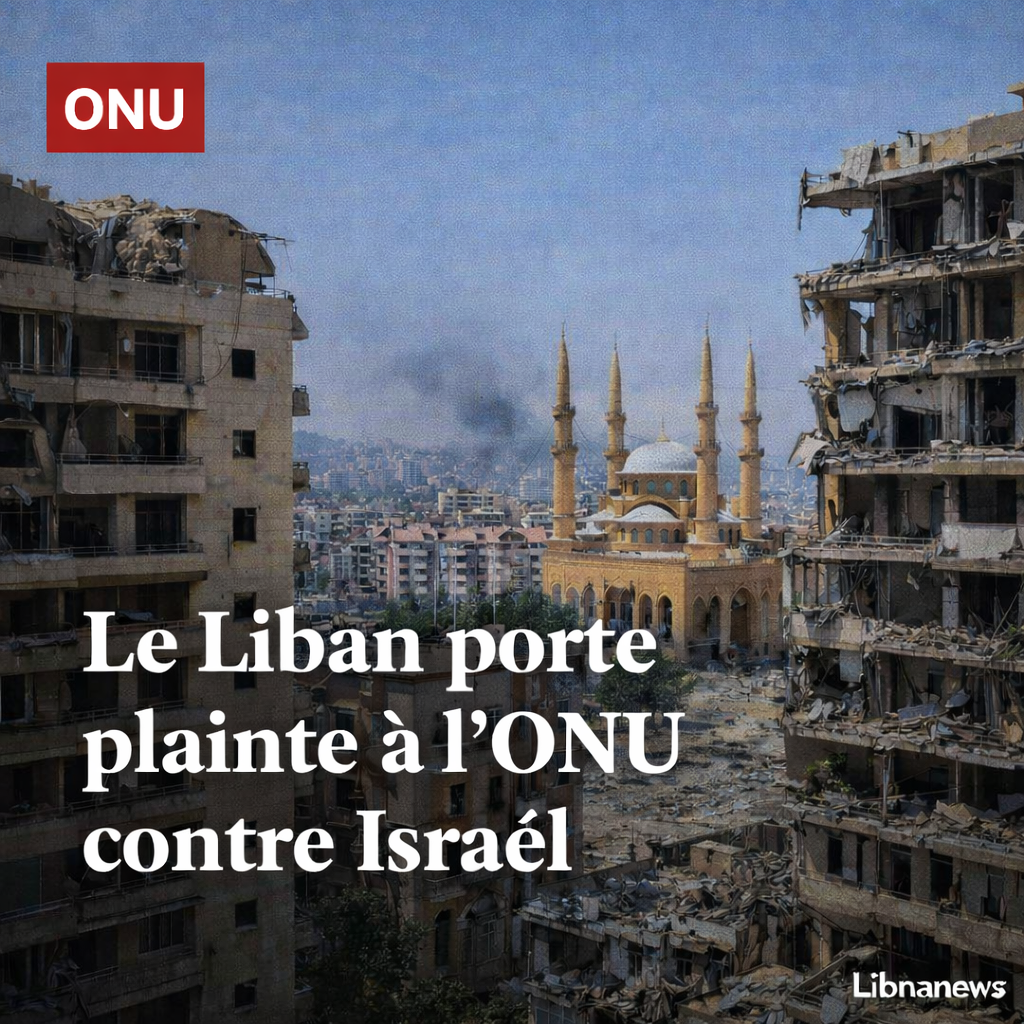
Lebanon’s complaint to the United Nations after the Israeli strikes of 8 April 2026 is not a matter of diplomatic reflex. Beirut seeks to bring this day of bombing out of the mere flow of war to a more binding political and legal framework, as the human balance continues to grow and fighting continues.
A complaint to turn strikes into cases
The Lebanese complaint to the United Nations after the Israeli strikes of 8 April is not a mere gesture. It alone will not change the military power ratio. Nor will it force the Security Council to act. But it has a clear political, diplomatic and legal value: turning a bombardment day into a formal international record, with facts, qualifications and requests inscribed in the United Nations archives. This is his central issue. Lebanon is not only trying to denounce. It seeks to prevent the violence of 8 April from being absorbed by the daily flow of war, then relegated to one more episode in an already saturated regional sequence. By asking his representative to the United Nations to refer the matter to both the Security Council and the Secretary-General, and by calling for the complaint to be circulated as an official document of the Council and the General Assembly, Beirut wants to give this matter a lasting diplomatic existence. The complaint thus becomes an instrument of memory, pressure and framing. She told the international community that what had happened was not just an armed confrontation, but a dispute that involved international law, the protection of civilians and the political responsibility of States. (الوعلال)
The text transmitted by the Lebanese Ministry of Foreign Affairs is constructed as an indictment. He recalls first the exceptional scale of the strikes of 8 April, described by Beirut as the most violent escalation since 2 March. According to the official document, nearly 100 strikes were carried out in less than 10 minutes, targeting several parts of the country, including Beirut, without prior warning and during rush hours. The complaint then sets a heavy record: 303 deaths, including 30 children and 71 women, as well as 1,150 injuries, including 143 children and 358 women. It adds another key element in the Lebanese argument: repeated attacks on the health sector and relief aid since 2 March. The text refers to 17 attacks on hospitals, 101 on relief services, 73 rescue workers killed and 176 injured. These figures are not only used to document a day of war. They are used to build a qualification. Lebanon wants to show that it is not talking about one-off collateral damage, but about a dynamic of violence that affects civilians, caregivers and protected infrastructure.
A text that seeks to qualify, not only to denounce
This is why the complaint is based on a very legible legal architecture. Beirut invokes the Charter of the United Nations, international humanitarian law, the Fourth Geneva Convention for the Protection of Civilians of 1949, Additional Protocol I of 1977 on the principle of distinction, and Security Council resolutions 2175 and 2286 on the protection of humanitarian and medical personnel. Again, the logic is clear. Lebanon does not just want to move. He wants to describe the facts in the precise vocabulary that counts at the United Nations. The complaint seeks to shift the discussion of the register from indignation to violation. It says in substance: these are not just deadly strikes, but acts that need to be examined in the light of already codified international legal obligations. This method has nothing to do with it. In multilateral forums, the accumulation of legal references serves to prevent the case from being reduced to an exchange of contradictory stories between belligerents. It aims to impose a less political ground for discussion in the form, even if its effects remain deeply political.
The strength of the complaint therefore lies less in an immediate prospect of punishment than in its effort to qualify and archive. In the Security Council, a Lebanese text has virtually no chance of leading alone to a binding measure against Israel. The precedent of recent years shows how paralysed the Council is when it comes to turning condemnations into acts when the interests of the great powers are directly engaged. But Lebanese diplomacy obviously does not ignore this limit. She acts in spite of her, and even because of her. When a State knows that it will probably not get a strong decision, it can look for something else: to record its version of the facts, to force Council members to position themselves, to feed on future UN statements, and to lay the groundwork for other initiatives, be they humanitarian, political or later judicial. The complaint is therefore also a way of not letting impunity start in silence. In the United Nations, not everything is in the final vote. Many are also involved in the constitution of a dossier, in the repetition of alerts, in the official registration of a chronology and in the ability of a State to make it recognise that the event deserves a collective response.
The strikes of 8 April gave this approach a special strength because they were perceived far beyond Lebanon as a changeover. The Secretary-General of the United Nations unequivocally condemned the massive strikes carried out that day, stressing that they had caused hundreds of civilian casualties. The UN High Commissioner for Human Rights, Volker Türk, spoke of « horrific » destruction and called for independent investigations into possible violations of international humanitarian law. More recently, UN experts have denounced what they call illegal aggression and indiscriminate bombing. This international sequence does not replace the Lebanese complaint. It reinforces it. It allows Beirut to say that its recourse is not an isolated initiative or a purely defensive gesture, but that it is part of an international climate where the gravity of the strikes of 8 April is already recognized at several levels of the United Nations system. For Lebanese diplomacy, this is a decisive point: a complaint alone can be ignored; a complaint supported by convictions of the Secretary-General, OHCHR and independent experts becomes more difficult to reduce to a simple national posture.
What Beirut wants to get at the UN
The timing of the process also counts. The complaint comes as Beirut entered into unprecedented discussions with Israel in Washington under strong pressure. In this context, the risk for Lebanon was clear: that the diplomatic sequence should be fully absorbed by the Israeli security agenda, centred on Hezbollah, the southern border and disarmament requirements, while the human cost of the strikes would be relegated to the background. In bringing the matter to the UN, the Lebanese government is trying to reintroduce another centre of gravity into the discussion. He recalls that the Lebanese issue is not limited to a debate about Hezbollah’s weapons or the security of Israel’s northern border. It also covers the protection of civilians, respect for the law of war and the extent of the destruction inflicted on a country already exsangued. The complaint therefore serves to rebalance the diplomatic narrative. It allows Beirut to say: we are not only discussing under military pressure; We also carry a formal accusation against strikes that we consider illegal. In the current scene, this nuance is strategic. It prevents Lebanon from entering the talks simply as a demander of a cease-fire without its own language on the responsibility of bombing.
We must also measure what the strikes of 8 April represent in the current war sequence. According to a news agency, they were the most deadly day since the front opened on 2 March. Other humanitarian reports published in the following days confirmed the magnitude of the shock, with more than 300 dead and 1,150 injured that day, while UNICEF reported dozens of children killed in a matter of minutes. Hospitals have been submerged, emergency services saturated, and several United Nations agencies have alerted about the accelerated depletion of medical stocks and management capabilities. This fact explains why the complaint cannot be treated as an abstract diplomatic document. It is starting from a very concrete moment of rupture, when the violence of the strikes exceeded, in the eyes of Beirut, the threshold of what could still be absorbed by ordinary diplomatic channels. The use of the United Nations then becomes an attempt to make this threshold politically exist. Not to immediately suspend the war — Lebanon knows that the UN cannot alone — but to mark that a point of non-banalization has been reached.
Strikes and the balance sheet prevent the case from closing
Since then, the conflict has not stopped. The bombings no longer target Beirut with the intensity of 8 April, but the war continues mainly in the South, around Bint Jbeil and areas south of the Zahrani. According to a news agency, Israel has claimed more than 200 strikes against Hezbollah infrastructure in 24 hours, and new evacuation orders have been issued to civilians in the south of the country. The Lebanese authorities are now making an overall assessment of more than 2,000 deaths and 1.2 million internally displaced persons since 2 March. This context changes the reading of the complaint. It does not only refer to the immediate past. It is part of a continuing war, the effects of which continue to grow. The text sent to the United Nations documents the strikes of 8 April, but it intervenes in the middle of an ongoing military campaign. This gives him an additional scope: it is not just a question of asking for an episode to be examined, but of alerting him to a procedure that Beirut says can be repeated.
The complaint also has an internal function. In a country that is deeply divided about war, Hezbollah, and how to deal with Israel, the use of the UN offers the government a minimal language of unity. It allows the executive to place itself on the ground of law, the protection of civilians and sovereignty, rather than the most explosive partisan alignments. This does not erase internal fractures, but it gives the State a visible role: that of the party that documents, protestes and internationalizes the case on behalf of Lebanon, regardless of the differences on the general strategy. This point is important at a time when the Lebanese political scene is being crossed by strong tensions around discussions with Israel, the disarmament of Hezbollah and state authority. By seizing the UN, Beirut recalls that it is not only a disputed territory or a theatre of war by proxy. At least on this issue, he is a diplomatic and legal subject. Even modest, this reaffirmation has a political value. It shows that, in the midst of an unfavourable balance of power, the Lebanese State is still trying to produce its own acts, its own qualifications and chronology.
A political lever more than a decisive remedy
The decisive question remains: what can this complaint actually get? The most honest answer is twofold. In the short term, probably little in coercive matters. There is no indication today that the Security Council is ready to adopt a strong measure in direct response to the strikes of 8 April. Diplomatic balances remain too locked, and experience shows that major powers often protect their partners or their own strategic margins in this type of case. In the medium term, however, the complaint may weigh differently. It can feed into the work of the United Nations, support requests for investigations, strengthen the legitimacy of the positions taken by the Secretary-General and the Office of the High Commissioner, strengthen other States when they denounce attacks on civilians, hospitals or peacekeepers, and help build an official record that is indispensable for any future discussion of responsibilities. Already on 9 April, 63 countries and the European Union had condemned the attacks against peacekeepers in Lebanon to the United Nations and expressed concern at the massive civilian casualties and destruction of infrastructure. Since then, other States have called for an urgent end to hostilities. The Lebanese complaint goes into this chain. It does not create a diplomatic front on its own, but it provides a structured national basis for concerns that already lie within the UN system.
In reality, the complaint is also worth what it refuses. It refused to treat 8 April as a mere episode of war, detached from the standards supposed to protect civilians. She refused to allow the human balance to be reduced to a statistic that would have to be overtaken by that of the next day. Finally, it refuses to allow diplomacy on Lebanon to be rebuilt solely on the basis of the security demands and fate of Hezbollah, without the same clear question of proportionality, distinction, prior warning, protection of health structures and obligations of the belligerents towards the civilian population. This is, in essence, the deepest meaning of the Lebanese approach. Turn deaths into records, strikes into qualifications, and a protest into an official record. In a war where so many things are played out in the moment, the complaint tries to set something more lasting: not only the memory of one day, but the possibility that a day of war still requires international law to respond.




