

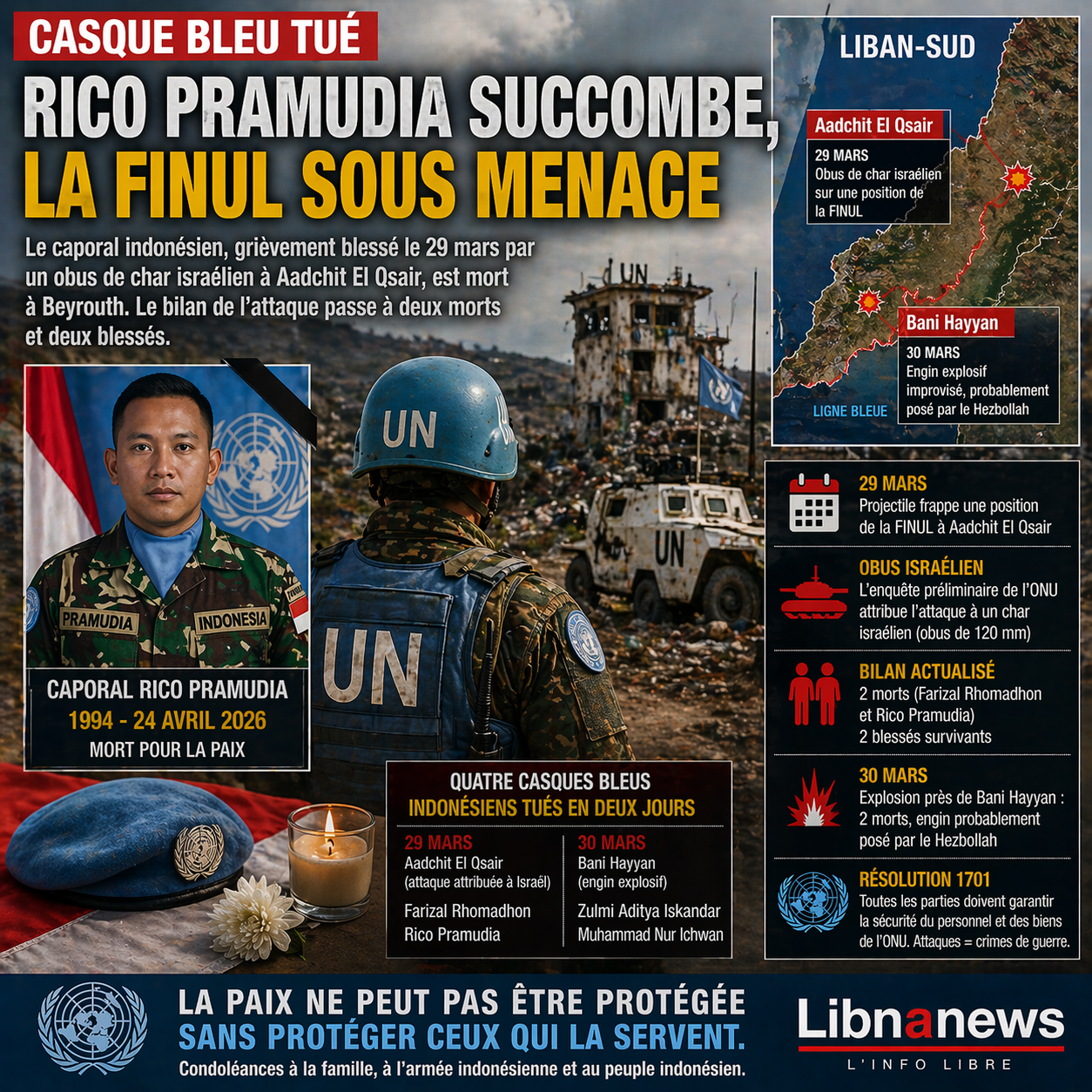
UNIFIL announced on Friday 24 April the death of Indonesian Corporal Rico Pramudia, who was seriously injured on 29 March in southern Lebanon. The 31-year-old soldier died in a hospital in Beirut after a projectile exploded at his contingent base in Aadchit El Qsair, in the area of operation of the United Nations Interim Force in Lebanon.
The death changed the record of the 29 March attack, which the United Nations preliminary investigation attributed to an Israeli tank shell. The strike had already killed Corporal Farizal Rhomadhon and injured three other Indonesian soldiers. With the death of Rico Pramudia, the updated record of this incident involving Israel established two Indonesian soldiers killed and two wounded.
This attack should not be confused with the explosion of 30 March near Bani Hayyan, which killed two other Indonesian peacekeepers in a UNIFIL logistics convoy. The United Nations indicated in its initial conclusions that this second incident would be linked to an improvised explosive device most likely placed by non-State elements, probably Hezbollah. In two days, the Indonesian contingent lost four men in South Lebanon.
Reported death by UNIFIL in Beirut
UNIFIL released on Friday the death of Corporal Rico Pramudia. The press release states that he was seriously injured during the explosion of a projectile in a UN position near Aadchit El Qsair on the night of 29 March. He was transferred to a hospital in Beirut, where he remained in critical condition until his death.
The UN mission offered its condolences to the soldier’s family, his relatives, the Indonesian army, the Jakarta government and the Indonesian people. It also recalled that all parties must ensure the security of United Nations personnel and property. It stressed that deliberate attacks on peacekeepers constitute serious violations of international humanitarian law and Security Council resolution 1701.
The name Rico Pramudia was already one of the serious injuries of the 29 March incident. At that time, the Indonesian authorities reported that three soldiers had been injured in the attack on the position of their contingent. Rico Pramudia was the most seriously affected. Two other soldiers, Bayu Prakoso and Arif Kurniawan, were reported to have been slightly injured.
The death of the corporal thus transforms the human balance of this strike. The first assessment reported one dead and three wounded. The updated record is now two dead, Farizal Rhomadhon and Rico Pramudia, as well as two injured survivors in the same incident. This assessment concerns only the 29 March attack on the position of Aadchit El Qsair.
UNIFIL: the circumstances of 29 March
The incident occurred on the night of Sunday, 29 March, as fighting between Israel and Hezbollah intensified in southern Lebanon. A projectile exploded in a UNIFIL position near Aadchit El Qsair, where an Indonesian contingent was deployed. The mission first indicated that it did not know the origin of the shooting and opened an investigation.
In the early hours, the Indonesian authorities spoke of indirect artillery fire affecting the contingent area. They condemned the attack and called for a full United Nations investigation. Jakarta also stressed that the coordinates of UNIFIL positions are known to the parties to the conflict, precisely to avoid such incidents.
The preliminary findings subsequently made public provided a decisive element. According to the UN Secretary-General’s spokesman, the first physical findings showed that an Indonesian soldier had been killed by an Israeli tank projectile. Sources citing UNIFIL indicated that it was a 120-mm shell fired from a Merkava tank.
This conclusion remains qualified as preliminary by the United Nations. The full investigation continues, with discussions with the parties concerned. But the initial assignment changed the reading of the incident. It is no longer just an explosion of unknown origin in a UN position. The available elements refer to an Israeli tank strike that hit a UNIFIL site.
A United Nations site with known coordinates
The issue of the coordinates of UNIFIL bases is central. The United Nations positions in southern Lebanon are normally known to the parties. The mission regularly communicates their locations in order to prevent accidental fire, confusion of target and obstruction of the movements of peacekeepers. This procedure of de-confliction is part of the minimum protection afforded to international forces.
According to the evidence reported after the preliminary investigation, UNIFIL had transmitted the coordinates of its positions to the Israeli army on 6 and 22 March. This information reinforces the seriousness of the incident. It means that the affected position was not an unknown point in an uncharted area, but a United Nations mission site.
The Israeli army did not immediately provide a detailed public explanation of why a shell struck that position. At the time of the attack, Israel was conducting expanded military operations in southern Lebanon, while Hezbollah was firing north of Israel. Both sides were operating in a very dense environment, where UNIFIL bases were still supposed to be protected.
For the UN, this protection is not optional. Blue Helmets are not a fighting party. Their safety must be guaranteed by all parties. Any attack on them exposes its perpetrators to serious responsibilities. The spokesman for the Secretary-General recalled that such incidents could constitute war crimes if the necessary elements were established.
Final report of the Israeli attack
With Rico Pramudia’s death, the report of the 29 March attack in Aadchit El Qsair can be updated. Two Indonesian UNIFIL soldiers died as a result of the strike: Corporal Farizal Rhomadhon, who was killed that night, and Corporal Rico Pramudia, who died on 24 April in Beirut after nearly four weeks of hospitalization.
Two other Indonesian soldiers injured in the same attack survived. The names reported by Indonesian sources are Bayu Prakoso and Arif Kurniawan. They were described as having a milder impact than Rico Pramudia. No additional deaths were reported among them at the time of the issuance of the UNIFIL communiqué.
The consolidated record of the Israeli attack of 29 March is therefore two dead and two injured survivors among the Indonesian peacekeepers. The two deaths of 30 March should not be added automatically, as they are the result of another incident near Bani Hayyan in a logistics convoy.
Confusion is common, as both attacks have affected the same contingent in less than 24 hours. The first incident struck a UN position in Aadchit El Qsair. The second destroyed a UNIFIL vehicle near Bani Hayyan. The balance sheets must therefore be distinguished, even if they are part of the same deadly sequence.
Four Indonesian deaths in two days
The aftermath of the incidents of 29 and 30 March caused a shock in Indonesia. On 29 March, Farizal Rhomadhon was killed in the attack on the position of Aadchit El Qsair. Rico Pramudia, Bayu Prakoso and Arif Kurniawan were injured. The following day, a UNIFIL logistics convoy was hit by an explosion near Bani Hayyan.
This second explosion killed two other Indonesian peacekeepers: Zulmi Aditya Iskandar and Muhammad Nur Ichwan. Two additional soldiers were injured in the convoy, including Sultan Wirdean Maulana and Deni Rianto, according to data published by Indonesian sources. The UN then reported that the explosion appeared to be linked to an improvised explosive device.
The preliminary conclusions of the United Nations therefore distinguish two probable responsibilities. The projectile that struck the position of Aadchit El Qsair is attributed to an Israeli tank. The explosion of Bani Hayyan is attributed to a device most likely placed by Hezbollah. This distinction is essential to avoid a global reading that would mix the two events.
With the death of Rico Pramudia, Indonesia’s record of 29 and 30 March rose to four deaths. Farizal Rhomadhon and Rico Pramudia are linked to the attack attributed to Israel. Zulmi Aditya Iskandar and Muhammad Nur Ichwan are linked to the explosion of Bani Hayyan. At least four other Indonesian soldiers remain among the injured survivors of this sequence.
Indonesian reaction
Indonesia immediately requested a UN investigation after the attacks in late March. His representative at the United Nations had rejected the Israeli explanations deemed insufficient and called for a direct, complete and transparent investigation. Jakarta also called for all those responsible to be identified and brought to justice.
The Indonesian Government stressed the non-negotiable nature of the security of peacekeepers. Indonesia is one of the major contributors to peacekeeping operations. Its presence in Lebanon is part of a tradition of participation in United Nations missions. As a result, losses in South Lebanon have had a strong resonance in the country.
The bodies of the first three soldiers killed were repatriated in early April. Military ceremonies were held in Indonesia. The death of Rico Pramudia prolongs this national mourning and revives the issue of the protection of contingents engaged in an area that has become much more dangerous than is normally foreseen by an interposition mission.
Indonesian officials also called for a review of security assurances within UNIFIL. The demand is for both the United Nations and the parties to the conflict. It covers the protection of bases, the movement of convoys, the procedures for de-conflicting and the ability of peacekeepers to fulfil their mandate without being targeted or exposed to fire.
A peace mission in a war zone
UNIFIL was established in 1978 and its mandate was strengthened after the 2006 war by Security Council resolution 1701. It monitors the cessation of hostilities, supports the Lebanese army in the South and reports on violations. It has no mission to fight Israel or Hezbollah. It operates within a peacekeeping framework, which requires minimum respect for its status by the parties.
The resumption of hostilities since March has profoundly changed the conditions for its deployment. Blue Helmets are now operating in areas where shelling, artillery fire, drones, mines, improvised explosives and infrastructure destruction are increasing. They may need to refuel isolated positions, clear roads or help maintain humanitarian access.
This situation exposes quotas to direct risks. Indonesian soldiers were hit in Aadchit El Qsair and Bani Hayyan. French soldiers were then targeted in an ambush in Ghandouriyah, which resulted in two deaths following the death of one injured. Other incidents involved mission patrols, convoys or surveillance equipment.
These events pose a substantive question. Can an interposition mission work when the parties no longer sufficiently respect its space, bases and movements? While the United Nations continues to defend UNIFIL’s presence, recent losses have reinforced calls for revised protection and travel rules.
The context of the prolonged truce
Rico Pramudia’s death occurred while the truce between Israel and Lebanon was extended by three weeks under American sponsorship. This extension does not mean a complete return to calm. Strikes, fire, house demolitions and restrictions on access to villages in the South continued to be reported after the announcement of the first cessation of hostilities.
For UNIFIL, the truce creates a work space, but it does not remove risks. Roads remain damaged. Contact areas remain unstable. United Nations positions may be close to axes used by armed forces or areas targeted by fire. The death of a March injured person reminds us that the consequences of the attacks extend far beyond the time of the explosion.
The security of peacekeepers is also linked to freedom of movement. UNIFIL must be able to move around to observe, refuel its bases, evacuate its wounded and support humanitarian activities. Blocking convoys, temporary detentions of soldiers or firing near United Nations positions directly undermine the implementation of resolution 1701.
Lebanon calls for the continuation of an international presence, even a reduced one, after the planned end of the current mission. The United Nations is exploring options for post-FINUL. But every death makes the debate more difficult. The contributing countries wanted to know whether their soldiers could be protected in an area where the distinction between peacekeeping and exposure to combat was becoming increasingly narrow.
A warning for the parties to the conflict
The death of Corporal Rico Pramudia is a simple obligation: peacekeepers must be protected. UN positions should not be targeted. The convoys must move. The coordinates communicated to the armies must be respected. Investigations must identify the perpetrators of the attacks, whether it is a tank fire, an explosive device or another hostile act.
It also recalls that the truce in Lebanon cannot be assessed solely on the basis of diplomatic declarations. It must be measured against the real security of civilians, humanitarian workers, journalists and international forces. If peacekeepers continue to die or be injured, the cessation of hostilities remains fragile.
For Israel, the UN’s preliminary investigation of the 29 March tank bus requires clarification. For Hezbollah, the conclusions on the explosion of Bani Hayyan also raise the question of the responsibility of non-State armed groups. For Lebanon, the protection of UNIFIL remains linked to the stability of the South and to the credibility of the institutions.
Rico Pramudia’s death adds a name to the record of an already heavy sequence. It transforms the results of the attack attributed to Israel in Aadchit El Qsair into two dead and two wounded survivors. It brings the number of Indonesian soldiers killed in two days in South Lebanon to four. The next step is the investigation, prosecution requested by the United Nations and the guarantees that the parties will have to give so that peacekeepers can continue to act in their area of operation.




