

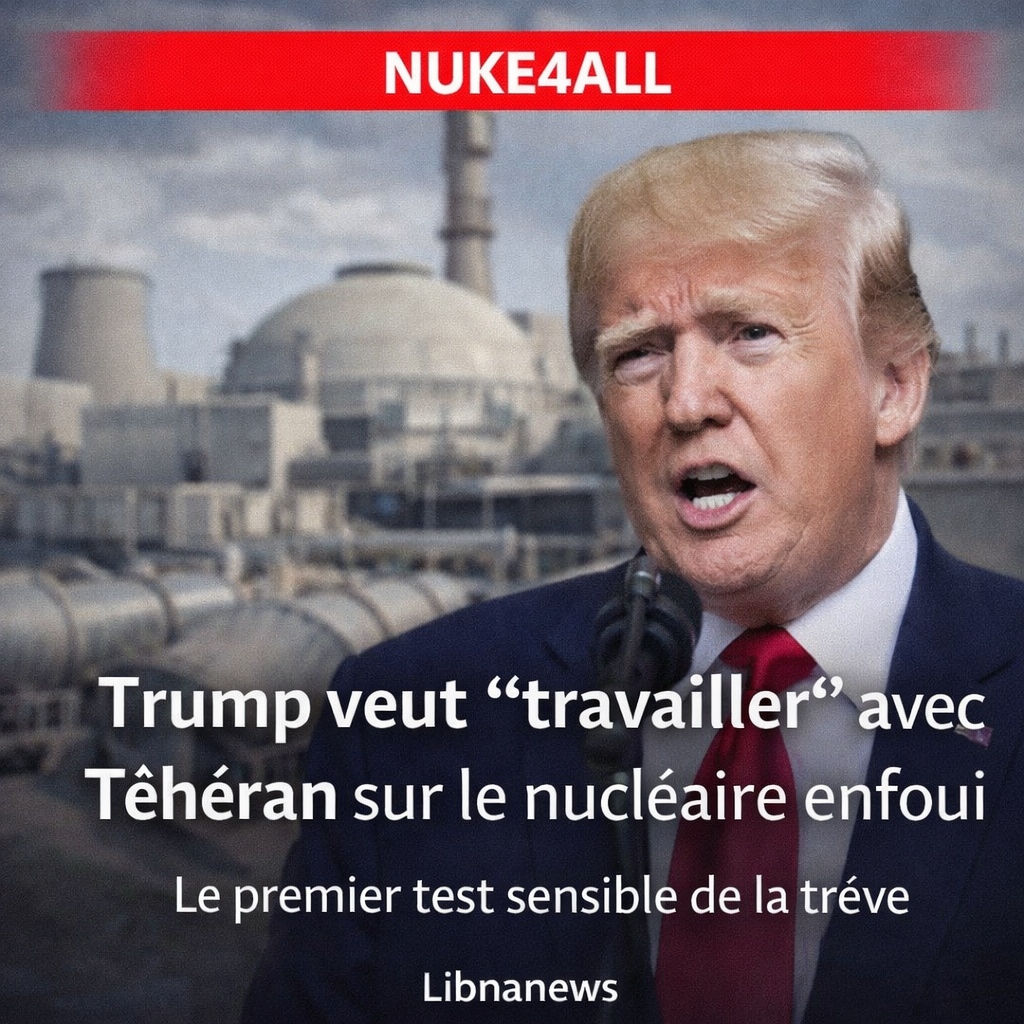
Donald Trump said on Wednesday, April 8 that the United States would « work » with Iran to extract « buried » nuclear material, following the two-week ceasefire between Washington and Tehran. This statement marks a notable shift in the American discourse: after the logic of threat and strikes, the White House now puts forward possible cooperation with Iran on one of the most sensitive issues of the crisis, that of nuclear material buried under the sites affected in 2025. But at this stage, Tehran has not publicly confirmed such a pattern, and the technical and political outlines of this operation remain unclear.
Trump’s new statement on Iranian nuclear power
According to several press reports published on Wednesday, Donald Trump explained that the United States would cooperate with Tehran to « destroy » and remove buried nuclear material. He also claimed that Iran would cease uranium enrichment, while presenting this development as a direct extension of the ceasefire announced a few hours earlier. The wording used by the US President suggests that he no longer speaks only of remote control or surveillance, but of a concrete intervention on nuclear material buried under the facilities targeted during the US and Israeli strikes of 2025.
This is important because it comes after several weeks of confusion about Washington’s real goals. So far, the Trump administration had mainly highlighted military pressure, the reopening of the Strait of Ormuz and the need for a broader agreement with Iran. Speaking now of an extraction of nuclear material buried with Tehran’s help, the US President suggests that a part of the nuclear issue could be dealt with in the talks to follow the ceasefire.
A central backrest since the 2025 strikes
The question of buried nuclear material is not new. Several analyses published in recent days indicated that significant stocks of enriched uranium and other sensitive components had remained buried under the rubble or protected in affected underground facilities last year. Even U.S. military projects had been studied to attempt to seize these stocks, but these options appeared to be extremely operationally and politically risky. The idea of a coordinated extraction with Iran therefore radically changes the register: it replaces, at least in the discourse, the hypothesis of a forced seizure with that of negotiated treatment.
This shift is all the more notable as Trump himself sent contradictory signals on this issue. At the beginning of April, Anglo-Saxon media recalled that it had sometimes minimized the immediate importance of these buried stocks, sometimes demanding that they be neutralized in the context of a wider settlement. Wednesday’s declaration therefore puts the nuclear buried in the center of the game, but in a more diplomatic than military version.
Tehran did not publicly confirm
The main point of caution is this: Iran did not at this stage confirm the scenario described by Trump. AP explicitly points out that the US President is talking about a joint work with Tehran to recover buried nuclear material, but that the Iranian authorities have not publicly validated this formula. In other words, Washington is already advancing its political reading of the ceasefire and its aftermath, but this reading is not yet repeated in the same terms by the Iranian side.
This lack of confirmation is not a detail. It recalls that the announced ceasefire remains fragile and that several of its most sensitive components — nuclear, missiles, sanctions, regional allies — remain open. If Iran really agrees to cooperate in extracting or neutralizing buried material, this would be a significant turning point. But in the state, there is only one American declaration, no detailed agreement or a confirmed mechanism on both sides.
A truce that opens negotiations, without settling the substance
The two-week ceasefire between the United States and Iran was presented as a suspension of attacks allowing for wider discussions with Pakistan as a key mediator. The available reports show that the truce mainly prevented a new rise to the extremes after the Ormuz crisis and the cross strikes in the region. But it did not settle the major substantive issues. Nuclear power remains at the heart of the disagreement, as does Iranian ballistic capabilities and the position of Tehran’s allies in the Middle East.
In this context, Trump’s statement on buried nuclear material also fulfils a political function. It allows the US President to present the cease-fire not as a mere defensive pause, but as a step towards a concrete treatment of a case which he himself had placed at the centre of his argument. By claiming that the buried materials will be taken over with Tehran, he seeks to show that the United States has not only obtained a suspension of hostilities, but is also moving towards a form of control over Iran’s nuclear risk.
A U.S. formulation that asks more questions than it provides answers
For the moment, several questions remain unanswered. Trump did not explain which teams would intervene on the spot, under what authority, with what security guarantees, or how the materials would be treated once extracted. It also did not specify whether the operation would be under international, bilateral or wider agreement. The media that relayed his statement insist on this blurry.
This blur is all the more important as the extraction of buried nuclear material is a technically heavy, politically sensitive and potentially dangerous operation. Articles published before the truce recalled that such a project would require considerable resources, protection, heavy logistics, nuclear specialists and a potentially long-term secure environment. The gap between the simplicity of the presidential formula – working with Tehran – and the likely reality of such an operation therefore remains very large.
An attempt to regain control of the story
Wednesday’s declaration is also part of the battle for the narrative following the announcement of the ceasefire. Trump has been saying since Tuesday that the United States has won a total and complete victory at a time when several issues remain open and Washington’s regional allies, including Israel, continue to express frustration over some aspects of the crisis. By highlighting future cooperation with Iran on buried nuclear, the US President seeks to give concrete content to this idea of victory.
But this narrative has several visible limitations. First, Iran has not yet confirmed this pattern. Secondly, the Lebanese front remains active, which weakens the idea of a fully regional de-escalation. Finally, the mere fact that Washington now has to work with Tehran on the buried nuclear also shows that the issue has not been resolved by force. On the contrary, it falls within the scope of negotiation.
A signal for future talks
In practice, Trump’s sentence may be worth more than a signal to future talks. It sets the American position: buried nuclear material will have to be treated, and Washington wants it to be part of the continuation of the ceasefire. Tehran, for its part, has not yet given its full version of such a mechanism. The case should soon become one of the first tests of credibility of the truce.
If both parties converge on a device, Wednesday’s statement will appear retrospectively as the announcement of a first major breakthrough. If they diverge, it will remain as an additional example of the gap between American proclamations and the actual content of the negotiations. For now, the most solid fact is simple: Trump claims to want to work with Iran to extract buried nuclear material, but this perspective is neither detailed nor publicly confirmed by Tehran.






