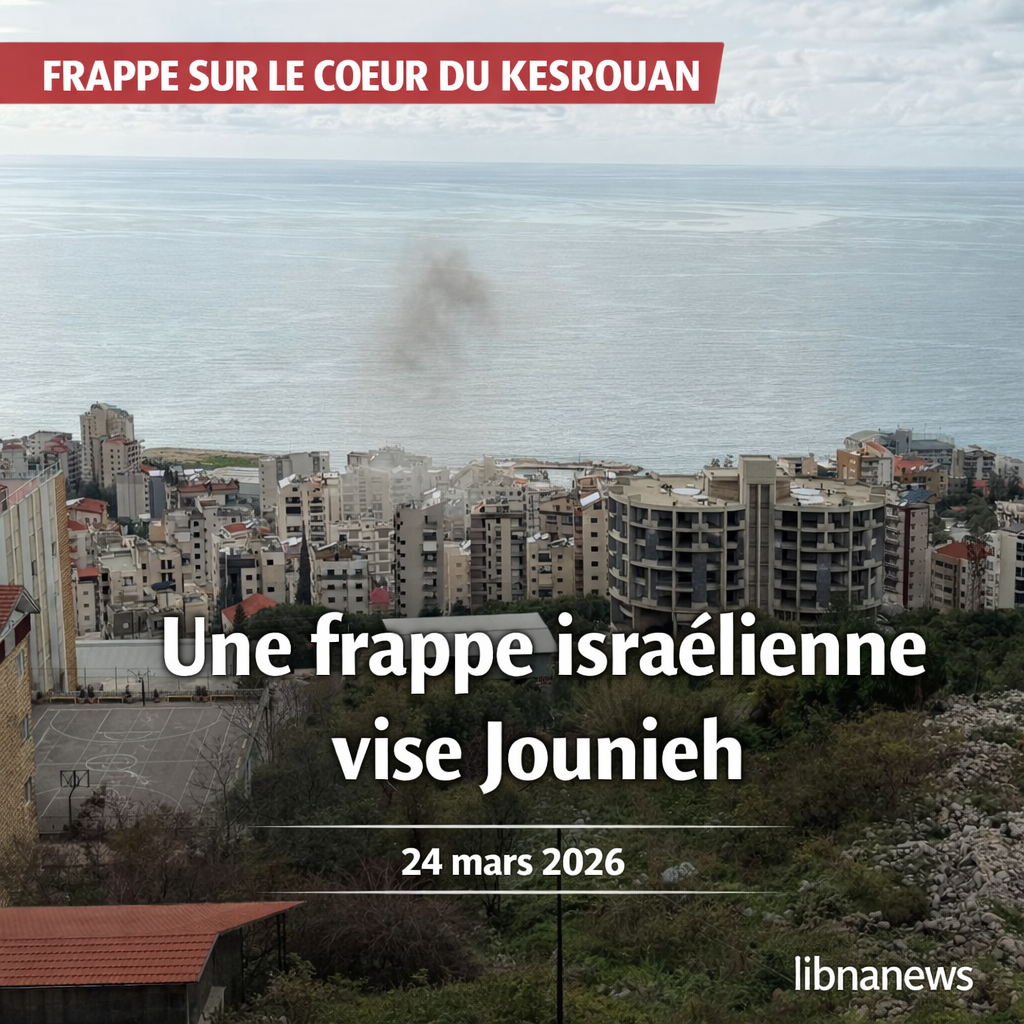
An Israeli strike targeted Jounieh on Tuesday, according to reportsLibnanews. The attack marks a new geographical extension of the war in Lebanon, after strikes in Hazmieh and the outskirts of Beirut. It now feeds the fear that the Christian areas of Mount Lebanon will also be directly exposed.
According to information fromLibnanewsAn Israeli strike struck Jounieh on Tuesday, bringing Kesrouan into the immediate geography of the war. The event takes place as the conflict continues to spill over from southern Lebanon to areas previously perceived as more distant from the front.
This strike is part of a clear worsening sequence. Since 2 March, Israel has intensified its operations against Lebanon, affecting the South, Bekaa, Beirut and several infrastructure axes. According to the Lebanese authorities cited by Reuters, the balance sheet exceeded the1,000 deathsand the number of internally displaced personsabout 1 million.
The day before, an Israeli strike targeted a building in theHazmieheast of Beirut, in an attack that the Israeli army described as targeting an Iranian al-Quds force member. This extension to the periphery of the capital had already reinforced the feeling that war was changing in nature, now affecting major urban and political spaces.
In this context, a strike in Jounieh would be an additional threshold. The city is not only a major urban centre in Kesrouan. It also occupies a special place in the Lebanese political and social imagination, as one of the hearts of Christian Mount Lebanon. That an attack be reported immediately feeds a broader reading: that of a war that now threatens Christian areas and is no longer limited to the traditional strongholds of the front.
This territorial shift is all the more sensitive as Israel simultaneously multiplies statements on a new security reality in Lebanon. On Tuesday, Israel’s Defense Minister, Israel Katz, claimed that his army would seize a « advanced defence line » to the Litani and control the bridges and security space south of the river.
For Beirut, the pressure is double. It is military, with the expansion of the strikes to more and more remote areas of the South. It is also political, as the United States and Israel intensify their demands on Hezbollah, while Iran continues to threaten reprisals if attacks against Lebanese and Palestinian civilians continue.