

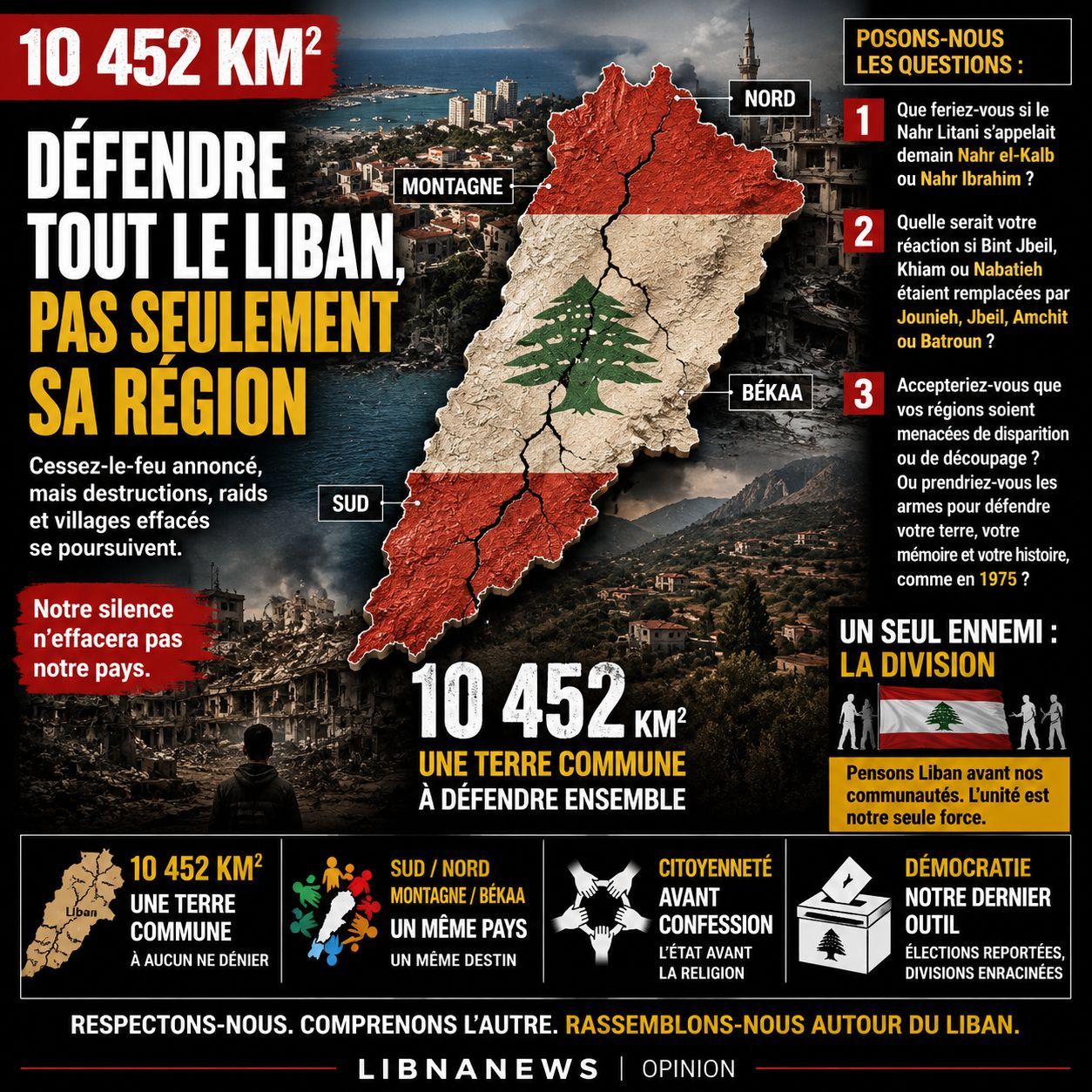
Rightly, the world eventually sees us as naive, even ignorant. We announce and confirm a cease-fire, while the destruction, raids and the suppression of entire villages continue before our eyes.
And yet, we remain unable to react, denounce or even clearly name what is happening around us. In the name of an alleged will to live, we accept in a form of resignation and denial the gradual disappearance of our country, until we tolerate the idea that a part of Lebanon — especially the South — may no longer exist as before.
Our people are deeply disunited, and this division is the greatest strength of our enemies.
To those who are silent, who accept or choose to look away, a few questions deserve to be asked:
- What would you do if the Nahr Litani was called tomorrow Nahr al-Kalb or Nahr Ibrahim?
- What would be your reaction if Bint Jbeil, Khiam or Nabatieh were replaced by Jounieh, Jbeil, Amchit or Batrun?
- Would you accept that your regions are threatened with disappearance or geographical division, or would you take up arms to defend your land, your memory and your history, as happened in 1975, without even consulting the people?
Yes, there are many shared responsibilities. Yes, there are multiple actors in the conflict. But in the end, there is only one common enemy.
Our duty, as Lebanese and patriotic citizens, is to defend the 10,452 km2 that each one speaks of in his speeches, to unite us around this land, and then to settle our internal differences far from any foreign interference.
It is time to think first and foremost in Lebanese, and to stop training citizens in sterile analyses and endless divisions.
If, from the beginning, we had learned to think, before thinking, Christian, Shiite, Sunni or Druze, if we had been able to separate the state from religion, if we had educated our children in the spirit of citizenship rather than in the spirit of denominational belongings, perhaps we could have built a country where one looks at the other as a compatriot, and not through the prism of his confession or his region.
The hour is serious. The last remaining democratic tool — the parliamentary elections — was postponed on the pretext of security, leaving more space for the rooting of divisions, hatred and the absence of citizenship.
Lebanon will never be able to survive in a logic of victoriousness and defeat. We all know that for more than half a century.
Let us respect ourselves and stop offering abroad the weapons used to destroy us. On the contrary, let us gather around Lebanon, try to understand the other, and to those who continue to accuse unilaterally, let us simply recall the questions asked above.
History repeats itself, perhaps differently, but with the same background. Let us learn from the past, reread our history so that we can finally build our future.
And I, a Lebanese citizen of Tyre, proud of being, still refuse to believe that it is too late. Maybe it’s optimism… But it’s also a necessity.




