

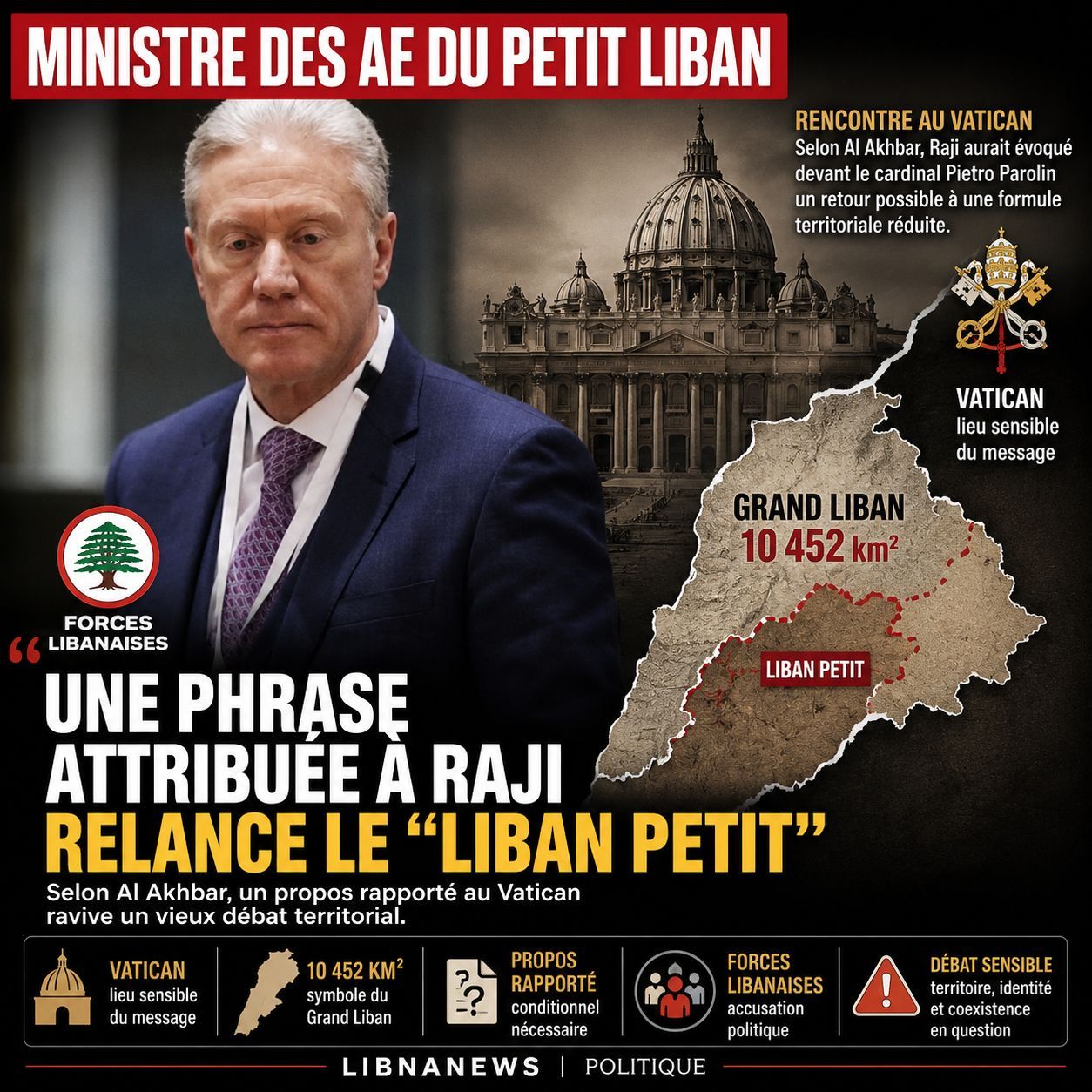
The daily Al Akhbar placed in its 19 May 2026 edition a sentence attributed to Youssef Raji in the centre of a major political controversy. According to the newspaper, the Lebanese Foreign Minister would have mentioned to Cardinal Pietro Parolin the idea of a possible return to small Lebanon, if this formula guaranteed Christians stability, economic prosperity and protection. The statement, reported by sources that the daily presents as informed of the visit, is not a public statement confirmed in the document consulted. However, it is of particular significance because it is attributed to a minister in office who is responsible for representing the Lebanese State abroad.
A controversy arising from a visit to the Vatican
The case is therefore not limited to partisan controversy. Al Akhbar presents it as a debate about the very nature of Lebanon, its territory and the meaning of Greater Lebanon as the final homeland of all its citizens. The newspaper states that the speech given to Raji would seek to suggest that the Christians in Lebanon would not be attached to the 10,452 square kilometres of the present territory, but to a smaller formula, conceived around community security. At this stage, the subject is based on press information. It therefore requires a distinction to be made between established facts, the words attributed and the political interpretation of everyday life.
Al Akhbar claims that Youssef Raji visited Italy the week before the article was published. During this visit, he reportedly met Cardinal Pietro Parolin, Secretary of State of the Holy See, often presented as the head of Vatican diplomacy. It is in this context that the Lebanese minister has developed, according to daily reports, a reading of the Lebanese internal situation and the future of relations between the country’s components. The scene described is sensitive. It does not take place in a television debate or in a partisan meeting, but in a diplomatic space where each word can engage an image of Lebanon.
A formula that revives the debate on « Little Lebanon »
According to Al Akhbar, Youssef Raji defended in the Vatican a worrying reading of the future of Christians in Lebanon. The Minister for Foreign Affairs would have thought that a return to the idea of « small Lebanon » should not be excluded if this would ensure political stability, economic prosperity and lasting protection for this community. The daily presents these statements as being held in front of Cardinal Pietro Parolin, Secretary of State of the Holy See, during a meeting whose content he attributes to informed sources of the visit.
The sentence referred to is of particular significance in the current context. It does not only concern the security of a community, a recurring topic in the Lebanese debate since the civil war. It affects the very definition of the country. « Little Lebanon » refers, in the local political imagination, to a more restricted space than today’s Lebanon, often associated with a more marked Christian centrality. Conversely, Greater Lebanon, proclaimed in 1920, remains in the official discourse the territorial framework of the Lebanese State and the common homeland of its citizens.
Al Akhbar sees this formula as an implicit challenge to the current 10,452 square kilometres of Lebanon. The newspaper believes that the statement attributed to Youssef Raji would suggest a shift: priority would no longer be attached to the national territory as a whole, but the search for community security in a more limited context. This reading is highly questionable. It places the visit to the Vatican in a broader controversy about the relationship between sovereignty, coexistence and Christian fear in the face of successive crises.
At this stage, the statements reported by Al Akhbar have not been publicly confirmed in the available evidence. The newspaper does not publish any official Vatican report or direct statement by the minister. Caution therefore remains necessary. But the accusation, because it is aimed at the head of Lebanese diplomacy and not just a partisan framework, gives the case an institutional dimension. It places Youssef Raji at the centre of a sensitive debate: the compatibility between a ministerial speech held abroad and Lebanon’s official attachment to its territorial unity.
A minister, not just a partisan figure
The precision on the function of Youssef Raji changes the scale of the case. A partisan leader can speak on behalf of a party, even when his or her words cause a crisis. A foreign minister speaks in a more institutional register. It embodies the diplomacy of a government. It represents a State, even when it comes from a political family determined or supported by specific training. If the statements reported were confirmed, they would therefore raise a question of consistency between the words of a member of the Government and the constitutional and political foundations of Lebanon today.
Small Lebanon is not a neutral expression. It refers to a political memory earlier or parallel to that of Greater Lebanon proclaimed in 1920. In Lebanese debates, it often refers to the former Mount Lebanon, a more pronounced Christian centrality and a form of community autonomy considered safer by its supposed supporters. For its opponents, it refers instead to a separatist temptation, or at least to a fatigue of living together. So the word reacts to old fractures. It not only describes a geography. It designates a vision of Lebanese society.
Lebanon faces 10,452 square kilometres
Al Akhbar insists on this dimension. The newspaper writes that the circles mentioned by Raji, according to its sources, are not attached to the entire Lebanese territory. They would consider Lebanon small as a community salvation project. In this reading, territorial integrity would become secondary to Christian security. It is this passage that gives the article its adversarial character. The newspaper considers that the statement attributed to the minister amounts to relativizing Greater Lebanon, that is, the framework that unites regions and communities in the same political space.
Controversy also affects the role of the Vatican. The Holy See has long followed the situation of Christians in the East and Lebanon. He often presents himself as an actor committed to coexistence, the protection of civilians and the unity of the country. Al Akhbar stresses this apparent contradiction. The newspaper claims that the speech lent to Raji was brought before an institution which, in its official line, does not promote community withdrawal. He also recalls the figure of Patriarch Elias Boutros Hoayek, associated with the birth of Greater Lebanon, to show that the Maronite memory itself is not reduced to the nostalgia of a narrower space.
Vatican as a sensitive diplomatic scene
This reference to Hoayek is not anecdotal. It allows the daily to oppose two Christian accounts. The first would be that of Greater Lebanon, intended as an expanded national framework, despite its tensions and imbalances. The second would be a small Lebanon, presented as safer because more homogeneous. Al Akhbar argues that the Vatican remains more linked to the first story than to the second. By placing the sentence attributed to Raji in this setting, the newspaper seeks to show that the minister has attempted to move the Christian reading of Lebanon in a more closed direction.
The daily then expanded his accusation to the Lebanese Forces. He presents Raji as a voice linked to this political family and affirms that the speech given in Rome would fit into a broader line. Again, caution is required. The newspaper formulates a political reading. It does not reproduce, in the passage consulted, an official Lebanese Forces resolution in favour of a reduced Lebanon. Rather, it builds a bundle: the political identity attributed to the minister, the phrase reported, the place of the meeting, and then the history of the Christian right. The set serves to support the idea of a return of an imaginary isolationist.
Information, attribution, interpretation
This method is characteristic of a press engaged in a political fight. It does not necessarily invalidate published information. It requires reading them by separating levels. The first level is factual: Al Akhbar publishes the accusation and highlights it in its 19 May edition. The second is attribute: unnamed sources bring a sentence to Youssef Raji. The third is interpretative: the newspaper sees it as a challenge to Greater Lebanon and an isolationist resurgence. The fourth is controversial: the daily newspaper links this reading to the Lebanese Forces and the context of war.
The war context weighs heavily on the article. Al Akhbar publishes this text in a issue dominated by the crisis in the South, discussions on the ceasefire and tensions around sovereignty. In this climate, any evocation of a reduced territory takes on a more serious resonance. The newspaper parallels Raji’s sentence with threats to territorial integrity, particularly in the South. He suggested that a speech on small Lebanon could, even if not willing, weaken the national position in the face of external pressures.
War makes debate more inflammable
This context is one of the main sources of the article. For Al Akhbar, the danger comes not only from an opinion on the protection of Christians. It comes from when this opinion would be expressed. The country faces strikes, displacements, debates about the occupation of parts of the territory and a diplomatic crisis. In such a sequence, the formulation of a doubt on the 10,452 square kilometres can be interpreted as a signal of fragmentation. The newspaper therefore makes it a symptom of a deeper national malaise.
The article is also based on a critique of an idealised memory of small Lebanon. Al Akhbar claims that this representation is circulating in certain academic, religious or student circles. It would present Lebanon before enlargement as an area of prosperity and coherence, then disrupted by the integration of Muslim-majority regions. The daily challenges this reading. He recalls that the former Mount Lebanon has experienced famines, social crises, massive migration and conflicts. He therefore refuses the image of a homogeneous, stable and prosperous past.
A disputed Christian memory
This part of the reasoning aims at dismantling the implied promise of small Lebanon. A smaller territory does not automatically guarantee stability. Stronger denominational homogeneity also does not guarantee prosperity. The newspaper uses history to challenge a simple political equation: less diversity would mean more security. In the Lebanese case, this equation remains explosive. It reactivates the fear of a partition, a decentralization thought as a prelude to separation, or a return to community enclaves.
In the same development, the newspaper also mentions the words of former deputy Fares Souhaid. He mobilizes them to show that the Christian unease with the current Lebanese formula would exceed the immediate calculations of the parties. According to the reading reported by Al Akhbar, some of the Christian opinion would have long accepted Greater Lebanon on the condition that it remains, in fact, in the service of a small Christian Lebanon, with a French guarantee originally. This evocation allows the newspaper to give historical and sociological depth to the controversy.
Christian Unease and its Political Answers
The most important point in this reference is the recognition of malaise. Al Akhbar does not deny that Christian fears exist. He challenged the answer to translate them into territorial withdrawal or nostalgia for a more homogeneous space. The newspaper also reports that the guarantee of Christians lies in their partnership with Muslims, not in the abandonment of the common formula. This joint is central. It allows the newspaper to oppose two responses to fear: the implicit separation or the revival of the national pact.
The government dimension, however, makes the case more delicate than the usual ideological debates. The Minister of Foreign Affairs is not only a Christian actor. He leads the outer word of Lebanon. Its positions are scrutinized by chanceries, international organizations, Arab States, Western powers and regional actors. A sentence on small Lebanon, if assumed, could be read as a trouble in the official Lebanese message. It could also feed internal accusations about the use of diplomacy to carry a community vision.
A clarification still awaited
Caution therefore remains essential. At this stage, Raji’s response does not appear in the document consulted. No official Foreign Affairs clarification is attached to the text. No Vatican statement is cited to confirm or invalidate the content of the exchange. The article by Al Akhbar opens a case. He’s not closing it. The next step will depend on a possible reaction from the minister, government, Lebanese Forces or ecclesial circles. Silence could allow the interpretation of everyday life to flourish. A denial would move the debate towards the reliability of sources and the battle of narratives.
The polemic finally reveals the fragility of Lebanese political language in times of war. Words that could be presented as historical or theoretical become immediately markers of national loyalty. Small Lebanon, in this context, does not only refer to a discussion of historians. It became a question of sovereignty, coexistence and diplomatic representation. The debate is all the more sensitive as the country simultaneously seeks to preserve its territory, manage the consequences of the war and maintain an institutional front in front of its foreign partners.
In essence, the Raji case raises a broader question than the sentence reported by Al Akhbar. It questions the ability of Lebanese officials to talk about community fear without reopening the door to small maps, implicit protectorates or separation solutions. It also questions the ability of the press to reveal sensitive statements without confusing information, political qualification and condemnation. Between the allegation, the possible denial and the partisan exploitation, the file remains suspended from a public clarification which, on Tuesday 19 May, does not yet appear in the material consulted.




