

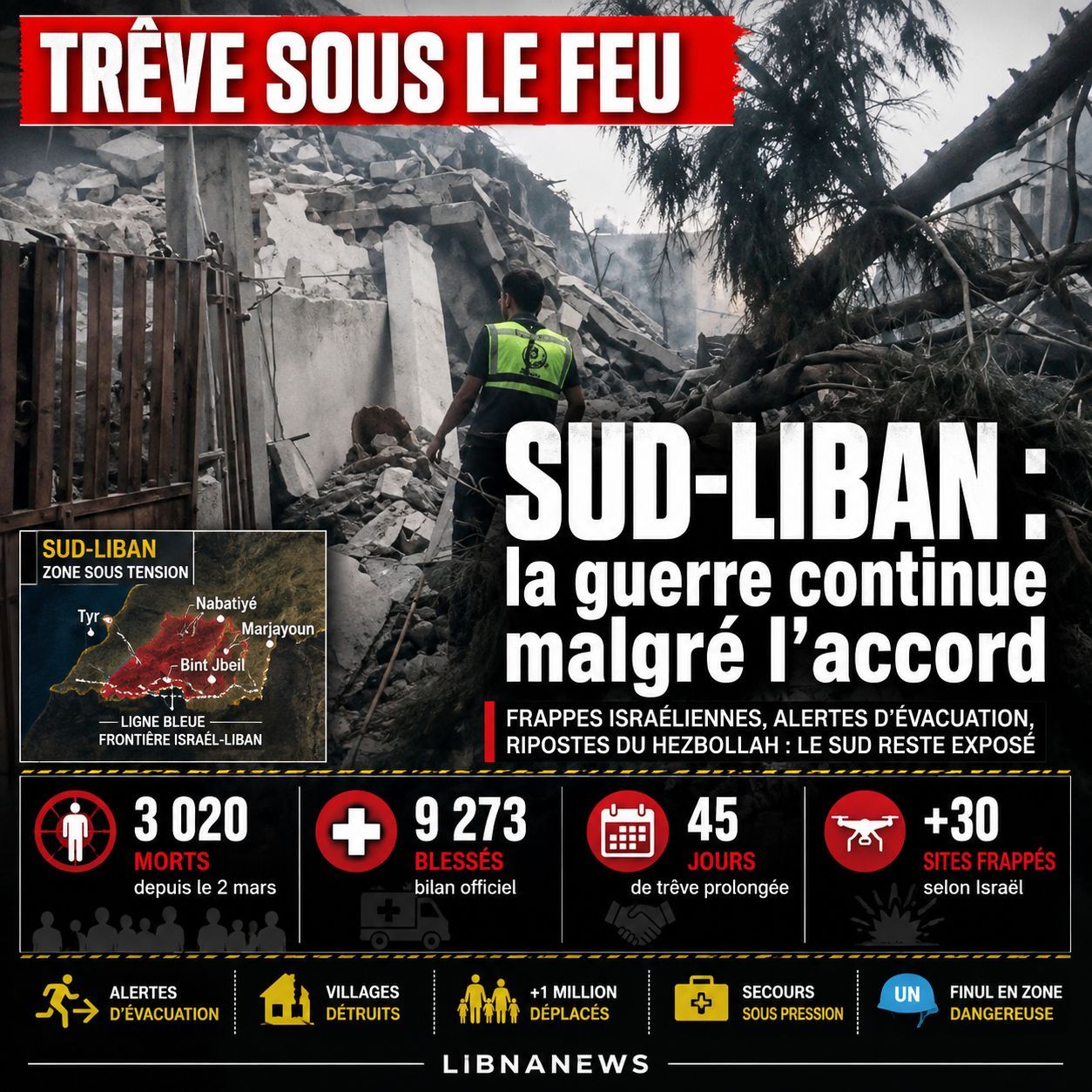
Lebanon is entering a new, but not suspended, phase of war. In southern Lebanon, the extension of the Washington-backed truce did not prevent a new sequence of strikes, evacuation alerts, rocket fire and drone attacks. Between Monday 18 May and Tuesday 19 May in the morning, the official balance sheet crossed a symbolic and political threshold: more than 3,000 deaths since 2 March. This figure gives the current crisis a new gravity. It also obliges the Lebanese authorities, American mediators, Israel and Hezbollah to answer the same question: can a truce still make sense if the people of the South continue to live under bombardments, forced departures and daily destruction?
South Lebanon: a prolonged truce, but challenged by the facts
The day of May 18 was to open a diplomatic break. After a third round of discussions in Washington, a 45-day extension of the ceasefire was announced. It was to come into effect at midnight, on the night of Sunday to Monday, with the aim of giving time to safe contacts. In chanceries, this duration was presented as a useful window. In the field, it was mostly received as a test. Villages in southern Lebanon did not observe a clear cessation of hostilities. They saw the continuation of an episode war, less massive than a general offensive, but intense enough to keep the inhabitants in uncertainty.
In the past 24 hours, Israeli strikes have been reported in several locations in the South. The Lebanese National Agency reported attacks on more than half a dozen points. The Israeli army, for its part, claimed to have targeted more than 30 Hezbollah-related sites in southern Lebanon over the previous 24 hours. It also renewed evacuation warnings against villages in the South, claiming to act against Shiite positions. This difference in language summarizes the crisis. Israel is talking about military targets. The Lebanese authorities speak of repeated strikes on sovereign territory. The inhabitants count the dead, the wounded, the houses destroyed and the roads become dangerous.
The military sequence was not limited to air strikes. Hezbollah has announced further attacks against Israeli forces, including by explosive drones and firing at military positions or rallies. The Israeli army confirmed that projectiles and an explosive drone had crossed the border or targeted its soldiers. It is therefore not a silent truce, but a hybrid regime. Both sides are avoiding, for the time being, declaring the total collapse of the process. Yet everyone continues to act militarily. This grey zone is the most dangerous for civilians. It maintains the war without offering guarantees of real de-escalation.
The night strike near Baalbeck in the eastern part of the country further expanded the picture. A Palestinian Islamic Jihad official, an ally of Hezbollah, was killed with his daughter, according to Lebanese security reports and the Israeli demand for a targeted operation. The event does not directly concern the southern coastline or border villages. But it shows that the crisis is not confined to southern Lebanon. The Békaa Valley, Beirut and its surroundings, the South Roads and the border areas now form an area of continued vulnerability. The geography of the war spreads even when diplomatic communiqués speak of truce.
A national record of over 3,000 deaths
The Lebanese Ministry of Health published a cumulative assessment of 3,020 deaths and 9,273 injuries since 2 March. This threshold of 3,000 deaths marks a break. It is no longer just a statistical indicator. It becomes a political fact because it weighs on all negotiations. The official figure doesn’t say everything. It does not clearly distinguish the share of combatants, civilians, first aid workers, children and medical personnel in its public total. However, international agencies report that several hundred women, children and health personnel are among the victims. The balance sheet therefore remains both massive and incomplete.
The number of victims is growing rapidly. A count in the Lebanese press still reported 2,988 dead and 9,210 wounded until 17 May. The following day, the official figure was 3,020 dead and 9,273 injured. This reflects the combined effect of recent strikes, the geographical extension of attacks and the slow upturn in the balance sheets from hard-to-reach areas. In several locations in the South, relief efforts must deal with the risk of further strikes, road closures, evacuation orders and the presence of unexploded ordnance. The human assessment can therefore be revised as teams access the affected sites.
The detail of the last days accentuates this feeling of degradation. Sunday strikes in the South resulted in at least five deaths and some 15 injuries, according to media reports. A few days earlier, an attack on a rescue centre in the South had killed at least six people, including three rescue workers, and injured twenty-two others. This type of event has particular concern. In a war of wear and tear, the destruction or paralysis of emergency structures worsens each subsequent strike. The wounded are waiting longer. Evacuations become slower. Families are reluctant to move, because they do not know which road remains practicable.
Israel’s record also weighs heavily on military dynamics. Israeli authorities have reported soldiers killed by Hezbollah attacks or operations in Lebanese territory, as well as civilians and contractors killed since 2 March. Military funerals took place following drone attacks attributed to Hezbollah. These losses fuel pressure on the Israeli side to maintain a military presence in southern Lebanon and to continue the attacks on the movement’s alleged infrastructure. They do not reduce the will to war. Instead, they tend to tighten public positions.
The figures that structure the crisis
The immediate assessment can be summarized around a few benchmarks. Since 2 March, more than 3,000 deaths and more than 9,000 injuries have been recorded in Lebanon. More than one million people have been displaced by hostilities, according to international agencies and humanitarian data. Dozens of localities in the South suffered direct strikes, evacuation orders or damage. Health and relief infrastructure have been affected. The United Nations Interim Force in Lebanon has also been caught in a more dangerous environment, with incidents involving drones, explosions near its positions and deaths among peacekeepers since the beginning of the war.
These figures are not limited to the South, but South Lebanon concentrates the most visible effects. The villages near the Blue Line, the areas around Tyre, Nabatiyé, Bint Jbeil, Marjayoun and the roads linking the southern Litani to the rest of the country are under constant pressure. The inhabitants still present live in a precautionary economy. They’re watching alerts. They keep bags ready. They’re avoiding rallies. They reduce travel to the essence. Those who have left often stay close, in temporary housing, in relatives or in collective centres. Many do not know if their house still stands.
The last 24 hours: strikes, alerts and responses
The central point of the last 24 hours is the simultaneousness between diplomatic announcement and military prosecution. The Israeli army reported hitting over 30 Hezbollah sites in southern Lebanon. This statement is intended to show that the truce does not, according to Israel, limit its right to act against what it presents as an immediate threat. In parallel, Lebanese media reported raids on several locations. The details available suggest dispersed attacks rather than a single concentrated operation. This model complicates the lives of civilians. It makes space unpredictable. An evacuation warning, drone overflight or artillery fire is sufficient to empty a road, close a trade or trigger a departure.
Evacuation alerts are a military and psychological tool. They are officially aimed at removing people from areas allegedly used by Hezbollah. But their repetition creates a permanent population movement. On 15 May, five localities around Tyre and its immediate vicinity had already been subject to a new evacuation notice: Chebrieh, Hammadiyah, Zqoq al-Mofdi, Maachouk and Al-Hoch, according to the national agency. On 18 May, new warnings targeted villages in the South. For families, the question is no longer just leaving or staying. It becomes more concrete: where to go, by what road, with what money, for how many days, and with what guarantee of return?
Hezbollah’s response follows the same logic of wear and tear. The party claims to attack Israeli positions, especially when the Israeli army remains present in Lebanese territory or continues its strikes. In the last 24 hours, he announced the use of drones and rockets against Israeli forces. This strategy aims to make the Israeli presence in the South costly and to prevent Israel from turning the area into a secure space. But it also exposes Lebanese villages to new strikes. Hezbollah reports responding to occupation and bombing. Its internal adversaries accuse of keeping the country in a war whose state does not control the rules.
This debate is going through Lebanon. Part of the political class insists on the state monopoly in deciding war and peace. Another stresses that any debate on Hezbollah weapons remains unrealistic as long as Israel strikes, occupies areas or maintains freedom of military action. The Speaker of the Chamber, Nabih Berri, plays a relay role in contacts with Hezbollah. The Presidency is also seeking stronger pressure from Washington on Israel. The government finds itself caught between two imperatives: to avoid the collapse of the truce and not to appear as a mere spectator of a war waged on its territory.
South Lebanon, the human heart of the crisis
South Lebanon is not just a front. It is a inhabited area, structured by villages, agricultural lands, family roads, schools, places of worship and shops. The present war is ruining this daily fabric. Strikes destroy houses. Evacuations fragment families. Roads become risk corridors. Residents who remain often do so to protect their property, care for relatives, feed animals, monitor land or lack a solution elsewhere. Their presence does not erase the danger. It makes it more visible.
In communities close to the border, civilian life is reduced to basic actions. Find fuel. Charge a phone. Get some bread. Check the safety of a trip. Join a loved one. Get an elderly person out. Repeated strikes on the South and evacuation warnings make these actions more expensive. Each movement can be interrupted by a drone or a strike. Residents speak less in strategic terms than in terms of time: how many minutes to leave the house, how many hours before the next alert, how many days before they can return.
Massive displacement worsens the social crisis. More than one million people have been displaced since the outbreak of hostilities. Some live in collective shelters. Another depends on family solidarity. Many settle in already fragile areas, including Beirut, Mount Lebanon, the North or the Bekaa. Lebanon, which has just emerged from several years of financial crisis, does not have a robust safety net. Displaced families often have to pay for housing, transport, care and food in an economy where incomes remain low and irregular.
This humanitarian pressure particularly affects children, the elderly, the chronically ill and pregnant women. Displaced or closed schools interrupt schooling. Regular treatments become difficult. Families that have fled several times since 2024 are experiencing a form of exhaustion. They don’t know if they have to arrange a stay for a few days or a new life elsewhere. This blurring produces a significant psychological cost. It is measured not only in official reviews, but in sleepless nights, aborted returns and anxiety to learn that a neighborhood was hit after departure.
Health, relief and live infrastructure
The crossing of the 3,000-death threshold is taking place while the Lebanese health system remains weakened by the economic crisis, lack of staff, high costs and shortages. Southern and Bekaa hospitals must absorb war-wounded people while continuing to treat ordinary emergencies. Rescue workers work in an environment where secondary strikes, damaged roads and evacuation alerts complicate response. The death of first aid workers in recent attacks has reinforced the feeling of exposure of medical and humanitarian teams.
Rescue centres play a vital role in villages in the South. They provide evacuations, transport of the injured, assistance to the elderly and sometimes the distribution of practical information. When a centre is affected, it is a whole sector that loses the capacity to intervene. The inhabitants must then wait for teams from further away. In an area where minutes count, this distance can affect the survival of the injured. Attacks on ambulances, medical centres or health personnel are also political signals. They fuel accusations of violations of humanitarian law and reinforce the Lebanese demand for more effective international protection.
Ordinary infrastructure is under the same strain. Electricity networks, already deficient before the war, are further deteriorating in the affected areas. Private generators become more expensive to operate. Telecommunications networks are saturating in the areas receiving displaced persons. Southern roads, when they are targeted or made impracticable, cut off access to villages. Farmers lose crops, equipment or land temporarily inaccessible. Shops close more often. Worksites stop. War not only destroys what it strikes directly. It also suspends a whole local economy.
Blue Helmets caught in an increasingly unstable area
The United Nations Interim Force in Lebanon is in an increasingly difficult position. Its mission is to monitor, link and stabilize. But the land that she must watch is militarizing. Drones explode near his bases. Israeli soldiers and Hezbollah operatives operate near UN positions. Buildings were damaged in recent incidents, even when explosions did not cause injuries. Since the beginning of the war sequence, several Peacekeepers were killed in southern Lebanon.
This situation reduces the space for action of the Finul. Patrols are becoming more risky. Communications with the parties are becoming more important. Incidents must be carefully documented, as each charge can fuel a diplomatic crisis. For the inhabitants, the presence of peacekeepers remains a landmark. But it is not enough to prevent strikes, shots or evacuations. The Finul can see, alert and coordinate. It cannot alone impose a truce on actors who continue to view the ground as an active space for confrontation.
The question of resolution 1701 is therefore at the centre of the debate. Lebanon claims to want to restore state authority south of the Litani. Israel claims that Hezbollah retains infrastructure, weapons and firing capabilities in this area. Hezbollah states that the Israeli withdrawal and the cessation of strikes must precede any serious discussion of its weapons. Between these three positions, the Finul occupies a narrow space. It embodies an international framework that everyone invokes, but that no one can fully enforce.
Washington at the centre of a fragile equation
The Washington negotiations have become the other front of the crisis. Lebanon calls for a complete ceasefire, the cessation of Israeli attacks and the withdrawal of occupied areas in southern Lebanon. Israel links any lasting progress to the disarmament of Hezbollah, the security of its northern border and verifiable safeguards. The United States is trying to turn a fragile truce into a more structured mechanism. The 45-day extension is intended to open this space. But the terrain threatens to close it every day.
The next stage announced is a military meeting scheduled for 29 May in the Pentagon. It must address the withdrawal, deployment of the Lebanese army, arms limitation, strengthening of Lebanese brigades and the activation of a more robust monitoring mechanism. This meeting is important because it moves the political language file to operational issues. Who’s watching? Who’s checking? Where does the Lebanese army deploy? Which card defines the withdrawal areas? What happens to Israeli positions in the South? What commitments does Hezbollah accept, directly or indirectly?
The difficulty lies in the absence of Hezbollah at the direct table. The movement refused to treat the issue of its weapons as a concession to Israel. He affirms that any substantive debate should remain Lebanese and intervene after the Israeli strike and withdrawal. This position complicates American mediation. Washington can discuss with the Lebanese State and Israel. But the central armed actor of the front remains outside the official framework. Nabih Berri then serves as an internal political channel. This architecture allows to maintain a dialogue. It also limits its scope.
Iranian case weighs on each calculation
The Lebanese crisis is not alone. It remains linked to the confrontation between the United States, Israel and Iran. The hostilities in Lebanon have resumed in the context of the American-Israeli strikes against Iran and the reaction of Hezbollah. Tehran supports Hezbollah and views the Lebanese front as part of regional negotiations. Diplomatic information indicates that the cessation of the war in Lebanon is one of Iran’s demands in broader discussions with Washington. This gives South Lebanon a value that goes beyond its villages and hills.
This regional dimension reduces the Beirut margin. The Lebanese government wants a halt to the strikes and to preserve national sovereignty. But military decisions also depend on calculations made in Tel Aviv, Washington and Tehran. Lebanon is becoming an area where external priorities intersect: security in northern Israel, pressure on Hezbollah, power relations with Iran, control of the risks of regional escalation and stability of an already weakened Lebanese state. This overlay of agendas makes any truce fragile. A breakthrough on the Iranian case could reduce tension. A blockage could, on the contrary, revive the southern front.
The Israeli debate itself reflects this impasse. Press reports refer to differences between the government and military officials on the ability of a purely military solution to neutralize Hezbollah. The idea that military pressure must be accompanied by a political breakthrough is gaining room. But this approach does not necessarily mean de-escalation. It may also mean that war continues to strengthen the negotiating position. For Lebanon, this is the main risk: to be trained in a diplomacy conducted under bombardment.
A Lebanese political crisis under duress
In Beirut, the situation in southern Lebanon is breaking political discourse. President Joseph Aoun promises to do everything to stop the war. The government of Nawaf Salam seeks to protect the American channel without appearing to be resigned. Nabih Berri tries to maintain a link with Hezbollah and preserve a parliamentary margin. MPs and politicians demand that the state alone recover the decision of war and peace. Others believe that this debate cannot move forward as long as the Israeli strikes continue.
The result is a cautious official word. Beirut insists on sovereignty, Israeli withdrawal, the strengthening of the army and respect for international commitments. But the state does not fully control the front. He doesn’t control Hezbollah’s decisions. Nor does it control the freedom of strike that Israel says it wants to retain. This institutional weakness is at the heart of the problem. It does not mean that the State is absent. It means that it acts in a constrained space, with limited levers.
Lebanese society looks at the truce with distrust. In the South, many do not judge the announcements to be diplomatic, but to be concrete. The inhabitants first ask for the cessation of strikes, the possibility of returning, the reopening of roads, the protection of relief and security guarantees. A truce that does not change these realities seems abstract. It can even fuel anger if it gives the feeling of prolonging the war under another name.
Which can switch in the next few days
The next few days will say whether the 45-day extension can become a real framework for de-escalation. Three elements will be decisive. The first is the level of Israeli strikes in the South. If they continue at the same pace, the ceasefire will remain primarily a diplomatic text. The second is Hezbollah’s response. If drone and rocket attacks continue, Israel will maintain its security argument to strike. The third is the American ability to impose verifiable limits on both parties, or at least reduce the frequency of operations.
The 29 May military meeting is therefore a more important milestone than the general statements. It will have to transform words into maps, calendars, mechanisms and responsibilities. Lebanon will seek a withdrawal and a halt to the strikes. Israel will seek guarantees against Hezbollah. Washington will seek a strong enough agreement to avoid regional expansion. Meanwhile, South Lebanon remains exposed. Displaced families follow the press releases, but also drones in the sky, open roads, calls from relatives and alert messages that decide, often in minutes, the next departure.




