

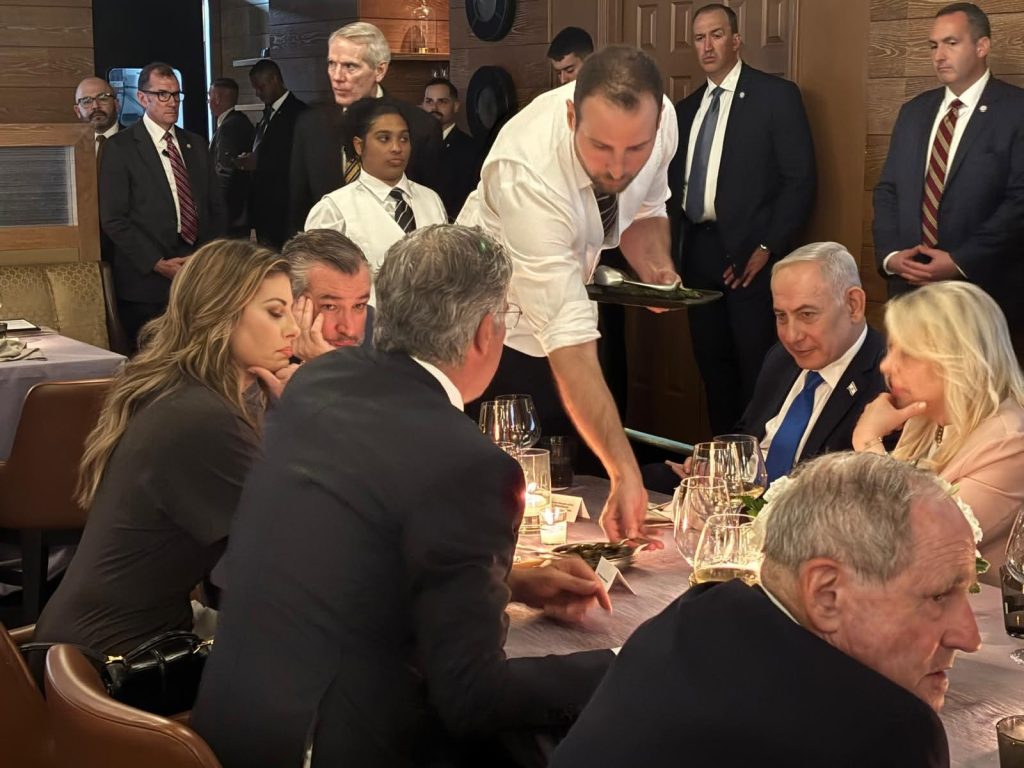
The photograph left in a few hours the frame of a private dinner to become a political object in Lebanon. Taken at the Four Seasons in Washington, she shows Benjamin Netanyahu at the table with several guests. Antoun Sehnaoui appears from the back, in the foreground. The Lebanese banker was not there by chance. He and Morgan Ortagus co-organized an evening in tribute to American Senator Lindsey Graham, one of Israel’s most consistent supporters of Congress.
The presence of the head of the Israeli government, his wife and American officials gives the image a reach that goes beyond worldly sociability. Antoun Sehnaoui appears in a host position. He welcomed an active Israeli official in the heart of Washington, while Lebanon remained officially in a state of war with Israel.
The scene immediately aroused anger in Lebanon. It occurs in a country marked by shelling, displacement and destruction caused by clashes with Israel. It also intervenes while the Israeli-Lebanese discussions, conducted under American mediation, remain at the heart of a regional power relationship.
Above all, photography reveals a network of private and media influence. Antoun Sehnaoui funds initiatives that are favourable to Israel, works with pro-Israeli politicians and participates in events related to this ecosystem. He also has a public relationship with Morgan Ortagus, a former US official directly involved in the Lebanese case.
This accumulation changes the nature of the debate. It is no longer a rumor, an indirect contact or a supposed proximity. Antoun Sehnaoui now occupies a prominent place in the American circles that support Israel. Its funding, political relations and host role with Netanyahu form a coherent whole.
The question now concerns the nature of this influence, the interests it serves and its connections with certain advisers of the Lebanese presidency. These questions take on a particular dimension in the context of the negotiations between Lebanon and Israel.
A photo that turns proximity into public reality
Antoun Sehnaoui is recognizable from the back on the shot. His presence was also established by the proceedings of the evening, which designated him as co-organiser with Morgan Ortagus. The debate is therefore no longer limited to visual identification. It concerns the nature of the event, the role played by the banker and the political significance of a dinner with Benjamin Netanyahu.
The composition of the cliché reinforced its impact. The Israeli Prime Minister faces the goal. Antoun Sehnaoui is a few places from him, in the foreground. This provision gives the impression of a small circle. It contrasts with the usual precautions surrounding contacts between Lebanese nationals and Israeli officials. Even when these meetings occur outside Lebanon, they remain exposed to a particularly severe legal and political reading.
The organizers presented the evening as a tribute to Lindsey Graham. South Carolina’s Republican senator was a constant supporter of Israel and a defender of a hard line against Iran. His disappearance brought together several political leaders and international allies in Washington. The commemorative framework explains Netanyahu’s presence. It does not, however, erase the choice of Sehnaoui to participate in the organisation of the event and to appear in this circle.
This distinction is central. A presence in a large room does not have the same scope as a host role. Co-organizing means participating in the preparation, welcoming guests and publicly assuming the event. It is precisely this point that feeds the anger of a part of Lebanese opinion. Critics not only describe contact. They denounce a social and political normalization conducted without a public mandate from Washington by a man who runs a large Lebanese banking group.
The pro-Israeli engagement of Antoun Sehnaoui
Antoun Sehnaoui is not content to associate with personalities in favour of Israel. It finances initiatives that contribute to the rapprochement between American and Israeli institutions.
In 2025, he provided financial support for cooperation between the Washington National Opera and the Israeli Opera in Tel Aviv. The U.S. community press presented it as a Lebanese entrepreneur that allowed the launch of this American-Israeli initiative.
His name was also inscribed on the donor wall of the Holocaust Memorial Museum in Washington. According to the rules made public by the institution, this registration corresponds to a contribution of at least $50,000.
At a ceremony held in April 2026, Sehnaoui appeared with Morgan Ortagus. She publicly praised her engagement with Israel and the Zionist convictions she attributes to her. That statement provoked a strong reaction in Lebanon.
The ceremony took place as the consequences of the war remained visible on Lebanese territory. It also coincided with Israeli-Lebanese discussions in Washington. The simultaneity of the two events reinforced the controversy.
The banker also participates in meetings involving politicians, donors and organisations belonging to the American pro-Israeli ecosystem. It revolves around networks close to AIPAC and Israel’s main lobby groups.
Its commitment does not depend on one institution. It is part of a broader system, where cultural financing, philanthropy, political collection, private diplomacy and access to elected officials intersect.
Funding for Israeli-American initiatives, donation to the museum, public appearances with Morgan Ortagus and dinner with Netanyahu are established. Its participation in events frequented by AIPAC networks is also reported.
However, the full details of its payments to US political committees or candidates are not available in a consolidated public list. This lack of transparency prevents the determination of the total amount of its commitments. It does not question the reality of its inclusion in this environment.
A lobby that is not limited to AIPAC
The pro-Israeli lobby in the United States is not limited to AIPAC. It is based on a set of structures. Election committees fund candidates. Associations organize meetings. Foundations support cultural or academic projects. Religious groups mobilize their members.
Private donors also play a central role. They finance events, bring politicians closer together and give access to spaces where decisions are built. It was in this set that Antoun Sehnaoui took place.
Its host role with Netanyahu is the most visible expression of this insertion. It is no longer just about bringing money to a cultural institution. It is a matter of organizing a major political meeting with the head of the Israeli government.
Lindsey Graham’s choice as honored figure reinforces this reading. The senator defended American military aid to Israel and supported Netanyahu’s positions on Iran. He pleaded for an offensive policy against Israel’s regional opponents.
By organizing this evening, Sehnaoui places himself at the centre of a clearly identified political current. It does not seek to maintain a level playing field between the actors in the conflict. It is evolving in an environment that defends Israel’s strategic interests and greater normalization of its relations with Arab countries.
His supporters see this activity as a commitment to peace. However, this expression masks an imbalance. Sehnaoui participates in events that highlight the Israeli vision, honour its supporters and bring together its politicians.
No comparable initiative for Lebanese or Palestinian victims appears in this public sequence. This asymmetry explains why the concept of dialogue hardly convinces its critics in Lebanon.
Antoun Sehnaoui, major figure of the Lebanese bank
Born in Beirut in 1972, Antoun Sehnaoui is a banker, businessman and producer. He studied in the United States before joining family activities. In 2007, he took over the presidency and general management of the Société Générale de Banque in Lebanon, better known as SGBL. The institution was one of the Lebanese banks involved in a regional expansion strategy.
Under his leadership, the group expanded its activities in Jordan, Cyprus, the Gulf and Europe. Sehnaoui also chairs Fidus Wealth Management. He heads the Compagnie Financière Richelieu, which controls private banking and asset management activities, notably in France and Monaco. This establishment gives it a financial area far beyond the Lebanese market.
His career is not limited to the bank. He has invested in the media, real estate, culture and cinema. He has been involved in funding several productions, including Lebanese films with international visibility. This diversification has helped to build the image of an entrepreneur connected to business, culture and politics in Europe and the United States.
This position also explains the extent of the controversy. Antoun Sehnaoui is not an individual without public or economic responsibilities. He chairs a Lebanese bank whose clients, like those of other institutions, have suffered the restrictions imposed since the financial collapse of 2019. His name remains linked to a banking system accused by depositors of having transferred the bulk of the losses to them.
The SGBL, like the whole sector, has applied restrictions on withdrawals and transfers. These measures were taken without formal capital control legislation for a long period of time. They have prevented many customers from accessing their savings freely. The banks invoked the liquidity crisis, exposure to the Bank of Lebanon and the decisions of the authorities. The applicants denounced de facto confiscation.
In this context, any manifestation of power, access or international proximity causes an increased reaction. The images of bank leaders frequenting American political circles contrast with the situation of savers in Lebanon. Many still face frozen accounts, limited withdrawals and considerable losses due to the different conversion rates applied since the crisis.
The banking crisis also in the background of controversy
The photograph does not directly concern bank accounts. Yet the financial crisis forms the social background to the debate. Antoun Sehnaoui belongs to the small group of leaders who shaped the sector before 2019. At that time, banks attracted deposits at high rates. They placed a significant share of their resources with the Bank of Lebanon and financed the State.
When currency inflows slowed down, the model collapsed. Establishments temporarily closed and then limited withdrawals. Depositors found that the dollars in their accounts were no longer available under the same conditions. Several categories of bank dollars have emerged. Their real value fell in the face of banknotes in circulation.
Responsibilities remain disputed. Banks highlight government deficits, monetary policy and government default. Political authorities sometimes accuse banks of enjoying excessive returns. The depositors blame both sides for delaying the distribution of losses. No comprehensive plan has yet made it possible to restore the accounts, to restructure the sector fairly and to revive credit.
Antoun Sehnaoui was also cited in court proceedings and controversies related to the bank. Lebanese procedures have often been slowed down by conflicts of jurisdiction, appeals and political confrontation. There is still a need to distinguish established judicial facts from media or partisan accusations.
The current controversy is based on a different and directly visible fact: Sehnaoui participated in organizing a dinner with Netanyahu. It is therefore not dependent on the old files. But these influence the reception of the cliché. For its critics, the image confirms the existence of an elite capable of bypassing the political and social boundaries that bind the rest of the population.
Antoun Sehnaoui and Morgan Ortagus, an exposed relationship
The presence of Morgan Ortagus alongside Antoun Sehnaoui is not new. Their relationship has been publicly reported by several American, Israeli, Arab and Lebanese media since the beginning of 2026. These publications describe it as a sentimental relationship. Sources close to Ortagus claimed that she had started after her marital separation and that she had been declared according to the applicable rules.
This personal relationship is now accompanied by common appearances. In April 2026, Antoun Sehnaoui and Morgan Ortagus participated together in a ceremony at the Holocaust Memorial Museum in Washington. Their names were on the donor wall. The press then stressed that the name Sehnaoui appeared to be a Lebanese donor, in a context of particularly sensitive discussions between Lebanon and Israel.
A few weeks later, they appeared at the launch of a book defending an Arab reading favourable to Israel. The event brought together diplomats, politicians, journalists and representatives of several communities. The personal site of Morgan Ortagus itself relayed this meeting by presenting their common commitment to the regional dialogue.
The dinner in tribute to Lindsey Graham marks an additional step. Sehnaoui and Ortagus are more than just invited. They’re the guests. They welcome an Israeli Prime Minister and American senators. This evolution turns their personal proximity into a public, social and political partnership. She explains why the new photograph causes a stronger reaction than the previous ones.
Morgan Ortagus is familiar with the Lebanese case. Former spokesman of the State Department under the first Trump administration, she then held positions related to American politics in the Middle East. In 2025, it participated in United States diplomatic efforts concerning Lebanon, Israel and the ceasefire follow-up mechanism. His positions were often judged very favourable to Israel by his Lebanese critics.
The revelation of his relationship with Sehnaoui had already raised questions about a possible conflict of interest. The subject is not limited to their privacy. It deals with access for a Lebanese banker to a US official who has worked on issues that directly concern his country, his economic sector and his networks. There is no single public evidence of irregular intervention. The question of the appearance of a conflict, however, remains.
Morgan Ortagus, diplomat and Republican voice
Morgan Ortagus made himself known as spokesman for the State Department between 2019 and 2021, under the authority of Mike Pompeo. She has previously worked in the intelligence, finance and media sectors. A reserve officer of the US Navy, she belongs to Republican foreign policy networks and regularly intervenes in debates on Iran, Israel and the Gulf.
His return to the US diplomatic apparatus in 2025 placed him at the centre of regional discussions. It travelled to Beirut and participated in discussions on the implementation of the post-Israeli-Hizbullah ceasefire. It also defended the disarmament of armed groups and the strengthening of the authority of the Lebanese State.
In Lebanon, his statements often triggered strong reactions. Its supporters consider that it clearly formulates American requirements. Its opponents accuse of resuming Israeli priorities and exerting unilateral pressure on Beirut. His relationship with Antoun Sehnaoui added a personal dimension to these criticisms.
Their public association blurs the boundaries between diplomacy, private influence and political sociability. Washington works largely through networks. Dinners, foundations, think tanks and charitable events play a real role in the flow of ideas and access to decision makers. Sehnaoui seems to have strengthened its place in this environment through Ortagus, its philanthropic activities and its financial relations.
However, it would be excessive to deduce from each appearance a precise political decision. The photographs attest to contacts and proximity. They do not automatically prove an intervention in a public file. Rather, the political problem is one of opacity: the Lebanese public ignores the nature of the discussions, the interests represented and the possible steps taken on behalf of Lebanon or private actors.
The weight of Lebanese law on contacts with Israel
Since 1955, Lebanon has been implementing a law of boycott of Israel. Its first article prohibits natural and legal persons from entering into certain transactions or agreements with persons residing in Israel, Israeli entities or actors acting on their behalf. The text includes trade, financial and economic exchanges.
Other legal provisions and practices have increased awareness of contacts with Israeli nationals. Artists, journalists and individuals have already been interviewed or prosecuted after meetings, interviews or collaborations. Application varies according to the circumstances. The nationality of the participants, the location, the nature of the contact and the existence of a transaction may change the analysis.
The cliché of the dinner, therefore, does not alone establish a criminal qualification. The presence at the same table may be a factual element, but a possible offence must be determined by the court. The exact role of Sehnaoui, organizational arrangements, invitations, funding and the nature of discussions with Israeli participants should be examined.
This legal reservation does not reduce the political scope. In Lebanon, the social norm around Israel often remains broader than the letter of law. Standardization refers not only to formal agreements, but also to cultural, economic or personal relations that could make contacts with Israeli officials ordinary. Opponents of this normalization see Washington dinner as a clear example.
The advocates of the dialogue put forward an opposing argument. They believe that contacts can prepare security arrangements, border agreements or reduce tensions. Some also see informal diplomacy as a means of exploring solutions when official channels are blocked. But Antoun Sehnaoui has no public mandate known to negotiate on behalf of the Lebanese State.
It is this lack of mandate that feeds suspicion. A private actor can defend his ideas and participate in events abroad. However, he cannot present his positions as those of Lebanon. Sehnaoui’s presence alongside Netanyahu then became the symbol of parallel diplomacy led by economic elites, without institutional control or democratic debate.
An image at the intersection of several Lebanese fractures
The polemic first reveals the fracture around Israel. Part of the Lebanese refuse contact before the end of the occupation, the settlement of border disputes and a solution for the Palestinians. Another party wants to dissociate Lebanese sovereignty from the regional conflict and envisages direct arrangements. In between, many support limited, state-led and ombudsmen-led negotiations.
It then reveals a social divide. Bank managers have international resources and networks that the majority of the population do not have. Since 2019, this difference has become more visible. Depositors sometimes have to initiate lengthy procedures to recover a fraction of their assets, while some bankers continue to operate abroad.
The photo also addresses the issue of representation. Who speaks for Lebanon in Washington? Official institutions, parties, diplomats, banks, businessmen or diaspora communities all maintain their own channels. This plurality can be useful. It becomes problematic when private interests are confused with national positions.
Finally, the image shows the power of political signs. No detailed communiqué was needed to launch the controversy. The arrangement of the guests, the face of Netanyahu and the presence of Sehnaoui were sufficient. On social media, the photograph was interpreted even before the organizers gave their full version of the evening.
Official Lebanese reactions will now be observed. A complaint may be filed, a prosecutor may decide to examine the facts or the authorities may remain silent. The government will also have to choose whether it considers the episode a private matter, a judicial matter or a political act. At this stage, no full public review of the conditions for the organization of the dinner was announced.




