





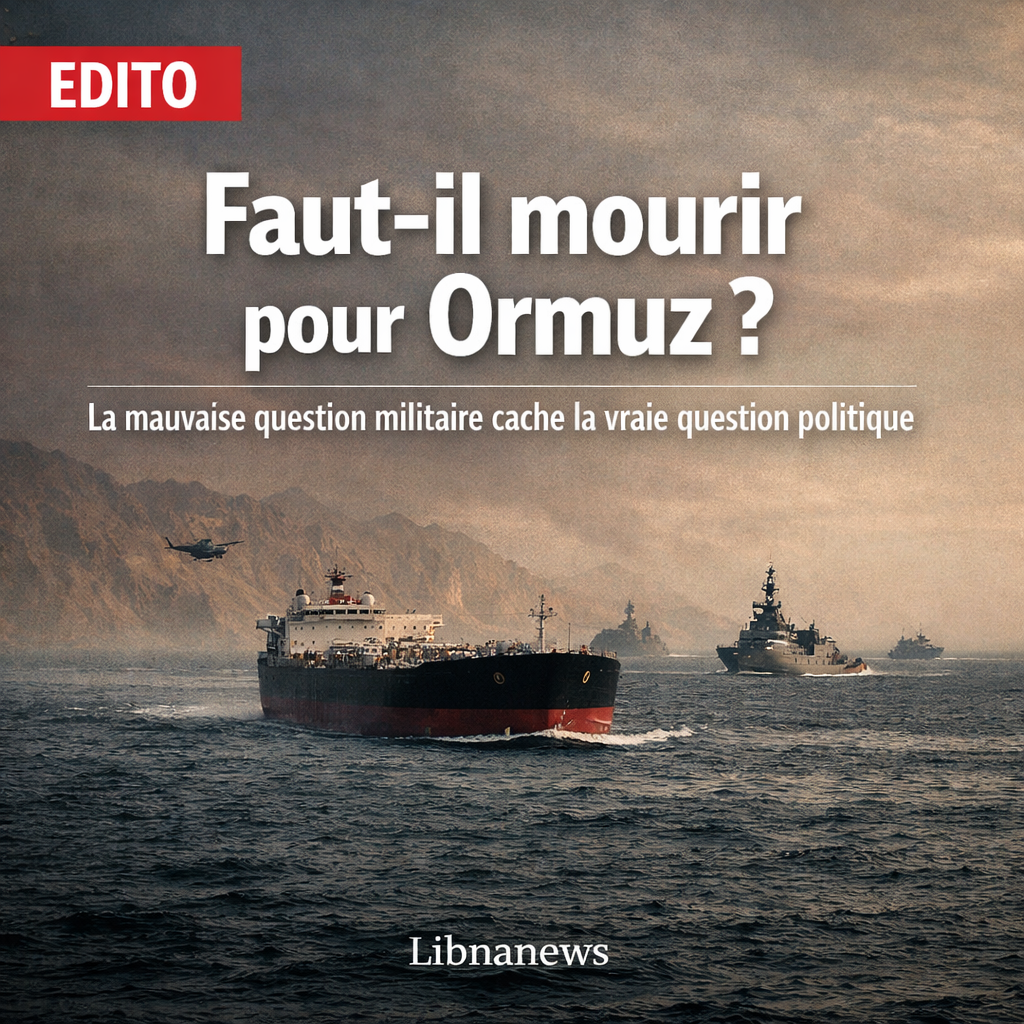
The wrong military question hides the real political question
Every major crisis, the same reflex returns. A strait threatens to close, markets panic, chanceries speak of « vital interest », and the idea of a naval coalition, buildings to be deployed, mines to be neutralised, escorts to be organized immediately emerges. The military response seems simple because it gives the illusion of clarity. It is, in fact, the most misleading.
Because the question is not whether Ormuz Strait counts. No one seriously disputes it. In 2024, it saw an average of 20 million barrels per day, representing about 20 per cent of global consumption of petroleum liquids, as well as just over 20 per cent of world trade in liquefied natural gas. According to the U.S. Energy Information Administration, it is the world’s leading oil gully.
The real question is elsewhere:Who has to pay, in human lives and in military engagement, for a crisis that others have helped bring to this level?Donald Trump has been pressing European and Asian allies for several days to help reopen Ormuz. He even linked this expectation to the future of the Atlantic Alliance, while also demanding the involvement of countries like Japan or China.
It is precisely this reasoning that must be refused. Not because Ormuz would be secondary. But because it is politically untenable to ask the rest of the world to turn the consequences of a war sequence decided first in Washington and Jerusalem into a collective duty.
Trump wants to share the burden after taking the climb
The central point is not energy. He’s political. The Trump administration is not just asking for technical assistance. She’s looking for a form of strategic mutualization. In other words, after climbing, she wants co-management; After the initiative, it calls for solidarity; After supporting an American-Israeli campaign against Iran, it wants to allocate the diplomatic, naval and human cost of securing the Gulf.
The method is questionable both in substance and in form. On the bottom, because a strong coalition is not built by summoning others once the crisis has started. On the form, because Trump now presents the protection of Ormuz as an obligation of those who profit from Gulf oil, without answering the question:Who decided on the force test, and with what exit strategy?The U.S. president demands resources, but he does not offer a readable political framework.
This is the original vice of the present moment. One would suggest that the closure of Ormuz or its partial paralysis mechanically imposes a multinational military response. A crisis does not create a mandate for itself. It does not automatically transform allies into substitutes. It does not remove the responsibility of those who chose the initial escalation.
The most elementary reasoning therefore requires firm restraint:if Washington and Benyamin Netanyahu consider that their line was necessary, that they assume first the main charges. It is not up to Europeans, Japanese or other outside actors to provide ships, crews, budgets and deaths from the outset that would give collective depth to a strategy they have not designed.
Ormuz is a global issue, but it does not justify sending troops
This is where we must guard against blackmail. Yes, Ormuz is essential. Yes, its blocking or threat destabilizes global energy flows. Yes, the International Energy Agency had to announce on 11 March the largest coordinated release of emergency stocks in its history, with 400 million barrels made available to the market, and then confirmed that the national plans had been transmitted.
But this reality is not enough to validate any answer. Because a naval operation never boils down to a technical gesture. It involves a mandate, a war goal, a chain of command, rules of engagement, a definition of the response threshold and, above all, an exit strategy. None of this appears to be stabilized today.
Sending troops « for Ormuz » sounds like an energetic slogan. In practice, this would mean entering a theatre where indirect strikes, risks of mines, drones, missiles, identification errors and political auctions are mixed. A mission presented as defensive can very quickly become a de facto co-belligerence. It is sufficient for an affected vessel, a seaman killed, to have a poorly interpreted clash to ensure that the security of a seaway is transformed into an enlarged conflict.
This danger is not theoretical. It forms part of this type of operation. Once forces are deployed, political logic changes. It is no longer just a matter of protecting traffic. We must then protect the force itself, respond to an attack, show that we do not retreat. It’s the classic gear. And that is exactly what third countries should avoid.
This is not the natural role of NATO, nor that of Asian marines.
Donald Trump seeks to dress his call in the style of « burden-sharing ». The problem is that NATO is not a universal provider of strait security. Its secretary general, Mark Rutte, recalled on 3 March that the Alliance was « not itself involved » in the US-Israeli campaign against Iran, while stressing that NATO would defend its allied territory.
The distinction is crucial. Defending Alliance territory does not amount to joining an operation decided outside its scope. To turn Ormuz into an Atlantic loyalty test would be a political contradiction. This would be tantamount to dragging a collective defence alliance into an adjunct function for ad hoc American choices. Such an extension would blur its mission and would aggravate internal divisions rather than absorb them.
The same caution applies to Asian powers. Japan has already indicated that it does not have, at this stage, a naval escort project in the Strait, recalling its legal and constitutional constraints. This reservation is not a denial of reality. On the contrary, it translates an adult reading of the situation:we don’t enter a military crisis simply because a great power tells you that world trade demands it.
As for China, the idea that Beijing, too, should join an operation desired by Washington is a pure paradox. On the one hand, one cannot pretend to lead a sequence of sovereign forces and, on the other, demand military support from all those who depend on the passage. It’s not a doctrine. It’s improvisation.
To die for Ormuz would be to die for the absence of a strategy.
The real scandal of sending troops today would not be to the stated objective, but to its political vacuum. What exactly would the mission be? Escort tankers? Demine? Destroy Iranian coastal capabilities? Guarantee freedom of navigation for all flags or only for some? For how long? Under what command? What response threshold? And above all, to go to what?
As long as these questions remain unanswered, speaking of intervention amounts to asking the allies for a blank cheque. They would be asked to take the supreme risk — that of armed confrontation — without telling them where the mission stops. They would be offered a firm stance, but without political architecture. We would offer them entry into the crisis, never exit.
This is why the formula« Do we have to die for Ormuz? »Keep his strength. Not as a sleeve effect, but as a revealing. It obliges us to name what technocratic language erases too often: behind the words « security », » corridor », « freedom of navigation », there is the very concrete possibility that sailors and soldiers will die. And that they die not for a coherent strategy, but to make up for his absence.
Accepting this today would be tantamount to validating a dangerous principle: the one according to which powers that trigger the test of force can then demand that others ensure its human sustainability. Such a logic would lead to privatizing the decision and socializing the blood.
The right line: no troops, no white-seing, yes to a durable solution
Refusing the immediate sending of troops does not mean choosing inaction. This means prioritizing answers with cold blood. The first emergency is diplomatic: to impose a specific negotiating framework on freedom of navigation, distinct from all the war objectives pursued by the protagonists. The second is energy: making full use of strategic stocks, bypass capabilities and stabilization tools already opened by the IEA. The third is maritime, but in a register of preparation and surveillance, not rushed into the war.
The right line is to say:no deployment of troops as long as there is no clear mandate, no limited objective, no credible prospect of de-escalation. This position is neither soft nor naive. It is the only one compatible with a serious idea of international responsibility.
For in essence, the question is not whether Ormuz is worth a beat. The question is whether the rest of the world must pay, in men, to make a policy that it has not chosen viable. To this, the answer must be firm.
No. We must not die for Ormuz when dying for Ormuz means, in reality, dying for the strategic improvisation of others.