

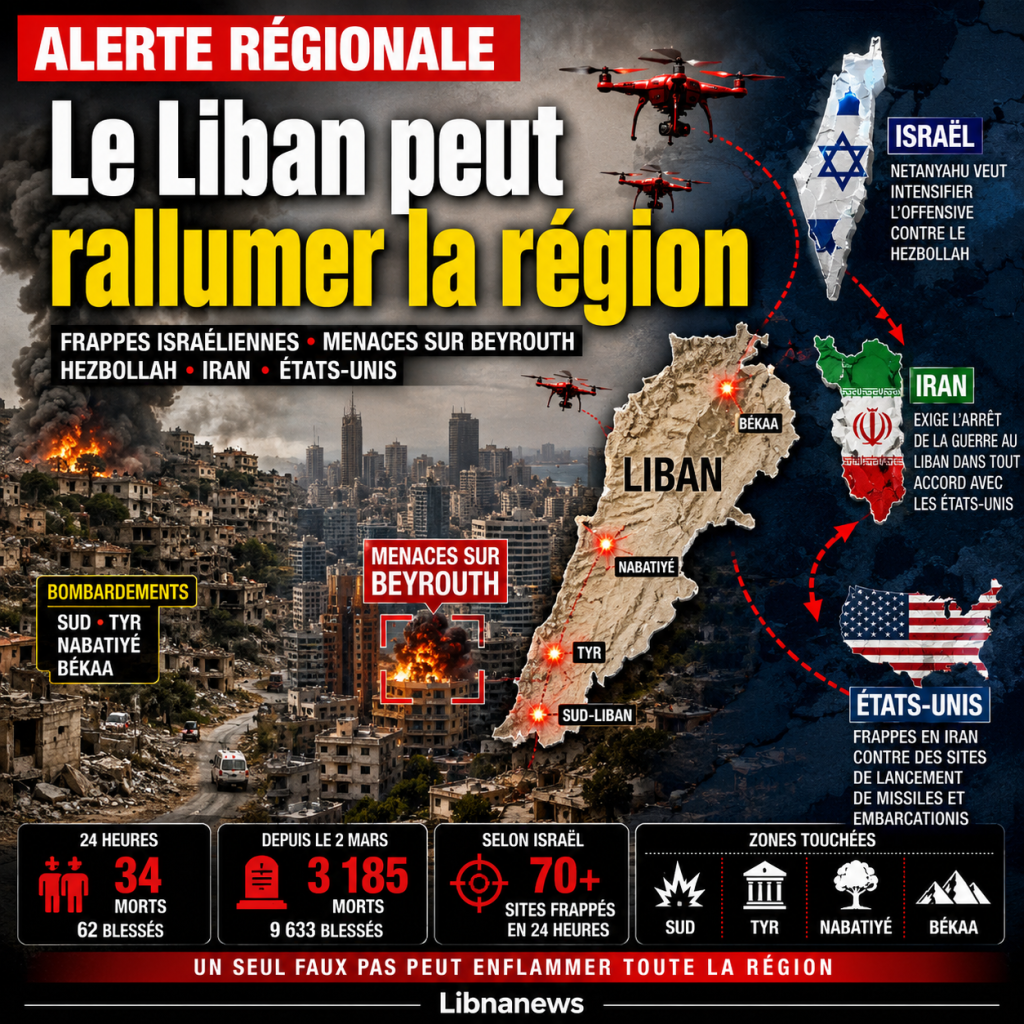
Lebanon has entered a new alert phase in the last 24 hours. The Israeli strikes targeted the South, the Nabatiyah area, the Tyre area and the Bekaa, while Benyamin Netanyahu announced that he would intensify the offensive against Hezbollah. The Lebanese official assessment reported 34 deaths and 62 injuries in one day, resulting in a total of 3,185 deaths and 9,633 injuries since 2 March. This sequence comes as Iran asserts that any agreement with the United States must include the cessation of the war in Lebanon. At the same time, the United States has struck missile launch sites and suspected mines in Iran, a sign that the Lebanese front can now affect regional balance.
Lebanon: An even greater human balance
The largest figure of the day comes from the Lebanese Ministry of Health. In 24 hours, 34 people were killed and 62 injured. The cumulative balance since 2 March reached 3,185 deaths and 9,633 injuries. This progression confirms that the prolonged truce did not produce a real cessation of fighting. Strikes continue, Hezbollah’s responses continue, and civilians remain exposed in several parts of the country.
The day was marked by dispersed attacks. Bombardments hit the South, the vicinity of Nabatiyah, the Tyre sector and the Western Bekaa. Drones targeted vehicles. Air strikes targeted buildings, roads and positions presented by Israel as Hezbollah infrastructure. The Israeli army claims to have struck more than 70 sites attributed to the Shiite movement in one day. This reflects the magnitude of the operation, even if each target claimed by Israel cannot be independently verified immediately.
The Nabatiyah region concentrates a significant part of the events. Kfar Rummane, Harouf, Zebdine, Toul, Arab Salim, Srifa, Bazouriyeh and several nearby axes were cited in the field reports. Drone strikes against cars or motorcycles are of particular concern. They make ordinary travel dangerous. Joining a hospital, evacuating a loved one or moving between two villages becomes a forced decision.
South Bekaa Bombardments
The Tyre sector has also been under increased pressure. Israel claims to target Hezbollah command centres, weapons depots and operational infrastructure. Hezbollah, for its part, challenges Israeli logic and presents its own operations as a response to the occupation of southern areas and the strikes against Lebanese territory. Between these two speeches, people have to deal with alerts, destruction and uncertainty about the next target.
Western Bekaa also occupies a central place in the sequence. Strikes hit or threatened the vicinity of Sohmor, Klaia, Labbaya, Machghara and other localities. This extension towards the interior of the country shows that the front is no longer limited to the border band. The hinterland is becoming a target area, as are border villages. For displaced families, this makes it difficult to choose a place of refuge, as areas long perceived as less exposed are now more vulnerable.
Evacuation notices heightened panic. The Israeli army issued appeals against several locations in the South and the Bekaa. The inhabitants concerned were ordered to leave their homes and move towards open spaces, often at least one kilometre from the designated areas. These messages cause rapid departures, but also hesitation. Some families do not have vehicles. Others refuse to leave without their elderly relatives. Many do not know if their house will still be standing when they return.
Netanyahu hardens his tone against Hezbollah
Fear also spread to the southern suburbs of Beirut. After the video of Benyamin Netanyahu announcing the intensification of the strikes, some residents started to leave some quarters as a precaution. It was not a general evacuation order but a spontaneous movement linked to the memory of previous bombings. The southern suburb remains identified by Israel as a stronghold of Hezbollah. Any threat to Beirut is therefore immediately read as a risk to this dense, residential and political area.
Benyamin Netanyahu’s statement set the tone. The Israeli Prime Minister said that Israel was at war with Hezbollah and that it was necessary to increase the intensity of the blows. He referred to the drones used by the Lebanese movement, including fibre optic drones, which were more difficult to neutralize. That point counts. These devices allow precise attacks against soldiers, armoured personnel or positions, bypassing some of the conventional means of interference.
Netanyahu also responds to internal pressure. The death of an Israeli soldier in a drone attack in southern Lebanon reinforced calls for a tougher response. Ministers in his Government believe that passive defence is no longer sufficient. They want to impose a higher price on Hezbollah and beyond in Beirut. The Israeli Prime Minister did not formally announce a resumption of the massive bombings on the capital, but his remarks opened the door to wider intensification.
Israeli threats against Beirut
The most explicit threat came from Bezalel Smotrich. The Israeli Finance Minister said that for every Hezbollah explosive drone, ten buildings should fall in Beirut. This sentence is not an official decision of the Israeli cabinet. The consequences are no less serious. It transforms the Lebanese capital into a deterrent and erases, in its formulation, the distinction between military targets, civilian buildings and urban spaces.
Itamar Ben Gvir followed a nearby line. The Israeli Minister of National Security asked not to normalize drone attacks and called for a return to war in Lebanon. These radical positions do not always dictate the operational conduct of the army. However, they weigh on the Israeli debate. They reinforce the idea that the Lebanese front should no longer be treated as a limited war, but as a confrontation to be intensified.
Hezbollah claims several attacks. The movement claims to have targeted Israeli rallies or positions with drones, rockets and artillery fire. In particular, he claimed a drone attack on Israeli troops in Misgav Am, northern Israel. His speech remains focused on the response and the refusal of disarmament under pressure. For the movement, any discussion of its weapons first involves stopping Israeli attacks, withdrawing from Lebanese territory and returning displaced persons.
Drones at the centre of the power ratio
The issue of drones now occupies the heart of climbing. For Israel, they pose an immediate tactical challenge. For Hezbollah, they offer a way to maintain military pressure without hiring large units. Their use changes the balance of the forehead, as relatively inexpensive equipment can kill a soldier, damage a vehicle or disrupt a surveillance device. This development explains Israel’s nervousness and the tightening of political vocabulary in Jerusalem.
The truce, which was extended for 45 days, appears to be largely empty of its effect. It exists in the texts and diplomatic discussions. It does not result in a halt to the strikes or an interruption of Hezbollah fire. Israel claims to act against immediate threats and military infrastructure. Hezbollah claims to be responding to Israeli violations and troops in the South. The Lebanese Government calls for an effective ceasefire, but does not have the means to impose it alone.
This fragility is read in everyday life. Schools open alerts. The shops close as soon as a drone turns over a village. Ambulances proceed with caution. Municipalities record damage, arrange evacuations and seek accommodation for displaced families. The first aid workers are exposed themselves. Recent attacks have killed or injured medical personnel in the South, further reducing local capacity to respond to emergencies.
Iran wants to include Lebanon in the agreement
The other dimension of the sequence is regional. Lebanon is no longer just a collateral theatre. It becomes a central part of the negotiations between the United States and Iran. Tehran stated that the cessation of Israeli strikes in Lebanon should be part of an agreement with Washington. This position gives the Lebanese front a test value. If Lebanon remains under bombs, Iran can claim that regional de-escalation remains incomplete.
This element changes the reading of events. A major Israeli strike on Beirut would not only be a Lebanese-Israeli episode. It could be interpreted by Tehran as a direct challenge to the framework for discussion with Washington. It could also push Hezbollah to increase drone or rocket attacks. The United States would then face a dilemma: contain Israel, protect its forces in the region and prevent Iran from responding directly.
US strikes in Iran add an additional level of risk. Washington announced that it had struck suspected mines and missile launch sites in southern Iran. The US command presents these operations as defensive actions to protect its forces. There is no public confirmation at this stage that these strikes directly respond to Israeli threats against Beirut. The chronology, however, remains worrying: threats against the Lebanese capital, Iranian hardening around the Lebanese issue, and then American strikes against Iranian capabilities.
Lebanon as a possible regional detonator
This sequencing is enough to show the danger. If Iran mobilizes or alerts launchers to influence the Israeli calculation, the United States can consider them a threat to its forces. If Washington strikes these means, Tehran can see a desire to reduce its deterrent capacity. Lebanon then becomes the starting point of a chain of decisions that far exceeds its borders. A threat to Beirut can provoke an Iranian reaction. An Iranian reaction may result in an American strike. An American strike can revive regional confrontation.
The Lebanese government finds itself at the centre of this mechanism without mastering its main levers. Beirut calls for a halt to the bombings and respect for national sovereignty. It also seeks to preserve open channels with Washington, Paris and the Arab countries. But the decision whether or not to intensify the strikes belongs to Israel. The decision whether or not to include Lebanon in the agreement belongs to the United States and Iran. The decision to continue the attacks belongs to Hezbollah.
This position exposes the Lebanese State to a contradiction. He must speak in the name of sovereignty, but part of the war is decided outside his institutions. It must reassure the inhabitants, but cannot guarantee the safety of roads or villages. It must negotiate with its international partners, while managing Hezbollah’s internal arms divisions. Every Israeli strike and every claim of the Shiite movement reduce the space for a strictly Lebanese solution.
A civil, economic and diplomatic crisis
The Lebanese company is already paying that price. Displaced persons are accumulating in less exposed cities. The damaged housing has been in the thousands since the fighting resumed. Families live between two departures, two returns and two alerts. In the South, some villages lose their inhabitants during the day, and then see them return at night to pick up papers, laundry or medicine. This instability undermines the local economic fabric as well as physical security.
The humanitarian cost adds to a continuing economic crisis. Displaced households must pay for transport, food, care and temporary housing. Municipalities have limited budgets. Hospitals absorb war-wounded people while the health system remains fragile. The slightest expansion of strikes to Beirut would have an immediate effect on roads, shelters, prices and hospital capacity. That is also why the threats against the capital produce a wave of national shock.
American diplomacy is also under stress. Washington supports Israel’s security and accuses Hezbollah of trying to sabotage the Lebanese-Israeli talks. But the United States is negotiating in parallel with Iran, which wants to include Lebanon in a regional settlement. These two lines become difficult to reconcile. The more Israel strikes Lebanon, the more Tehran can make the Lebanese front a condition. The more Washington hits Iran, the more credibility the discussion on de-escalation loses.
The next signs to watch
Israel seeks to preserve its freedom of action. Netanyahu claims to want to continue to strike threats on all fronts, including in Lebanon. This position is in friction with the idea of a regional agreement that would simultaneously calm Iran, Hezbollah and Israel’s northern border. For the Israeli government, abandoning the attack on Hezbollah would be tantamount to allowing a threat to re-establish itself. For Tehran and Hezbollah, maintaining Israeli strikes in Lebanon amounts to emptying the agreement of its content.
The next diplomatic appointment will therefore weigh heavily. Discussions still need to be held on the ceasefire, the disarmament of Hezbollah, the role of the Lebanese army, the Israeli withdrawal and security guarantees. But these files don’t move in a vacuum. They move under drones, strikes and threats. A single major bombing on Beirut could move the whole negotiation, as it would ask the question not only of southern Lebanon, but of Iranian engagement and American reaction.
For the time being, three indicators must be followed. The first is the number of evacuation notices for southern, Bekaa or southern suburbs. The second is the frequency of Hezbollah drone attacks and their impact on Israeli forces. The third is the level of US military activity against Iranian means in the Gulf or in southern Iran. These three signals will say whether Lebanon remains a contained front or whether it becomes the trigger for a more direct regional escalation.
The opening day will therefore be played on several cards at once. On Lebanese ground, residents will look at roads, drones and evacuation communiqués. In Washington, negotiators will need to measure the impact of Israeli strikes on the dialogue with Tehran. In Iran, military and political leaders will have to decide whether the threat against Beirut requires a response. In Lebanon, the next review of the Ministry of Health will give the first concrete measure of what this escalation has already cost.




