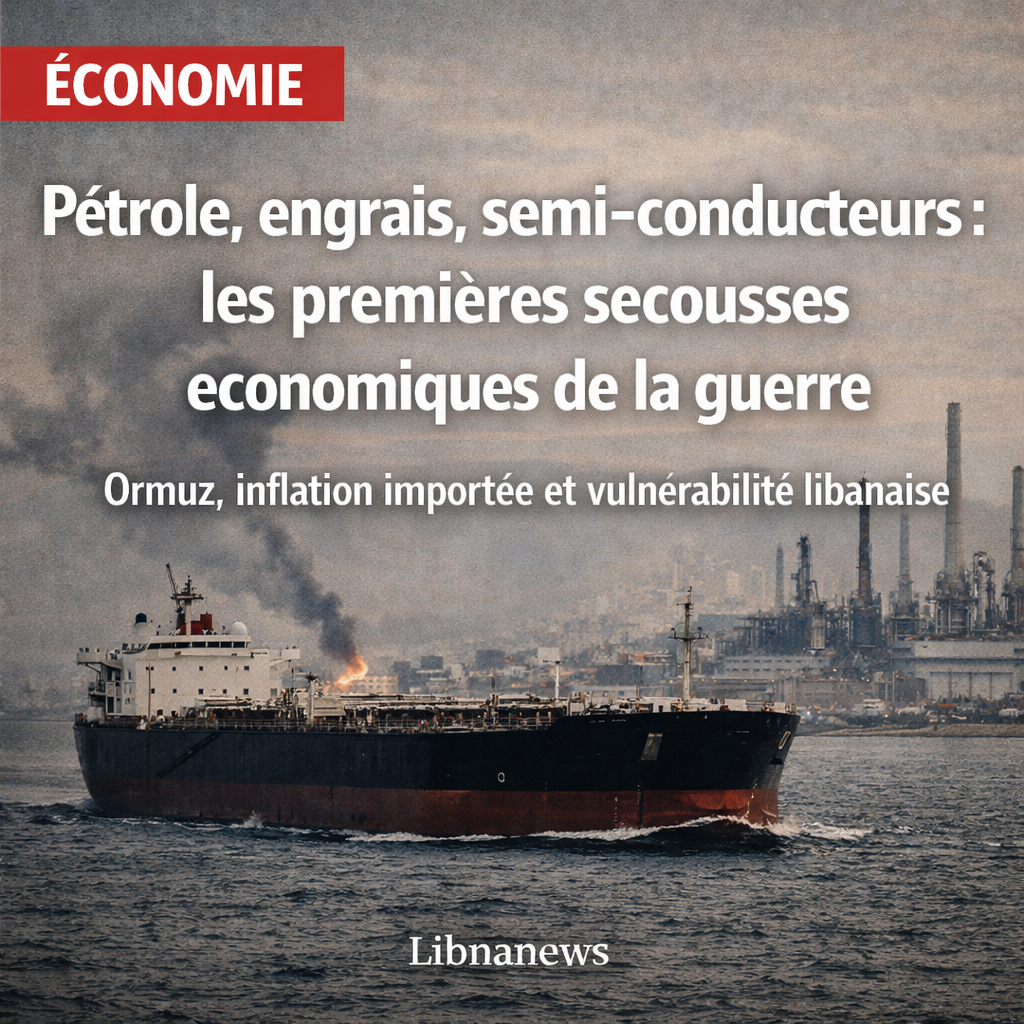
The first shock is visible, almost mechanical: oil goes up again, markets learn the price of geopolitical risk, and Ormuz becomes again what it has never ceased to be, the energy lock of the world. But reducing the current shaking to the barrel alone would be a scale error. The conflict is already beginning to deregulate other supply chains, which are less spectacular in appearance and yet decisive: fertilizers, certain chemical inputs, air freight and, in the background, the materials essential for the semiconductor industry. For Lebanon, an importing country, dependent on the dollar, vulnerable to every change in logistical cost, this shock wave has an immediate meaning: it not only threatens pump prices, it threatens the cost of bread, medicines, private electricity and an entire economy already under infusion.
Ormuz reopens the chapter of oil shocks
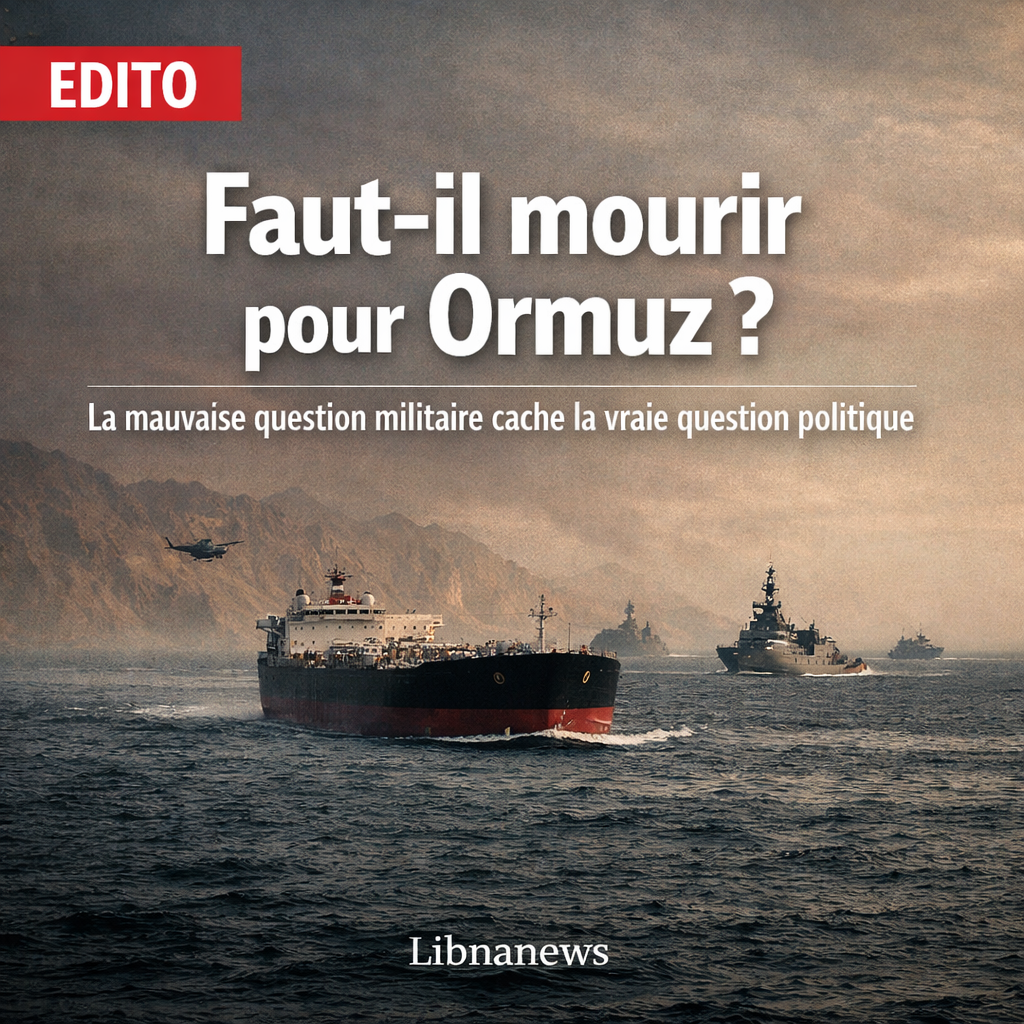
The Strait of Ormuz alone concentrates an essential part of global vulnerability. In 2024, 20 million barrels per day were transported, equivalent to about 20% of the world’s consumption of petroleum liquids; Just over 20 per cent of the world’s liquefied natural gas trade has also passed through. The circumvention solutions exist, but they remain limited. This explains the extreme sensitivity of markets to any military incident, threat to maritime insurance or reduction in traffic.
The price signal has already been given. The U.S. Energy Information Administration notes that the Brent increased from an average of $71 on February 27 to $94 on March 9, at the time the crisis settled over time. The Agency adds that, even without complete physical closure of the Strait, the threat of attack and cancellation of insurance coverage were sufficient to divert a large part of the tankers, to the point of causing regional production stops. In other words, the market reacts not only to destruction, but to the probability of destruction.
Faced with this risk, the International Energy Agency launched on 11 March the largest coordinated supply of strategic stocks in its history: 400 million barrels. On 15 March, it indicated that national plans were ready, with volumes immediately available in Asia-Oceania and from the end of March in the Americas and Europe. Its Executive Director, Fatih Birol, had previously warned G7 finance ministers that conditions on the oil market had deteriorated and that a significant share of production had already been discontinued. The message is clear: reserves can cushion the shock, not delete it.
Strategic reserves amortize, they do not repair
The release of stocks has an immediate virtue: it buys time. It can contain a sharper surge in crude oil, reassure refiners and give governments a few weeks of margin. But it does not replace interrupted flows or lost logistical confidence. The IEA also recalls that its member countries have large public and compulsory stocks, while the US EIA stresses that a prolonged closure of Ormuz remains the main risk on prices. The underlying problem therefore remains intact: if ships do not pass normally, reserves become a cushion, not a solution.
This distinction counts to understand the rest. A more expensive barrel increases transport, thermal electricity, petrochemicals, nitrogen fertilizers and the general cost of imports. In a globalized economy, oil never strikes alone. He acts like a multiplier. This is why the first shocks observed in agricultural and industrial markets are not a separate phenomenon. They already prolong the initial shock of Ormuz.
Fertilizers are already affected
The second economic front is less commented, but it is already visible. IFPRI notes that prices for several key fertilizers began to rise again in early March. The price of urea in the Middle East exceeded $590 per metric tonne on 5 March, up over $90 per week, or +19 per cent. At the same time, the DAP on the Gulf of Mexico reached $655 per tonne, up over $30, or +5%. These levels remain below the peaks of 2021-2022, but the signal is clear: the war is starting to increase global agricultural inputs.
This movement is based on several channels at a time. First, the production of fertilizer depends heavily on gas, and therefore on energy. Second, the Gulf Sea Routes play a central role in ammonia, urea and other inputs. Finally, freight itself becomes more expensive and uncertain. IFPRI warns that this increase comes at a delicate time for farmers, already faced with tight margins and less favourable agricultural prices. This is not yet a global food crisis, but it is already a cost increase which, if it lasts, will eventually rise to retail prices.
In net importing countries, the effect is formidable: it does not appear immediately on stalls, but it settles in contracts, sowing, the cost of future crops and the price of bread a few months later. The 2022 precedent showed how quickly a shock on energy and fertilizers can turn into food inflation. The difference, this time, is that several fragile economies enter the episode with much less fiscal and monetary room for manoeuvre.
Semiconductors see a risk coming back that industry thought was better controlled
The third front is more technical, but equally strategic. The war did not at this stage break the world’s flea production. Two major Taiwanese groups, Pegatron and GlobalWafers, reported on 11 March that their operations were not immediately broken down. But their statements say something else: they have adapted their logistics in advance, monitor their critical inputs, and know that the risk is not theoretical. The President of Pegatron acknowledged that, should energy supplies in the Middle East be cut more sustainably, the impact on components and raw materials would become difficult to anticipate.
The point of vigilance includes helium, a gas essential for several stages of semiconductor manufacturing. GlobalWafers has indicated that it has sufficient stocks for several years, which protects in the short term. But this relative security of a large actor does not erase the fragility of the system. Qatar is a major supplier of helium, and the slightest prolonged disturbance in the Gulf is sufficient to re-energize a value chain already marked by several episodes of rarity since 2022. Markets do not necessarily wait for the shortage to react: they first reassess the risk, hence the costs.
To this is added the cargo. The International Air Transport Association warned on 10 March that hostilities in the Middle East were disrupting airspace and complicating the operation of the cargo. For value chains based on just-in-time, high-value unit components and fast links, this data counts almost as much as the energy price. The risk at this stage is not that of a sudden shutdown of the flea industry. It is the result of a gradual increase in prices, longer deadlines and a new uncertainty premium on already sensitive inputs.
Lebanon, first-line importer
It is here that the world war of flows meets Lebanese reality. Lebanon does not address this shock in a neutral position. The World Bank points out that, in the first half of 2025, imports grew 14.6 per cent year-on-year, faster than exports, further deepening the trade deficit in goods. It projected a current account deficit of 15.8% of GDP in 2025 and 16.1% in 2026, while recalling that pressures on the balance of payments remain strong and external vulnerabilities remain structural. As world prices rise and freight increases, Lebanon is not only experiencing imported inflation: it is absorbing with an already unbalanced economy.
This fragility is particularly clear for essential goods. The Lebanese Ministry of Economy, in a memorandum issued on 8 March, assured that stocks of commodities, including food, wheat and fuel, were sufficient to cover several months of local consumption. This statement aims to avoid panic and speculation. It also says, in a hollow, that the issue of security of supply has again become central. In a country where the State has to monitor stocks on a daily basis with importers, the slightest international shock immediately becomes an issue of domestic stability.
Wheat is a good indicator of this exhibition. According to FAO, imports of wheat from Lebanon for the 2025/26 season are estimated at 680,000 tonnes, or about 8 per cent above average, after a very low harvest in 2025. The World Bank also recalls that the country imports about 80 per cent of the wheat it consumes. Again, the issue is not just the volume available, but the final price, the cost of freight, access to the dollar and the ability to maintain regular flows without further surge in bread prices.
An energy vulnerability that amplifies everything
Lebanon also pays for its energy dependence. Its first biennial transparency report explains that the shortage of currencies has made it more difficult to import fuels for electricity production and transport, fuelling cuts and the massive use of private generators. The document also highlights the continued high dependence on diesel and heavy fuel oil, due to the lack of a switch to gas. In such a system, any global oil shock has a multiplied effect: it affects not only motorists, it affects alternative electricity, shops, hospitals, water pumps and a large part of daily activity.
The World Bank has been describing the same mechanisms for several years: currency shortages, critical import shocks, difficulties in accessing medicines and fuel, and public services that are unable to absorb the shock. The danger today, therefore, is not that of an instant collapse of supplies. It is the result of a rapid erosion of purchasing power, a diffuse increase in costs, and a new social tension as importers pass the barrel, freight and inputs on to book prices.