

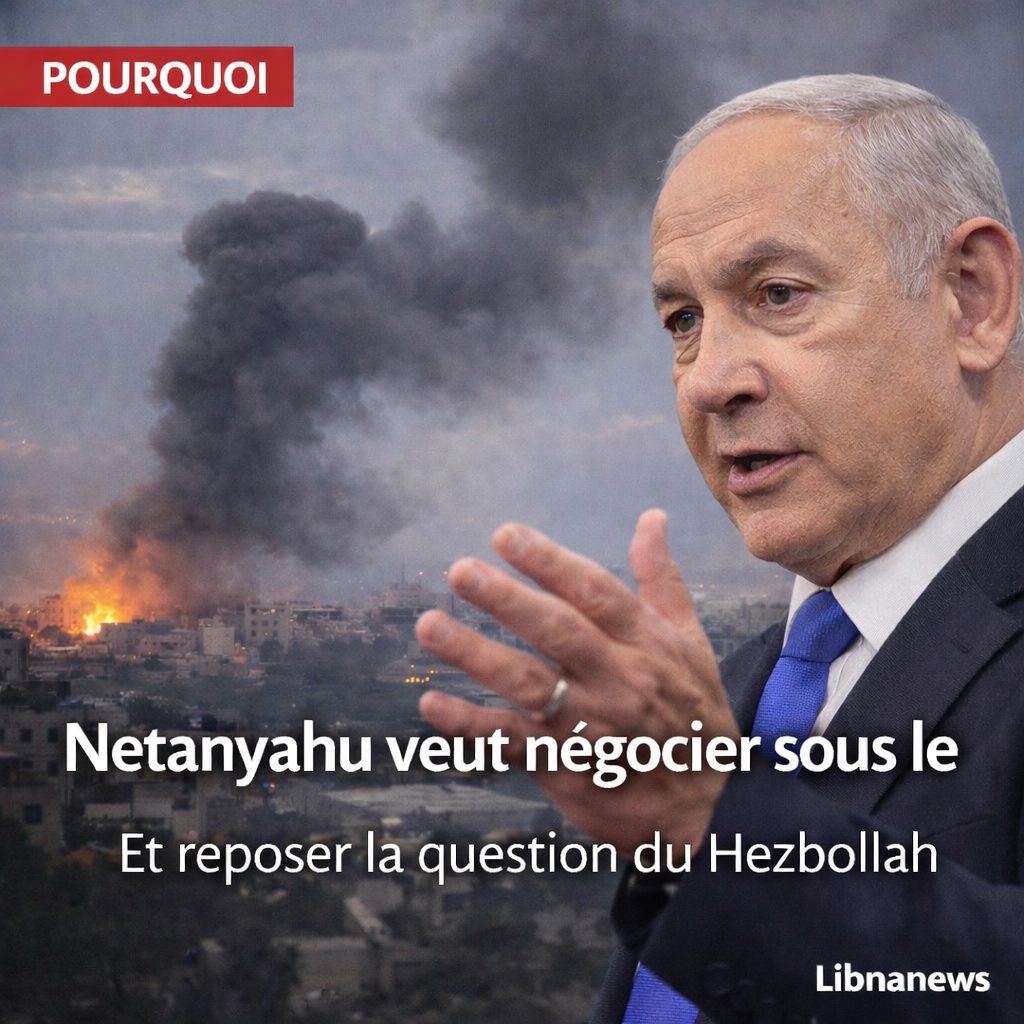
By announcing that it will launch « as soon as possible » direct negotiations with Lebanon, Benyamin Netanyahu does not open a balanced peace sequence. It focuses on two strategic objectives:negotiate while strikes continueandseparating the Lebanese file from the regional framework created by the ceasefire between Washington and Tehran. But this sequence did not weaken Hezbollah in Lebanon politically. On the contrary, it gave him a regional centrality, since the Lebanese question became one of the main points of friction around the truce. In this balance of power, Israel has more to gain than Beirut, which arrives without real leverage, if not the urgent need to finally achieve a ceasefire.
Timeline illuminates everything. According to Axios, Netanyahu’s statement came after phone calls with Donald Trump and Steve Witkoff. The media added that Witkoff had asked the Israeli Prime Minister to calm the strikes in Lebanon and open negotiations. But an Israeli official, quoted in the same article, clearly states thatThere will be no ceasefire in Lebanon. The Israeli proposal is therefore immediately framed: to speak, yes, but without suspending the war. That’s the point. Israel does not first want to stop the fire to create a political space. He wants to use fire to shape negotiations.
This logic is exactly the opposite of the Lebanese diplomatic doctrine put forward in recent weeks. According toLibnanewsThe line defended by Beirut is clear:first the ceasefire, then the negotiations. This hierarchy is not a technical detail. It means that the Lebanese State considers that no serious, sovereign and balanced discussion can take place as long as the bombing continues. Speaking of direct negotiations without prior truce, Netanyahu therefore does not respond to Lebanese logic. He’s trying to crush it.
Israel wants to separate Lebanon from the regional issue
The first Israeli objective is tomoving Lebanon out of the regional framework. After the ceasefire between the United States and Iran, several actors argued that Lebanon should also be included in the de-escalation. Reuters reports that France and the European Union insisted on this, while Iran also considered the Lebanese front to be part of the logic of the ceasefire. Israel and the United States have defended the opposite: the truce does not concern Lebanon.
For the Israeli government, this decoupling is vital. If Lebanon were to be covered by regional dynamics, it would lose part of its freedom of action against Hezbollah. By separating the two files, he can instead continue the strikes, maintain the military pressure and transform Lebanon into an autonomous theatre, detached from the pause obtained with Tehran. Netanyahu’s statement on direct negotiations is exactly in line with this strategy: it aims to establish the idea that there is now aseparate Lebanese file, to be dealt with face-to-face, away from the wider regional framework.
But this decoupling has produced an opposite political effect to that sought. By explicitly excluding Lebanon from the ceasefire, Israel has in fact recalled that the Lebanese front remains central. The mere fact that the truce triggered a diplomatic battle over Lebanon’s inclusion or not put Hezbollah at the heart of the equation. Instead of appearing marginalized, the movement was able to appear as the actor that Washington and Tel Aviv could not neutralize within the framework of the truce. That is what strengthens its political legitimacy in relation to Lebanon, despite the military pressure it is under. This reading is analytical, but it is based directly on Lebanon’s place in the international debate on the ceasefire.
The ceasefire with Iran gave Hezbollah political weight
This is the central paradox of the sequence. Militaryly, Hezbollah remains under pressure. Politically, he regained weight. Why? Because the agreement between Washington and Tehran immediately stopped the Lebanese question. If Lebanon had to be explicitly excluded from the ceasefire, it was good that the Lebanese front remained strategic. Hezbollah can therefore argue that it remains one of the elements that the region cannot circumvent. The symbolic effect is powerful: instead of being relegated to a simple Lebanese internal issue, he has again, through the very crisis of the ceasefire, become an actor at the centre of the regional debate.
For Israel, this is a bad sequence. His objective was to present the pause with Iran as a stabilization of the large regional front, while leaving Hezbollah alone in front of the Israeli military machine. But the dispute over Lebanon’s inclusion has produced the opposite: Hezbollah can argue that it remains the main lock for a wider settlement. This does not mean that he comes out militarily reinforced. That means he’s coming out.repoliticized. And this is precisely what Netanyahu is trying to correct by immediately relaunching the idea of direct negotiations focused on its disarmament.
The Israeli announcement therefore seeks to change the framework. We must no longer speak of a Lebanon whose situation is a condition for the coherence of the regional ceasefire. We need to talk again about a Lebanon that has been ordered to deal alone and directly with Israel with the issue of Hezbollah. It is a way of taking back from the movement the political benefit arising from the ceasefire crisis, placing at the centre a strictly Israeli agenda: disarmament, border security, and then possible peace.
Negotiating during strikes: Israel imposes a framework that benefits
The problem for Lebanon is simple: Israel wants to negotiatewithout cease-fire. Axios is very clear on this point: Witkoff asked Netanyahu to calm the strikes and launch negotiations, but the Israeli side claims that no truce is foreseen on the Lebanese front. This means that the diplomacy proposed by Israel does not replace war. She’s superimposing. The talks would therefore be conducted while Israel maintains the military initiative, the ability to strike, threaten and climb at any time.
In such a framework, Israel has almost everything for it. He controls military pressure. It sets the agenda, focusing on the disarmament of Hezbollah. He obtained that Lebanon was treated separately from the regional framework, which deprived Beirut of wider diplomatic support. He can then present any Lebanese prudence as a reluctance to peace. Lebanon, for its part, enters into the discussion without guarantees, without suspension of strikes and without a favourable balance of power. His only coherent requirement remains, therefore, the one he already makes: to silence weapons before speaking.
This is where the real imbalance appears. Israel is negotiating from a position of active force. Lebanon would negotiate from a position of continued vulnerability. In these circumstances, the Israeli formula is not that of de-escalation. It’s that of acoerced bargaining, where war becomes the tool for making compromise. For Beirut, accepting such a scheme would mean transforming the urgency of the ceasefire into a lasting diplomatic weakness. This conclusion is based on an analysis based on the Israeli refusal of the ceasefire in Lebanon and the reverse Lebanese doctrine.
The Lebanese government finds itself without a real map
In this configuration, Lebanon has few levers. He can count on verbal support: several international actors have said that a credible ceasefire should include Lebanon. But these positions did not produce a binding mechanism. Washington continues to support Israeli reading. And as long as the United States maintains that the Lebanese front is not part of the regional truce, Beirut does not have the strength to assert its conditions.
The Lebanese authorities can of course recall, as Joseph Aoun did, that only the state negotiates on behalf of Lebanon. It can also advance the control of Beirut and the monopoly of legal weapons in the capital, as decided by the Council of Ministers. But these actions remain, for the moment, gestures of political positioning rather than strategic rebalancing. They do not give Lebanon a new map in front of an Israeli who wants to speak while continuing to bomb.
This is the harshest reality of the sequence: Israel has more to gain than Lebanon from an immediate opening of negotiations that could lead to civil war. For Netanyahu, this allows us to resume the initiative after a truce with Iran that has politically restored weight to Hezbollah. For Lebanon, this is likely to lock him in a discussion where he does not choose the time, pace, or conditions of entry. Asymmetry is obvious. It explains why Lebanese doctrine — first of all ceasefire, then negotiations — remains, at this stage, the only coherent position for Beirut.
The risk of sedition in the Lebanese government
This external pressure has an immediate effect in Beirut: it can accelerate internal fractures. According to the ANI dispatch you provided, the government’s decision on Beirut — to strengthen the state’s grip and to reserve arms to legitimate forces alone — was not entirely consensual. Paul Morcos himself indicated that there had been no « sajal » but that there had been an objection from the Ministers of Health and Labour. This does not yet mean a government break. But this shows that the subject already touches a sensitive point inside the firm.
The danger, from now on, is that of a political quasi-sedition within the executive, or at least an open divide between a line that wants to take advantage of the moment to reaffirm the state, and another that will refuse that this reaffirmation appears as a forced alignment on an Israeli agenda. The more Israel insists on the disarmament of Hezbollah as the strikes continue, the more likely any security initiative of the Lebanese government will be re-read, in part of the Shiite camp and its allies, as a concession obtained under the bombs. That is precisely what can turn a government divergence into a crisis of internal legitimacy. This conclusion is based on an analysis based on the Beirut decision schedule and the simultaneous Israeli pressure.
In other words, the Israeli proposal not only weighs on the diplomatic front. It also acts as a test of resistance by the Lebanese government. If the firm seems to yield too quickly, it risks losing its cohesion. If he refuses categorically, he may face more military and international pressure. In both cases, the danger is that of deep internal political destabilization, especially if some government partners consider that the State wants to resolve under Israeli pressure an issue that Lebanon has never resolved sovereignly under calm conditions. This analysis is consistent with the already visible fragility of the government consensus.
The risk of civil war becomes a word that can no longer be ruled out
This is the most serious point, and probably the most taboo. As long as the question of Hezbollah remains in the context of active war, any attempt at internal force passage carries a risk of national confrontation. Not because such a scenario would be inevitable, but because the combination of three factors makes it thinkable: ongoing Israeli bombings, Israel’s demand for disarmament, and Lebanese fractures around the legitimacy of this demand.
The danger comes not only from a conventional military confrontation. It comes from a more insidious political mechanism: if part of Lebanon believes that the central government is acting under Israeli compulsion, while another believes that it is finally doing what it had to do for a long time, then the country is again crossed by an existential fracture line. In such a fragmented Lebanon, where neighbourhoods, territories, partisan apparatus and memories of war remain powerful, this fracture cannot be treated as mere administrative disagreement. This conclusion is a general political analysis, not a fact already noted.
The risk of civil war is therefore not, at this stage, an imminent scenario that could be announced as certainty. But it becomes a horizon that can no longer be wiped out if the issue of Hezbollah’s weapons is pushed under foreign military pressure, without a ceasefire, without internal political consensus and without a stable national framework. That is precisely why the Lebanese doctrine of ending the fire first is also, implicitly, a doctrine of preventing internal explosion. It aims not only to stop Israeli strikes, but also to prevent the discussion of the state, weapons and Hezbollah from taking place in a climate where any decision can be interpreted as capitulation or treason.
Why Netanyahu Speaks Now
Netanyahu speaks now because he has to correct an unfavourable sequence. The ceasefire with Iran suspended part of the regional confrontation, but left Hezbollah at the centre of the controversy. He also forced Israel to publicly assume that he wanted to exclude Lebanon from the truce, which fed international critics. Speaking of direct negotiations, the Israeli Prime Minister is therefore trying to close this breach: Lebanon must no longer be the test of credibility of the regional ceasefire, it must become a separate issue, brought back to the Hezbollah question alone.
But behind the diplomatic dress, the logic remains that of constraint. Israel wants to negotiate under bombs, isolate Lebanon from the rest of the regional crisis and turn Lebanese fragility into a negotiating advantage. That is why Netanyahu’s statement must be read not as a classic opening, but as an attempt at political recovery after a ceasefire which, paradoxically, gave Hezbollah a central place. Until this centrality is politically neutralized, Israel will seek to take over. And that’s exactly what he’s trying to do today.






