

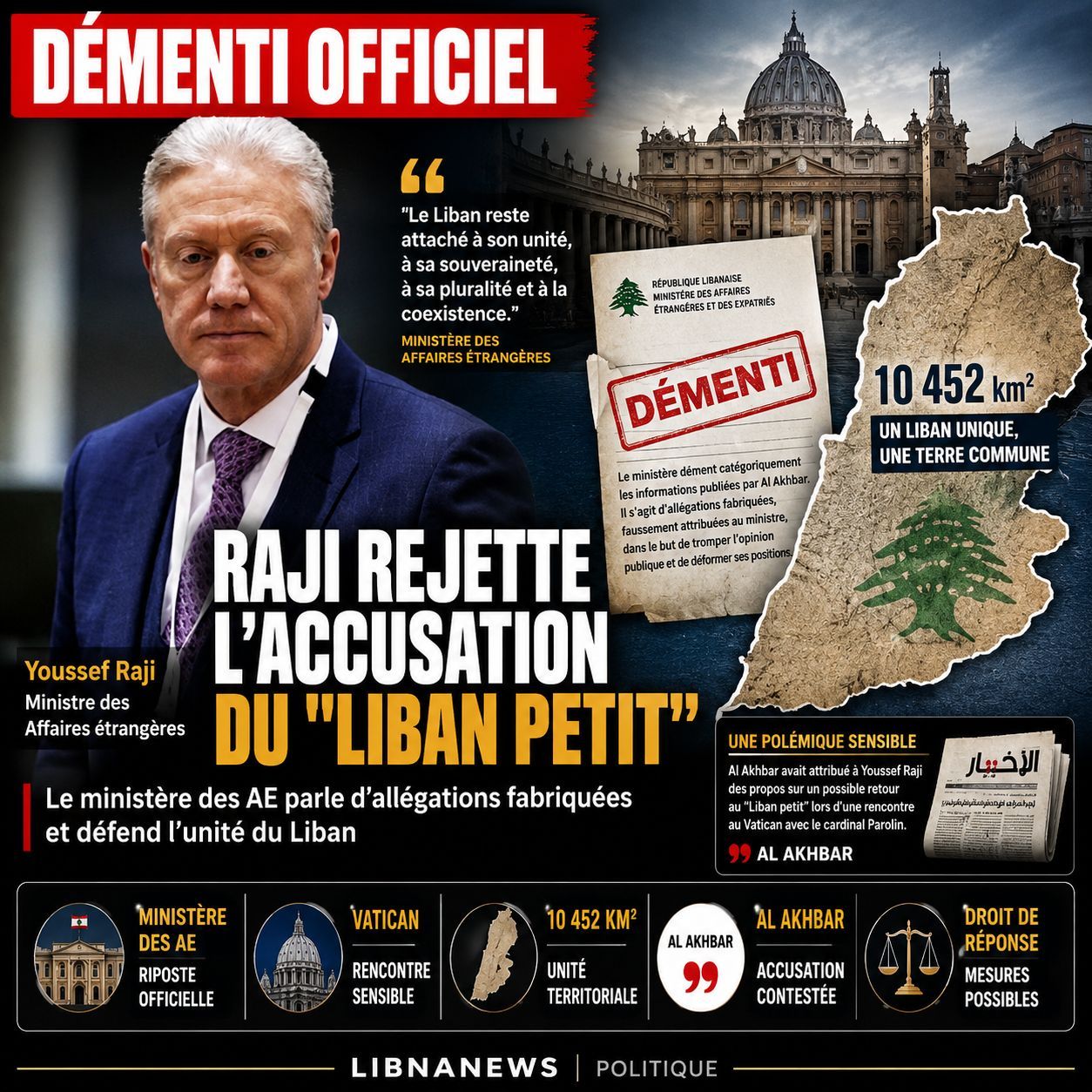
The Lebanese Ministry of Foreign Affairs strongly rejected on Tuesday the information published by Al Akhbar about Youssef Raji and his meeting in the Vatican with Cardinal Pietro Parolin. In a 1431 dispatch, the ministry spoke of a fabricated charge, an organized campaign and an attempt to distort the positions of the chief of diplomacy. This denial turns the controversy opened by the daily into an institutional confrontation. It now opposes an official response from the Lebanese State, based on Al Akhbar’s opinion on sources informed of the visit.
The controversy is about a highly sensitive formula: « Little Lebanon ». In its 19 May 2026 edition, Al Akhbar attributed to Youssef Raji statements made during a Vatican interview. The newspaper states that the minister would have considered that a return to this idea should not be excluded if it guaranteed Christians stability, economic prosperity and protection. The ministry categorically denies this version. He claims that Raji, on the contrary, reaffirmed Lebanon’s commitment to its unity, sovereignty, plurality and coexistence.
The denial of the ministry changes the sequence
At the beginning of the case, the debate focused on the political scope of Al Akhbar’s article. The daily did not only have a sentence attributed to Youssef Raji. It was reflected in a broader reading of the place of Christians in today’s Lebanon, their relationship to Greater Lebanon and the tensions generated by the war. The newspaper saw it as a back-up speech, which he said was held in a major diplomatic and religious forum. This reading quickly gave a national dimension to a meeting of which no detailed public report had yet been published.
The department’s response moves the case. She’s not just denying the sentence. She accuses Al Akhbar of having published false allegations made and falsely attributed to the minister. It speaks of a process designed to deceive public opinion and alter the perception of facts. The formulation is unusual in its firmness. It points out that Lebanese diplomacy does not wish to allow the idea that a minister in office would have argued, even indirectly, for a reduction in the Lebanese national framework.
The ministry adds that Youssef Raji defended before Cardinal Parolin the national constants of Lebanon. These constants are listed in the communiqué: pluralistic Lebanon, living together, freedoms, national unity and sovereignty. The text insists on one point: the Lebanese State does not market these principles. He describes them as pillars of the country’s diplomatic approach and its international relations. The purpose of this reminder is to close the gap opened by the term « small Lebanon », which refers to a much more divisive political memory.
A Charge Becomes State File
The scope of the case lies in the function of Youssef Raji. The Minister of Foreign Affairs does not express himself as an ordinary partisan official when he meets the Secretary of State of the Holy See. He has a government word. He embodies Lebanon’s official position abroad. That is why the ministerial denial insists so much on the principles of the State. The controversy no longer concerns only the interpretation of a reported sentence. It affects Lebanon’s institutional image with the Vatican and, beyond that, with its international partners.
Al Akhbar had chosen a frontal angle. The newspaper claimed that Raji, during his visit to Italy, had held a language reminiscent of the isolationist discourse of the ancient Christian right. He then reported that the minister would not have excluded the idea of a smaller Lebanon if it provided protection for Christians. The newspaper presented this statement as an indication of a distancing report in Greater Lebanon, considered since 1920 as the territorial framework of the Lebanese Republic and as a definitive homeland for all its citizens.
The ministry responded on the other hand. He claims that Raji defended a multiple, common and sovereign Lebanon. It links this position to the freedom of the Lebanese citizen, his dignity and his right to live in safety on his land. This precision is not secondary. It makes it possible to place the protection of communities, including Christian communities, within the national framework and not within a separation logic. In other words, the official response affirms that the security of Christians is not through a reduced Lebanon, but through a united State.
« Little Lebanon », an explosive expression
The term « small Lebanon » is enough to revive several layers of memory. It refers, in the Lebanese political debate, to a narrower space than the current territory of 10,452 square kilometres. It often evokes the historical Mount Lebanon, a more pronounced Christian centrality and the idea of a community seeking its security in a more homogeneous setting. For his critics, this representation carries a risk of fragmentation. It opens the door to a Community reading of the territory, in a country whose balance rests precisely on a difficult but maintained coexistence.
The accusation published by Al Akhbar was based on this historical charge. The newspaper believed that Raji’s remarks were based on the suggestion that Christians would not be attached to Lebanon as a whole. He claimed that this Vatican speech would run counter to the formula of Greater Lebanon and its principle of common homeland. The daily, therefore, did not treat the sentence as merely an opinion on security. He saw it as an implicit challenge to the national framework.
The ministerial denial attempts to neutralize this reading by returning to a state vocabulary. It does not respond with a long historical argument. It opposes accusations with a series of principles: unity, plurality, sovereignty, freedoms. This strategy aims to prevent the discussion from closing in the memories of the civil war or the ideological trial of the Lebanese Forces. The ministry seeks to bring the controversy back to a single claim: Lebanese diplomacy does not carry a project of partition, territorial reduction or community withdrawal.
The Vatican, a framework that increases sensitivity
The meeting venue reinforces the scope of the case. The Vatican closely follows the Lebanese situation and the condition of Eastern Christians. He regularly expressed his support for coexistence, the protection of civilians and the preservation of Lebanon as a pluralistic space. In this context, a statement attributed to the Foreign Minister on a possible « small Lebanon » could not remain a mere anecdote. He was concerned about the way in which the Lebanese authorities present their internal concerns outside the country.
Al Akhbar had precisely built his article on this gap. According to the newspaper, Raji’s speech did not resemble that of a state seeking to defend its unity in a dangerous period. According to his reading, he looked like a political current marked by reflexes of retreat. The newspaper claimed that the minister would have carried to the Vatican a vision that reduced the Christian question to a separate search for security. This charge explained the violence of the title and the place given to the subject in the May 19 issue.
The ministry responded by saying that Raji spoke of a Lebanon of freedoms and living together. He also insists on border villages, especially Christians, and on their resilience. This passage is important. It makes it possible to link the Christian question with that of the threatened national territory, especially in areas close to the border. The objective is clear: to present the Christians of Lebanon not as a community ready to retreat, but as a component rooted in its villages, attached to its land and concerned by state sovereignty.
A battle of stories about sovereignty
Controversy occurs in a climate marked by war, tensions in the South and debates about national decision-making. In this context, the word « sovereignty » is disputed by several actors. For Hezbollah’s opponents, it often means the state monopoly on the decision of war and peace. For the supporters of the resistance, it refers first to confrontation with Israel, refusal of occupation and protection of the territory. The Raji case is part of this narrative competition.
Al Akhbar places the controversy in a broader context. The newspaper questions a tendency that it attributes to the Lebanese Forces and their representatives: to seek external guarantees for Christians instead of defending the unity of the country. The ministry, on the other hand, contests this accusation and asserts that Raji’s positions are sovereignist, constant and unsolicited. The same word, « sovereignty », is thus at the centre of two opposing narratives. In one, sovereignty would be weakened by a back-up speech. In the other, it would be defended against a campaign of deformation.
This battle of narratives explains the firmness of the communiqué. The department is not only saying that the words are incorrect. He states that they are part of a systematic campaign to alter the Minister’s image. He accuses the authors or relays of these allegations of damaging the official image of Lebanon and its relations with its international partners. This external dimension weighs heavily. An internal controversy can become a diplomatic problem when it concerns a meeting in the Vatican and the speech of the Head of Diplomacy.
Border villages at the heart of the response
The ministry’s statement introduces a concrete element: border villages, especially Christians. He claims that Raji stressed their resilience and recalled that freedom, dignity and the right to live in safety on his land remain non-negotiable principles. This sentence indirectly responds to the idea of withdrawal. She claims that the protection of a community is not considered outside the national territory, but by keeping the inhabitants on their land and defending their right to live there freely.
This reminder takes on particular importance in the context of South Lebanon. The border communities, Christian, Shiite, Sunni or mixed, have been living for months under the pressure of hostilities, displacement and strikes. The debate on « Little Lebanon » may seem abstract from Beirut or Rome. It becomes much more concrete when it is confronted with the reality of the villages, their inhabitants and their attachment to territories sometimes located far from the ancient imaginations of Mount Lebanon.
The ministry therefore uses border villages to re-establish diplomatic words in the field. It does not respond to Al Akhbar by referring only to constitutional principles. It recalls that citizens, especially Christians, live in exposed areas and claim their right to security without giving up their national affiliation. This line seeks to defuse the opposition between Community protection and territorial unity. She states that the former must remain included in the latter.
What the denial does not yet cut
However, the denial does not close the whole political issue. He sets the official position of the ministry, but he does not yet say how the exchange with Cardinal Parolin was transcribed, nor what specific points were addressed during the interview. In a controversy of this nature, chronology counts. Al Akhbar publishes a version attributed to informed sources. The ministry responded the same day with a complete denial. Between these two acts, the Lebanese public space sees a controversy formed where each camp speaks to its own audience, but also to chanceries.
This uncertainty explains the implicit request for clarification. The ministry says Raji gave a speech of unity. The daily reports that the visit conveyed a more community-based message. The Vatican, for the time being, does not appear as a public arbitrator of this sequence. Its silence leaves Lebanese actors responsible for the debate. In a country accustomed to leaks, competing narratives and partisan readings of diplomatic meetings, the case could therefore remain open as long as no more detailed account will clarify the exact content of the interview.
Possible follow-up: reply, right and clarification
The Ministry announced that it retained its right of reply and the possibility of taking appropriate legal action. This entry opens a new phase. The case could remain a media controversy, with press releases, editorials and partisan reactions. It could also take a judicial turn if the authorities consider that the article has damaged the reputation of the minister or the official image of Lebanon. In both cases, the controversy already exceeds the simple correction.
The follow-up will also depend on any further clarifications. A direct statement by Youssef Raji could clarify what was said in the Vatican. A comment from the Holy See, if he intervened, would weigh heavily in the debate. A response from Al Akhbar could, for its part, maintain the prosecution, provide new evidence or defend its interpretation. For the moment, two versions are competing: that of a daily newspaper which claims to report the atmosphere of a sensitive encounter, and that of a ministry which speaks of a false manifesto.
This case shows the strength of words in a Lebanon in crisis. A historic expression, an assigned phrase, a diplomatic place and an official denial are sufficient to open a debate on the national identity, the security of the communities and the external representation of the country. The case remains suspended following the release of the Ministry, Al Akhbar and possibly the Vatican interlocutors of the visit.




