

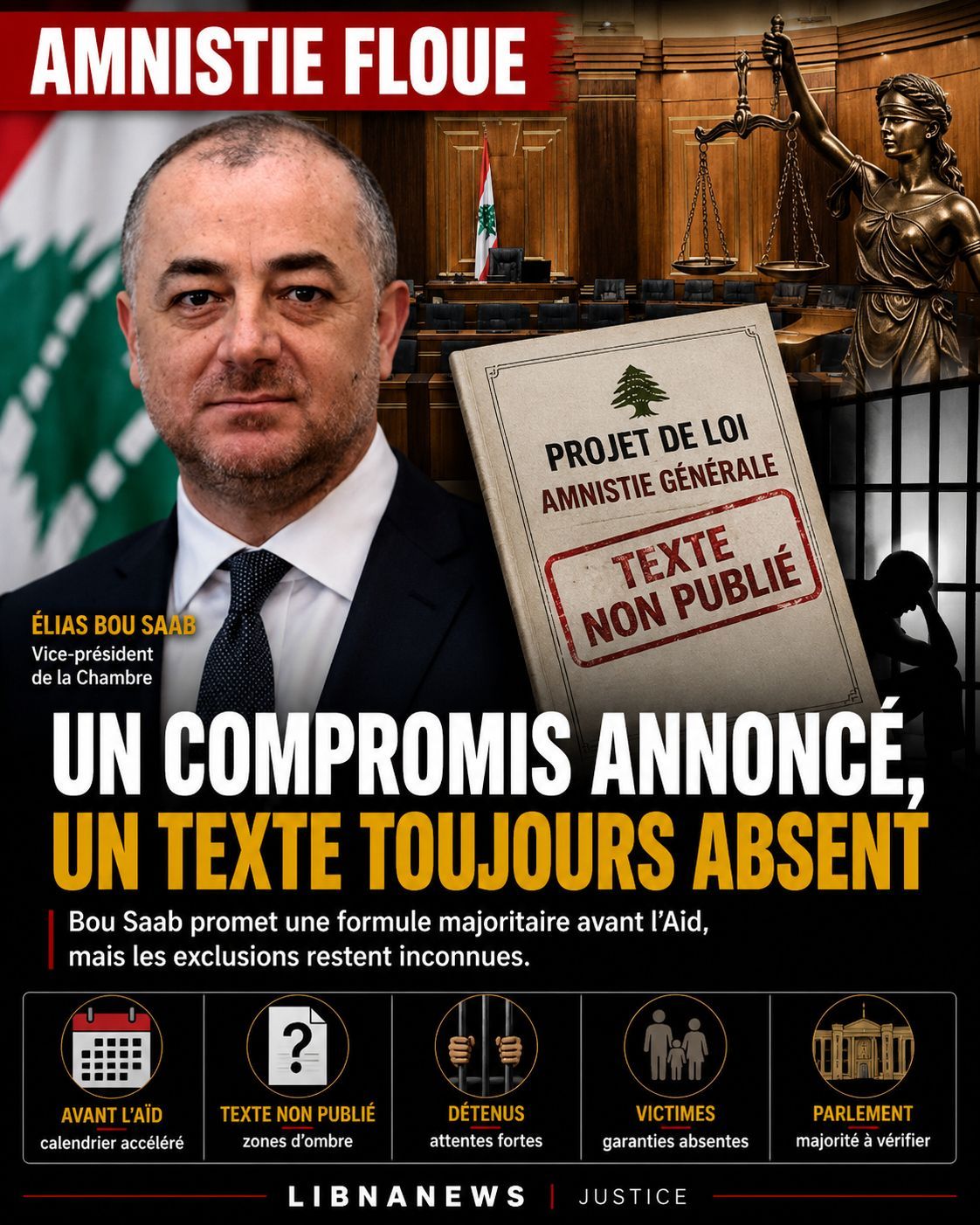
The draft general amnesty comes back to the Lebanese Parliament with a promise of rapid voting and many shadow zones. On Tuesday, House Vice-President Elias Bou Saab announced that a formula « acceptable by the parliamentary majority » had been found around the text. He asked the President of Parliament, Nabih Berri, to prevent the plenary session from turning into a bargain around each article. It also had a clear political objective: to pass the law before Eid al-Adha. Behind this announcement, the file remains explosive. It affects Islamist detainees, Lebanese refugees in Israel after 2000, drug trafficking, financial crimes, victims and the chronic prison crisis.
A quick announcement, a text always blurred
The announcement of Élias Bou Saab marks a step, but it does not regulate anything on the substance. The parliamentary leader claims that a majority exists. It does not yet say what this majority exactly agrees to remove, reduce or exclude. No specific list of the offences concerned has been published. No enforcement mechanism was presented. No detailed guarantees were given to the victims. In a country where confidence in justice remains weak, this blurry is enough to fuel mistrust.
The term chosen by Bou Saab, that of « formula », sums up the problem. A general amnesty cannot remain a political formula. It becomes a law that amends sentences, interrupts prosecutions, reopens family files and touches the memory of victims. It can relieve families of prisoners. It can also give the impression that justice is being negotiated between parliamentary blocs. The difference between an act of appeasement and a bonus for impunity is therefore due to the details of the text.
The will to go quickly adds to the tension. The objective of voting before Eid al-Adha speaks to families who have been awaiting a release or judicial decision for years. But it also exposes Parliament to the accusation of haste. An emergency amnesty law can create more problems than it solves. It can produce conflicting interpretations, remedies, challenges and a new wave of anger among those who feel forgotten.
The risk of a parliamentary « bazaar »
Bou Saab’s request to Nabih Berri is revealing. By calling for a « bazaar » to be avoided in plenary session, he acknowledged that the text could dislodge under the amendments. Each block wants to protect its priorities. Each community monitors categories that may fall within the amnesties field. Each region has its files. Every political family wants to avoid appearing to yield to security, justice or memory.
This risk is real. Amnesty laws in Lebanon are never only legal. They are often used to counter political tensions that the state has not settled by ordinary justice. They become instruments of compensation between groups. A bloc can support the inclusion of Islamist detainees. Another can defend the return of Lebanese settled in Israel. A third may claim treatment for certain drug records. Ultimately, the text can become an addition of concessions rather than a coherent law.
But refusing the « bazaar » should not mean stifling the debate. Parliament cannot treat a general amnesty as a technical text. He must explain the choices. He must say who will be concerned and who will not. It must explain the reasons for each exclusion. It must allow Members to take up their votes publicly. Such a law cannot be adopted only because an agreement has been reached behind the scenes.
Islamic prisoners, first point of friction
The case of Islamist detainees remains one of the most sensitive. Several Sunni officials have been calling for these cases to be processed for years. They denounce lengthy detentions, delayed trials and a court deemed unequal. In some families, the feeling of abandonment is profound. Inmate relatives claim that people have spent years in prison without final trial, sometimes under difficult conditions and without a clear perspective.
Opponents of a broad amnesty put forward an equally heavy argument against them. Some cases concern clashes with the Lebanese army, accusations of terrorism, attacks on military or security forces. For the families of killed soldiers, any measure that would free people involved in these cases would be seen as humiliation. The subject therefore directly affects the prestige of the army and the respect due to the victims.
This is where compromise becomes the most delicate. A total amnesty may seem politically impossible. A simple reduction of sentence could be presented as intermediate ground. But even this option requires precise drafting. Not all Islamist detainees are in the same file. Not all are accused of the same facts. Parliament will have to distinguish cases, instead of stacking categories under a single label.
Lebanese refugees in Israel, historical red line
The second explosive case concerns the Lebanese who left for Israel after the Israeli withdrawal from the South in 2000. Many are directly or indirectly associated with the former South Lebanon Army. For their support, this is a humanitarian issue. Families have been living in exile for over 20 years. Children were born far from Lebanon. Some did not participate in the fighting. Others say they want to return and regularize their situation.
For their opponents, the issue cannot be separated from cooperation with Israel. The South Lebanon Army remains, for a large part of its opinion, linked to occupation, prisons, interrogations and war years. In the current context, marked by Israeli strikes and tensions in southern Lebanon, this issue is becoming even more flammable. Any measure perceived as a relaxation of former collaborators or their relatives may provoke a violent political reaction.
Parliament will therefore have to choose its words carefully. Dealing with families, children or persons who have not carried weapons does not have the same scope as laundering acts of collaboration. Again, a general law could create confusion. The text should distinguish between individual responsibilities. It should also avoid turning a humanitarian issue into a political rehabilitation of the old collaboration with Israel.
Drug crimes, between social misery and powerful networks
Drug cases are a third controversial issue. They concern thousands of cases, often linked to poor regions, smuggling networks and the lack of economic development. Some argue for a social approach. They claim that many small convicts or defendants are more marginalized than organized crime. They demand treatment that takes into account poverty, weak state and the abandonment of certain areas.
But the risk is great. Lebanon cannot give the signal that major trades can be erased by political agreement. Drug networks are not minor offences. They fuel crime, corruption, violence and tensions with neighbouring countries. Too wide an amnesty would immediately be accused of protecting powerful traffickers or local figures with political coverage.
The only defensible path is through clear distinctions. Small files cannot be treated as large networks. Consumers do not follow the same logic as organized traffickers. Former and minor offences must not open the door to the removal of crimes related to structured gangs. Parliament will have to say precisely where it puts the limit. Otherwise, the law will be suspected of serving clients.
Corruption and financial crimes: a danger to the country’s credibility
The issue of financial crimes, corruption and money laundering was equally sensitive. Lebanon seeks to convince its partners that it wants to restore its financial credibility. It must prove that it can combat money laundering, terrorist financing, illicit channels and capital flight. In that context, an amnesty that would affect serious financial crimes by far or near would be disastrous.
This is beyond the internal debate. Lebanon’s partners monitor financial system reform, judicial cooperation, investigations into suspicious flows and the State’s capacity to prosecute economic crimes. If Parliament gives the impression that those responsible for financial offences can benefit from political indulgence, the message sent will be negative. It will weaken official discourse on reform and transparency.
Amnesty promoters should therefore clearly exclude serious financial crimes, corruption, money laundering and misappropriation. They will also have to avoid ambiguity about those prosecuted in cases related to economic collapse. Many Lebanese have lost their savings. In this context, the very idea of a financial amnesty would be explosive. It would give the country the feeling that it was protecting the powerful and asking ordinary citizens to pay the bill.
The victims, who were largely absent from the debate
Public debate is about many of the inmates. He’s not talking about the victims. It’s a major weakness. Any general amnesty affects persons who have suffered violence, loss, threat, injury or damage. A law can extinguish a sentence. It cannot erase the suffering of those waiting for justice. If the text ignores this dimension, it will reinforce the idea that victims count less than parliamentary balances.
The issue of civil rights will be central. A criminal amnesty should not automatically remove the right to reparation. Victims need to know whether they will still be able to claim compensation, pursue certain procedures or obtain recognition of their harm. Parliament will have to explain this clearly. Otherwise, the law will be received as a decision taken above the affected citizens.
Lebanon’s recent history makes this demand even stronger. The 1991 Amnesty Act, adopted after the civil war, made it possible to turn an institutional page. But it has also left many families without truth, reparation and justice. A new amnesty cannot ignore this legacy. It cannot repeat the reflex of closing files in the name of stability, without responding to the injuries left open.
Prisons as a real but insufficient argument
However, advocates of the law have a serious argument: the state of prisons. The Lebanese prison system suffers from overcrowding, judicial delays and often denounced material conditions. Inmates spend long periods awaiting trial. Prisons absorb the dysfunctions of the entire criminal justice system. In this context, amnesty appears as a valve.
But a valve does not reform. Release of some prisoners or reduction of certain sentences may temporarily ease pressure. This does not address the slowness of investigations, delays in trials, weak judicial capacity, prolonged pretrial detention or the condition of prisons. Without structural reform, Lebanon risks returning to the same point in a few years, with saturated prisons and new requests for amnesty.
This is one of the dangers of the announced text. It can give an impression of rapid action while avoiding difficult reforms. Real criminal policy would require faster courts, safeguards against abusive detention, alternatives to incarceration for certain offences, better administered prisons and a clearer distinction between danger and insecurity. Amnesty can accompany such a policy. She can’t replace her.
A law under Community pressure
The file is also Community. That’s what makes him so fragile. Islamist detainees mainly mobilize part of the Sunni scene. Lebanese refugees in Israel mainly concern Christian families linked to the South or the former occupied area. Drug records are highly sensitive to certain areas of the Bekaa and Shia and tribal environments. Each camp suspects the other to want an amnesty for « its » detainees.
This pattern is dangerous. It turns justice into a Community market. Instead of asking if a person deserves treatment according to the gravity of his or her file, we look at which group he or she belongs to. Instead of drafting legislation based on principles, competing demands are added. Parliament must break this logic if it is to produce a credible text.
Bou Saab’s sentence on the parliamentary majority is therefore not enough. A majority can very well pass an unfair law if it results from a sharing of interests. The issue is not just counting the votes. The question is whether the text meets criteria that are legible to all. An implicit quota amnesty would be another proof of the State’s inability to treat citizens as equal litigants.
Public safety in question
Public safety will be the other test. Too wide an amnesty may cause concern to the security forces. It can demoralize those who have arrested suspects, conducted investigations or lost colleagues in operations. It can also give the impression that political pressure always prevails over sanction. In a country that has already experienced security crises, this signal would be dangerous.
Conversely, too limited an amnesty can be denounced as an empty text. The families of prisoners would see a new promise without effect. Regions calling for relief would talk about a parliamentary manoeuvre. The government and the Chamber must therefore find a difficult balance: to correct the excesses of the system without weakening criminal deterrence.
This balance cannot be based on slogans. It must be written in the law. Crimes against persons, premeditated murders, terrorist acts, collaboration with Israel, major trafficking, heavy corruption and serious financial crimes cannot be treated as mere cases that burden the courts. The text will have to say what it excludes, and assume it politically.
A communication that feeds suspicions
The current communication remains insufficient. The announcement of Bou Saab speaks of a majority, a calendar and a risk of bargaining. It does not present the content. This method feeds suspicions. All too often, Lebanese people have seen texts negotiated between officials, then justified after the fact on behalf of the national interest. On the general amnesty, this approach would be particularly risky.
Parliament should quickly publish the chosen version. It should explain the categories concerned, exclusions, conditions and enforcement mechanisms. He should say what role the courts would have. It should also clarify whether the law would be accompanied by measures on preventive detention and prison reform. Otherwise, there is a risk that the plenary will be played in a climate of rumours and pressure.
Criticism is not just about Bou Saab. It concerns all the parliamentary blocs. Those who support the text must say why. Those who oppose it must offer an alternative to saturated prisons and judicial delays. Those who want amendments must make them public. The country does not need a new opaque arrangement. He needs a clear debate on what the state agrees to forgive and what he refuses to erase.
A vote before Eid, but at what price?
The calendar before Eid al-Adha can serve as a political engine. It can also become a trap. The party gives a human dimension to the announcement. It allows the promoters of the text to talk about families, reunions and soothing. But an amnesty law must not be passed to produce a leniency image. It must be voted because it meets a real need, according to fair and publicly accepted criteria.
Parliament will therefore have to resist two temptations. The first is the auction. Each block could try to extend the law to its own files. The second is the force passage. Officials could seek to preserve the agreement by limiting the debate. Those two ways would be bad. One would make an inconsistent law. The other would make a suspicious law.
In between, there is a way. It involves publishing the text, explaining exclusions, protecting the rights of victims, distinguishing offences and linking amnesty to minimum criminal justice reform. This path is more demanding. It is also the only one that allows the law to go beyond the logic of corridor compromises.
What Parliament still has to prove
The announcement of Élias Bou Saab opens a decisive sequence. It shows that the issue has returned to the top of the parliamentary agenda. It also shows that those in charge want to avoid silencing. But it does not yet prove that Lebanon has a good law. A general amnesty may be necessary in a blocked judicial system. It can become dangerous if it removes responsibilities indiscriminately or if it serves community interests.
Parliament must now prove three things. First, let the text not sacrifice the victims. Secondly, that it does not protect the most serious crimes. Finally, it does not replace justice reform with a one-off decision. These three conditions will determine the credibility of the announced compromise.
The general amnesty therefore returns as a political and moral test. She would say whether the Chamber could produce a measure of calm without weakening the rule of law. She will also say whether Members can resist community calculations when they touch justice. Before Eid al-Adha, Lebanon now expects more than a formula acceptable to the majority. It awaits a public text, legible and able to answer a simple question: who does Parliament choose to amnesty, and on what behalf?




