

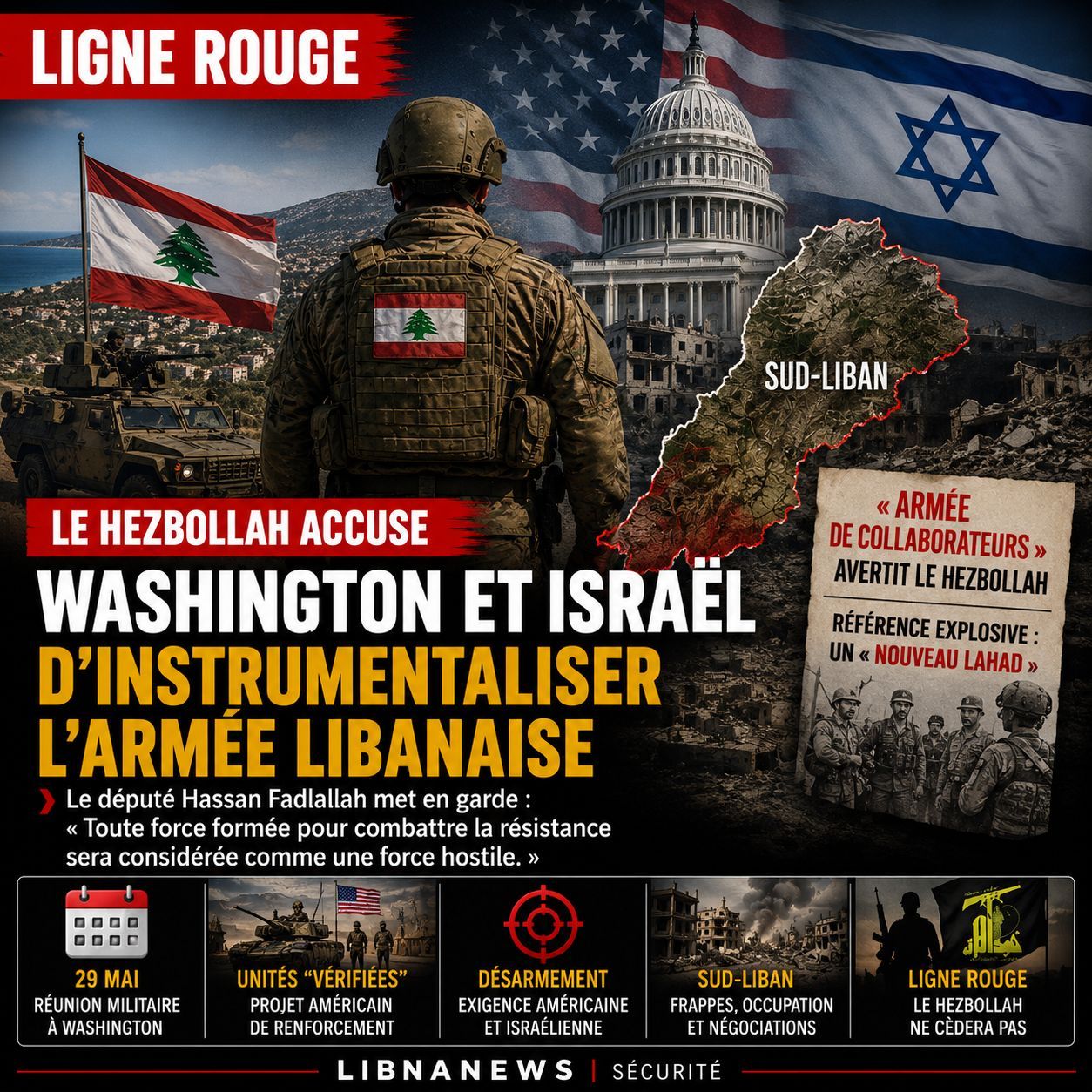
Hezbollah chose to respond before the next negotiations. On Tuesday, MP Hassan Fadallah accused Washington and Israel of wanting to use the Lebanese army to weaken his movement. According to Naharnet’s report, the leader of the Shiite party claims that any unit formed by the United States and Israel to combat « resistance » would be treated as a hostile force. The purpose of the project is to strengthen selected units of the Lebanese Armed Forces to enable them to attack and dismantle Hezbollah structures.
The declaration falls into a sensitive diplomatic moment. Military discussions are scheduled to take place in Washington on May 29. Further negotiations between Lebanon and Israel are scheduled for 2 and 3 June, following several rounds of direct contacts. The subject of Hezbollah disarmament is at the centre of American and Israeli demands. Beirut, for its part, seeks to stop the strikes, Israeli withdrawal from occupied areas in southern Lebanon and security guarantees for border villages. The arm thus focuses on the order of priorities: disarm first, or withdraw first.
Hassan Fadallah was not content with a general refusal. He spoke of an « army of collaborators » if such a mechanism were to emerge. He also referred to the specter of a « new Antoine Lahad », a reference to the former South Lebanon Army, allied with Israel during the occupation. This reference gives the debate a historical burden. Hezbollah does not present the US project as a technical military training programme. He describes him as an attempt to recreate a successor Lebanese force, charged with carrying out an Israeli-American mission against him.
An assumed distinction between the army and a unit deemed hostile
The MP took care to preserve, at least in his words, the relationship with the Lebanese army. He claimed that the relationship between Hezbollah and the military institution was « excellent ». He added that the army devoted itself to protecting the country and, in his view, refused to be used as an enemy tool. This precision is not secondary. It allows Hezbollah to separate the national army, which it claims to respect, from a possible specialized unit which it considers to be created to confront it.
This distinction is at the heart of the party’s political strategy. Hezbollah knows that the army remains one of the few institutions still receiving national credit. To designate her as an enemy would be to open a direct crisis with an important part of the opinion. On the other hand, denouncing an attempt to instrumentalize makes it possible to move the charge to Washington and Israel. The party thus claims to defend the army’s national mission against possible external drift.
But this line remains fragile. If Lebanese units receive training, equipment and an explicit mission against Hezbollah, the party could consider them to be outside the national framework. The problem would then shift from diplomacy to the field. Who would decide that a unit acts for the state, not for a foreign agenda? What would be the margin of the Lebanese military command? How can a control operation not be seen as the beginning of an internal confrontation? These questions explain the harshness of Fadllallah’s warning.
Fadllallah’s US Plan
The Member’s statement responds to an orientation posted by US Secretary of State Marco Rubio. He explained that Washington was working on a system based on « verified » Lebanese Army units. These units would receive, according to this approach, the training, equipment and capabilities necessary to act against and dismantle Hezbollah elements, so that Israel would not do so directly. This sentence led to an immediate reading on the side of the Shiite party: the United States would seek to transfer to Lebanese a mission that the Israeli army is carrying out today through strikes, ground operations and military pressure.
For Washington, this mechanism can be described as a strengthening of the Lebanese state. The argument is known: arms must be placed under the authority of regular institutions, and sovereignty implies a state monopoly of force. This logic seduces part of Lebanon’s Western partners, as well as Lebanese political forces hostile to the maintenance of Hezbollah’s arsenal. It is also consistent with Israel’s demand for concrete guarantees north of its border.
For Hezbollah, the reasoning is the opposite. The party believes that disarmament, under current conditions, would serve Israel first. He claims that the cessation of the attacks, the Israeli withdrawal and the end of the occupation must precede any discussion of his weapons. In this perspective, strengthening units to combat it would not be a restoration of sovereignty. It would be an attempt to transform the Lebanese State into a tool for an external strategy. It is this accusation that Fadllallah wanted to place at the centre of the debate.
Antoine Lahad, a reference intended to mark the spirits
The reference to Antoine Lahad is not merely a controversial formula. In Lebanese memory, his name remains linked to the South Lebanon Army and the period of Israeli occupation. Hezbollah uses this memory to draw political equivalence: any Lebanese force that acts against resistance under Israeli or American impulse would be assimilated to the former local relays of occupation. The message is clear. Such a force would not be regarded as an actor of the state, but as a hostile instrument.
This language first targets Lebanese officials involved in the negotiations. He reminded them that some arrangements could be signed in a room in Washington, D.C., but remain inapplicable in Lebanon. Fadallah also warned that security agreements or arrangements with Israel at the expense of national sovereignty would have « no effect on the ground ». This means that Hezbollah reserves the right to reject any decision that it considers to be contrary to its conception of national defence.
It also targets public opinion. The party seeks to transform the disarmament debate into a debate on collaboration with Israel. This strategy is effective with its public and with part of the Lebanese marked by the history of occupation. It is challenged by its opponents, who believe that Hezbollah uses this memory to prevent any reform of the monopoly of force. This is the whole difficulty of the case: each camp mobilizes sovereignty, but gives it a different meaning.
President Aoun directly arrested
Hassan Fadllallah also criticized President Joseph Aoun’s method. The MP reported that Hezbollah had instructed him to contact the Head of State. At the same time, he considered that the presidential choice to engage in direct discussions with Israel had shown its ineffectiveness and should be reconsidered. The formulation retains an institutional appearance. Nevertheless, it is a political disavowal. Hezbollah accepts contact with the presidency, but challenges the path chosen.
This criticism places the Lebanese power in a narrow position. The President and the government are seeking concrete results: an Israeli withdrawal, a stabilization of the South, a reduction in strikes and an increased role for the army. To achieve this, they accept a framework for discussion supported by Washington. However, this framework remains highly contested in the country. Direct negotiations with Israel, even under pressure from war, immediately revived the debate on normalization and the limits of what a Lebanese State could accept.
Hezbollah exploits this fragility. He claims that betting on the US administration failed. He accuses Washington of working for Israeli priorities, not for balanced mediation. This criticism touches on a sensitive point. A part of the Lebanese want to get out of the war through negotiation, but refuse to see the country put before a binary choice: accept conditions imposed by Israel, or stay in an endless confrontation. The political margin of power therefore narrows between external pressure and Hezbollah’s refusal.
Refusal of standardization as a central argument
He also said that the majority of Lebanese, all faiths, refuse Israel’s recognition, normalization and what he calls « so-called peace ». According to him, the promoters of this route are a noisy minority, supported by important media. This claim seeks to prevent Hezbollah being presented as isolated on a strictly Shiite basis. The party wants to include Israel’s refusal in a broader national tradition.
This reading will be contested by its opponents. Several Lebanese formations believe that the country must regain control over its strategic decision. Some reject formal normalization with Israel, but consider that Hezbollah can no longer decide the level of confrontation alone. Others believe that the national priority is now reconstruction, the return of displaced persons and the end of the cycle of destruction. In this perspective, the maintenance of an independent arsenal weakens the state rather than protects it.
Fadllallah’s most revealing sentence concerns national consensus. He argued that resistance does not need a consensus as long as occupation exists. For Hezbollah, this logic stems from the Israeli threat. For her opponents, she confirms that the party is above the institutions. The debate therefore comes back to a fundamental question: can an armed force say national if its use does not depend on a national agreement? Lebanon has never resolved this contradiction. The current war makes it more explosive.
South Lebanon as a ground of truth
South Lebanon gives this controversy a concrete dimension. Border villages live under the pressure of strikes, displacement and destruction. The prolonged truce did not end military operations. Israel maintains positions in several areas that Beirut considers to be occupied, while Hizbullah continues its attacks on Israeli forces and positions. In this reality, discussions on the role of the army are not only an institutional debate. They concern the immediate safety of the inhabitants.
Hezbollah claims that its weapons remain necessary as long as the strikes continue and as long as the occupation persists. Its opponents respond that these weapons prolong the war cycle and prevent the state from regaining control. Both speeches feed on the same ground. Every Israeli attack reinforces Hezbollah’s argument. Each party’s response reinforces the argument of those who accuse resistance to expose the country to further destruction.
The people of the South expect more immediate answers. They want to be able to return to their homes, reopen roads, restore networks, protect schools and rebuild villages. The Lebanese army should play a central role in this stabilization. But it cannot do so if it is perceived as a force directed against part of the Lebanese. That’s where the American project becomes politically explosive. Strengthening the army can stabilize the country. Specializing her against Hezbollah can open another front.
Iran, still in the background
Hassan Fadallah rejected the idea that Hezbollah is fighting for Iran. He claimed that the movement acts in defence of Lebanon, after the failure of a long diplomatic sequence. He also claimed that Tehran had suspended its negotiations with Washington to take account of the Lebanese case. This statement is part of a clear effort to present Hezbollah as a national force, not as the simple Lebanese arm of a regional strategy.
The Iranian question does not disappear. Hezbollah remains a Lebanese actor with a real social and political anchor, but also a pillar of a regional axis supported by Tehran. The United States and Israel analyse its arsenal through this prism. His Lebanese opponents too. They believe that the country pays the price of strategic choices that go beyond its institutions. Hezbollah replied that the alliance with Iran did not replace its defence function against Israel.
This dual identity complicates any solution. If the problem is strictly Lebanese, it can be discussed within an internal framework. If it is regional, it also depends on the power ratio between Washington, Tel Aviv and Tehran. But the present war has involved both dimensions. Lebanon finds itself at the same time a national ground, an Israeli-Lebanese front and a wider confrontation. That’s what makes Washington meetings so delicate. They will have to deal with a Lebanese case that its actors themselves link to regional balances.
A warning that reduces the margin of mediators
Fadllallah’s statement aims to weigh before the Washington meetings. It sets a limit that mediators cannot ignore: Hezbollah will not let a Lebanese force, even with the army, be used against it if it is perceived as the expression of an Israeli-American plan. The message is addressed to Washington, Israel, Beirut and the Lebanese military command. He said that proxy disarmament would not be accepted.
This position complicates the work of the government. Beirut must show its partners that it wants to strengthen the State and implement its commitments. It must also avoid causing an internal armed crisis. Israel must be reassured about border security, without giving Israel a veto over the Lebanese military organization. He must finally speak to a population exhausted by losses, displacement and economic collapse. The formula of balance remains unobtainable.
The risk is double failure. An agreement that ignores Hezbollah could remain ineffective on the ground. An agreement that takes too much account of its red lines could be rejected by Israel and the United States as insufficient. Between these two impasses, the Lebanese army could become the centre of unsustainable pressure. The discussions on 29 May should therefore clarify whether the strengthening of regular forces is aimed at stabilization of the South or direct confrontation with Hezbollah. The difference will largely determine the future.
A case involving the future of the state
The case goes beyond a press conference statement. It touches on the core of the Lebanese problem: can the State regain the monopoly of force without causing an internal war? Hezbollah’s opponents respond that this monopoly is indispensable to any sovereignty. The party replied that a monopoly without defence capacity in a country still exposed to Israel would be tantamount to disarming Lebanon. Everyone claims the state, but no agreement exists on how to rebuild it.
The title of the debate is now clear. Hezbollah accuses Washington and Israel of instrumentalizing the Lebanese army. This accusation is not only defensive. It aims to delegitimize any formula that would make certain military units the tool of imposed disarmament. It also obliges the Lebanese authorities to clarify their own position. Strengthening the army is a national necessity. Transforming it, or giving the feeling of transforming it, into a force directed against a major internal actor would be a choice of a completely different nature.
The continuation will depend on the guarantees that will be placed on the table. A verifiable Israeli withdrawal, a halt to strikes and a clear army mission could open up a stabilization area. A first approach to the dismantling of Hezbollah could, on the contrary, fuel confrontation. The party immediately made its red line known. Negotiators will now have to say whether the Lebanese army will be presented as an instrument of common sovereignty or as a lever for a confrontation that Lebanon does not seem able to support.




