

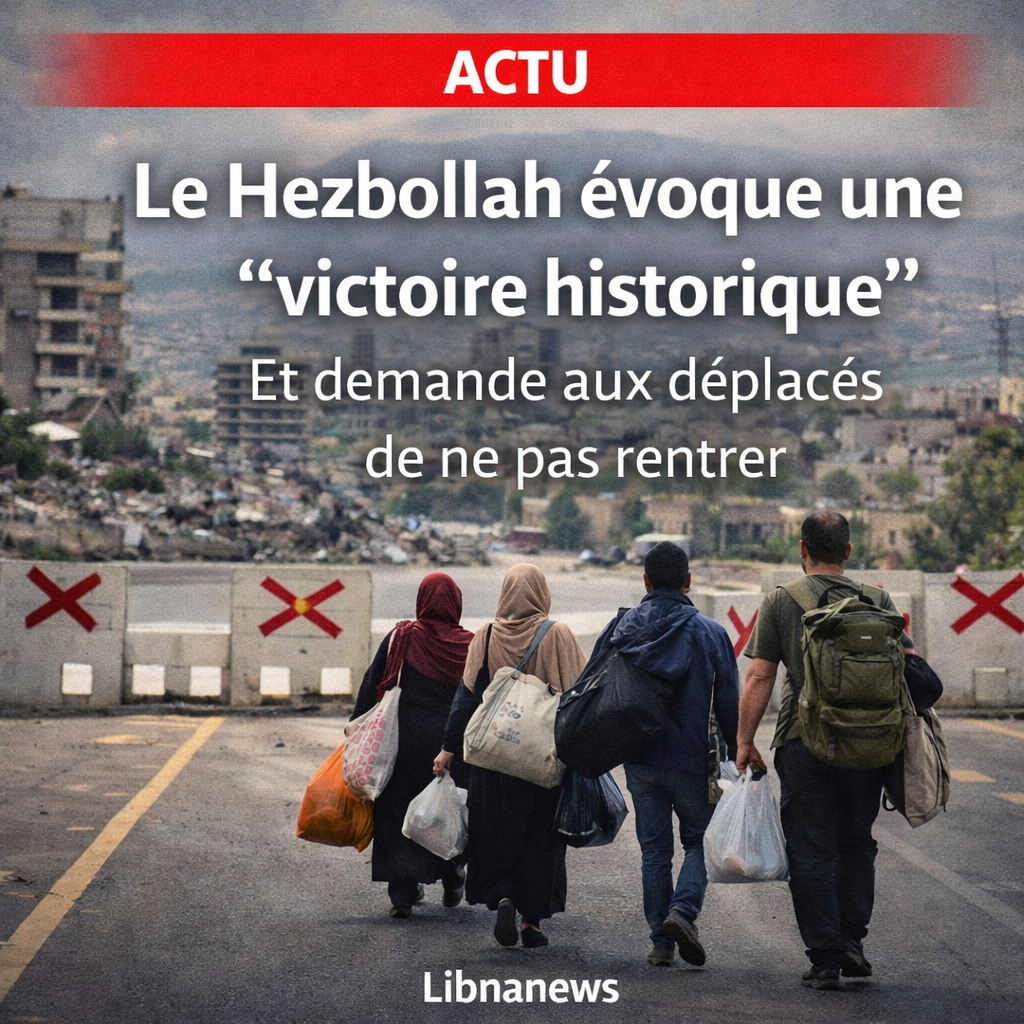
Hezbollah stated on Wednesday that it was « close to a historic victory » and called on displaced people from the South, the Bekaa and the southern suburbs of Beirut not to return to their localities until a « official and definitive announcement » of a ceasefire in Lebanon. This position comes at a time when the movement has not yet officially expressed itself on the announced two-week truce between the United States and Iran, but that it has no longer claimed to attack Israel since the night of Tuesday to Wednesday. At the same time, Israel continues its strikes in Lebanon and claims that the Lebanese front is not covered by the ceasefire with Tehran.
A clear call for displaced people from the south, the Bekaa and the southern suburbs
In a statement in Arabic broadcast on Wednesday, Hizbullah addressed « the people of the South, the Bekaa and the southern suburbs » and asked them not to visit « the villages, cities and targeted areas » before the final official announcement of a ceasefire in Lebanon. The movement invoked the risk of further Israeli last-minute attacks, accusing Israel of being able to produce an artificial image of military success before the fighting stopped. The purpose of this instruction is therefore to prevent the hasty return of civilians to areas still exposed to strikes or unexploded ordnance.
The message explicitly concerns three spaces: South Lebanon, Bekaa and the southern suburbs of Beirut. This is important because it shows that Hezbollah does not limit its warning to border villages alone. It also extends to internal areas and the Dahiyeh, which remain under threat of Israeli attacks or evacuation orders. In recent hours, Israel has increased warnings and maintained military pressure on several Lebanese areas, explaining that its campaign against Hezbollah was continuing independently of the truce with Iran.
» We are close to a historic victory »
The second part of the communiqué is political. Hezbollah claims to stand « at the gates of a great historical victory », which it attributes to the sacrifices of the fighters, to the blood of the dead and to the patience of its social base. The formula fits into the usual register of the movement, which presents the ability to stand up to Israel as a form of victory, even in the absence of decisive military announcement on the ground. At the same time, the text calls for more patience, firmness and wait, stressing that the moment remains « critical ».
In the immediate future, this statement performs three main factual functions. First, it maintains the cohesion of the base of movement as displacement and destruction continue. Secondly, it is politically responsible for the absence of Hezbollah’s military claims for several hours. Finally, it is preparing a possible cessation of hostilities in Lebanon without giving the impression of a retreat. The movement does not talk about a retirement or a compromise. He talks about an approaching victory, while asking civilians to wait until they return.
No official position on the Washington-Tehran Truce
At this stage, Hezbollah has not formally pronounced on the announced ceasefire between the United States and Iran. It’s a central element of the sequence. The movement did not publish formal support for the text announced by Donald Trump and subsequently confirmed by Tehran. On the other hand, several sources close to Hezbollah reported that he had suspended his attacks on northern Israel and Israeli forces in Lebanon after the announcement of the truce. This suspension in fact, without full political declaration, leaves the movement a margin of adjustment on the rest.
This caution is also due to the continuing blurring of Lebanon in the regional arrangements. Pakistan presented the truce as also including Lebanon, while Israel claims exactly the opposite. Hezbollah therefore finds itself in an intermediate situation: it can suggest that it respects the spirit of wider de-escalation, while avoiding public endorsement of an agreement whose perimeter remains contested. Wednesday’s declaration is in line with this: not explicit adherence to the Iranian-American truce, but more focused behaviour on the ground and a message preparing a possible separate Lebanese ceasefire.
Israel maintains that « the battle continues » in Lebanon
On the other hand, the Israeli position remains unchanged. The Israeli authorities stated that the two-week truce with Iran did not apply to Lebanon. Benyamin Netanyahu’s office supported the American plan on the Iranian front, but made it clear that the war against Hezbollah was continuing. On the same day, the Israeli army continued its operations in Lebanon and maintained evacuation warnings to several areas of the country.
This Israeli position largely explains the tone of the Hezbollah communiqué. As long as Israel publicly affirms that Lebanon is excluded from the ceasefire, the Shiite movement cannot portray the situation as an acquired cessation of hostilities. The call not to return to the targeted villages and neighbourhoods reflects this immediate reality: on Lebanese ground, the war is not formally stopped, even though the Washington-Tehran axis has entered a negotiated pause.
A return of internally displaced persons still suspended from official announcement
The most concrete point in the communiqué is ultimately the displaced. Hezbollah specifically calls on the inhabitants not to return to the targeted localities before the final official announcement of a ceasefire in Lebanon. This means that, in reading the movement, a separate or explicitly confirmed Lebanese truce remains necessary. In the state, neither the inhabitants of the South nor the inhabitants of the Bekaa, nor those of the southern suburbs, according to the movement, have sufficient guarantees to return safely.
This call also joins a reality already highlighted by other actors. In recent days, Lebanese authorities and several agencies have warned that many areas remain dangerous owing to ongoing strikes, damaged roads and unexploded ordnance. Hezbollah, in its communiqué, turns this security prudence into a collective political order. By promising the displaced that they will soon return to « head high », he seeks to hold together two imperatives: to avoid an immediate return under the bombs and to maintain the idea that this return will take place in a logic of victory, no prolonged flight.
A war communication in a phase of uncertainty
Wednesday’s statement therefore appears as a transitional text. It does not proclaim a Lebanese ceasefire, but it prepares the ground for a possible announcement. It does not explicitly validate the Iranian-American truce, but it does accompany the suspension of Hezbollah’s demands for attacks. She does not say that the war is over, but she says that a « historical victory » is near. In practice, the movement seeks to occupy the political space of the in-between: that where the war is not officially closed, but where some of the actors are already preparing for a sequence change.
For Lebanon, this means that the situation remains suspended at two separate announcements: on the one hand, the consolidation or not of the truce between Washington and Tehran; on the other hand, whether or not there is a clearly recognized ceasefire on the Lebanese front. As long as Israel affirms that « the battle continues » and as long as Hezbollah calls its supporters not to return, the real state of the front remains that of an armed expectation, not yet that of an exit from war.






