

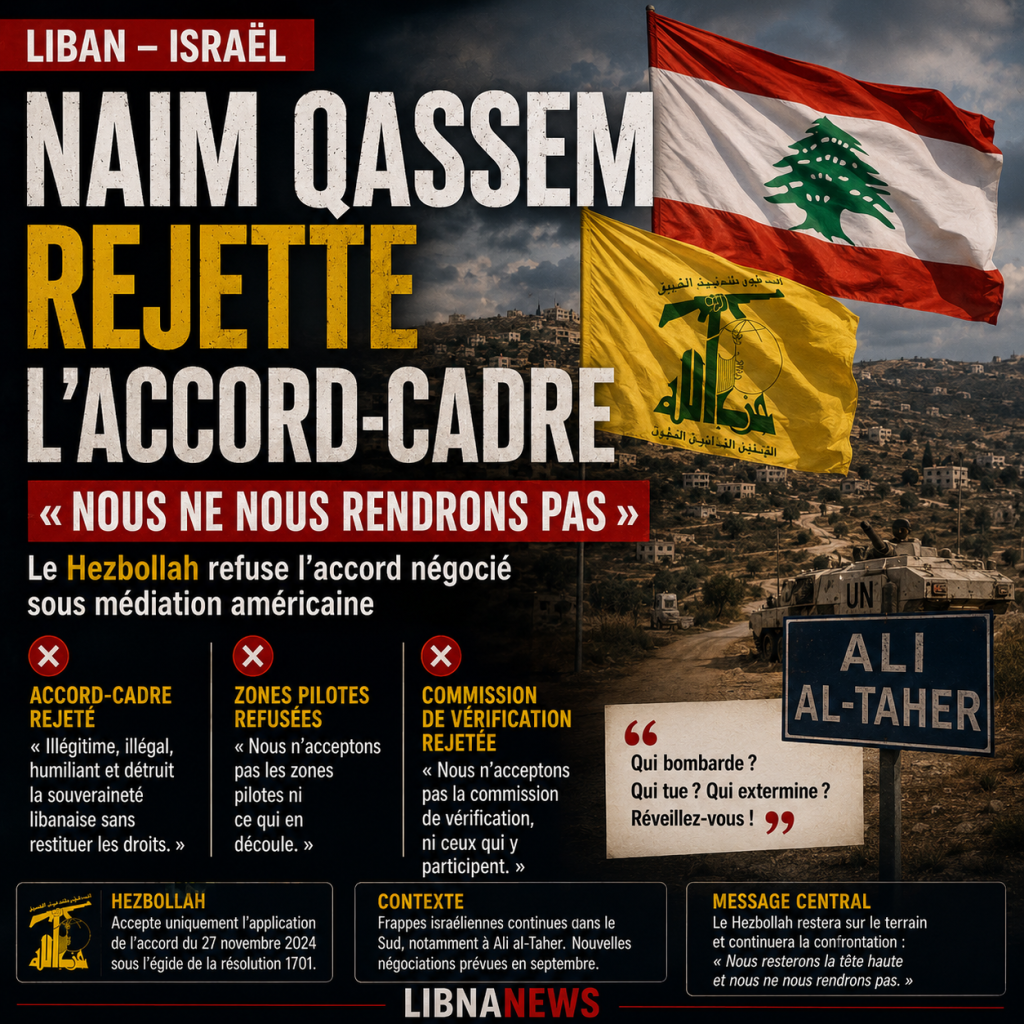
Hezbollah’s Secretary General, Naim Qassem, called on Friday, 28 August, to bring down the framework agreement concluded in June between Lebanon and Israel under American mediation. In a speech in the southern suburbs of Beirut, he described him as « illegal, » « illegal, » and « humiliating, » believing that he « destroys Lebanese sovereignty » without allowing the country to recover its rights. It also rejected the planned « pilot zones » for the Israeli withdrawal and deployment of the Lebanese army, as well as the international verification mechanism discussed between the parties. « We will stand up and we will not surrender, » he said, in one of his strongest positions against the process initiated by the Lebanese State with Israel.
Qassem calls for « putting down » the framework agreement
Naim Qassem devoted a significant part of his intervention to the framework agreement negotiated under American mediation. The Hezbollah leader did not content himself with expressing reservations about some of his provisions. He explicitly requested abandonment.
» We are against the framework agreement and we are calling for it to be dropped, » he said at the rally in Ashoura Square, Dahiyeh. He then accumulated the qualifiers to challenge his legitimacy: « The framework agreement is illegitimate, illegal, humiliating and destroys Lebanese sovereignty without restoring rights. »
This position places Hezbollah directly in opposition to the process initiated by the Lebanese authorities. The June agreement must organize several interrelated issues: the gradual withdrawal of Israeli forces from southern Lebanon, the deployment of the Lebanese army and the treatment of Hezbollah’s weapons and military infrastructure.
For Qassem, this arrangement is not a compromise that could restore sovereignty. On the contrary, it considers that it imposes obligations on Lebanon without first guaranteeing the recovery of its territory.
« We will stay on the ground »
Hezbollah’s Secretary General accompanied his political rejection by a message to show that his movement does not intend to withdraw under military or diplomatic pressure. « Today we are in a situation of confrontation, » he said to his supporters.
He then added: « We will continue, we will remain firm. In another formula designed to summarize the position of the movement, Qassem launched: « We will remain the head high and we will not surrender. Let them do whatever they want. »
The message is particularly significant in the current military context. Hezbollah has suffered considerable losses since 2023 and Israeli forces still occupy several areas of Lebanese territory. Israel is continuing its strikes, blasting and ground operations in the South.
Qassem therefore seeks to rule out the idea that the military weakening of the movement would necessarily lead to the acceptance of conditions negotiated under international pressure. « We will stay on the ground and we will not accept these projects they are talking about, » he said.
Adamant rejection of « pilot zones »
The Hezbollah leader has specifically targeted the « pilot zones » mechanism, which has become one of the main operational elements of the negotiations between Lebanon, Israel and the American mediators.
« We don’t accept the pilot areas or the resulting results, » Qassem said. These sectors should allow for the gradual testing of an Israeli withdrawal, the deployment of the Lebanese army and the dismantling of Hezbollah’s military infrastructure.
Recent discussions included areas where this mechanism could be implemented. The Lebanese authorities have proposed several areas in the Nabatiyah area, while discussions must also determine the modalities for the withdrawal of Israeli forces.
For Hezbollah, however, the problem goes beyond the geography of the sectors concerned. Accepting these areas would, according to his leader, be tantamount to recognizing a process which he himself considers devoid of legitimacy.
Qassem therefore refuses both the general agreement and the instruments for its implementation.
» We do not accept the audit commission »
The Secretary-General of Hizbullah also opposed the establishment of a mechanism to monitor the implementation of commitments made in the areas concerned.
« We do not accept the audit commission, nor do we accept those involved, » he said. He described this mechanism as « out of law and outside the Lebanese consensus ».
Discussions at the beginning of August in Rome had focused on countries that could participate in the Commission. It would monitor the deployment of the Lebanese army and the destruction of Hezbollah’s weapons or military infrastructure in the pilot areas.
Qassem gives a much more hostile reading. He presented the commission as a mechanism dominated by the United States and Israel and imposed on the Lebanese army. From this perspective, the arrangement would not constitute an international guarantee for Lebanon, but rather a form of control over its institutions.
This rejection directly complicates the implementation of the process. Hezbollah maintains a significant political and military presence in the areas concerned, although its balance of power has been profoundly altered by successive wars.
Qassem attacks direct negotiations
The speech of 28 August also contains an explicit criticism of the path chosen by the Lebanese authorities to negotiate with Israel. Qassem believes that Beirut has embarked on a process that does not respect the sacrifices made by the country or its sovereignty.
He accused Lebanese officials of choosing « a path that does not honor Lebanon or its sacrifices ». According to him, entering into direct negotiations with Israel is tantamount to making concessions as Israeli military operations continue.
The Hizbullah leader insists precisely on this simultaneousity. Negotiations are taking place as Israeli aviation continues to strike Lebanese territory and Israeli forces maintain their presence in the South.
Qassem therefore presents the process as a negotiation conducted « under Israeli bombing ». He assimilated it to a form of « delivery in humiliation, » contesting the idea that the current balance of power could produce a balanced agreement.
« Who’s bombing? Who kills? »
The Secretary-General of Hizbullah sought to place the issue of his armament in the broader issue of Israeli operations in Lebanon. He asked his audience a series of questions: « Who’s bombing? Who kills? Who’s exterminating? Who does this? Wake up! »
This formulation directly targets those in Lebanon and abroad who make the disarmament of Hezbollah a prerequisite for stabilization. In contrast, it considers that the Israeli presence and operations should be dealt with before any discussion could weaken the military capabilities of its movement.
The context of the last days feeds this argument. On 25, 26 and 27 August, Israeli operations in the south were further intensified, with strikes, artillery fire and blasting in several localities.
One woman was killed in a strike against Arab Salim during the 27 August bombing wave. Israel had presented these raids as a response to the launching of two explosive drones attributed to Hizbullah against its forces deployed in the Ali al-Taher area. The movement had not claimed the attack in the available information.
Hezbollah still claims the November 2024 agreement
Naim Qassem does not reject any settlement framework. He claims that Hezbollah remains committed to the agreement to cease the hostilities of27 november 2024concluded under the ceiling of UN Security Council Resolution 1701.
» Our position is clear: we accept the application of the agreement of 27 November 2024, » he said on Friday. This reference allows Hezbollah to present its opposition not as a refusal of any commitment, but as a rejection of the new mechanism negotiated since June.
The distinction is central in the discourse of the movement. The November 2024 agreement was based, inter alia, on the implementation of resolution 1701 and provisions concerning the area south of the Litani River. The new framework agreement goes further in defining the stages of Israeli withdrawal, military deployment and Hezbollah infrastructure.
For Qassem, Lebanese sovereignty must therefore remain under the previous arrangement. He refused to see a new international mechanism expand the constraints imposed on his movement.
Ali al-Taher’s file at the centre of the tensions
The speech comes as the heights of Ali al-Taher in the Nabatiyah region become one of the main points of friction between Israel and Hezbollah. Israel asserts that the movement’s infrastructure remains in the sector and challenges the effectiveness of the mechanism envisaged for the pilot areas.
At the same time, a Lebanese source accused Israel of seeking to delay negotiations, in particular by citing the failure of those experiences. According to this reading, Israeli political considerations and the October elections would also weigh on the timetable.
The Lebanese authorities are seeking to avoid direct confrontation between the army and Hezbollah. The same source stated that there was no will to provoke an internal confrontation to force the disarmament of the movement quickly.
The situation of Ali al-Taher thus illustrates precisely the conflict that Qassem is putting forward: Israel calls for concrete results regarding Hezbollah’s infrastructure, while it refuses the mechanisms developed to achieve its dismantling.
A direct critique of the State’s strategy
In calling for the fall of the framework agreement, Qassem is not only addressed to Israel and the United States. His speech also constitutes a direct challenge to the strategy adopted by the Lebanese State.
The government is seeking an Israeli withdrawal through negotiation, in return for stronger military control and progressive treatment of Hezbollah weapons. This strategy is based on the idea that the different stages must proceed in parallel.
Hezbollah defends a different order. Israel should first cease operations and withdraw from Lebanese territory. The arms issue would then be dealt with within a Lebanese internal framework, without a mechanism imposed by Washington or involving Israel.
These two approaches are difficult to reconcile. They directly affect the issue of the monopoly of armed force and the very definition of sovereignty. For the authorities, it assumes that the army becomes the only armed force organized in the territory. For Hezbollah, it presupposes the disappearance of the Israeli military presence and the maintenance of a resilience while the threat persists.
« Two major currents » in the region
Naim Qassem also placed the Lebanese case in a broader regional confrontation. According to him, two large camps are currently fighting in the Middle East.
He opposed a current dominated by the United States and Israel to another gathering Iran and the « resistance » movements in Palestine, Lebanon, Iraq and Yemen. This presentation confirms that Hizbullah continues to place its strategy on a regional axis beyond Lebanese borders.
The leader of the movement accused his opponents of using all available forms of military and political pressure. He presented the current situation as a phase of « confrontation and firmness ».
This regional dimension remains one of the main points of disagreement between Hezbollah and its Lebanese opponents. They blame the movement for linking the country’s security with regional conflicts and Iranian strategy. On the contrary, Qassem describes membership of a regional axis as a component of the resilience to Israel.
A refusal on the next stage of negotiations
The speech comes just a few days away from a new diplomatic sequence expected in September. A new round of discussions between Lebanon and Israel is envisaged, although no final date had yet been announced on Friday night.
Previous discussions had focused specifically on pilot areas and the composition of a verification mechanism. Qassem has just explicitly rejected these two elements. Its position therefore reduces the space available to apply the scheme without internal political confrontation.
At the same time, Israel expresses its dissatisfaction with the pace of operations conducted by the Lebanese army. Israeli reports indicated that certain coordinates transmitted to identify Hezbollah infrastructure were not followed by the expected destruction.
On the Lebanese side, this pressure is seen as an attempt to transfer to the army the responsibility for a situation created by the continuing Israeli occupation and operations. The risk is that both sides will consider the June mechanism insufficient, but for exactly opposite reasons.
» We will not surrender. »
The final passage of the speech summarizes the line chosen by Hezbollah. Qassem does not propose any additional compromises on the pilot areas or the verification commission. On the contrary, it reaffirms the continuity of the movement’s presence on the ground.
« We will continue and remain firm, » he said. Then, in the clearest formula of his intervention: « We will remain the head high and we will not surrender. »
This statement comes as Hezbollah emerges from several military sequences since 2023 and that part of the southern territory remains occupied by Israel. At the same time, the movement is subject to Israeli military pressure, international demands on its disarmament and an internal debate on the state monopoly of arms.
Qassem responded to these three pressures by the same principle: Hezbollah refused to allow its disarmament to result from a negotiated agreement with Israel under American mediation. The next step will now be between this line of refusal, the Lebanese Government’s willingness to continue negotiations and the military situation in the South, where Ali al-Taher’s file could quickly impose its own timetable.




